What it is
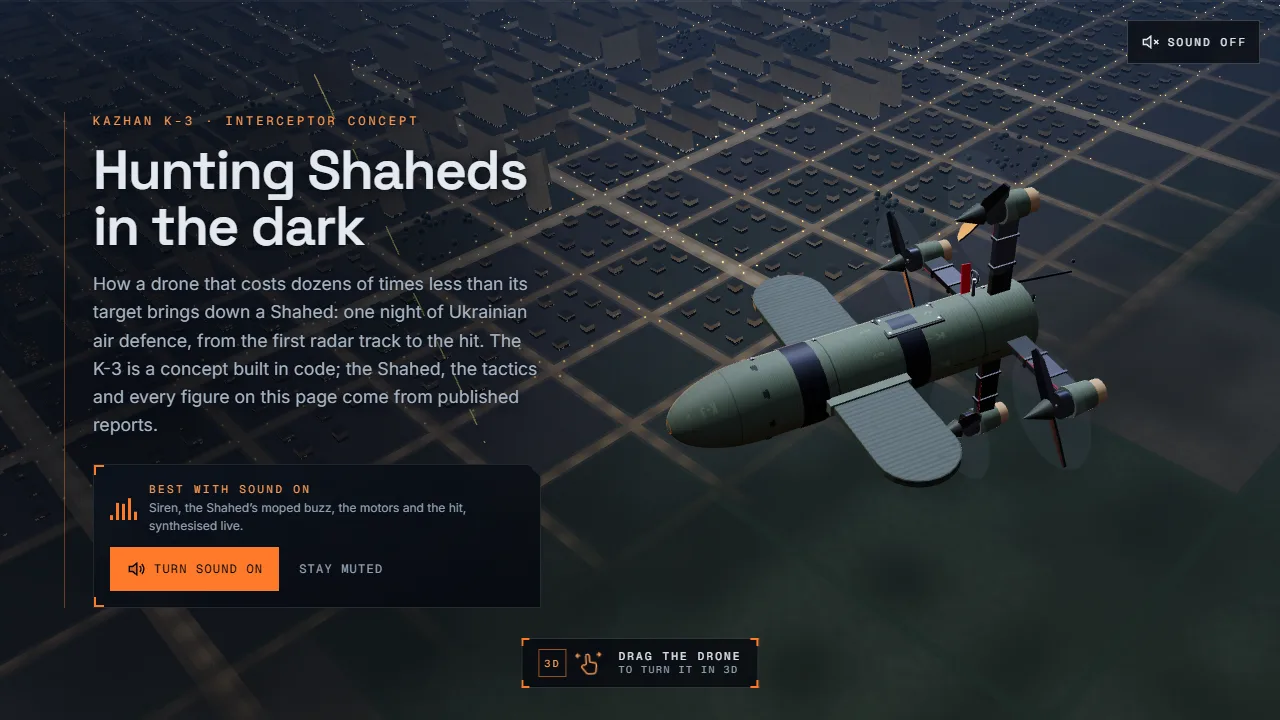
A scroll story about how a Ukrainian interceptor drone brings down a Shahed-136 at night. One sticky canvas carries eleven chapters: the hero seen from above over a night city, a radar alert, the Shahed with its published dimensions and labelled parts, a mobile crew launching from a field edge, an exploded view of the interceptor in flight, the two drones side by side with speed gauges, a tactical map where the radar track and the interceptor's path meet, the pilot's white-hot thermal view in the goggles, the intercept, dozens of interceptors rising around the city, and Inspect, where both drones can be turned by hand. A comparison table and a list of sources follow in plain HTML. The interceptor, KAZHAN K-3, is a concept modelled on published photos of the class: a short octagonal printed body wrapped in tape, a rounded nose dome, two flat wings with rounded tips, and at the very tail a cross of four beams with a motor on each (tractor props with pointed spinners, round feet behind them so it stands on its tail for a vertical take-off). It has no numbers of its own. The Shahed and every quoted figure come from published reports, listed on the page.
Engineering decisions
- Everything is generated in code, with no model or image files. The only texture is the K-3's printed-plastic skin (layer lines, scuffs, panel seams and stencilled markings), drawn on a canvas at load. The K-3 shell is an octagonal prism in two halves; the nose dome with the camera, wings, charge, flight stack, video and control links, battery pack and the tail motor cross with two-blade props are primitives merged per material by a small
Kit helper, one group per part so the Anatomy chapter can pull them apart. The Shahed is a lathed fuselage with an extruded cropped-delta wing in two halves (so they can tumble after the hit), elevons, tip fins, engine bay, exhaust, pusher prop and the satellite-navigation puck. The crew position is a pickup with an open tailgate and a ground station, a telescopic antenna mast with guy lines, a launch stand, two crew members and a windbreak of poplars. - The city is one instanced mesh of about 4,000 blocks (1,900 on the light tier) placed by a seeded generator, off the river and the streets. Windows are drawn in the fragment shader on a 3.2 × 3 m grid, lit warm or with a cool TV glow; far away they fade to the grid's average so they never shimmer. The ground is one plane whose shader draws streets with sodium light (beads close up, a glow far off), avenues, a river with bridges, fields with furrows, country roads, village lights, and on the Guidance chapter a tactical map grid. The sky has stars, a moon, cloud bands and a city glow on the horizon.
- All motion lives in a flight frame that circles the city at each chapter's speed and altitude; the drones, the crew, the blast, the map tracks, the wind streaks and the swarm sit in that frame, so the camera poses in
data.ts stay simple. Each chapter has its own camera move, blended to the next with a swoop. - Effects are shaders driven by one value each, so they scrub both ways: searchlights (instanced cones), machine-gun tracers in bursts, wind streaks at the flight speed, the swarm (72 quadratic paths, each with an incoming Shahed drawn as a point with a short wake, with trails and a flash at the end), and the blast (a fireball of points cooling from white through orange to smoke, fragments on ballistic arcs with drag, a flash sprite and a point light). The Shahed's wings tumble away after the hit.
- Reflections without an HDRI: a small night sky (navy dome, the moon as a bright spot, the city's orange glow on the horizon, warm streets below) is drawn into a sphere once and prefiltered with
PMREMGenerator as the scene environment, so the drones' plastic, metal and glass pick up moonlit highlights. The city and ground shaders light themselves and ignore it. All shaders are compiled under the loader with hidden objects included, so nothing stalls when the crew, the blast or the swarm first appears. - The thermal view needs no post-processing: every material shares one uniform block, and a GLSL chunk injected through
onBeforeCompile mixes in a white-hot palette driven by a per-material heat value (the Shahed's engine and exhaust run hot), plus analogue video noise and vignette. - HTML overlays (radar scope, dimension lines, part labels, speed gauges, map labels, the goggles OSD with a live range) are positioned from screen projections the scene writes each frame. They repeat the chapter text, so they stay out of the accessibility tree with the canvas.
- The camera blends distance and altitude in log space with a long smootherstep, so a move from a close-up to a kilometre-wide view is as even as a small one. At the hit the Shahed breaks into nose, rear and two wings that tumble on ballistic paths; the shader-driven fire and smoke trails follow the same paths, with a blast wave, sparks and a second flash for the Shahed's own warhead.
- Sound is synthesised with the Web Audio API, no files (with a convolution reverb, stereo panning from screen position and a Doppler drop): wind, a civil-defence siren, the Shahed's two-stroke buzz (sawtooth through a soft clipper with an amplitude wobble), four slightly detuned motor tones for the interceptor, goggles hiss, radar pings and the blast (a filtered noise burst with a low thump). Levels follow the chapter weights every frame. It stays off until the visitor turns it on, and pauses when the tab is hidden or the story is off screen.
- Hand turn: on chapters with a close subject a drag orbits the camera around it (yaw and, with a mouse, tilt), with momentum after letting go; the turn eases back while the camera travels to the next chapter. The camera also holds still on each chapter while its text is read and only travels in the middle of the scroll between two chapters. The last chapter, Inspect, puts both drones side by side at true scale with a one-metre bar, lets the visitor switch the subject and take the interceptor apart.
- The crew position and the launch stand are pinned to the ground, so while the camera comes down from altitude the crew never appears in the sky. Trees use real proportions (crowns 4–8 m, 7–13 m tall).
- Frame loop:
frameloop="demand" plus a small pump that asks for frames only while the stage is on screen, the tab is visible and motion is allowed. Quality tiers: the light tier (phones, 4 cores or fewer, ?quality=low) uses a lower DPR, no antialiasing, fewer buildings, particles, tracers and trees. ?debug shows the frame rate.
Performance notes
Three.js and React Three Fiber load only on this page. No drei, no post-processing, no model or texture files. Geometries and materials are disposed on unmount; the audio context is closed.
Reduced motion
No intro glide and no camera travel: each chapter cuts to its finished pose behind a 0.15 s fade. Nothing moves on its own (no rotors, tracers, searchlight sweep or radar sweep); the launch, the exploded view, the intercept and the swarm rest at the middle of their sequence.