What it is
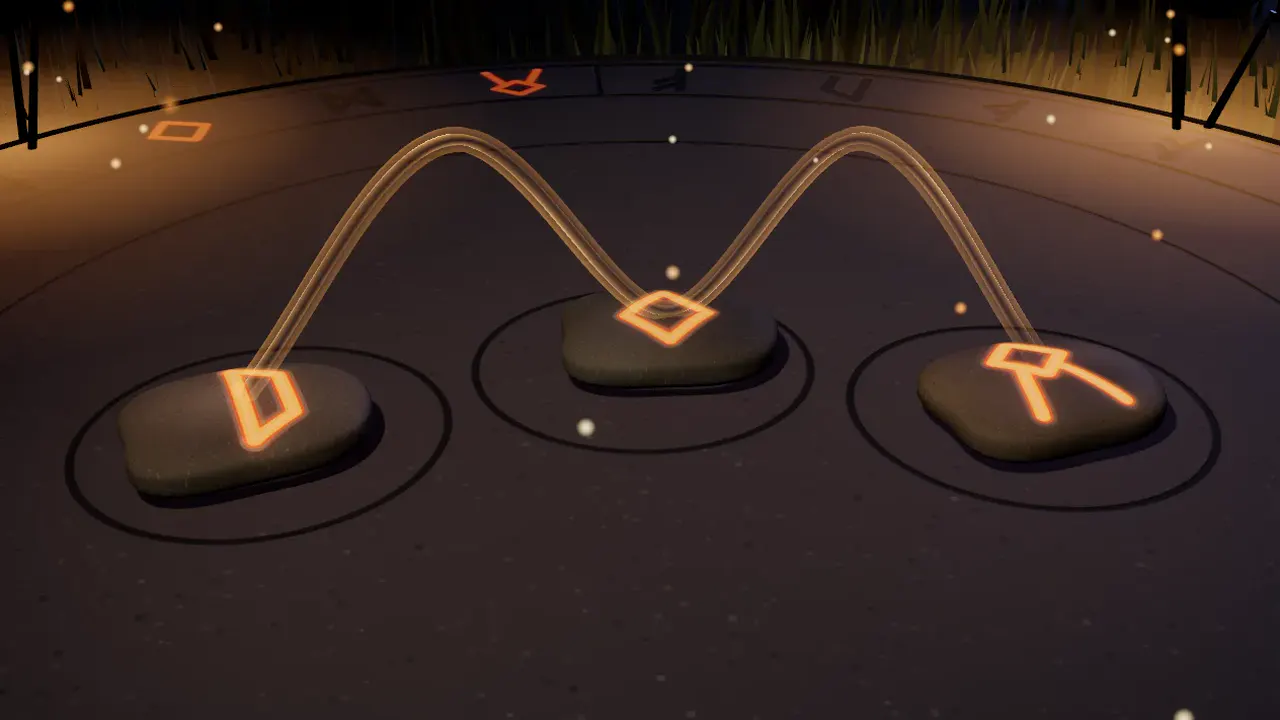
A night-time table of rune stones under the northern lights. Cast three stones for the three Norns (Urðr, Verðandi and Skuld), spell a name or word in Elder Futhark, or pour out all 24 stones and turn them one by one. Each stone leaves a leather pouch, bounces on a basalt table carved with the 24-rune ring, settles face down and turns over, and its rune burns in with ember light. Changing the mode burns the old stones away to embers. Under the scene, every rune has its name, what the name means, the Old English and Norse rune-poem lines, and the modern divinatory reading, kept apart. It is a companion to the Runes Android app and links to its page.
Engineering decisions
- Everything is made in code, no model or image files. A stone is a pebble: a sphere pushed into a rounded square with a nearly flat top and a rounded edge, split into two material groups so the carved face and the blank back use different textures. One painted atlas (5 by 5 cells) holds colour, bump and emissive maps for all 24 runes; each stone shows its rune by moving a copy of the texture to the right cell, so the pixels are uploaded once.
- The runes are drawn from straight-stroke data (
src/lib/runeGlyphs.ts), not from a font, so stones, the carved ring, the page glyphs and the loader look the same on every device (Windows, Android and Apple draw the Runic block very differently or not at all). - A thrown stone follows a short solved trajectory: it leaves the pouch mouth, is aimed so the first hit, the bounces and the slide end exactly on its spot, spins in the air and turns flat as it settles. The path is plain TypeScript (
logic.ts) and tested; the world only plays it back and plays a clack for each impact. - The burn-in and the burn-away are one fragment shader added to the standard material: a sweep along the stone lights the groove from the top of the rune down with a white-hot front that cools to ember, and a noise threshold with a glowing edge dissolves a stone away. Embers and dust are one point cloud updated on the CPU.
- The world round the table is made in code too: a sky shader with two layers of stars, a low moon and a northern-lights curtain (noise-folded bands that shift from green to violet), two rings of mountain ridges drawn from seamless canvas silhouettes, rolling ground (the same height function places everything on it), thousands of instanced grass blades that sway in the vertex shader, drifting mist cards and a ring of standing stones whose carved runes breathe and answer when the same rune is lit on the table.
- The camera is a small director: it opens wide on the whole scene, dollies in as the first stones land, swings to a close-up on each stone as it ignites and then settles above the table. Follow, Wide and Table buttons let a visitor take over; there is no screen shake. Once every stone of a cast or a word is lit, a thread of light (a tube with a pulsing shader) links them in order.
- Light is one warm spotlight with soft shadows, a cool rim and fill, two fire bowls with animated flames, and three small lights that follow the most recently lit stones. On the high tier a bloom pass makes the carving glow.
- Sound is synthesised in the browser: a knock and thump for each impact, a rising hiss and a bell for each ignition (the 24 runes climb a minor pentatonic scale, so a three-rune cast is a chord), and a crackle for the burn. The audio context starts on the first tap.
- Mode, stone positions and the three Norn positions are plain data; the reading text is the same data the Runes page uses.
Performance
- Renders on demand when nothing moves, and runs every frame while embers or flames are alive. It stops off-screen and in a hidden tab.
- The low tier halves the textures, drops shadows, bloom and the fire-bowl lights, and uses fewer segments and embers.
- Shaders are compiled before the first frame; the page reports ready after two frames and the fonts.