Guitar tuner online, free, with your microphone
Tune a guitar, bass, ukulele or violin right here: press Start, play one string and turn the peg until the needle sits in the green. When you want it on your phone, the same tuner is a free Android app with a metronome, chords and ear training.
–
Auto: the nearest string is picked. Tap a string to lock it and hear its note.
Sound is analysed in your browser. Nothing is recorded or uploaded.
The full tuner on your phone
This page is a quick tuner. The Android app does the same job faster, works without a connection and keeps going in your pocket at rehearsal, with a practice kit built in:
- Chromatic tuner for guitar (6, 7 and 12 strings), bass (4 and 5), ukulele, violin, viola, cello, banjo, mandolin and balalaika
- Standard, Drop D, Drop C, Half Step Down, Open G, Open D, DADGAD, Nashville and your own tunings
- Reference pitch A4 from 415 to 466 Hz, with 432, 440, 442 and 443 one tap away
- Tighten ↑ and Loosen ↓ hints, a green In tune state and a short vibration
- Metronome from 20 to 300 BPM with tap tempo, time signatures from 2/4 to 12/8, accents and a speed trainer
- Guitar and ukulele chord diagrams with several positions and sound
- Ear training: note names, higher or lower, intervals and tuning by ear
- No full-screen ads while you tune; microphone audio stays on the phone

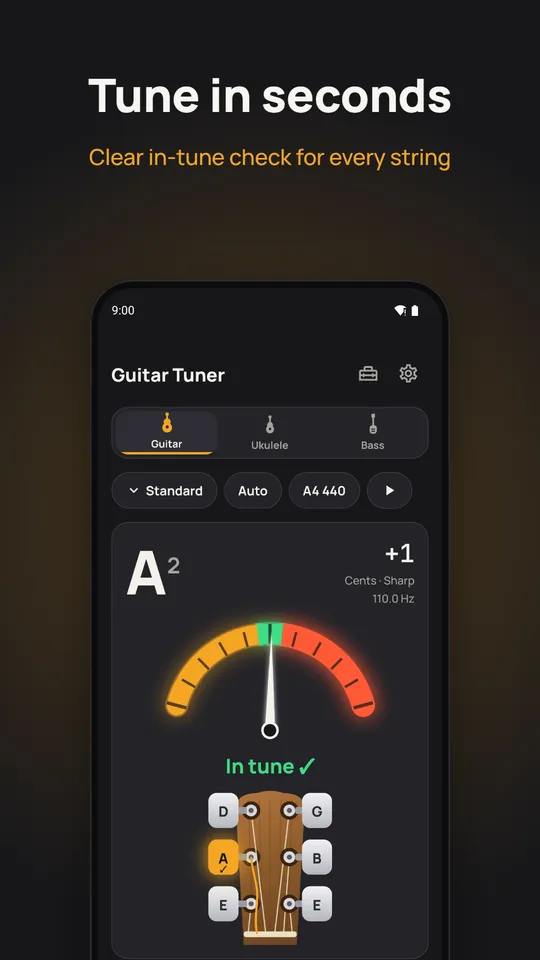
Arc gauge with the headstock 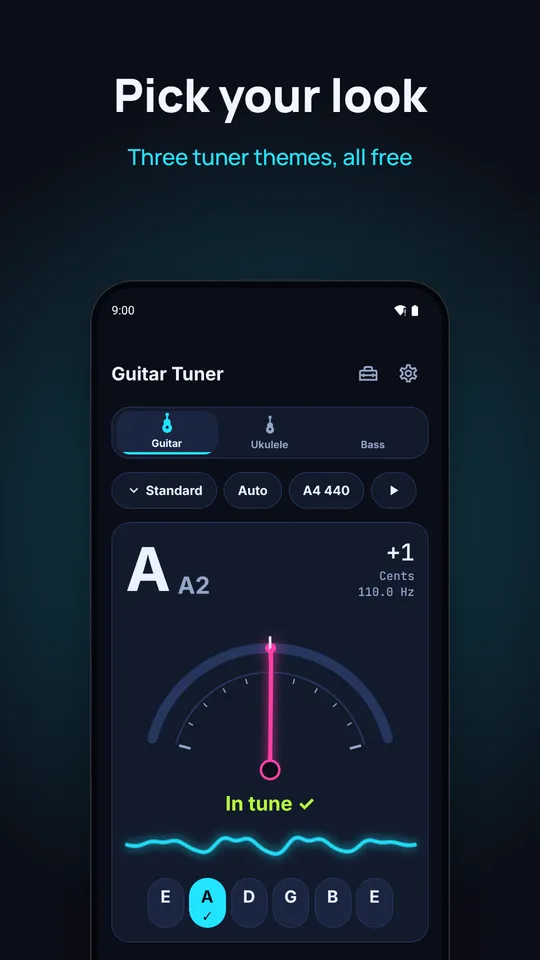
Neon gauge and live waveform 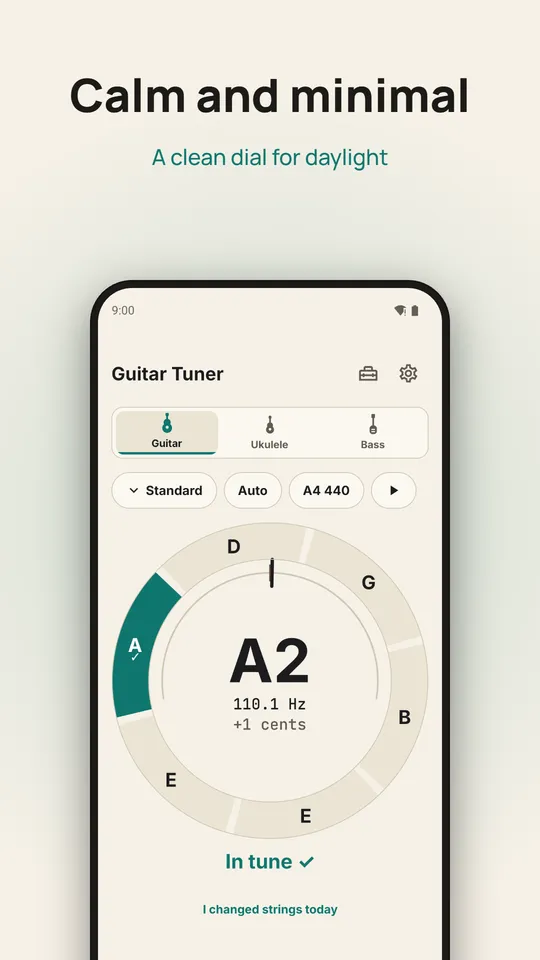
Minimal dial for daylight 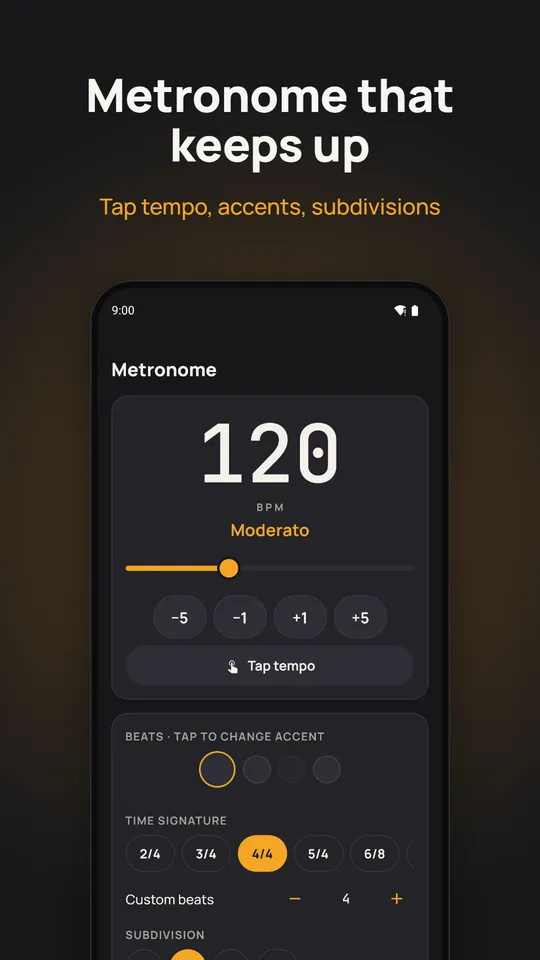
Metronome with tap tempo 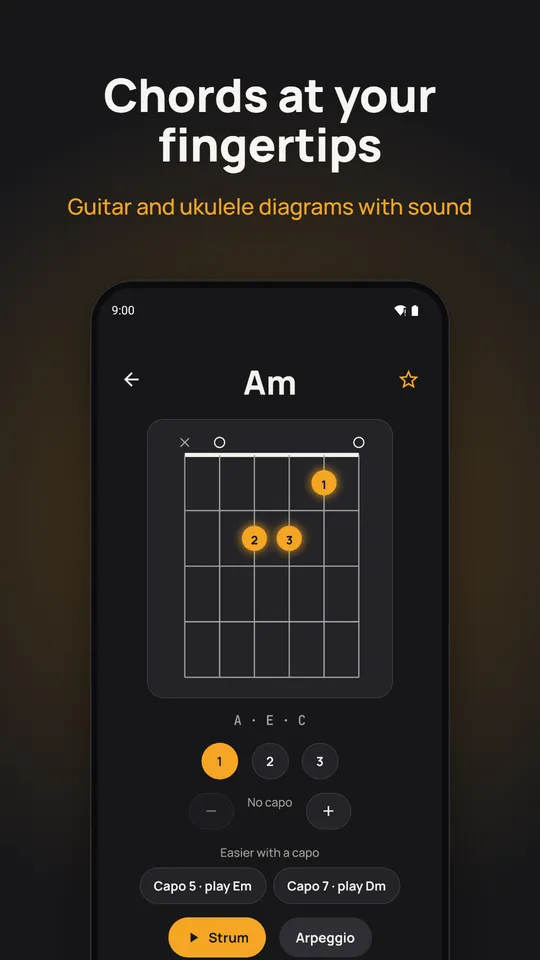
Chord diagrams with sound 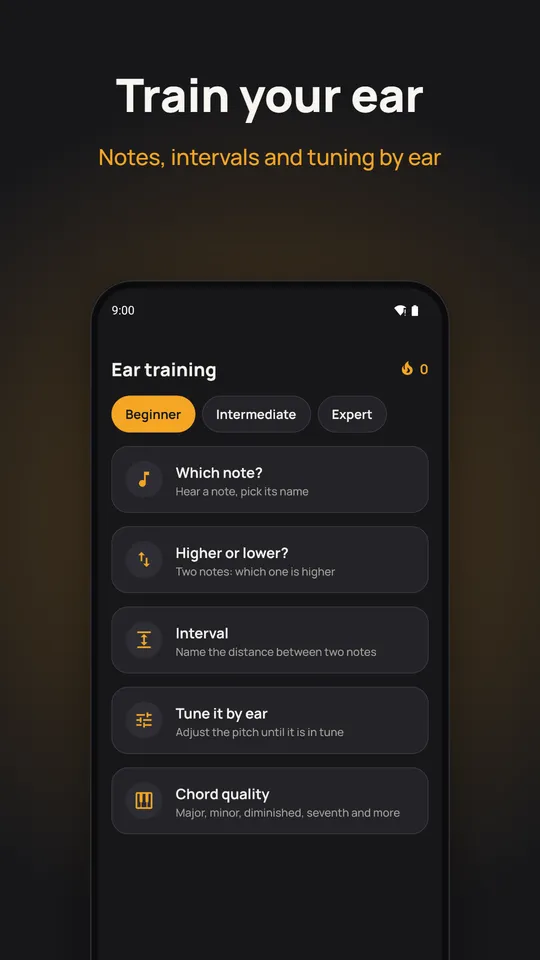
Ear training
How to tune a guitar with a tuner
- Press Start tuner and allow the microphone. On a laptop, sit close to it; on a phone, hold it near the soundhole or the amp.
- Pick the instrument and tuning. Standard tuning is already selected for guitar.
- Play the thickest string (6th, low E) once and let it ring. Mute the other strings with your fretting hand.
- Read the needle. Left of centre and Tighten means the string is flat, so tighten it; right of centre and Loosen means it is sharp, so loosen it.
- Turn the peg a little at a time and pluck again. When the dial turns green and shows In tune, move to the next string.
- After all six, check them once more. Tightening one string slightly changes the tension on the neck, so the first strings drift a little.
Always finish by tuning up to the note. If a string is sharp, loosen it below the note and bring it back up: the string then holds its pitch better because the slack in the peg gear is taken up.
Standard guitar tuning notes: E A D G B E
From the thickest string to the thinnest, standard tuning is E A D G B E. Guitarists count strings from the thinnest, so the high E is string 1 and the low E is string 6. A common way to remember the order from low to high is Eddie Ate Dynamite, Good Bye Eddie.
| String | Note | Frequency |
|---|---|---|
| 1 | E4 | 329.63 Hz |
| 2 | B3 | 246.94 Hz |
| 3 | G3 | 196.00 Hz |
| 4 | D3 | 146.83 Hz |
| 5 | A2 | 110.00 Hz |
| 6 | E2 | 82.41 Hz |
The two E strings are two octaves apart (82.41 Hz and 329.63 Hz). Between neighbouring strings the gap is a perfect fourth (five frets), except between G and B, which is a major third (four frets). That one exception is why the tuning-by-ear method below changes at the B string.
Drop D, half step down and other tunings
Every tuning below is in the tuner above. Pick it from the Tuning list and the needle measures each string against its new note.
| Tuning | Notes | What it is for |
|---|---|---|
| Drop D | D A D G B E | Lower only the 6th string a whole step. Heavy riffs and power chords with one finger. |
| Half step down | D# G# C# F# A# D# | Every string a half step lower. Easier bends and a darker sound; common in rock and blues. |
| Full step down | D G C F A D | Every string a whole step lower. Lower and looser than Eb. |
| Drop C | C G C F A D | Drop D, then everything a whole step lower. Metal and hard rock. |
| Open G | D G D G B D | Strumming the open strings plays a G major chord. Slide and rhythm guitar. |
| Open D | D A D F# A D | The open strings play D major. Slide, folk and fingerstyle. |
| DADGAD | D A D G A D | Open, modal sound with no major or minor third. Celtic and acoustic fingerstyle. |
Drop D in one step: play the open 4th string (D) and the 6th string together, and lower the 6th until the two sound the same note an octave apart, without any wobble. Then check it with the tuner.
How to tune a guitar without a tuner
With no tuner, you can tune the strings to each other. The guitar will then be in tune with itself, though not necessarily with a piano or a recording, so start from a reference if you have one: a piano key, another instrument, or the string buttons in the tuner above, which play each note.
The fifth fret method
- Tune the low E string to a reference, or leave it if it sounds close.
- Press the low E at the 5th fret. That note is A: tune the open 5th string to it.
- Press the A string at the 5th fret and tune the open D string to it.
- Press the D string at the 5th fret and tune the open G string to it.
- Press the G string at the 4th fret and tune the open B string to it (the G to B exception).
- Press the B string at the 5th fret and tune the open high E string to it.
When two notes are close but not equal you hear a slow wobble, called beating. Turn the peg in the direction that makes the wobble slower until it disappears.
The harmonics method
Touch a string lightly right above a fret wire, without pressing it down, and pluck: you get a clear, bell-like harmonic that rings longer than a fretted note, which makes beating easier to hear. Compare the 5th-fret harmonic of one string with the 7th-fret harmonic of the next thinner string (low E with A, A with D, D with G). For G and B, compare the open B with the fretted 4th fret of G instead, because the harmonic pair does not line up there in equal temperament.
Bass and ukulele tuning
Pick Bass or Ukulele in the tuner and the strings change with it.
| String | Note | Frequency |
|---|---|---|
| 1 | G2 | 98.00 Hz |
| 2 | D2 | 73.42 Hz |
| 3 | A1 | 55.00 Hz |
| 4 | E1 | 41.20 Hz |
| String | Note | Frequency |
|---|---|---|
| 1 | A4 | 440.00 Hz |
| 2 | E4 | 329.63 Hz |
| 3 | C4 | 261.63 Hz |
| 4 | G4 | 392.00 Hz |
Bass strings are an octave below the four lowest guitar strings; a 5-string bass adds a low B at 30.87 Hz. The low notes are hard for small laptop and phone speakers to pick up, so play firmly and keep the microphone close. Standard ukulele tuning is re-entrant: the G string is higher than the C beside it. Low G tuning drops that string an octave to 196.00 Hz.
440 Hz or 432 Hz?
The A above middle C at 440 Hz has been the international standard pitch since the 1950s and is what nearly all recordings, instruments and tuners use. Claims that 432 Hz is more natural or healing have no reliable evidence behind them. Use a different A4 only to match something that is already at another pitch: an old piano, a baroque ensemble (often 415 Hz) or an orchestra at 442 or 443 Hz. The tuner above and the app both accept any A4 from 415 to 466 Hz.
Why a guitar goes out of tune
- New strings stretch. For the first day or two, retune often, or stretch each string gently along its length after fitting it.
- Temperature and humidity change the wood and the strings. Let a guitar warm up to the room before you tune it.
- Pressing too hard bends fretted notes sharp, so the open strings can be right while chords still sound off.
- Intonation: if the open string is in tune but the 12th fret is not, the saddle needs adjusting, which a tuner can show but not fix.
Questions
Is this online guitar tuner free?
Yes. The tuner on this page is free, needs no sign-up and runs in your browser. The Android app is free too, with ads and no paid tunings.
Does the tuner record my microphone?
No. The browser hands the sound to code on this page, which measures the pitch and throws the audio away. Nothing is stored or sent to a server, and the app works the same way on the phone.
Why does the needle jump around?
Usually background noise, several strings ringing at once or a weak signal. Mute the other strings, pluck firmly with the pick near the middle and hold the phone or laptop close to the soundhole.
Should I tune to 440 Hz or 432 Hz?
Use 440 Hz unless you have a reason not to: it is the standard pitch that recordings, other players and most tuners use. Change A4 only to match a piano, an orchestra or a recording that sits at a different pitch.
Can I tune a bass or a ukulele here?
Yes. Pick Bass for 4-string, 5-string or Drop D bass, or Ukulele for standard GCEA, low G and baritone. Violin and a chromatic mode for any other instrument are there too.
Does it work on a phone?
The page works in Chrome, Safari, Firefox and Edge on phones and computers once you allow the microphone. For daily practice the Android app is easier: it opens instantly, works offline and adds a metronome and chords.

Keep a tuner in your pocket
Free on Android. No subscription, no account, no full-screen ads while you tune.
Facts from the Google Play listing, last checked .