Mexican Train score sheet online, free
Add your players, enter the points left in each hand after every round and the sheet keeps the totals, shows who leads and applies the tie-break. It runs in your browser and saves on your device. Below are the rules step by step, how many dominoes each player gets, how scoring works and which house rules people use. The free Android app adds a full game against the computer and a score sheet with a big keypad for table games.
Mexican Train score sheet
Saved on this device. Nothing is sent anywhere.
Round 1 of 13. Enter what each player scored when the round ends.
| Round | ||||
|---|---|---|---|---|
| Round with the double 12 | ||||
| Round with the double 11 | ||||
| Round with the double 10 | ||||
| Round with the double 9 | ||||
| Round with the double 8 | ||||
| Round with the double 7 | ||||
| Round with the double 6 | ||||
| Round with the double 5 | ||||
| Round with the double 4 | ||||
| Round with the double 3 | ||||
| Round with the double 2 | ||||
| Round with the double 1 | ||||
| Round with the double 0 | ||||
| Total | 0 | 0 | 0 | 0 |
Enter the points left in each hand; the player who goes out scores 0. Lowest total wins. A tie goes to the most zero rounds, then to the lowest non-zero round.
Count the tiles left in a hand
Tap one end of a tile
0 tiles0 points
Play the computer, or keep score at a real table
The sheet here covers a game on a real table. The Android app also plays Mexican Train against computer players by the house rules you choose, and its own score sheet adds up your tiles with a big keypad:
- Play against 1 to 7 computer players, 2 to 8 in total, each on Easy, Normal or Hard
- Double-12 set (91 tiles) or double-15 set (136 tiles), a real shuffle every round with a deal code, and every hand revealed when the round ends
- The computer sees only its own tiles and plays by the same rules as you; undo and hints, no timer
- House rules: doubles covered or optional, cover in the same turn or by the end of the turn, when the Mexican Train can start, draw one or draw until you can play, blanks worth 0, 50 or 25, plus Standard, Family friendly and Strict presets
- Score sheet for table games: 2 to 12 players with names, rounds from the highest double down to 0, for double-6, 9, 12 or 15 sets
- A big keypad that adds up tiles, totals, leader and winner, a history of past games, and sharing as text or CSV
- Large and extra large tiles, pips or numbers on the tiles, coloured or classic pips, light and dark themes, portrait or landscape
- A rules page and a quiz that explains how to play Mexican Train in plain words

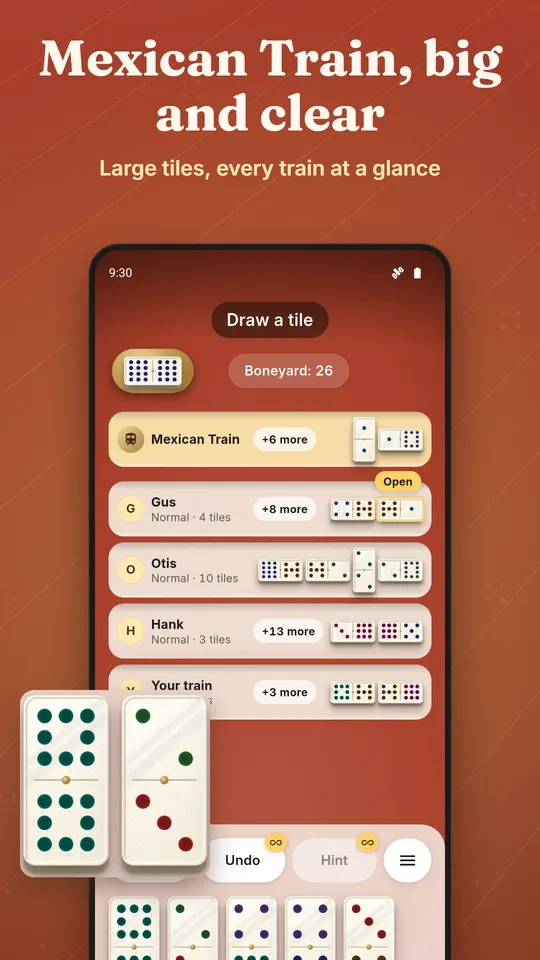
Big tiles, every train in view 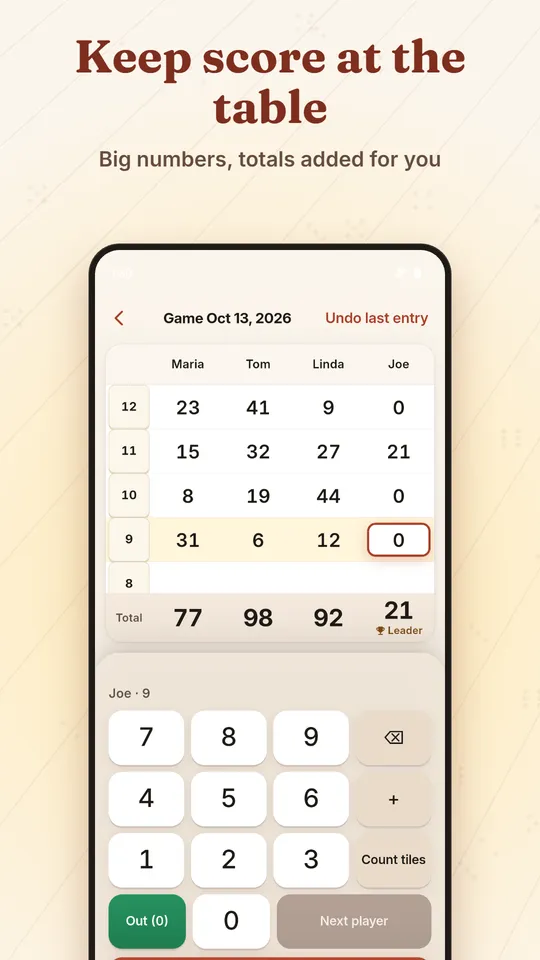
A score sheet with a big keypad 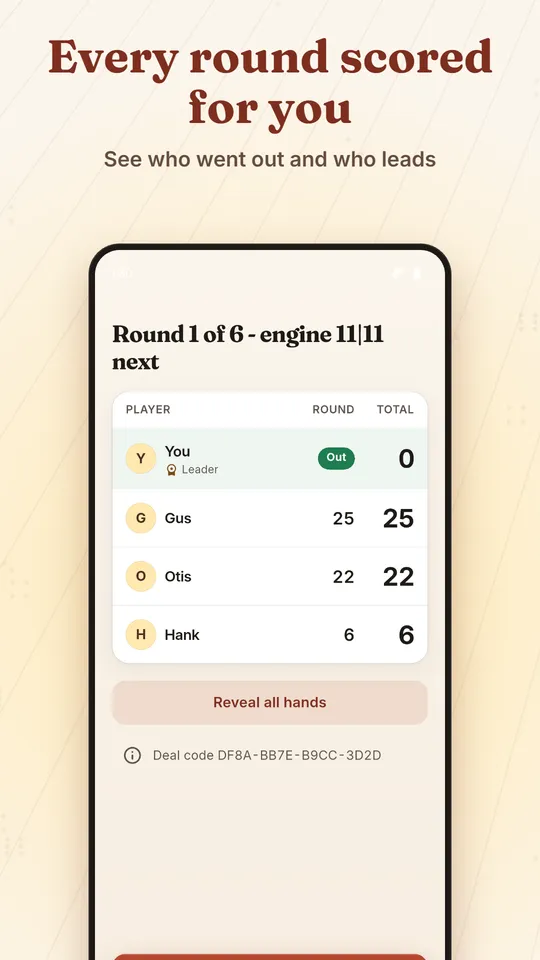
Every round scored for you 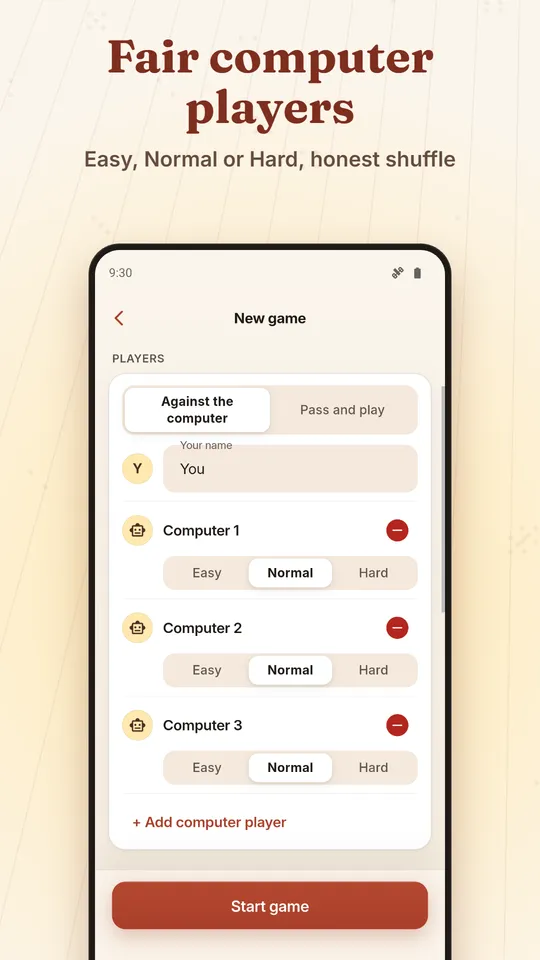
Choose your computer players 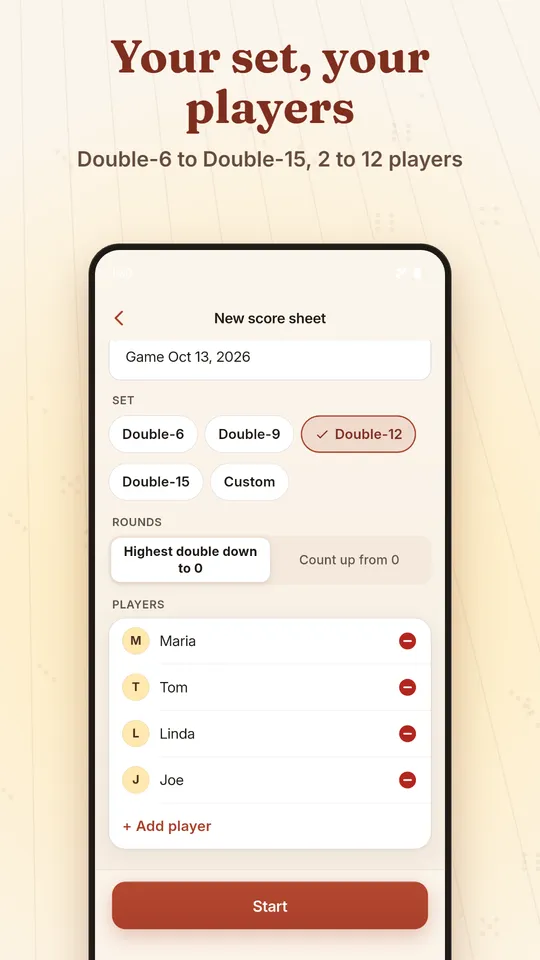
Double-6 to double-15 sets 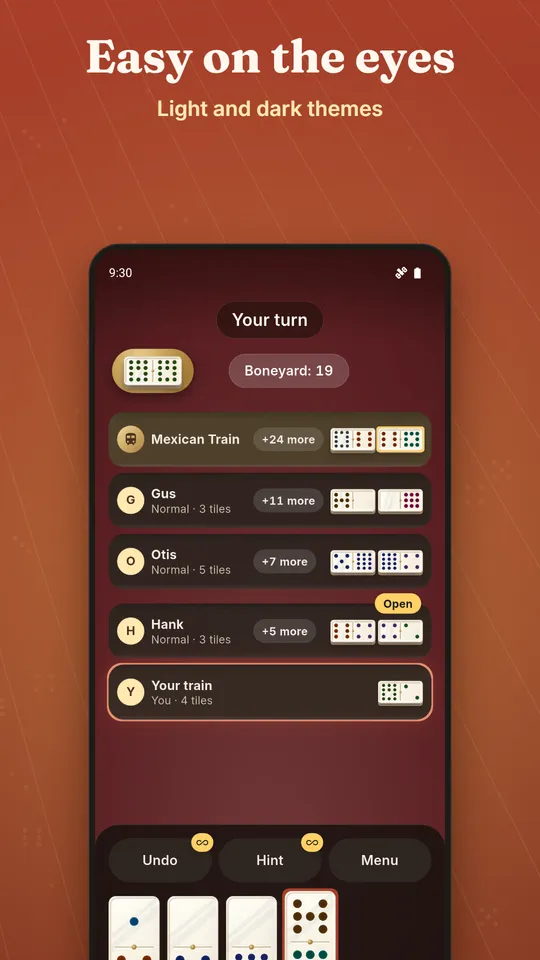
Easy on the eyes 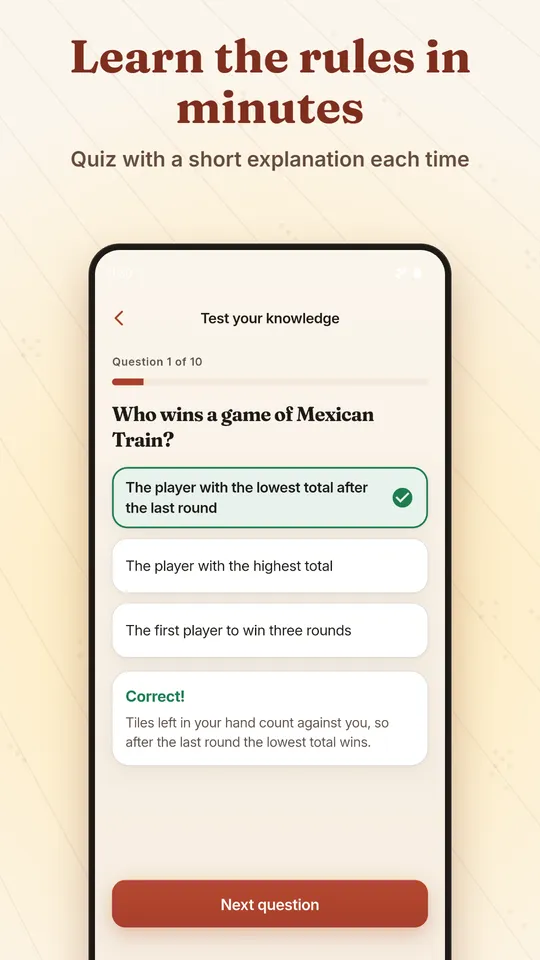
Learn the rules in minutes 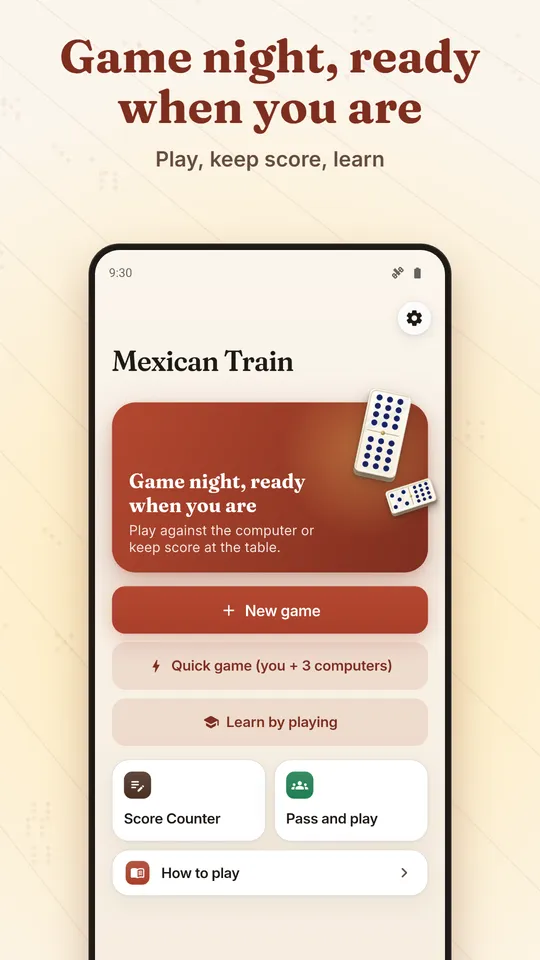
Play, keep score, learn
How to play Mexican Train dominoes
Mexican Train is a domino game for two to eight players with a double-12 set (91 tiles). Each player builds a train of tiles that match end to end, starting from a double in the middle called the engine or station. Pips left in your hand at the end of a round are your score, and the lowest total after all rounds wins. There is no single official rulebook: Wikipedia says so itself. This guide follows the rules on pagat.com and Wikipedia, which agree on the set, the hand sizes, the round order and the scoring, and it says where they differ.
- Set up. Turn the tiles face down and shuffle. Each player takes a hand of the size in the table below and stands it on edge. The tiles left over form the boneyard. Each player needs a marker.
- Place the engine. The first round starts with the 12-12 in the middle, the second with the 11-11, and so on down to the double blank in round 13. Whoever holds the double places it. If nobody does, players draw one tile at a time from the boneyard until it appears. You can also take the double out before the deal and place it face up.
- Build your train. On your turn, add a tile to a train by matching its end number. Your own train grows from the engine toward your seat. You may also play on the Mexican Train, which anyone can use, and on another player's train when it carries a marker.
- Play, draw or pass. If you can play, you must. If you cannot, draw one tile. Play it if it fits; if not, you pass and put your marker on your train.
- Go out. The round ends when a player plays the last tile, or when nobody can move and the boneyard is empty.
- Score. The player who went out scores 0. Everyone else scores the pips on the tiles still in their hand. Enter the points on the sheet above, then start the next round with the next lower double.
How many dominoes does each player get?
For a double-12 set pagat.com gives 15 tiles each for up to 4 players, 12 each for 5 or 6, 10 each for 7 or 8 and 8 each for 9 or 10. The table adds the boneyard that is left once the engine is placed.
| Players | Tiles each | In hands | Boneyard |
|---|---|---|---|
| 2 | 15 | 30 | 60 |
| 3 | 15 | 45 | 45 |
| 4 | 15 | 60 | 30 |
| 5 | 12 | 60 | 30 |
| 6 | 12 | 72 | 18 |
| 7 | 10 | 70 | 20 |
| 8 | 10 | 80 | 10 |
Other sets: a double-9 set (55 tiles) suits two to seven players and a double-15 set (136 tiles) is the usual choice for nine to twelve, according to Wikipedia. Sources disagree on hand sizes for those sets, so agree one before you deal. The Mexican Train Dominoes Counter app uses 15 tiles for up to four players, 13 for five or six and 11 for seven or eight with the double-15 set.
| Set | Tiles | Tiles with one number | Pips on all tiles |
|---|---|---|---|
| Double 6 | 28 | 7 | 168 |
| Double 9 | 55 | 10 | 495 |
| Double 12 | 91 | 13 | 1092 |
| Double 15 | 136 | 16 | 2040 |
The last column is a check for a disputed count: the pips in all hands, on the table and in the boneyard must add up to the set total, so a missing tile shows up as a gap.
The engine double and the order of rounds
A full game is 13 rounds with a double-12 set. Round 1 uses the 12-12 as the engine, round 2 the 11-11, and so on to the 0-0 in round 13: 12, 11, 10, 9, 8, 7, 6, 5, 4, 3, 2, 1, 0. A sheet for a double-9 set has 10 rows and one for a double-15 set has 16. The first player usually changes every round, and the player who places the engine often goes first.
On the first turn of a round pagat.com lets every player in turn build as long a train as they can from the engine, and a player who cannot start places a marker without drawing. Other rule sets have one tile per turn from the start. Agree which one you use before the first round.
Trains, markers and the Mexican Train
Every train starts at the engine. A tile can go on a train only when one of its numbers matches the open end. A double is placed crosswise.
- Your own train is private: only you add to it, until you have to mark it.
- A marker on a train means its owner could not play on their last turn. Now every player may add to that train. The marker comes off when the owner plays a tile on their own train again. Playing elsewhere does not remove it.
- The Mexican Train is a public train started with any tile that matches the engine. It is public from the moment it starts, so it needs no marker. In the pagat.com rules any player may start it from their second turn.
Doubles must be satisfied
A double placed crosswise has to be covered by another tile that matches it, before play goes on as normal. The two sources handle this a little differently.
- Wikipedia (the 1994 Galt rules): the player who played the double covers it in the same turn. If they cannot, they draw. If the drawn tile does not cover it either, their train gets a marker and the next player must cover it. Until the double is covered, no other train can be played on.
- pagat.com: after a double you play another tile anywhere you may. An exposed double must then be satisfied by the next player, in the order the doubles were played, even on a private train.
Galt's exceptions: you need not cover a double when it is the last tile you hold, or when every other tile with that number is already on the table. The app lets you pick either timing and can treat doubles as optional.
Going out, a blocked game and how to score Mexican Train
A round ends when someone plays their last tile, or when the boneyard is empty and nobody can play. The player who goes out scores 0. Every other player scores the total of the pips on the tiles they still hold. The tiles count by their spots: a 5-7 is 12 points, a 12-12 is 24 and a blank end is 0. Points add up over the rounds, and the lowest total at the end wins.
Blanks are worth 0 in the standard count. A common variant makes the double blank worth 50, and another counts every blank end as 25. Take the hand 0-0, 0-6, 3-5, 12-12: it is 38 points with blanks at 0, 88 with the double blank at 50 and 113 with every blank at 25. The counter under the sheet above does this sum for you.
Ties
When two players have the same total, the usual order is: most rounds with 0 points, then the lowest single round that was not 0. If that does not separate them either, the win is shared. Two players on 15, one with one zero round and one with two, are settled in favour of the one with two. The score sheet applies this rule and shows who leads after every full round.
Keeping a Mexican Train score sheet
A score sheet is a grid with one column per player and one row per round, plus a total row. Write the engine double in the first column (12, 11 and so on to 0) so nobody has to count which round it is, and write pips left, not running totals, in the cells. Add each column after the round, and again at the end.
- Use a pencil, so a recount can fix a cell.
- Have the player who went out write 0 first. It makes the round visible on the sheet and the tie-break easy to read afterwards.
- Let a second player count each hand before it is written down. Counting twice is quick and catches slips.
- A sheet for eight players on one page needs narrow columns. The sheet above scrolls sideways for up to twelve players and prints on one page with the Print button.
- Pick the set first. A double-9 game has 10 rounds, a double-12 game 13 and a double-15 game 16.
Mexican Train strategy that helps
These are general tips, not rules. Because points are the pips you hold when someone goes out, most of them are about getting heavy tiles out of your hand.
- Play the heavy tiles first. A 12-12 left in your hand costs 24, a 0-1 costs 1. When a round might end soon, dump the high tiles before the cheap ones.
- Plan the train from your hand. Try to end your train on a number you hold more tiles of, so the next turn is easy and you are less likely to draw and mark it.
- Keep a way to cover doubles. Under the cover-at-once rule, a double you cannot cover opens your train to everyone. Play doubles when you hold a tile that matches them.
- Use the other trains. The Mexican Train and any marked train let you play tiles without lengthening your own. They also change which numbers are open to the players after you.
- Count the numbers. Each number is on 13 tiles in a double-12 set. When most of them are on the table, a train ending on that number is hard to continue and a double of it is hard to cover.
- Avoid a stuck hand. The average tile in a double-12 set is worth 12 points, so a nearly full hand of 15 is close to 180. One such round outweighs many small gains, so spend a turn to free your train rather than hold on to a tile you may never get to play.
Common house rules
Many tables play with rules of their own. These are house rules or variants rather than part of one rule set, and the app lets you set each of them before a game, with Standard, Family friendly and Strict presets.
| Topic | Standard | Variant | In the app |
|---|---|---|---|
| Doubles | A double must be covered | Doubles are optional: nobody has to cover them | Setting: doubles must be covered, or optional |
| When to cover a double | The player who played it covers it in the same turn (Wikipedia and the Galt rules) | The player plays any tile after a double, and the next player must cover an exposed double (pagat.com) | Setting: same turn, or by the end of the turn |
| Starting the Mexican Train | Any player may start it from their second turn | Only after you have played a tile on your own train | Setting: when the Mexican Train can start |
| Drawing | Draw one tile; if it does not fit, pass and mark your train | Keep drawing until you can play or the boneyard is empty | Setting: draw one and pass, or draw until you can play |
| Blanks | A blank counts 0 | Double blank 50, or every blank 25 (so 0-0 is 50 and 0-6 is 31) | Setting: blanks worth 0, double blank 50, or every blank 25 |
| Length of the game | 13 rounds, double-12 down to the double blank | A short game of 10, 6 or 3 rounds, starting from the highest double | Setting: 13, 10, 6 or 3 rounds |
Agree on these six lines before the first tile is played, and write them on the sheet if the group changes often.
Questions
How do you score Mexican Train dominoes?
When a round ends, the player who went out scores 0 and everyone else scores the pips on the tiles left in their hand. Points add up over all rounds and the lowest total wins.
How many dominoes does each player get in Mexican Train?
With a double-12 set, up to 4 players take 15 tiles each, 5 or 6 players take 12 and 7 or 8 players take 10. The tiles that are left form the boneyard.
How many rounds are in a game of Mexican Train?
A full game with a double-12 set has 13 rounds, starting with the 12-12 in the middle and ending with the double blank. Shorter games of 10, 6 or 3 rounds are a house rule.
Who wins Mexican Train if two players have the same total?
The usual tie-break gives the win to the player with more rounds at 0 points, then to the one with the lowest non-zero round. If they are still level, the win is shared.
Does this score sheet save my game and can I print it?
Yes to both. The sheet is stored in your browser on this device, so it survives a reload, and the Print button prints the table without the rest of the page. Nothing is sent anywhere.
Is the Mexican Train Dominoes Counter app free?
Yes. It is free with ads, the listing shows no in-app purchases, and there is no account. Playing against the computer and keeping score both work without internet.

Take the score sheet to game night
Free on Android, with ads. Works without internet and needs no account; your games and score sheets stay on your phone.
Facts from the Google Play listing, last checked .