No guess minesweeper: every board solvable by logic
Play minesweeper right here with no fifty-fifty traps: a solver checks every board before you see it, so logic alone is enough. Pick a size, ask for free hints, chord, and replay any board from its code. The same game is a free Android app with six modes, a daily board and seven looks.
Minesweeper, no guessing
Every board is checked by a solver before you see it
Tap or press Enter to dig. Long-press, right-click or press F to flag. Tap a number whose flags match it to open the rest around it (chording).
Open any square to start. The first opening is always safe.
Six modes, a daily board and seven looks on your phone
This page plays one board at a time. The Android app adds modes, a daily puzzle, records and a layout built for touch, all offline:
- Every board is generated after your first tap and checked by a solver, so it can be finished by reasoning alone; classic random boards are one switch away
- Classic, Zen (a mine only costs time), Evil (dense boards, still solvable), Time attack (five minutes, as many boards as you can), Daily and Chaos
- Beginner 9 × 9, Intermediate 16 × 16, Expert 30 × 16 and a custom size and mine count
- Unlimited free hints that circle the numbers proving the next move and never open the square for you
- Board codes: replay the same board after a loss or send it to a friend; the last 30 daily boards stay playable
- Pinch to zoom, adjustable square size, a dig and flag switch, chording and a left-handed layout; the board works with a screen reader
- Seven looks: Neon, Wood, Minimal, Classic, Light, Colour blind and High contrast
- Each difficulty keeps its own game in progress, with best times, win rate, 16 achievements that unlock nothing, offline play, no account and 100+ languages

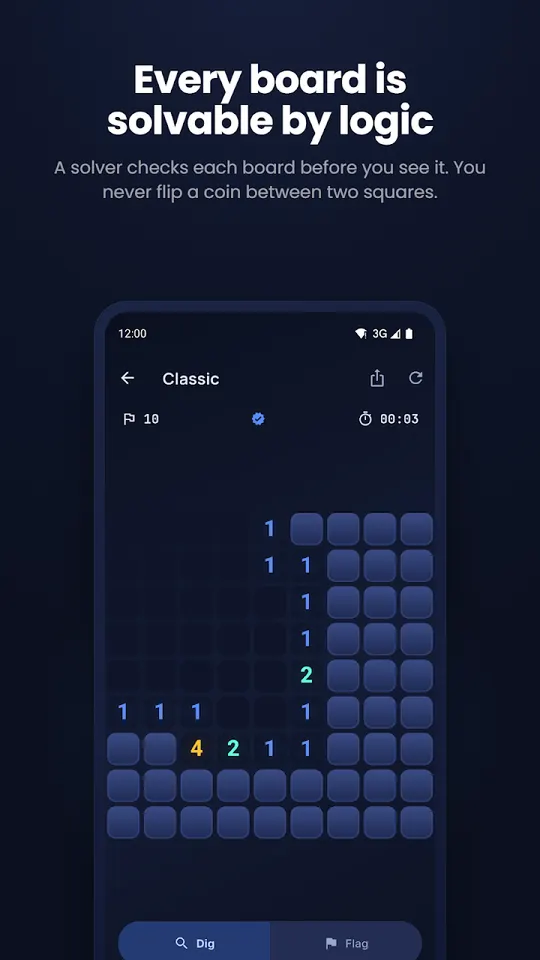
Every board solvable by logic 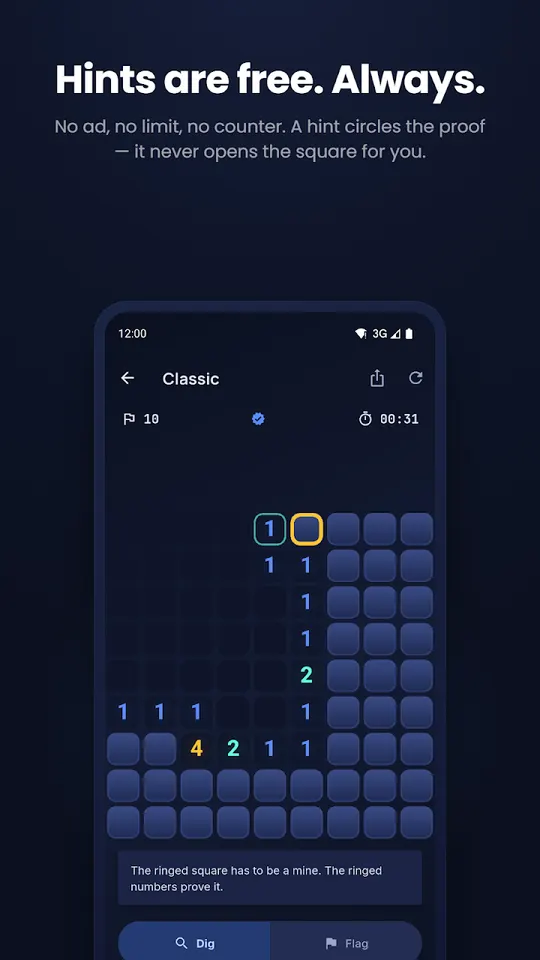
Hints that show the proof 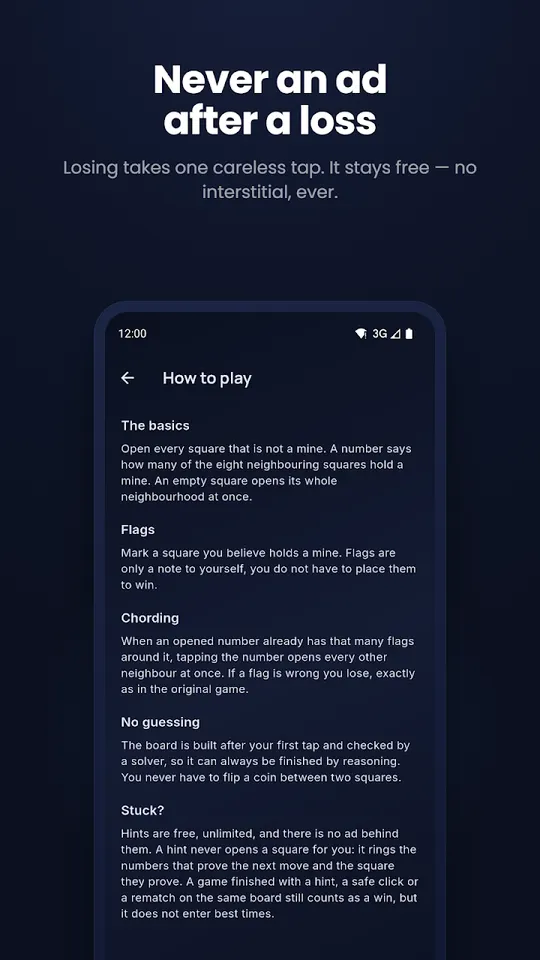
How to play, in the app 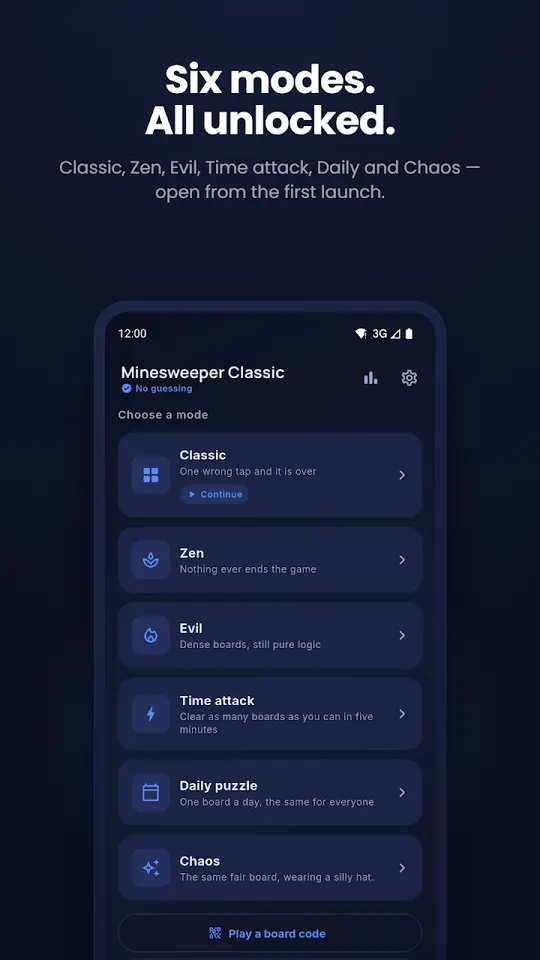
Six modes, all unlocked 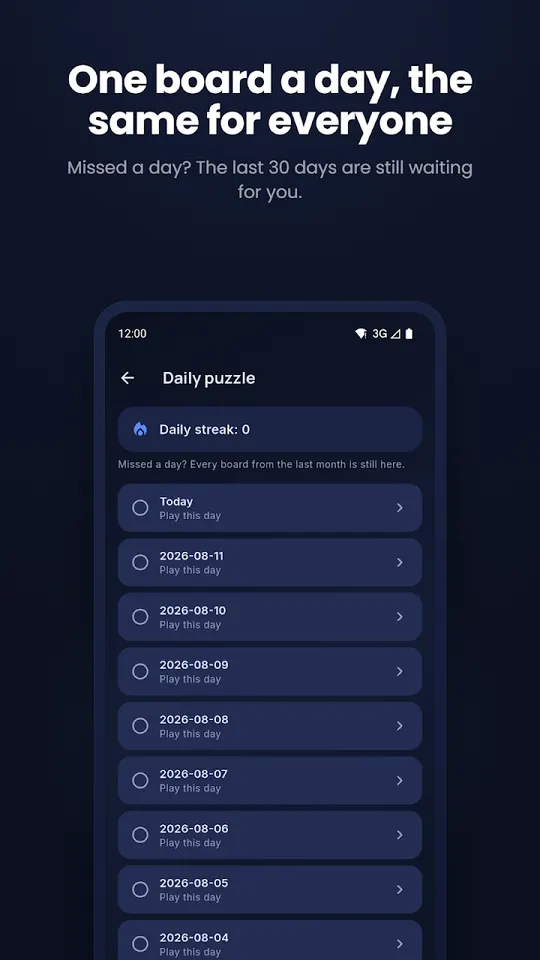
One board a day for everyone 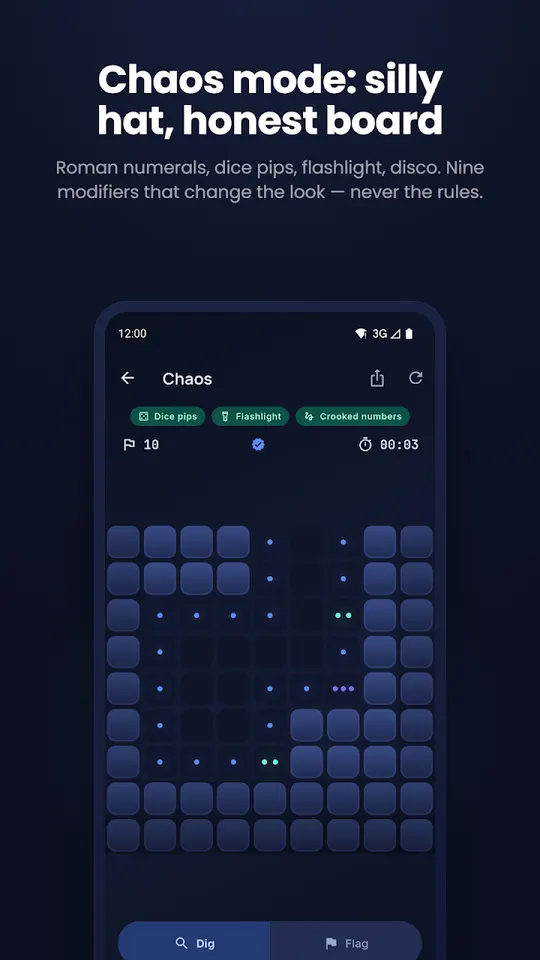
Chaos mode: silly hat, honest board 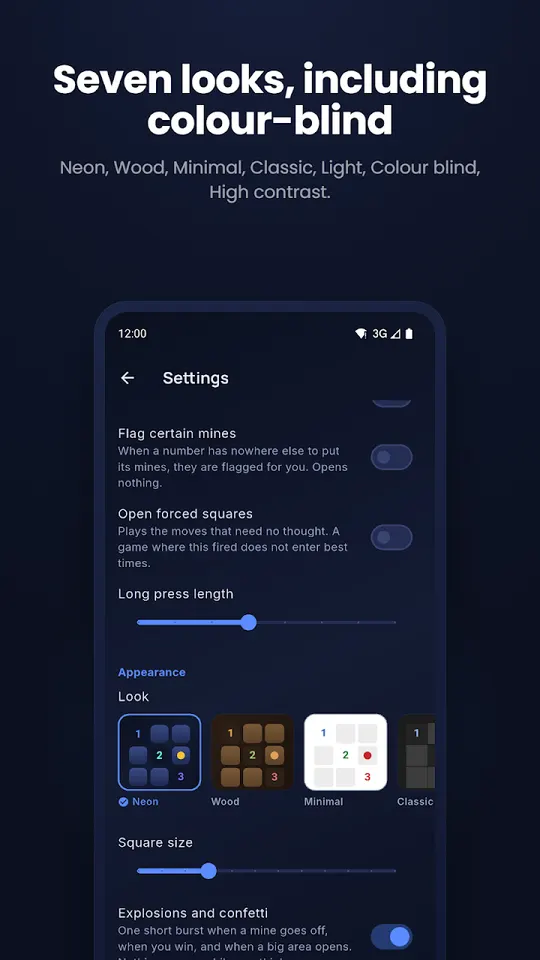
Seven looks 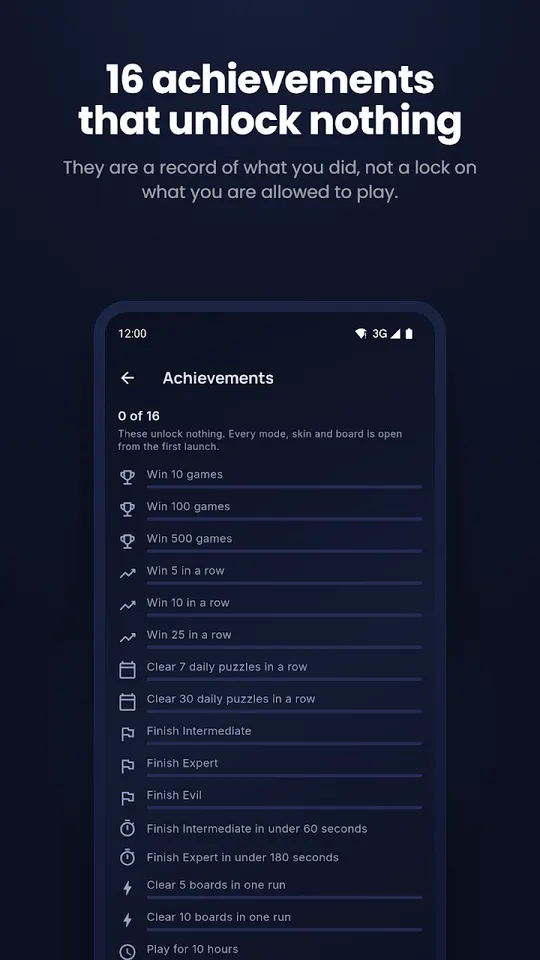
Achievements that unlock nothing
How to play Minesweeper
A Minesweeper board is a grid of covered squares with a fixed number of mines hidden under some of them. You win when every square without a mine is open. You lose when you open a mine.
- A number counts mines. An opened square shows how many of the eight squares touching it hold a mine, diagonals included. A blank square has none, so the game opens all its neighbours for you.
- A flag is a note to yourself. Mark a square you know is a mine. Flags change nothing in the rules, but they make the numbers around them easier to read, and the counter above the board shows mines minus flags.
- Chording. When an opened number has exactly that many flags around it, tapping the number opens every other covered square around it at once. If one of your flags is wrong, that opens a mine.
- The first square is safe. In the tool above the board is built after your first tap, with that square and its neighbours kept clear, so you always start with an opening.
| Level | Board | Mines | Share of squares that are mines |
|---|---|---|---|
| Beginner | 9 × 9 | 10 | 12.3% |
| Intermediate | 16 × 16 | 40 | 15.6% |
| Expert | 30 × 16 | 99 | 20.6% |
Some versions use 8 × 8 for Beginner; the 9 × 9 board with 10 mines is the common one. The denser the board, the more often two squares look alike, which is why Expert is where the guessing happens.
How to win Minesweeper: a method that does not need luck
- Start from the opening. Work along the edge of the open area first. Every number there touches only a few covered squares, so it is easy to read.
- Compare each number with its covered neighbours. If a 1 has one covered square left, that square is a mine. If a 3 has three covered squares left, all three are mines.
- Flag what you proved. Once a mine is flagged, a number that has all its mines flagged tells you the rest of its neighbours are safe. Open them, or chord.
- Compare two numbers side by side. This is the step that unlocks most stuck positions. If one number's covered squares are all inside another number's, the squares only the bigger one touches hold the difference. The patterns below are this rule in a standard shape.
- Move on when stuck. A different part of the board often opens up, and a new number can change the picture where you were stuck.
- Use the mine counter at the end. When only a few covered squares are left, the number of mines still unflagged can settle what the numbers cannot.
- Press Hint if you are stuck. It tells you which numbers prove the next move, in words, and never opens the square for you.
Minesweeper patterns: 1-2-1, 1-2-2-1 and the corner rules
Players name the shapes that keep coming up. Each one is just the compare-two-numbers step done in advance. The diagrams below are marked by the same solver that checks the boards in the tool: the flag is a square it proves is a mine, the tick is a square it proves is safe, using only the lit numbers. Blank grey squares are other opened squares that play no part.
1-2-1 along an edge
Call the five covered squares A to E from the left. The left 1 sees A, B and C, the 2 sees B, C and D, the right 1 sees C, D and E. The 2 has one more mine to place than the left 1, and the only difference between their squares is D against A, so D is a mine and A is safe. From the other side, B is a mine and E is safe. The left 1 already has B, so C is safe. The result: a mine directly under each 1, and the three other squares are safe.
1-2-2-1 along an edge
Same reasoning, one number longer. The first 2 has one more mine to place than the 1 beside it, which makes the square only the 2 touches a mine; the mirror image does the same on the other side. The mines end up directly under the two 2s, and the four outer squares are safe.
1-2 at a corner: the extra square is a mine
A 1 and a 2 touch the same covered squares, but the 2 also touches one more. The 1 holds one mine among the shared ones, so the 2 needs its second mine in the extra square, which is therefore a mine. The 1-2-X rule on minesweepergame.com states it the same way.
1-1 at a corner: the extra square is safe
The mirror case. Two equal numbers, and the second one touches one more covered square. The shared squares already hold the whole count, so the extra square cannot hold a mine.
What is a 50-50 in Minesweeper?
A 50-50 is a position where two covered squares look exactly alike to every number around them, and one of them holds a mine. No rule can tell them apart, so you choose and hope. Nothing in the rules of Minesweeper prevents the random layout from producing one, so on an ordinary random board you cannot always win by skill alone.
The fix is not a better strategy but a better board. A no-guess game builds the layout, tries to solve it by logic, and throws it away if the solver gets stuck. Simon Tatham's Mines does this with its "Ensure solubility" option, which is on by default. The result is a board where every square can be found by deduction from the opening.
How the no-guess check on this page works
The first time you open a square, the tool places the mines at random, keeping that square and its neighbours clear. Then a solver plays the whole board from your opening, using only three rules:
- One number at a time. A number needs none of its covered neighbours to be mines, or all of them.
- Two numbers compared. The squares only one number touches must hold the difference between the two counts. This covers the subset rule and the patterns above.
- The mine counter. No mines left means every covered square is safe; as many mines left as covered squares means they are all mines.
If the solver opens every safe square this way, you get the board. If it gets stuck, the layout is discarded and the next one is tried. The same seed always gives the same board, which is what makes a board code work. If no layout passes in 800 tries, the tool says so under the board instead of claiming a guarantee it does not have.
| Level | Accepted first time | Layouts tried, average | Most layouts needed |
|---|---|---|---|
| Beginner | 83.5% | 1.2 | 6 |
| Intermediate | 63.0% | 1.6 | 10 |
| Expert | 11.1% | 9.4 | 80 |
Read the table as a measure of how often random boards are fair, not as a promise about every board. About one random Expert board in nine is fair on the first draw; the other eight need a redraw, and the tool does that in the background in a few milliseconds.
One honest limit: the solver uses simple rules on purpose. A strong player can sometimes untangle a position with deeper case work, such as trying both options for one square and following the consequences. Those boards are rejected here, so the boards you get are solvable with the rules above and nothing harder. Finding out whether a partly revealed board is consistent at all is a hard problem in general (Kaye showed in 2000 that it is NP-complete), which is why real solvers stop at rules like these.
Board codes and the daily board
A board code such as 9x9-10-n-1k2j3h-40 holds the size, the number of mines, the mode (n for no guess, c for classic), a seed and the first square. Paste it into the box under the board and you get exactly that board, with that first square already opened. It is a way to replay a board you lost at ninety percent, or to send one to a friend.
The Today's board button builds a code from the date, so everyone who presses it on the same day plays the same Intermediate board.
Where Minesweeper comes from
The version most people know came in the Windows Entertainment Pack in 1990, written by Robert Donner and Curt Johnson, and it shipped with Windows until Windows 8. Where the idea started is disputed: some sources name the 1983 game Mined-Out, and Johnson has said the design was borrowed from another game but not from that one. An earlier game called Mines ran on SunOS in 1987. Windows Vista added a guaranteed opening on the first click.
What the Minesweeper Classic No Guess app adds
The tool on this page is one board at a time. These details come from the Google Play listing of the Android app (updated August 12, 2026):
- Six modes. Classic, Zen (a mine only costs time), Evil (denser boards, still solvable by logic), Time attack (five minutes to clear as many boards as you can), the Daily puzzle with the last 30 days kept open, and Chaos, the same fair board with visual modifiers.
- Four difficulties. Beginner, Intermediate, Expert and a custom size and mine count.
- Hints. Free and unlimited. A hint circles the numbers that prove the next move and never opens the square. Games where you used a safe click are kept out of the best-time records.
- Phones and tablets. Pinch to zoom, adjustable square size, a dig and flag switch, chording, a left-handed layout, and a board that works with a screen reader.
- Seven looks. Neon, Wood, Minimal, Classic, Light, Colour blind and High contrast.
- Records and saves. Each difficulty keeps its own game in progress, best times and win rate are tracked, and 16 achievements unlock nothing.
- Offline and free. No internet, no account, 100+ languages. Google Play marks the app as containing ads, and the listing screenshots say no ad follows a loss.
The app has its own solver, so which boards it accepts can differ from this page. The listing says its boards are checked so they can be finished by reasoning alone.
Sources
- Minesweeper (video game), Wikipedia: standard sizes, history, chording, first-click guarantee, the NP-completeness result. Opened 2026-11-01.
- Mines, Simon Tatham's Portable Puzzle Collection: the "Ensure solubility" option. Opened 2026-11-01.
- Minesweeper Patterns, minesweepergame.com: the names 1-2-1, 1-2-2-1 and 1-2-X, and the subset rule. The diagrams above are marked by this page's own solver rather than copied from it. Opened 2026-11-01.
- Minesweeper Classic No Guess on Google Play: every app fact above. Checked 2026-11-01.
Questions
What is no guess minesweeper?
Minesweeper where every board can be finished by logic alone. The board is built after your first tap and a solver plays it first; if the solver gets stuck, the layout is thrown away and another is drawn. You never meet a fifty-fifty.
How do you win minesweeper without guessing?
Read each number against its covered neighbours: a 1 with one covered square left has a mine there, and a number with all its flags placed makes the rest safe. When that stops, compare two neighbouring numbers: the squares only one of them touches hold the difference. On a no-guess board that always finds the next move.
What does 1-2-1 mean in minesweeper?
Three numbers in a row along an edge, over five covered squares. The mines are directly under the two 1s and the other three squares are safe. The guide above shows it with a diagram and the arithmetic.
What is a 50-50 in minesweeper?
Two covered squares that every nearby number touches equally, with one mine between them. No rule can separate them, so you guess. A no-guess game avoids them by rejecting any layout where one would appear.
Is the first click always safe?
In the tool on this page, yes: the board is built after your first tap and keeps that square and its neighbours clear, so you always start with an opening. The Android app also builds its board after your first tap.
How can I replay or share a board?
Copy the board code under the board and paste it into the Play a code box, or send it to a friend. A code holds the size, mines, mode, seed and first square, so it rebuilds the same board with the first square already open.
Is the Minesweeper Classic No Guess app free and offline?
Yes to both. It is free with ads, needs no account and works without internet. Every mode, look and board is open from the first launch.

Minesweeper without the coin flip
Free on Android, with ads. Works offline with no account, and every mode and look is open from the first launch.
Facts from the Google Play listing, last checked .