llms.txt on a static site: worth it?
I generate llms.txt and Markdown copies of my tool pages at build time. What the file contains, what Google and Lighthouse say about it, and what it costs.
· Updated · 4 min read
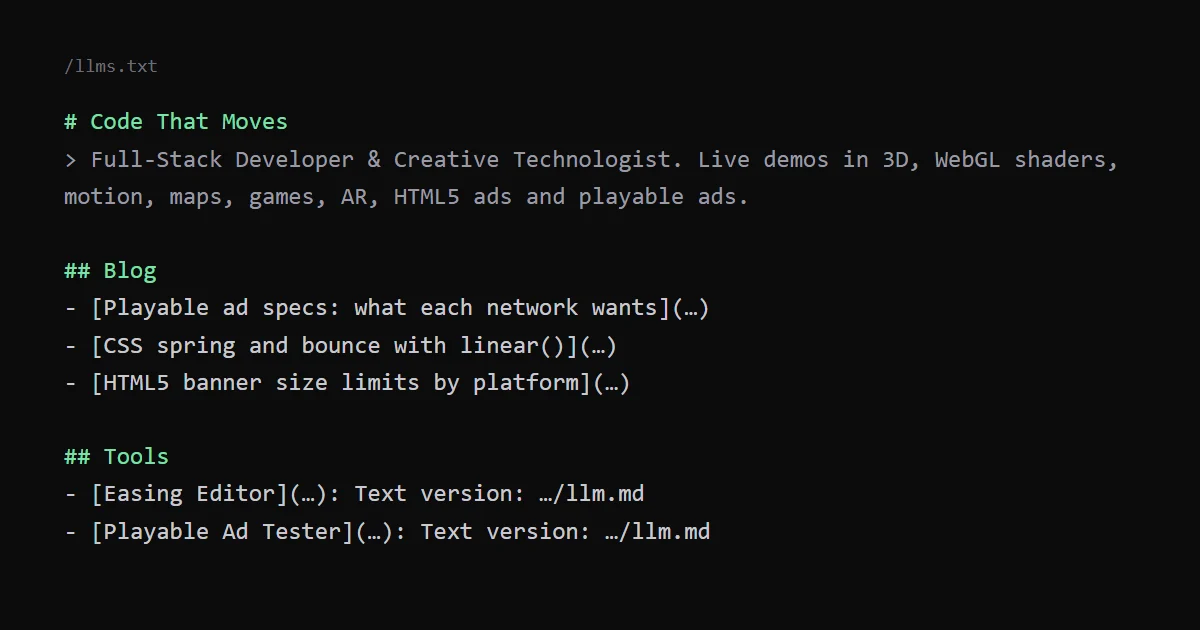
llms.txt is a Markdown file at your site root that lists your key pages for AI tools. Google's John Mueller has called it "purely speculative", and nobody has shown it brings traffic. I still generate one, because on a static site it costs one small file and no upkeep.
This is what mine contains, what the sources say about it, and the one place where it plausibly does something.
What the proposal asks for#
llmstxt.org is the proposal. Jeremy Howard published it on 3 September 2024. The file is Markdown with this structure:
- An H1 with the site name. It is the only required part.
- A blockquote with a short summary.
- Optional body text with no headings.
- H2 sections that hold lists of links, each written as
[name](url)with an optional note after a colon. - An "Optional" section, by convention for secondary links an agent can skip.
The proposal also suggests that pages agents may need get a clean Markdown copy at the same URL, named page.html.md or page.md (index.html.md or index.md for a URL without a file name), and found through rel="alternate" type="text/markdown".
How I build mine#
The file is a static route handler that runs at build time. It reads the same content as the sitemap, so a new post or tool appears in it without anyone editing it.
export const dynamic = "force-static";

export function GET() {
  const url = (path: string) => new URL(path, site.baseUrl).toString();
  const posts = listedPosts();
  const lines = [
    `# ${siteName}`,
    "",
    `> ${site.description}`,
    // ...
    ...posts.map((p) => `- [${p.title}](${url(`/blog/${p.slug}/`)}): ${p.description}`),
  ];
  return new Response(lines.join("\n"), {
    headers: { "Content-Type": "text/plain; charset=utf-8" },
  });
}
Each tool page also has a Markdown copy, for example the one for the Easing Editor at /tools/motion/easing/llm.md, linked from the page <head> as an alternate and listed in llms.txt. Those copies reuse the reference tables the page shows, so the numbers match.
I did not follow the proposal's naming exactly. The proposal's convention would be page.md or index.md, and mine is llm.md. I also do not use the "Optional" section. Both are easy to change.
What Google says#
Google's position is on the record, though I could only read it through press coverage. Search Engine Journal reported on 2 June 2026 that John Mueller, answering in a Reddit thread, called the file "purely speculative for now" and noted that none of the AI systems use it. He said you could create one if an AI platform that brings you clients asks for it. He also said "I like the WebMCP approach", and that the most basic step for agents is to not block them.
The same article says a Redditor claimed Search Central states that publishers do not need files like this to appear in generative AI search. The article does not quote that page, so I have not confirmed it against Search Central myself.
So there is no ranking reason to publish one.
What Chrome does#
The one place the file appears in a product is Lighthouse. Its Agentic Browsing category has an llms.txt audit that checks for a machine-readable summary at the domain root. The documentation calls it an emerging convention. A missing file, a 404, gets a Not Applicable result because the file is optional for now. A server error while fetching it is flagged. The docs say the audit needs Chrome 150 or later.
That audit has had rough edges. There is a GitHub issue reporting that a 304 or 300 response for /llms.txt makes the audit error out and clears the Agentic Browsing score, and it was open when I looked. Another reported a spec-compliant file failing on PageSpeed Insights, and it is closed.
If you ship the file, serve it with a plain 200 and the right type.
Is it worth it?#
For my site, yes, for three small reasons:
- It is generated, so it costs nothing to maintain.
- Lighthouse's Agentic Browsing category checks for it.
- The per-tool Markdown copies are useful to a person too: you can paste one into an assistant to ask what a tool checks, such as the Playable Ad Tester's.
For a site where someone writes the file by hand, I would think harder. A hand-written file that goes stale is worse than none.
I would not expect traffic from it. I have no data showing that any AI product has fetched mine, and I have not looked at server logs to check. If you want evidence on your own site, the logs are where to look.
What to do instead first#
Mueller's point about not blocking agents is the cheaper win. Check that your robots.txt and your firewall are not turning away the crawlers you want. After that, clear titles, descriptions and headings on every page do more for any reader, human or not, than a link list does.
What I cannot tell you#
I read Google's position through Search Engine Journal and the Lighthouse documentation, not through a Search Central page. The status of those GitHub issues may have changed since I looked. I do not know whether any AI product fetches my llms.txt.