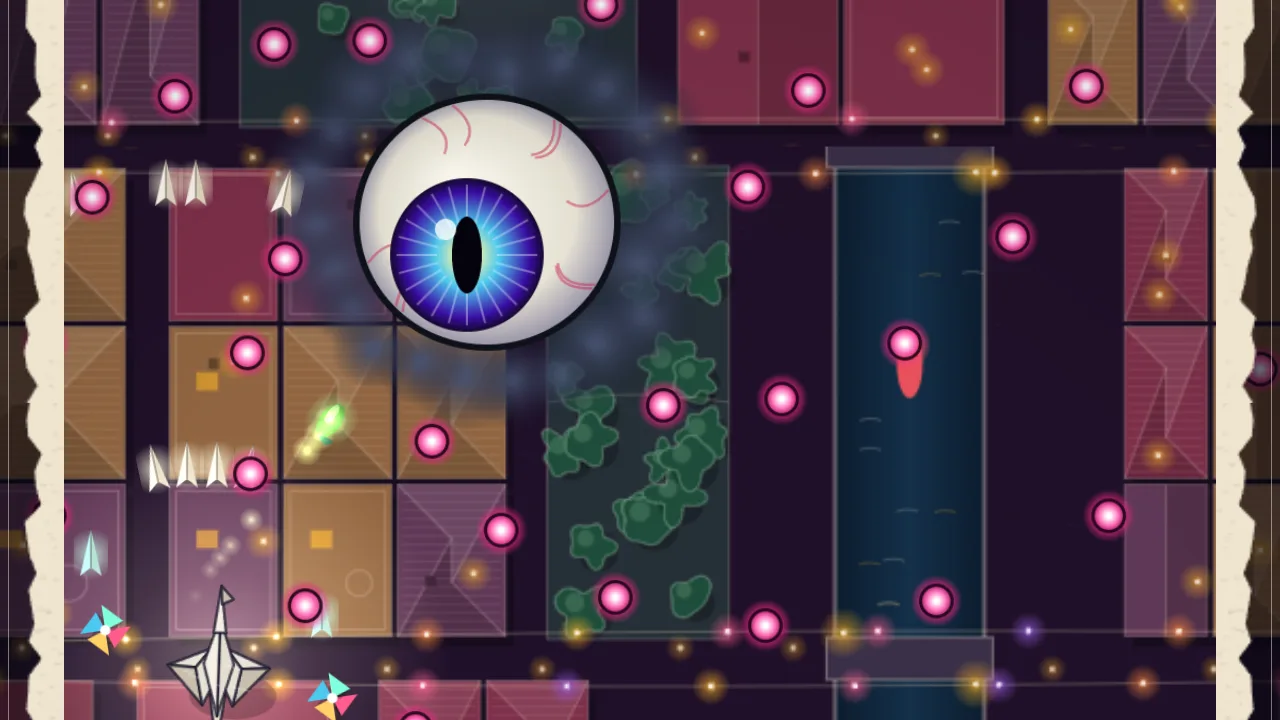
A vertical roguelite shooter. An origami bird flies over a top-down night city drawn in ink while living ink blots pour in from a cloud bank. The bird fires on its own; the player steers, dodges the glowing pink ink shots, and collects paint drops and paper scraps. Scraps fill the fold meter, and every full meter offers three upgrade cards, so each flight builds a different weapon. Three waves make a sector, then a boss arrives; every sector moves to a new district (Old Town Roofs, Harbour Cranes, Lantern Market, Storm Belt, Moon Observatory) and the run is endless, with enemies getting tougher and more aggressive each sector. Every kill splashes watercolour onto the city below.
How it's built
- Rules apart from drawing.
core/ is plain TypeScript with no Phaser import: every balance number in one file (config.ts), the run simulation stepped at a fixed 60 Hz from a seed (run.ts), the profile with the workshop, birds, missions and the first-flight-of-the-day bonus (profile.ts), and a bot (pilot.ts). The same seed always plays the same run, which the tests rely on. - Enemies. Blots drift and sway (and from sector 2 some spit one drop on the way down), Splitters break into two Blots, Spitters stop near the top and fire aimed fans after a visible swell, Dart Bats hover, show a dashed aim line and dash, and Ink Eels are chains of segments that follow the head's recorded path; cutting a segment hands the path to the next one. Elites have a gold-leaf rim, triple health and four times the reward. A spawn budget grows with the sector and the wave, and expensive kinds are held until the budget can afford them so they still appear.
- Bosses. Octoblot sways at the top firing ring bursts, aimed fans and tentacle sweeps; the Ink Wyrm loops across the screen with twelve armoured segments that block shots while its head sprays a spiral; the Storm Eye marks lightning lanes a second before they strike, then spins a bullet flower. Its iris follows the bird.
- Cards. Sixteen cards with five levels each: parallel streams, angled fans, piercing, ricochet to the next target, fire rate, damage, homing seed missiles, orbiting drones that shoot, burning hits, chain lightning on every eighth volley, a shield that recharges, extra hearts, pickup reach, paint bonus, exploding kills and speed. Common, rare and epic cards are weighted 70 / 26 / 6, cards already taken are a little more likely so builds can grow, and a boss always drops a draft that favours rare and epic cards.
- Skill tools. A Fold Dash (Space, Shift, right click, a second finger or the Dash button) throws the bird 170 px in 0.17 s with no damage taken and a 2.4 s cooldown. Shots that pass within 26 px of the hitbox count as grazes: a few points and ink. Kills add a little ink too; a full meter fires a Paint Storm, a watercolour wave that turns every ink shot into a paint drop and hits every enemy (bosses lose 7 %). A Golden Blot may appear once a wave: it zigzags in, waits and flees after 6.5 s, and pays a pile of paint and a boss-grade card draft. Bosses below half health rage and attack 45 % faster.
- Game feel. Hit-stop on elite kills, slow motion on Golden Blots, Paint Storms and boss kills, shockwave rings, numbers that pop out, a paper contrail behind the bird, dash afterimages, combo callouts at ×2, ×3 and ×4, a red pulse on the last heart and short vibrations on phones. None of the hit-stop, slow motion, shake, flashes or vibration happen under reduced motion.
- Fairness. The bird's hitbox is a 7 px circle inside a 60 px sprite, enemy shots are the brightest thing on screen, every attack is telegraphed, a hit clears nearby shots and gives 1.4 s of invulnerability, and the fold meter, hearts and shield are always visible.
- Economy. One currency, paint. Kills pay
value × 0.13 × (1 + 0.35 × sector), bosses pay more, missions pay a reward that grows with their tier, and the first flight of each day pays double. Six workshop upgrades cost base × 1.6^level (Paper Weight, which adds whole hearts, grows by 2.6 per level); three more birds unlock by sector reached and cost 2,500, 7,000 and 16,000 paint. - Balance.
core/balance.test.ts plays whole careers with the bot, which re-plans only every 14 frames to stand in for human reaction time, picks cards by a fixed priority and spends paint on a new bird as soon as it can, else on the cheapest upgrade. It checks that the first flight buys one to three upgrades, that a purchase never takes more than four flights, and that everything takes hours: the bot finishes the workshop and the birds after about four hours. A fresh bird lasts about two minutes and usually dies at the first boss; a fully upgraded one reaches sector 6 to 8 in about fifteen minutes. - Art painted in code. Every sprite is drawn on 2D canvases at twice the display size and uploaded as a texture: the birds as folded paper with lit and shaded facets in four wing-flap frames, the ink creatures as glossy wobbly blobs with drips, eyes and a coloured rim so they read on the night city, the bosses, darts, seeds, drones, paint drops, scraps and watercolour splats (white, tinted at runtime). The city is a seamless top-down map per district: blocks of buildings with hipped, gabled, flat or domed roofs in night-muted colours, cast shadows, lit windows, parks, plazas with fountains, a river with bridges, a harbour with piers and boats, and lantern strings in the market. Two variants alternate on a two-tile period so the scroll never visibly repeats a seam.
- Phones and desktops. The play area is a fixed 540 × 960 column scaled to fit; on wide screens the city carries on at the sides behind torn paper edges, and on tall phones a cloud bank covers the extra space so enemies emerge from it. Touch uses relative drag (the bird moves with the finger's travel, never under it), the mouse is followed directly, and WASD or the arrows work too. Interface text is DOM, sized for thumbs.
- Performance. Darts, shots, drops and particles reuse pooled sprites; the particle count is capped (lower on the low quality tier and under reduced motion); the canvas resolution is capped at 2× and drops to 1× on the low tier; the game sleeps when the tab is hidden or the page scrolls it out of view and pauses itself.
- Districts feel different beyond their colours: fireflies over the Old Town, gulls and sea mist at the Harbour, paper lanterns rising over the Lantern Market, rain and blue lightning in the Storm Belt, twinkling stars and shooting stars at the Moon Observatory. Enemies are kept inside the play column (only dashing bats may leave it).
- Sound and music are generated with Web Audio. Effects: paper flicks, ink pops, a pickup chime that climbs the scale, boss rumbles. Music: a look-ahead sequencer plays a four-chord loop in each district's own key (A minor, D dorian, E phrygian, C minor, F lydian): a calm pad and arpeggio on the menu, bass and drums during a flight, faster with sixteenth-note hats in boss fights. Both are on by default, start on the first tap or key press, and have their own switches (M for sound, N for music).