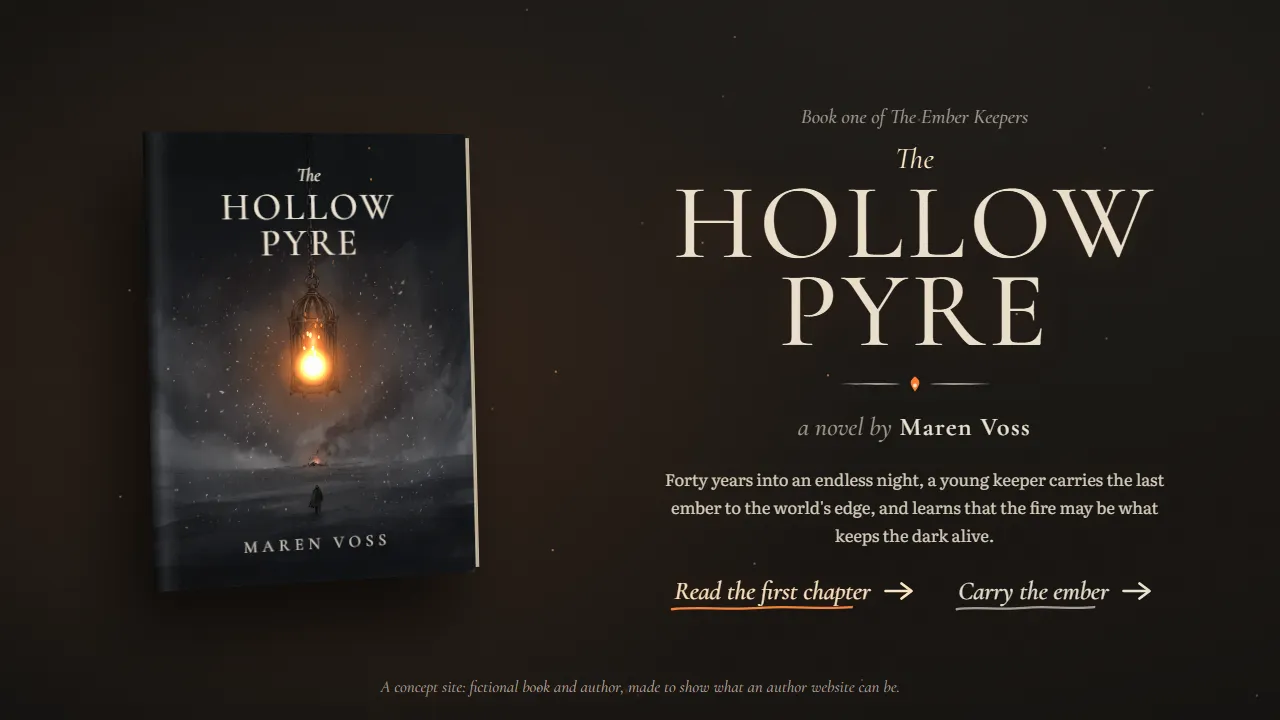
A book site for The Hollow Pyre, a fictional dark-fantasy novel by Maren Voss, a fictional author. It is a concept: it shows what an author website can be, with the parts a real one needs (the book first, a sample chapter, store buttons, a newsletter and a press kit) and a little of the book's world around them. There are no reviews or quotes, because the book does not exist.
Design
The page is set like an illustrated edition rather than a landing template: soot-dark paper with a fixed grain and vignette, bone ink, and one ember. The hero is the book as an object (turned slightly, spine shadow, page block on the fore-edge) beside a centred title page; the concept note sits under it as an imprint line. Each section has its own rhythm: a narrow centred premise, a map spread with a large italic title, full-bleed painted vistas with running heads and folios, staggered engraved plates of different sizes, a printed page with a deckle edge, a wide band for the game and an asymmetric author spread closed by a colophon. Links and buttons are italic words on a brushed ink underline with the page's own arrow; ornaments (fleuron, page corner) are drawn SVG.
Page
1. Hero. Title, series line, pitch and two calls (the first chapter and the game), the cover beside them, and a "Concept site" label that never leaves the first screen. 2. Premise. The blurb, lit word by word as it passes through the screen; the fire words take the ember colour. 3. The road. An inked map in SVG; scroll draws the road and carries a lantern along it, lighting each region as it passes. Four region panels follow, and each one repaints the whole page (CSS variables on the example root) while it is in the middle of the screen and has one small interaction: hold the Ashfield cage to tend the ember, breathe on the Frost Hollow ice, ring the Bellmire bell, stir the heart of the Pyre. 4. Characters. Four painted portraits set as book plates of different sizes, each with a plate number and caption; the caption button lays a paper leaf over the plate, hinged at its left edge like a turned page. One is open at a time. 5. First chapter. About 560 words of original prose in Literata at a 36 em measure, with a drop cap and a small-caps first line. Reading time is computed from the word count (200 words a minute). Three text sizes and three themes (Night, Ash, Paper) are saved in localStorage; a progress line on the left follows the reading. 6. Carry the ember. The reader bonus: a looping CSS vignette of the keeper in the swarm (no game code), three facts about the real game and one link to /games/ember-swarm/. 7. Author. Bio, store buttons, press kit and newsletter, each stated as a demo in text: store buttons are aria-disabled and go nowhere, press kit cards are not links, the form checks the address and says nothing was sent (no request is made).
Details
- Ember. One Canvas 2D layer over the hero, no library. The flame is layered (a halo, a warm body, a tongue that stretches with a never-repeating flicker made of a few incommensurate sines and leans against the motion, a white-hot core), with heat shimmer rising off it, up to 140 sparks drawn as short streaks that inherit part of the ember's velocity and cool from gold to red, and loose embers drifting up across the whole first screen. Glows are pre-rendered into sprites and particles live in typed arrays, so a frame allocates nothing. The ember eases after the mouse, flies to a tap on touch and rests in the cover's lantern (
coverLantern); its position is handed to the title page as two CSS variables, and the title's glyphs are painted with a radial gradient clipped to the text, so the type warms where the fire passes. It runs only while the hero is on screen and the tab is visible, at a device pixel ratio of at most 2. - Weather and the living flame.
Particles.ts gives each region painting its own weather on one small canvas: wind-blown ash in Ashfield, falling snow in Frost Hollow, pale mist motes in Bellmire, and embers rising from the Hollow Pyre with a living flame of three swaying tongues over its core. Each canvas runs only while its region is on screen. - Cursor. On mouse and trackpad only (
Cursor.tsx), a small lantern glow trails the pointer through GSAP quickTo, sheds pooled sparks as it travels, grows and names the action over anything marked data-hp-act (Read, Play, Hold, Breathe, Ring, Stir, Open, Join, Demo), dims over running text and steps aside over text fields, where the native cursor returns. It looks again at what is under it after a scroll. Not mounted on touch screens or under reduced motion; focus rings are unchanged. - Scroll moments. Scrubbed by ScrollTrigger, transforms and opacity only: the region paintings drift slower than the page, the road draws as the lantern walks it, character plates turn in like pages hinged at the left edge, the chapter page settles onto the desk, and the author spread opens from its spine (
useScrollMoments). - Screens. Below 880 px tall the first screen tightens (cover and title sized from the viewport height) so it fits a 1280 x 720 laptop whole; from 1800 px wide the type, measures and art grow (body text, titles, reader text up to 1.35x at 2560) so a 2K screen has no tiny text or empty bands; phones get single-column plate captions and roomier taps.
- Bell. One toll synthesised with Web Audio from nine inharmonic bell partials, each with its own decay, through a low-pass filter. The audio context is created on the first press of the bell, never before, so nothing can autoplay; a mute button keeps the rings and lights without sound.
- Map. The road path uses
pathLength="1", so scroll progress maps straight to stroke-dashoffset; the lantern is placed with getPointAtLength, and each region lights when the lantern passes the nearest sampled point to it (no MotionPath plugin). - One entrance.
useRise lets [data-rise] blocks soak in once, like ink into paper (out of focus to sharp); it is the only entrance on the page. Vistas drift slightly slower than the page (ScrollTrigger scrub, off under reduced motion), and a few CSS sparks cross three section seams (hidden under reduced motion). - Cost. Interactive marks ripple with a transformed ring (no animated shadows), the vistas fade into the page with gradients instead of masks, and the game band and author spread use
content-visibility: auto. - Images. The cover, the four region paintings, the four character portraits and the author portrait were generated with Google Flow (Nano Banana) for this fictional concept; they show invented places and people.
node scripts/convert-hollow-pyre.mjs turns the 2K PNGs in art/hollow-pyre/**/out/ into WebP (regions 2000 px wide, cover 1400 px tall, portraits 1000 px wide, each with a -sm size for srcset, all under 250 KB; the Bellmire border is trimmed) and prints the slot values for data.ts. Every slot has its focal point, and each region its interactive mark, measured on the painting. The region frame keeps each painting's own aspect ratio, so the marks stay on the cage, the far lantern, the drowned bell and the core; on phones the frame slides so the mark sits mid-screen. Only the cover loads eagerly. The code-drawn SVG scenes and engraved plates in Placeholder.tsx remain as the fallback for an empty slot. - Fonts. Cormorant Garamond (titles), Literata (the chapter) and Hanken Grotesk (interface), all SIL Open Font License, through
next/font/google without preload. The page reports ready once they load, capped at 4 s. - Accessibility. Every control is a real button or field with a label; cards use
aria-expanded, reader settings and the mute button aria-pressed, the bell and newsletter report through role="status". Text colours in every region palette and reader theme pass WCAG AA (checked in data.test.ts). - Reduced motion. No ember canvas (the cover keeps its own still glow), the premise is shown lit, the map is drawn, regions swap colours without a fade, the bell shows still rings, and nothing rises in.
Round 4
- Loader.
HollowPyreBody is an engraved iron lantern in SVG (chain links, ring, riveted cap, shaded bars lit on their inner edges, heavy base). The ember grows from a coal into a flickering flame whose light spreads over the cage; sparks and ash rise. Under it, the title is set like a half-title page with an ember fleuron, a thin progress rule and a count in Roman folio numerals. On exit the flame flares, a warm light floods the panel and the lantern lifts and dissolves into the hero. Reduced motion: a still lit lantern and a plain fade. - Joins. Region paintings fade into the page over 42 % of their height in the current page colour, the hero fades into the premise, ember seams overlap the neighbouring sections, the page colour eases over 1.8 s, and blocks begin to soak in before they reach the viewport so nothing pops in late.
- Carry the ember. The preview is Ember Swarm's own card clip (
/lab/ember-swarm/card.mp4, poster card.webp) in a forged iron plate with rivets, an ember-lit lower edge and a burnt-parchment tab, plus margin notes in the keeper's hand. The whole frame is one link to /games/ember-swarm/. The clip is muted, preloads nothing until it nears the screen, plays only on screen and is replaced by the still under reduced motion. The main call to action is an iron-plate button with a flame arrow and a plain note that the game is free and runs in the browser. No game code is used.
Round 5
- Page colour from scroll. The road no longer toggles region palettes with a timed fade. The page colour is a pure function of scroll position: night above the road, each region's palette at the centre of its panel, night again once the road is behind, with the four colours (page, text, muted, accent) mixed between neighbouring stops through a smoothstep. A single ScrollTrigger recomputes it on scroll and remeasures the stops on refresh. The road, panels, running heads and the paintings' fades are transparent or use the live colour, so the fade into the page always matches. Measured at 1440 x 900 and 390 x 844, scrolling 150 px at a time, the largest change between frames is 11/255. Under reduced motion it is the same mapping, static at each position.
- Annotations. The two hand-inked arrows in the game section are redrawn with a 2.4 stroke and a full 2.6 head.