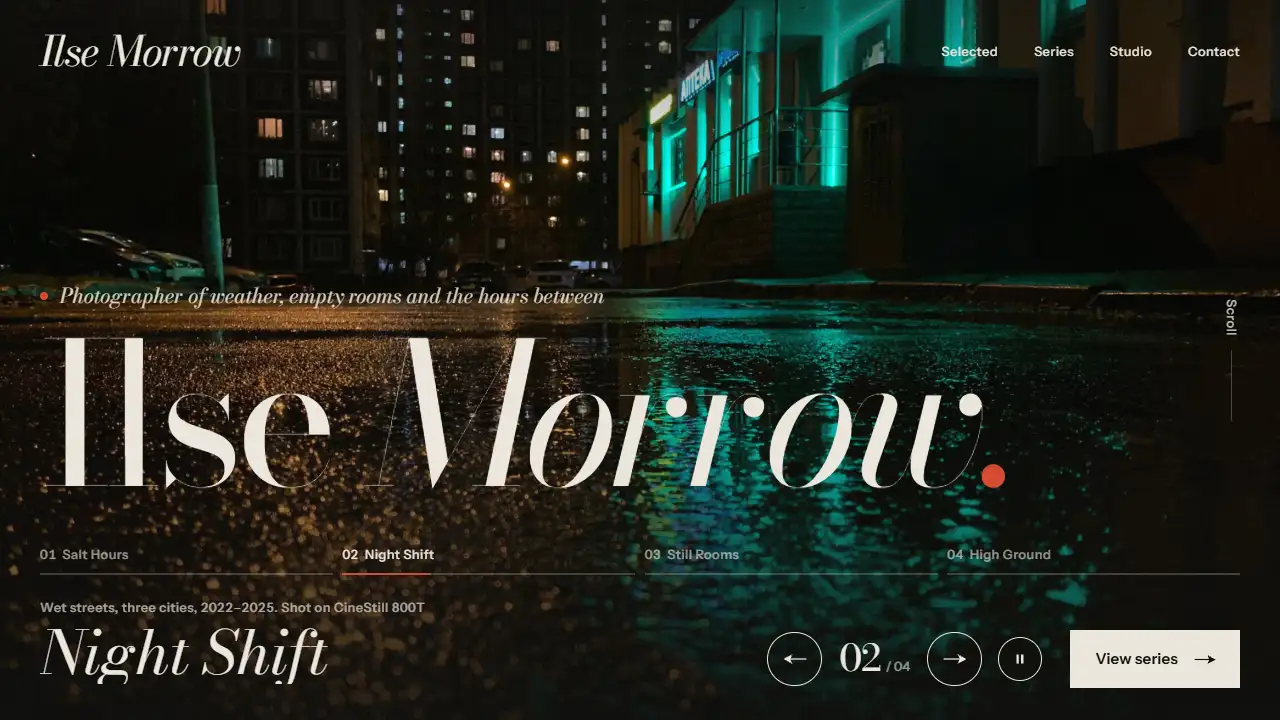
A portfolio website for Ilse Morrow, a fictional photographer (a concept, not a real person). Four series of five photos each: fog on the coast, wet streets at night, empty rooms and mountains above the cloud. The page is built to show photos large and get out of their way: darkroom black, warm paper-coloured type, one safelight red.
Page logic (round 2)
Order of the page and what each step teaches the visitor:
1. Hero states who and what in one line and shows one cover per series. The rail at the bottom teaches that there are four series and that they change by themselves; the buttons and a swipe change them by hand. 2. Selected work (Gallery.tsx) is the strongest twelve frames in one strip. The cursor disc says "Drag", then "View" over a frame, so the gesture is learned on first touch. Big running numbers and a hairline progress bar show position. 3. Series (Series.tsx, route anchor #im-index) is the structure: four chapters, each with a large cover, its title, a one-line note, its five frames and one button. Chapters alternate sides for a steady left-right rhythm. 4. Studio is the only paper-coloured section: a print that stays while a statement develops word by word, then three services. 5. Contact is one large line, a mail link, a demo form and the credits.
Ideas taken as principles from Awwwards photography portfolios (nothing copied): a cursor that names the next action; a horizontal strip with big numbering instead of a hijacked scroll; series chapters led by a large image and a split-text title; one consistent image reveal on every section instead of many different effects; a calm contact-sheet strip per series; restrained, image-first transitions.
Removed because they competed with the photos: the film-edge dividers, the pinned scroll gallery (it trapped the scroll), the cursor-trailing index preview, the pointer parallax on the hero, the studio calendar, the signature stroke and the print sheet in the contact section.
Details
- WebGL image transition. The first screen cycles through one cover per series. Both photos are textures in a single fragment shader written in raw WebGL (no 3D library, about 3 KB of code). A fractal-noise field mixed with a sideways sweep decides which pixels have already changed; near that ragged front both photos are pushed along the noise and split slightly in colour, so the next picture spreads in like ink through wet paper. GSAP tweens one progress value and the canvas only redraws while it moves. Each photo is cropped like CSS
object-fit: cover by a UV scale and a focal centre computed in data.ts (unit-tested), so the crop follows the same focal point as the HTML image. - Fallback. A real
<img> of the current cover sits under the canvas. Without WebGL, or under reduced motion, the canvas is never created and the image simply swaps. The slideshow advances every 6.5 seconds only while the hero is on screen and the tab is visible, and it has a pause button. - One image reveal.
reveal.ts (useReveal) is the only reveal: when a [data-reveal] photo wrapper enters the viewport the image is decoded first (capped at 1.6 s), then uncovered from the bottom up while it settles from a slight push-in; [data-split] headings lift their words out of masks. Reduced motion shows the finished page with nothing hidden. - Focal points. Every photo has
fp (x, y in percent) in data.ts, used as object-position everywhere and as the crop centre in the hero shader, so nothing important is cut on phones or in tall crops. Aspect ratios are reserved from the real file sizes. - Lightbox. A native
<dialog> shows one frame at a time with the series title and note, a thumbnail strip and previous/next. Arrow keys page, Home and End jump, Escape closes, a horizontal swipe pages on touch. The next frame is decoded before it slides in; neighbours are warmed. Smooth scrolling stops while it is open. - Photos. Twenty free-licence photos from Pexels (no attribution required; photographers and pages are in
data.ts and in the credits list in the page footer). Exported from the full-size originals to WebP: 2000 px wide (2400 px for the four hero covers, 2200 px tall for portraits), quality chosen per photo to stay under 350 KB, plus a 900 px -sm size for srcset. Four photos were replaced in round 2 (salt-3, salt-5, night-3, rooms-5) for resolution and a more consistent grade. Only the first cover loads up front; everything else is lazy. - Fonts. Bodoni Moda (a didone with an optical-size axis; display lines at opsz 56, smaller text at 20) and Instrument Sans, both through
next/font/google in fonts.ts, no preload; the page reports ready once they are loaded (capped at 4 s). Class-based size steps live in the CSS module because an unlayered module rule beats a Tailwind utility. - Grain. One fixed layer at 5.5 % opacity, stepped by CSS only (off under reduced motion), plus a still paper tooth on the studio page.