What it is
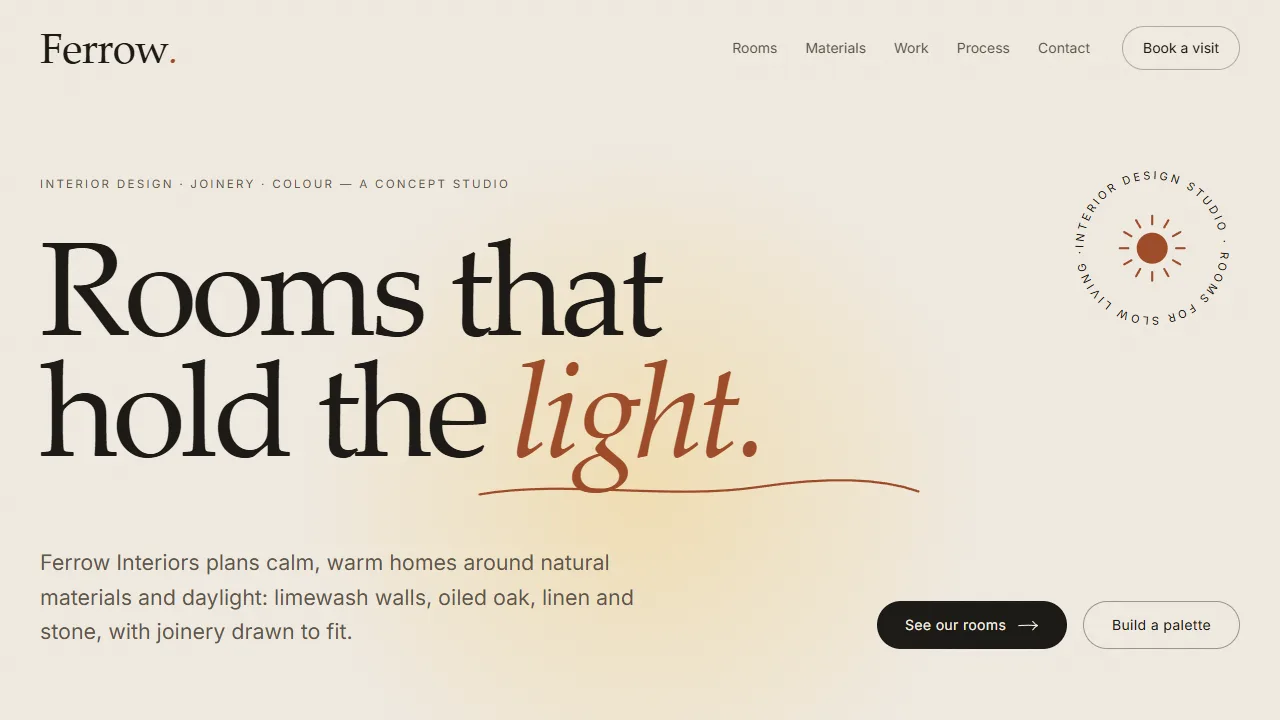
A complete website concept for Ferrow Interiors, a fictional interior design studio. It follows the structure a real interior design website needs (finished rooms, services, process, frequently asked questions and a way to book a first visit) and gives every section a piece of motion that does a job: the hero headline letters tip up into place, a living room builds itself as you scroll, a sideways tour walks through a living room, kitchen, bedroom, bathroom and study, a moodboard repaints a room from material samples, a before/after slider shows the same room transformed, a project index trails an arched preview, service cards tilt under a soft light and a thread sews the five process steps together.
The studio, its projects, places, fees and answers are invented sample content and describe nobody; the contact form sends nothing. Every room is an inline SVG drawn in code; the page loads no images and no extra fonts.
Engineering decisions
- GSAP is the only animation engine. Each section uses
useGSAP with a scope, so its tweens and ScrollTriggers are reverted on unmount or when the reduced-motion preference changes. DrawSVG, Flip and MotionPath are registered in plugins.ts inside this experiment, so they ship only in this page's chunk. - The rooms share one small perspective model (
room.ts): furniture is described as boxes in front-plane units with a depth, and box() returns only the faces a viewer would see in one-point perspective (the top below eye height, the inner side toward the vanishing point). Sofas, shelves, beams, the kitchen island and the bed are all boxes, so every drawing has the same consistent perspective; soft pieces (cushions, the armchair, plants, lamps) are rounded shapes placed with the same projection. - Colours are CSS custom properties (
--r-wall, --r-floor, --r-textile, --r-accent); shading is drawn as translucent black and white over the base colour, so any palette stays lit the same way. The moodboard recolours a room by tweening those four variables. - The room build is a sticky stage inside a tall track (
position: sticky, no pin spacer). One 10-unit timeline is scrubbed across the track: the arch opens to full screen while construction rays draw to the vanishing point, then surfaces, then furniture (each piece arrives its own way: the rug unrolls, the sofa drops, the shelves slide off the wall, the plant grows, the pendant lowers on its cord), then the evening light. The chapter text, the step rail and the clock follow the same timeline, so scrolling back takes the room apart in the right order. - The room tour is a horizontal strip moved by vertical scroll on a sticky stage. Each room is its own ScrollTrigger on the strip's
containerAnimation, which moves the back wall, the furniture and the foreground at three speeds; panels lean with scroll velocity through quickTo. On screens under 768 px the tour is a vertical list whose arches open with a clip. - The manifesto lights up word by word with the scroll; material words get a small swatch that rolls in. The discipline marquee runs on a GSAP loop whose time scale and skew follow scroll velocity and ease back after a fling.
- Moodboard picks are native radio inputs, so arrow keys and screen readers work. The pinned sample flies from the picked swatch to its place on the board with a manual FLIP (measured rects, then
x, y and scale back to zero). - The before/after comparison is a native range input over the drawing; the "after" layer is clipped from its value. The first time it comes into view, the handle sweeps once to show it can be dragged, unless the visitor has already moved it.
- The project preview follows a fine pointer with
quickTo, tilts with the pointer's horizontal speed and recolours to the hovered project's palette. On touch every row shows its own small preview instead. - The process thread is drawn with DrawSVG and a needle rides it with MotionPath (
align and autoRotate), both on one scrubbed trigger. - Service cards set
--mx/--my for a radial light and tilt toward a fine pointer; their line icons draw in on reveal. The FAQ uses buttons with aria-expanded, closed panels are inert, and the height tween is the one layout exception, because the content below has to move. - A cursor ring follows fine pointers and grows into a label over interactive areas ("Pick", "Drag", room names); the native cursor stays visible. Buttons marked magnetic lean toward the pointer.
- All copy is real HTML (headings in order, lists, a form with labels), and the drawings carry text alternatives, so the page reads fully without the motion.
Reduced motion
Under prefers-reduced-motion: reduce there is no smooth scrolling, no letter split and no pointer effects. The room build becomes a finished room above a list of the four steps, the tour is a vertical list, the manifesto is fully lit and the marquee stands still. Moodboard colours, the before/after handle and the FAQ change instantly, the thread is fully drawn without the needle, and the footer wordmark is static.