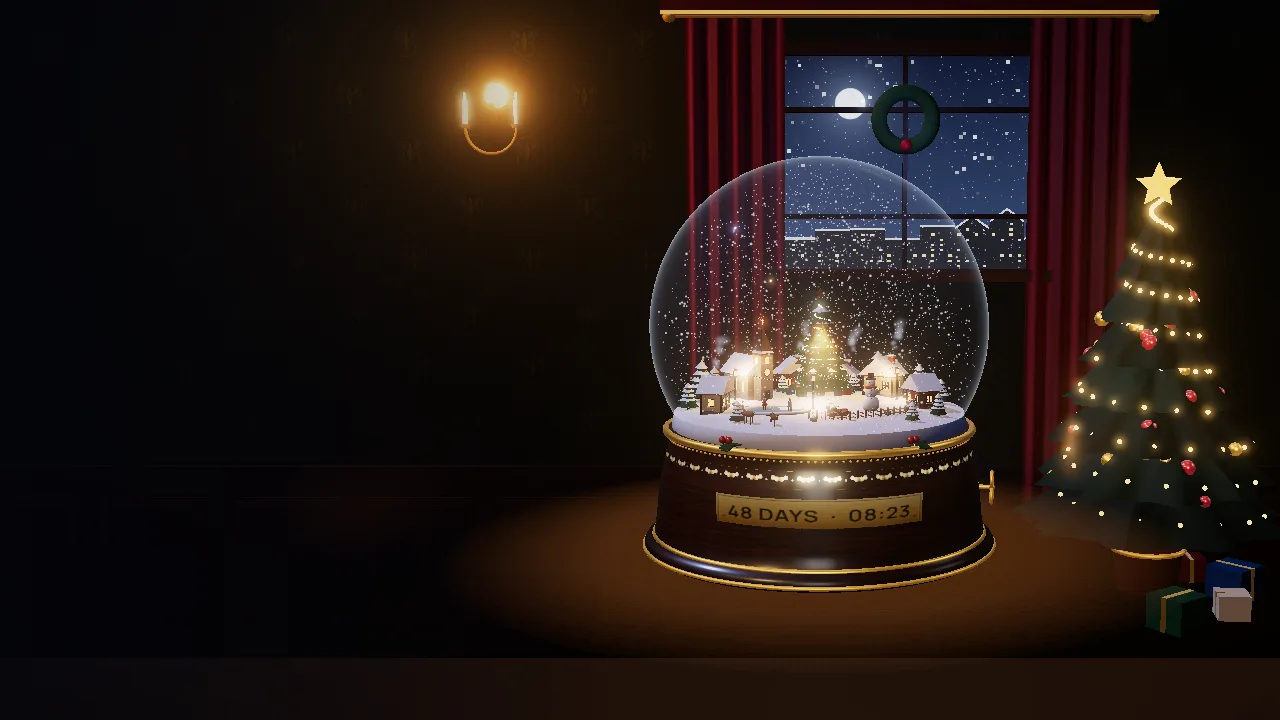
A snow globe drawn with Three.js, with no model files or images: every cottage, icicle, bauble and fence post is generated in code at load time.
The village. Each house is built from boxes and an extruded roof prism, with a thicker snow prism laid over the roof, icicle cones along both eaves, framed windows with mullions and snowy sills, a door with a wreath and, on most, a brick chimney. The chapel, the pines, the big tree with its baubles and presents, the pond, the snowman, the lamps and the picket fence follow the same approach, along with a red lacquered sleigh carrying presents, a bench, two skaters on the pond, a pair of deer by the trees, a stepping-stone path, snowy shrubs with berries and strings of warm bulbs sagging between the lamps. Trees and snowballs get a small radial wobble so they do not look machine-turned. All of it is merged into one mesh per material, so several thousand parts cost about two dozen draw calls.
The snow. Between 2,200 and 5,200 flakes are simulated on the CPU every frame: gravity, drag, a swirl field that rises in the middle of the globe and sinks along the glass, and a little noise per flake. A shake adds energy that decays over about half a minute, lifts settled flakes and gives them a kick; turning the globe makes the liquid lag behind it. Flakes bounce off the inside of the glass and settle on the ground, the roofs, the tree and the snowman's hat once the swirl calms. They are drawn as one point cloud with a small shader that adds a faint six-armed crystal to the bigger flakes.
The base. Turned mahogany with a procedural figured grain (broad light and dark bands, fine streaks), a satin lacquer, three gold bands, a row of gold beads, a gilded holly-and-star frieze, holly sprigs with berries on the rim, a music-box wind-up key on the side, and the engraved brass plaque. Only the interior turns, so the plaque always faces the viewer. The countdown numerals and the plaque use Manrope (thin numerals, solid colour, no blurred text effects); only the date line uses Playfair Display italic.
Glass and light. The glass is clear and drawn straight over the village (a transmission pass filtered and softened everything inside), with reflections from a room environment generated in code (no HDR download) and a fresnel shell for a thin bright rim; soft painted highlights were dropped because they smudged the village. Moonlight casts shadows through the village, the tree and two lamps add warm point light, and a bloom pass makes windows, lamps and fairy lights glow. Bloom is kept low and the flakes small so the village stays crisp. Behind the globe is a room built in code: damask wallpaper, a panelled wainscot, a mullioned window with a wreath, red velvet curtains on a gold rod under a pelmet, a brass two-candle sconce on the left wall, and a tall decorated tree in the corner. The night outside the window (moon, stars, snowy rooftops with lit windows, three layers of falling snow) is one small shader, so it stays crisp. On wide screens the dial sits on the left and the globe fills the height; in portrait the room drops so plain wall sits behind the dial.
The music box. Jingle Bells (Pierpont, 1857, public domain) is played by a small Web Audio synth: each note is a struck tine, a sine with slightly inharmonic overtones, a sharp attack and a long ring, with a low comb note on each bar and a short feedback delay for the wooden box. Notes are scheduled ahead on the audio clock. While it plays, the interior turns steadily like a real music-box globe.
Camera. A slow push-in once the loader lifts, then a slight parallax towards a mouse pointer; neither runs under reduced motion.
The countdown. Pure functions pick the occasion from the visitor's own clock and time zone: Christmas up to and including 25 December, New Year from 26 December to 1 January, then next Christmas. On the day itself the dial greets instead of counting. The plaque on the base is a canvas texture that is redrawn only when its text changes. The logic is covered by unit tests.
Performance. Rendering pauses off screen and in hidden tabs. If frames stay slow for a few seconds, the globe drops to the light tier: no transmission or shadows, a lower pixel ratio and half the snow. Under reduced motion nothing moves on its own; the scene renders only on input, and Shake cuts straight to a frozen snowfall.