Ballet for beginners at home: the five positions and a barre timer
Pick a position and set your own turnout to see the feet from above, then build a short barre routine and follow a count of eight at the tempo you choose. No studio and no experience needed. The free Android app goes further with a 3D teacher you can turn around, slow down and mirror, and classes from 10 to 30 minutes, offline.
Ballet practice at home
Positions from above and a barre timer that counts in eights
Feet
First position première position
Heels together, toes turned out to the sides, both feet flat.
Feel for. Turn out from the hips, not the feet. The knees point the same way as the toes.
Common mistake. Twisting the feet outward while the knees stay forward, which strains the knees.
90 degrees in total, the usual beginner aim. If your knees twist or your pelvis tips, turn out less.
Arms
Low bras bas
The arms rest low and slightly rounded near the hips.
Feel for. Soft elbows, fingers close but not touching, shoulders down.
Third and fourth are left out here: schools place them differently.
Build your barre
5 exercises, both sides, 200 beats: about 2 min 30 s.
A 3D teacher that never gets tired
This page shows positions from above and keeps the count. The Android app adds a 3D dancer you can watch from the front, the side, behind or above, with mirror mode, slow motion and alignment guides, plus follow-along classes and a 30-day program, all offline:
- A 3D teacher you can turn, slow down from 1x to 0.25x and mirror; camera presets for front, back, both sides, top view and a close-up of the feet
- Alignment guides for knee over toe, turnout angle, level hips and a plumb line, and "show common mistake" demos
- Posture, pulling up and your natural turnout, explained without forcing
- The five positions of the feet and the positions of the arms, each with its own lesson and a top view of the feet
- Barre I steps: plié, tendu, dégagé, rond de jambe, relevé, retiré and port de bras; Barre II and centre steps: fondu, développé, grand battement, balancé, glissade and small jumps
- Follow-along barre classes of 10, 15, 20 and 30 minutes, and a 30-day program with one new step and one short class a day
- Counts and short cues on screen, optional voice counts and gentle piano music; a chair or kitchen counter works as the barre
- A glossary of about 80 French terms with pronunciation, stretches for calves, hamstrings, hips and feet, and a streak with minutes and steps mastered

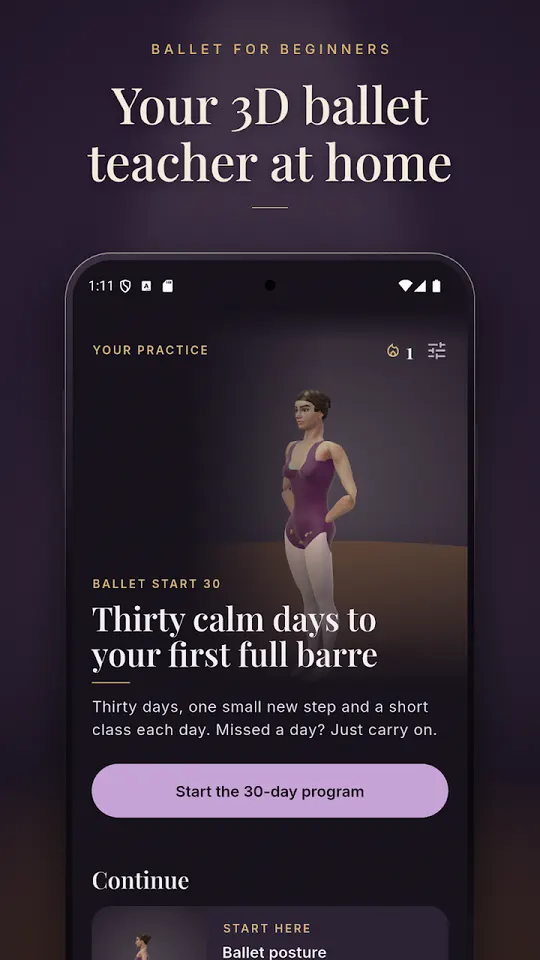
A 30-day program 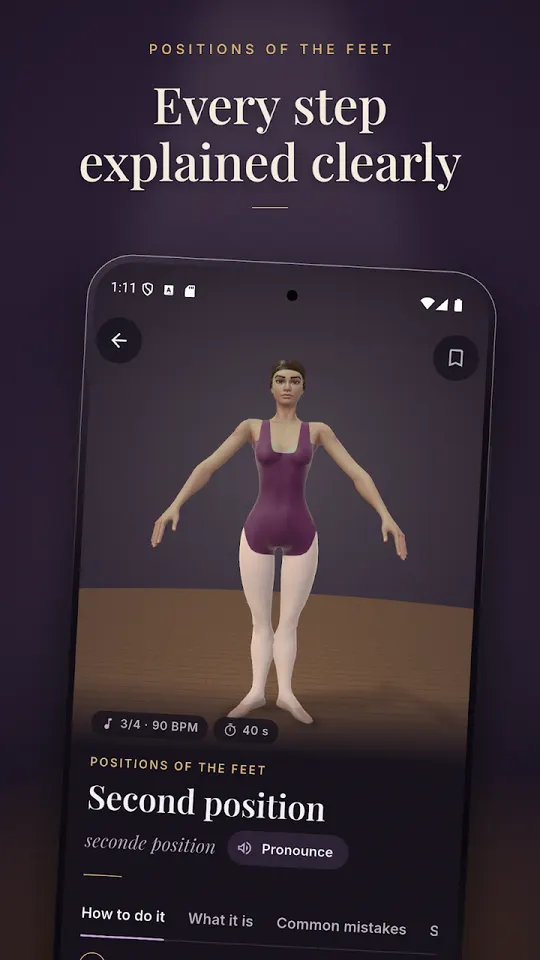
Every step explained 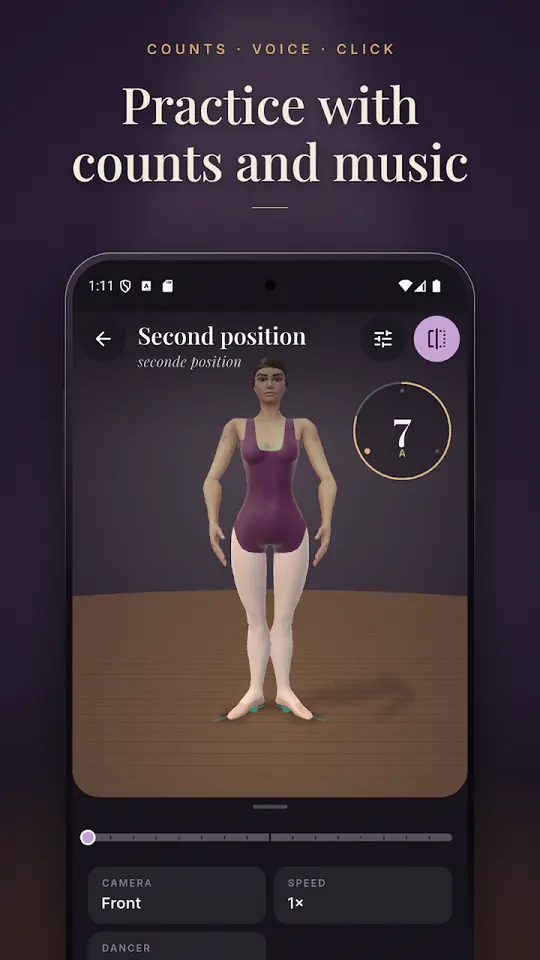
Counts and music 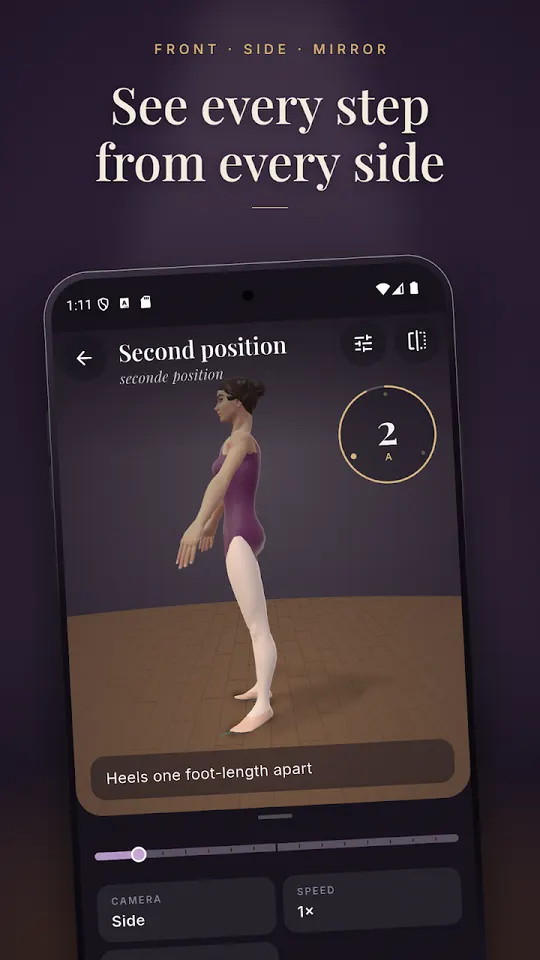
See it from every side 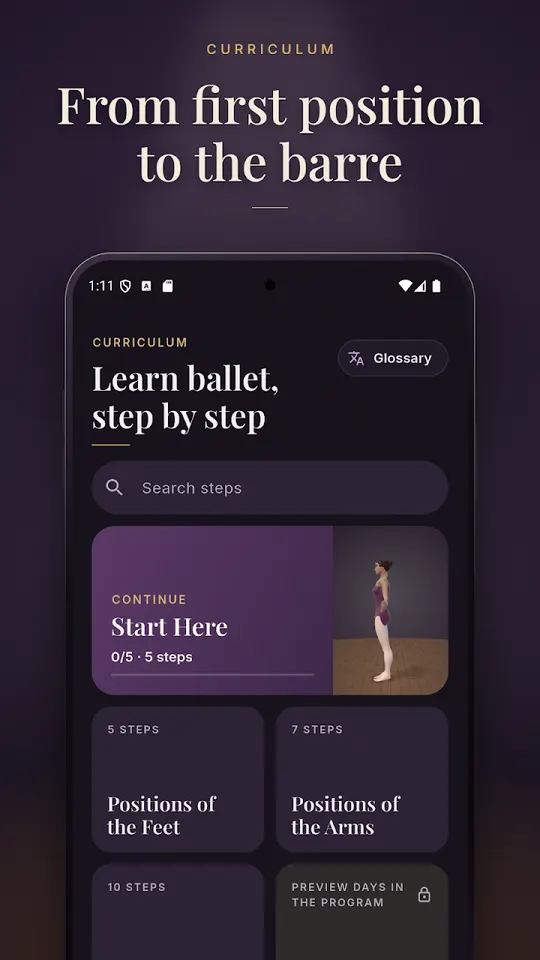
From first position to the barre 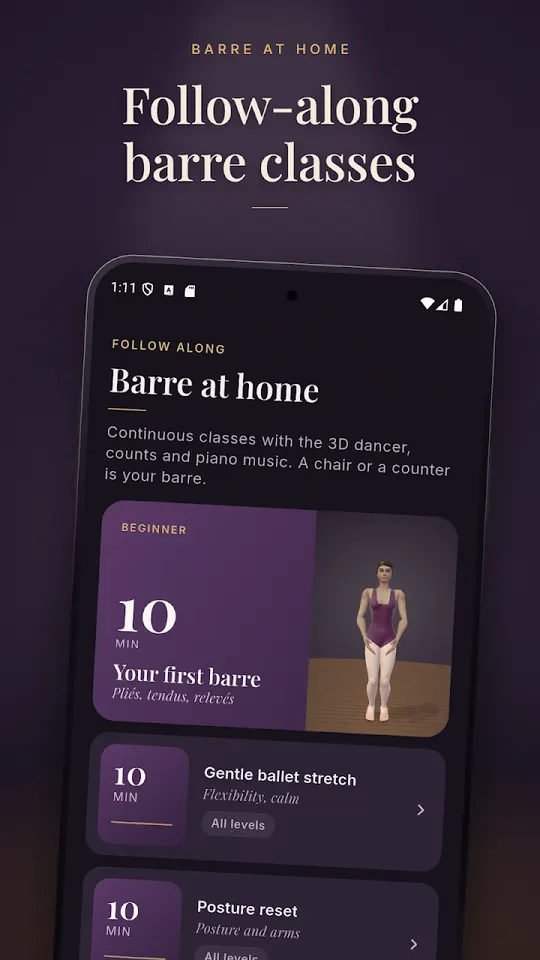
Follow-along barre classes 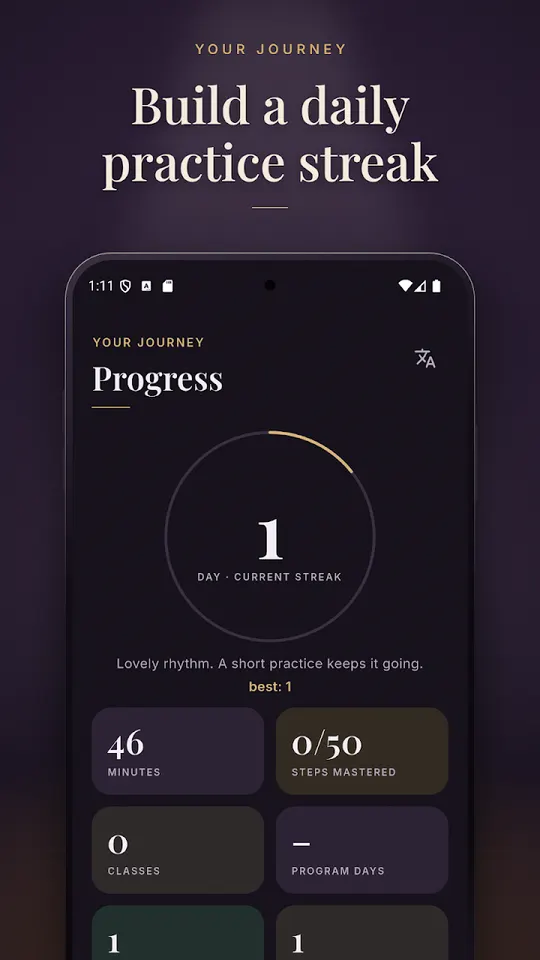
Streak and progress 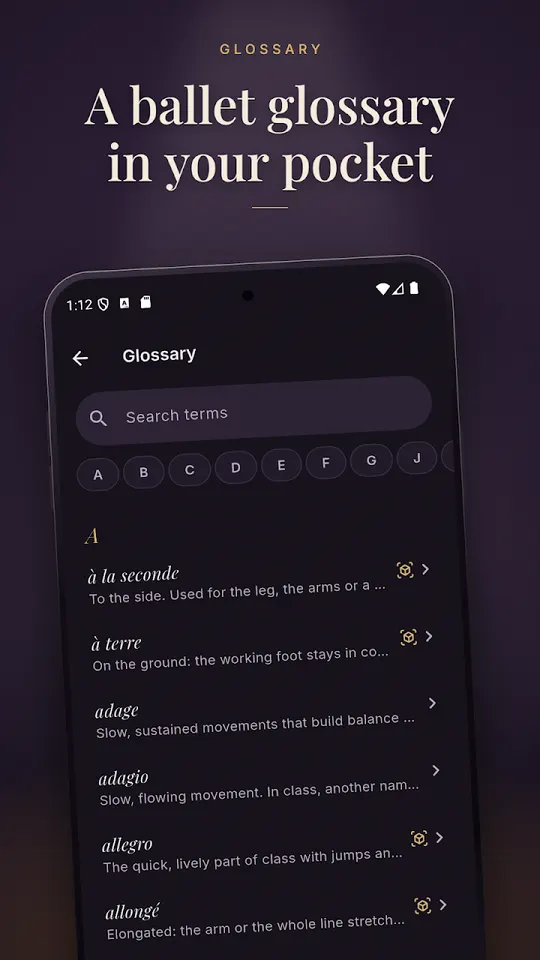
A ballet glossary
The five ballet positions of the feet
Every ballet step starts from one of five positions of the feet. All five turn the legs out from the hips, so the toes point to the sides and the knees follow them. The positions were set down in the 17th century: Pierre Rameau credited their codification to the choreographer Pierre Beauchamp in 1725. The drawings below are seen from above at a 45° turnout for each foot, and the distances are the ones the Wikipedia article gives: about 30 cm (12 in) for the gaps. Change the angle to your own in the tool above.
Beginners often work in first and second position for the first weeks, and in third instead of fifth when fifth does not come without forcing. That is normal and no one is behind: a smaller turnout you can hold is better than a wider one you have to struggle for.
Arm positions, and why schools disagree
Port de bras means the movement of the arms to different positions. The four below are the same in most schools. The third and fourth positions are placed differently in the Russian, French or Royal Academy of Dance and Cecchetti methods, so the tool leaves them out; follow your teacher or your course if you use them.
- Low (bras bas). The arms rest low and slightly rounded near the hips. Soft elbows, fingers close but not touching, shoulders down.
- First (première). The arms are held round in front of the body, fingertips approaching each other. Imagine holding a large ball, with the elbows lifted a little.
- Second (deuxième). The arms extend out to the side, palms and forearms facing forwards. Slightly in front of your shoulders, so you can still see your hands.
- Fifth, overhead (cinquième en haut). The arms are held overhead, slightly rounded. Keep the shoulders low and the rib cage closed, not lifted.
Can you learn ballet at home as an adult?
You can learn the basics at home: the positions, the barre exercises and good posture. What you cannot get from a screen is someone watching you and correcting a twisting knee, so keep to small movements and check yourself in a mirror. A teacher in a studio is the better source for anything beyond the first steps.
- A barre. A barre is a sturdy horizontal bar at about waist height. At home, a firm chair back or a kitchen counter does the same job. Rest your hand on it lightly for balance; do not pull on it.
- Space and floor. A square of clear floor where your feet can slide on a smooth surface. Bare feet or soft ballet shoes are the usual choices.
- Short and often. Ten to twenty minutes a few times a week is easier to keep up than one long session.
Ballet barre exercises for beginners, in a common order
A traditional barre starts with slow exercises and moves to faster ones, which warms up the legs before they work hard. A textbook on beginning ballet puts demi-plié and grand plié first, then battement tendu, and notes that methods order the exercises in a similar but not identical way, and that beginner classes may not follow that order at all. The list below is one reasonable beginner order, not the only one.
| Exercise | Set | What it is | Think of |
|---|---|---|---|
| Plié plié | I | A smooth, continuous bend of the knees outward, with the upper body upright. | Knees over the toes, heels down, back long. |
| Tendu battement tendu | I | The working foot slides along the floor to a fully pointed position and back. | The supporting leg stays still and tall. Stretch the foot through the floor. |
| Dégagé battement dégagé | I | The working foot brushes off the floor to a point in the air, at 45 degrees or lower. | A quick, light brush. Do not lean away from the working leg. |
| Rond de jambe rond de jambe à terre | I | The working foot draws a half circle on the floor, outward (en dehors) or inward (en dedans). | Keep the hips level. The leg moves, the pelvis does not. |
| Relevé relevé | I | A rise onto the balls of the feet, usually after a plié. | Push up through the whole foot and lower slowly with control. |
| Fondu fondu | II | A lowering of the body by bending the knee of the supporting leg. | Melt down and rise again with the same speed. |
| Frappé battement frappé | II | The working foot extends out from the ankle of the supporting leg. | Quick out, a little slower in. Keep the thigh still. |
| Développé développé | II | The leg is lifted to the ankle or knee and then fully extended outward. | Hold only as high as you can with level hips. Low is fine. |
| Grand battement grand battement | II | A large, controlled swing of the straight leg up and down. | Keep it low and controlled at first. The standing leg stays straight and strong. |
The timer in the tool counts each exercise in eights on both sides at the tempo you choose, with four “get ready” beats before each one. It is a metronome with a name, not a lesson: it does not show you how to do the step.
How much turnout is safe?
Turnout is rotating the hips, legs and feet outward. A dance-health article reports that turning the feet and legs out further than the hips allow is the most common cause of dance injuries: the extra rotation goes into the knees, lower legs and feet, and tilting the pelvis to gain turnout raises the risk of low back pain. Its advice is to turn the feet and knees out only as far as your hips allow, and to work on hip movement with stretching and strengthening rather than forcing it. The page does not name the study behind this, so treat it as general advice, not a measured limit.
In practice that means:
- Keep each knee above the line of its toes in every plié.
- Never twist the feet to a position the hips cannot reach.
- If the pelvis tips forward to hold a position, turn out less.
Stop straight away if
- Something hurts, in the knees, hips, feet or back.
- Your knees twist or your arches roll in to hold the turnout.
- You feel dizzy or short of breath.
If you have an injury or a health condition, ask a doctor or physiotherapist before you start. This guide is not medical advice and does not replace a teacher.
Ballet terms for beginners
Ballet words are French. These are the ones in this guide: the positions, then the barre exercises.
- première position: first position of the feet.
- deuxième position: second position of the feet.
- troisième position: third position of the feet.
- quatrième position: fourth position of the feet.
- cinquième position: fifth position of the feet.
- plié: A smooth, continuous bend of the knees outward, with the upper body upright.
- battement tendu: The working foot slides along the floor to a fully pointed position and back.
- battement dégagé: The working foot brushes off the floor to a point in the air, at 45 degrees or lower.
- rond de jambe à terre: The working foot draws a half circle on the floor, outward (en dehors) or inward (en dedans).
- relevé: A rise onto the balls of the feet, usually after a plié.
- fondu: A lowering of the body by bending the knee of the supporting leg.
- battement frappé: The working foot extends out from the ankle of the supporting leg.
- développé: The leg is lifted to the ankle or knee and then fully extended outward.
- grand battement: A large, controlled swing of the straight leg up and down.
Sources
Questions
What are the five basic ballet positions?
Five positions of the feet, all turned out from the hips: first with the heels together, second with the heels about 30 cm (12 in) apart, third with the front heel near the arch of the back foot, fourth with one foot about 30 cm in front of the other, and fifth with the front heel against the big toe of the back foot. The arms have their own positions too.
Can I learn ballet at home by myself?
You can learn the basics: the positions, simple barre exercises and good posture. Go slowly, check your knees in a mirror and keep movements small. A screen cannot correct you, so a teacher is better for anything beyond the first steps.
Is it hard to learn ballet as an adult?
Ballet asks for patience more than flexibility. Start with the positions and a few barre exercises, keep sessions short and never force a position your hips do not reach.
Do I need a barre at home?
No. A barre is a sturdy bar at about waist height, and a firm chair back or a kitchen counter does the same job. Rest your hand on it lightly for balance.
How much turnout should a beginner have?
As much as your hips give you without twisting the knees or tipping the pelvis. About 45 degrees for each foot, 90 in total, is the usual aim, and less is fine. Forcing the feet out further than the hips allow is a common cause of dance injuries.
What order do barre exercises go in?
Slow ones come first and faster ones after. A common beginner order is plié, tendu, dégagé, rond de jambe and relevé, then fondu, frappé, développé and grand battement. Methods and teachers order them a little differently.
Is the Ballet for Beginners app free?
Yes. It is free with ads and works offline without an account. Ads never interrupt a class, one short video removes them for 10 minutes, and the basics, barre classes up to 20 minutes and the glossary are always open.
Learn ballet at your own pace, at home
Free on Android. Works offline, no account. Ads never interrupt a class. Not a replacement for a teacher or medical advice.
Facts from the Google Play listing, last checked .