Line dance steps for beginners, count by count
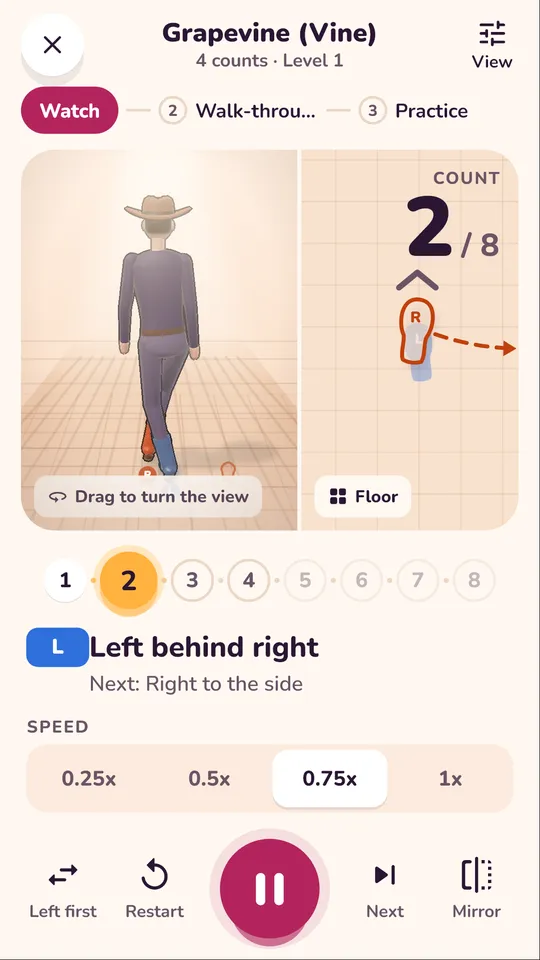
Pick a step, press play and watch the feet move on the floor, one count at a time, at half speed if you like. Coral is your right foot, blue your left, and a filled foot carries your weight. The same 33 steps, with a 3D dancer, routines and a 4-week plan, are in a free Android app.
0/ 4
Ready: weight on the left foot
Next: R Right to the side
Side, behind, side, touch: the classic vine.
Watch for: Crossing the left foot in front instead of behind. On 2 the left goes behind the right, and on 4 it only touches, with no weight.
The full trainer on your phone
The trainer on this page shows the feet. The Android app adds a 3D dancer you can turn around, full routines and a plan that brings steps back just before you forget them, all offline:
- 33 steps from walks and step touches to the sailor step, monterey turn, weave and rumba box
- Animated floor diagram next to a 3D dancer you can rotate to see the step from the front, side or back
- Slow motion at 0.5x and 0.75x, mirror or back view and a wall indicator
- 16 original 32-count routines in 8-count sections you can loop
- Beat counter with adjustable tempo, so you can practise without music
- "Name that step" quiz and a daily mix with spaced repetition
- 4-week beginner plan with lighter review days, streaks, a practice calendar and reminders
- Works offline with no account; progress stays on your phone with export to a file; 40+ languages

Lessons count by count 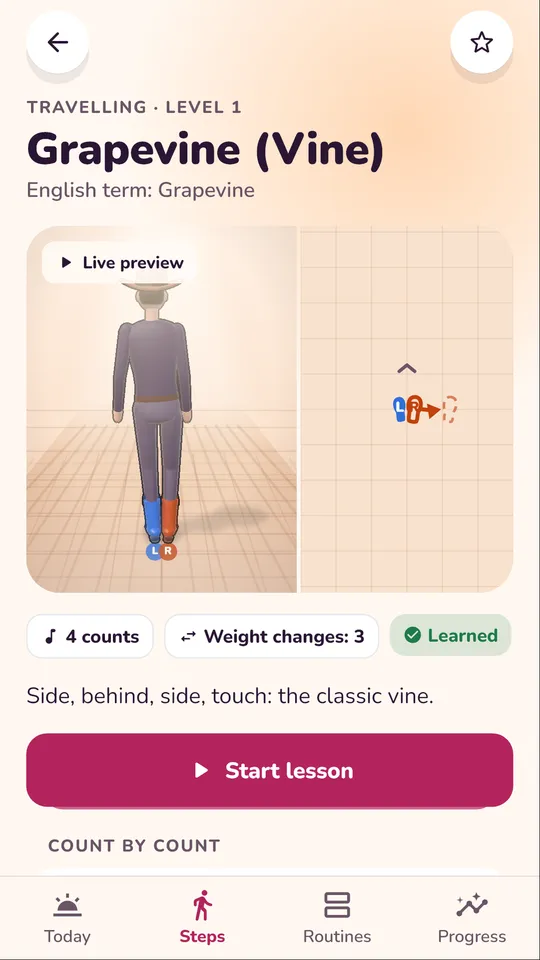
Every step with a live preview 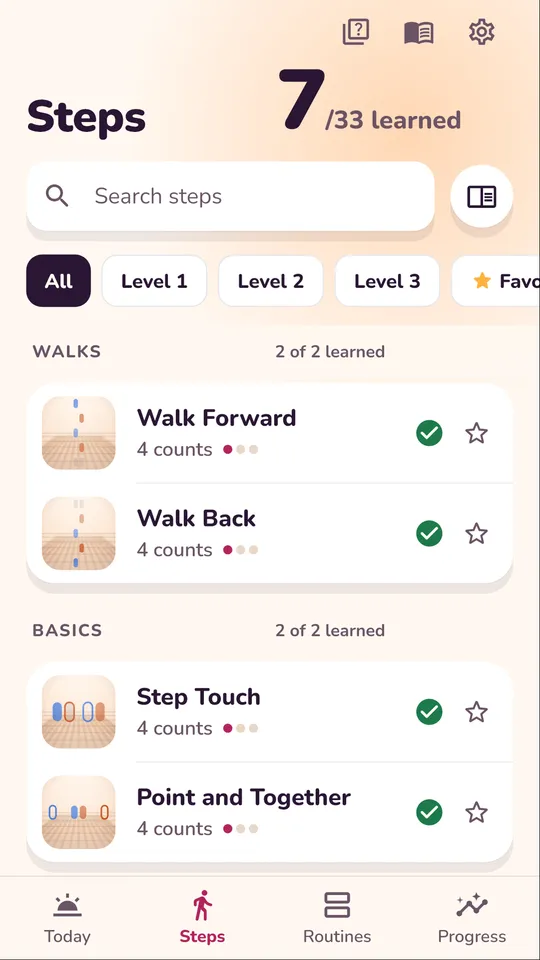
33 steps by level 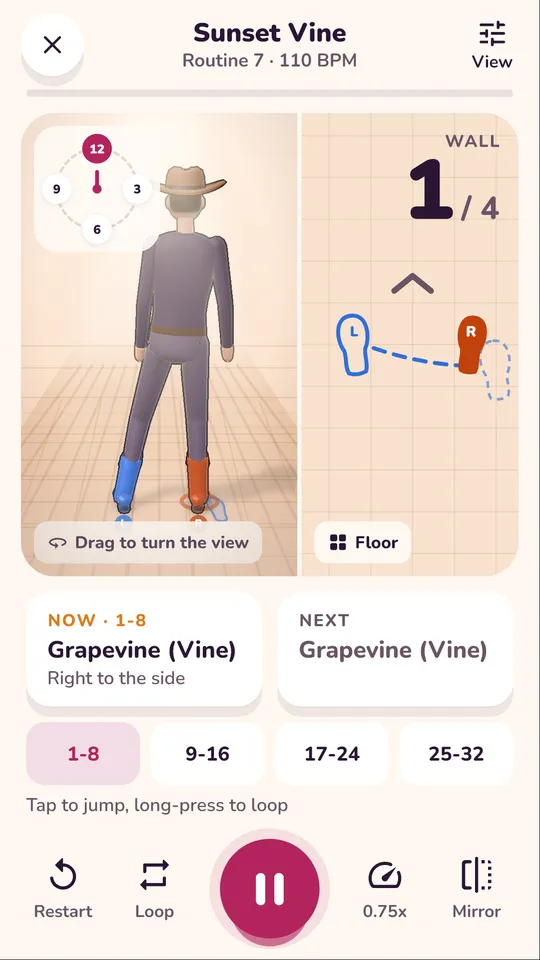
Routines with a wall indicator 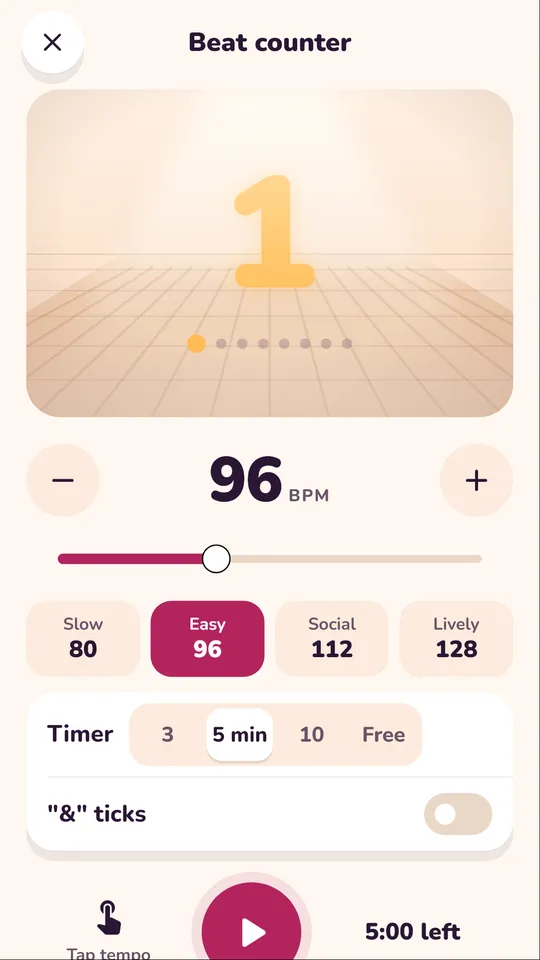
Beat counter 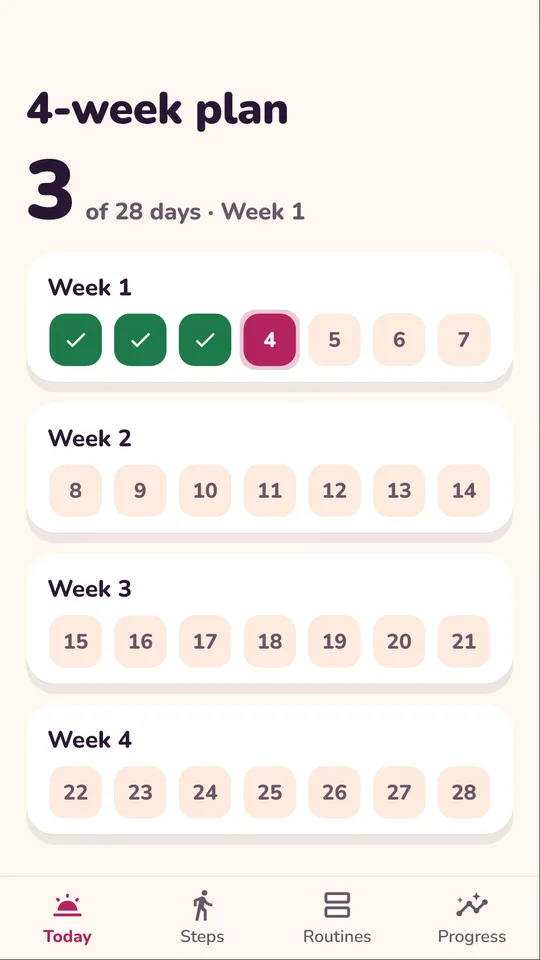
4-week beginner plan 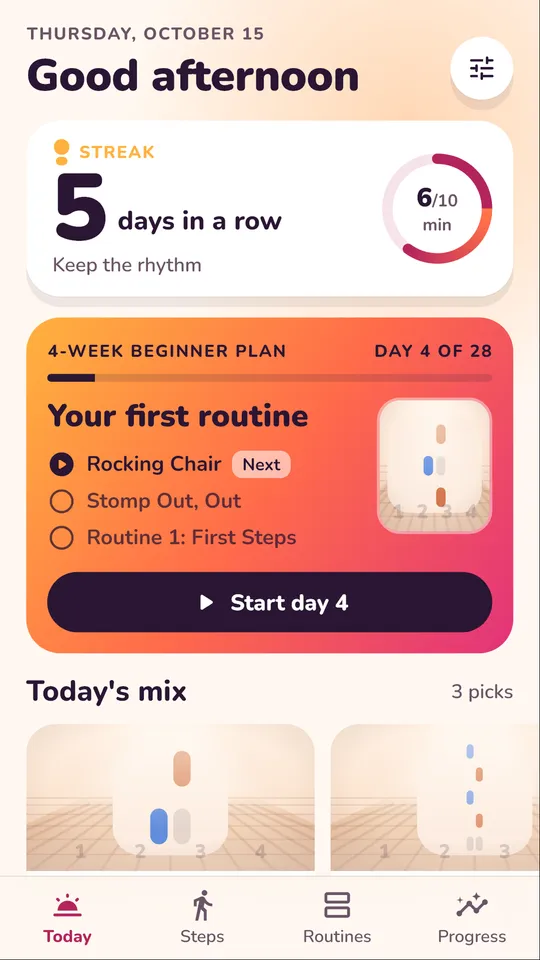
Daily goal and streaks 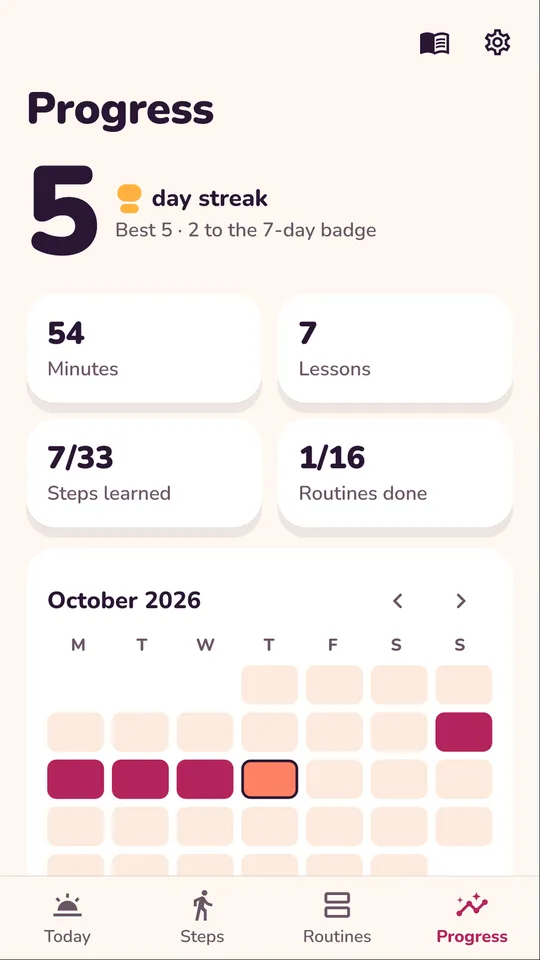
Progress and calendar
How line dancing works: counts, walls, tags
Counts and the “and”
A count is one beat of the music, the steady pulse you would tap your foot to. Most steps take one count per foot change: step on 1, step on 2. Quick steps fit an extra move halfway between two counts, called the “and” and written “&”. A shuffle is right on 1, left on &, right on 2: say it as “one and two”.
8-counts and the count-in
Music is phrased in eights, so dances are built and taught one 8-count at a time. A typical beginner dance is 32 counts, four 8-counts, repeated from the top. Before the music starts a teacher calls “5, 6, 7, 8”: stand still and start on the next 1.
Walls and turns
A wall is the direction you face. Picture a clock on the floor with you facing 12. In a 1-wall dance you start every repeat facing 12. A 2-wall dance has a half turn, so you alternate between 12 and 6. A 4-wall dance has a quarter turn and starts each repeat on a new wall: 12, 3, 6, 9. Look toward the new wall before you turn, so your body knows where to stop.
Tags and restarts
Songs do not always fit the same number of counts. A tag adds a few extra counts at a set point, then the dance carries on. A restart stops partway through and begins again from count 1. The step sheet says where both happen, usually by wall and count, so count your walls quietly as you turn.
Basic line dance steps: names and counts
These are the 33 steps the trainer above and the app teach, from first walks to syncopated turns. Most beginner dances use the first group; pick any step to see it move on the floor diagram.
Diagrams show the feet from above with you facing up: grey outlines are where you start, coral is the right foot, blue the left, a filled foot takes your weight and the number is the count it lands on. Steps are written right foot first.
| Step | Feet | Counts | How it goes |
|---|---|---|---|
| Walk ForwardBeginner | 4 | Four easy walks forward, right foot first. | |
| Walk BackBeginner | 4 | Four easy walks back, right foot first. |
| Step | Feet | Counts | How it goes |
|---|---|---|---|
| Step TouchBeginner | 4 | Step to the side and bring the other foot in for a touch. | |
| Point and TogetherBeginner | 4 | Point a toe out, bring it home, then the other side. |
| Step | Feet | Counts | How it goes |
|---|---|---|---|
| Heel TapsBeginner | 4 | Tap a heel forward, bring it home, swap feet. | |
| Toe StrutsBeginner | 4 | Walk on the toe first, then drop the heel. | |
| Heel SwitchesImprover | 2 | Quick heel taps that switch feet on the "and". | |
| Heel, Hook, Heel, StepImprover | 4 | Heel forward, hook it across the shin, heel again, home. |
| Step | Feet | Counts | How it goes |
|---|---|---|---|
| Rock ForwardBeginner | 2 | Rock your weight forward, then back onto the other foot. | |
| Rock BackBeginner | 2 | Rock your weight back, then forward onto the other foot. | |
| Rocking ChairBeginner | 4 | Rock forward, recover, rock back, recover. | |
| Side Rock and CrossNext level | 2 | Rock to the side, recover, cross over. |
| Step | Feet | Counts | How it goes |
|---|---|---|---|
| Stomp Out, OutBeginner | 2 | Two stomps out to the sides, feet end apart. | |
| Step, ScuffBeginner | 2 | Step forward and brush the other heel along the floor. | |
| Step, HitchBeginner | 2 | Step forward and lift the other knee. |
| Step | Feet | Counts | How it goes |
|---|---|---|---|
| Grapevine (Vine)Beginner | 4 | Side, behind, side, touch: the classic vine. | |
| WeaveNext level | 4 | Side, behind, side, front: a vine that keeps travelling. |
| Step | Feet | Counts | How it goes |
|---|---|---|---|
| Jazz BoxBeginner | 4 | Cross, back, side, together: you draw a small square. | |
| Jazz Box Quarter TurnBeginner | 4 | A jazz box that turns a quarter to the right. | |
| Rumba BoxNext level | 8 | Side, together, forward, hold, side, together, back, hold. |
| Step | Feet | Counts | How it goes |
|---|---|---|---|
| Shuffle ForwardImprover | 2 | Three quick steps forward: step, together, step. | |
| Shuffle BackImprover | 2 | Three quick steps back: step, together, step. | |
| Coaster StepImprover | 2 | Back, together, forward in a quick rocking motion. | |
| Side Shuffle (Chasse)Improver | 2 | Three quick steps to the side: side, together, side. | |
| Lock Step ForwardNext level | 2 | Forward, lock behind, forward: a travelling shuffle. |
| Step | Feet | Counts | How it goes |
|---|---|---|---|
| Kick Ball ChangeImprover | 2 | Kick, step on the ball of that foot, change weight. | |
| Kick Ball CrossNext level | 2 | Kick on the diagonal, ball beside, cross the other foot over. | |
| Sailor StepNext level | 2 | Swing behind, small side, small side: a rocking sway. | |
| Charleston StepNext level | 4 | Touch forward, step back, touch back, step forward. |
| Step | Feet | Counts | How it goes |
|---|---|---|---|
| Pivot Half TurnBeginner | 2 | Step forward and turn half way on the balls of both feet. | |
| Pivot Quarter TurnBeginner | 2 | Step forward and turn a quarter on the balls of both feet. | |
| Rolling VineNext level | 4 | A full turn to the right while you travel sideways. | |
| Monterey Half TurnNext level | 4 | Point, turn half on the supporting foot, point, together. |
How to line dance step by step
- Pick one step in the trainer and press Back view: you follow the dancer from behind, like following a teacher in class, so their right is your right.
- Watch it once at 0.5x. A filled foot carries your weight; an outlined foot is free, and that is the foot that moves next.
- Walk through it with Next, one count at a time, saying the counts out loud. Saying the numbers helps your feet find the rhythm.
- Dance it with the click at 0.5x, then 0.75x, then full speed. If it falls apart, go back one speed. Moving between speeds for a few days is normal.
- Switch to Left first and learn the other side: most steps are danced with both feet in a real routine.
- Join two steps together, then a full 8-count. Learn a 32-count routine one 8-count at a time and give the joins between them extra practice.
Learning line dance at home
- A clear space of about 2 by 2 metres is enough for almost every step. Move rugs, cables and small furniture; many steps travel sideways and back.
- Wear comfortable shoes with a smooth sole. Grippy trainers catch on pivots and socks slip; bare feet are not ideal for turning either.
- Short sessions work best: ten or fifteen minutes most days beats one long session a week.
- Once you know a routine, dance it to music you like at a similar speed. For beginners, songs around 80 to 100 BPM leave time to think about every step.
Easy line dancing for seniors and returning dancers
Line dancing suits any age because nobody needs a partner and every step can be made smaller. Start with walks and step touches as a warm-up, keep kicks low and take turns slowly. Have something steady nearby, like a counter or a sturdy chair. Stop if you feel pain or dizziness, and if you are unsure whether dancing is right for you, ask a doctor before you start.
Line dance terms
- Count
- One beat of the music, the steady pulse you would tap your foot to. Most steps take one count each.
- And (&)
- The halfway point between two counts, written as "&". Quick steps like a shuffle put an extra step on the "and".
- 8-count
- A group of eight counts. Music is phrased in eights, so dances are built and taught one 8-count at a time.
- Count-in
- The "5, 6, 7, 8" called before the music starts. Stay still during it and begin dancing on the next 1.
- Wall
- The direction you face. A 4-wall dance turns you a quarter each time through, so you face all four sides of the room.
- Front wall
- The wall everyone faces at the very start of the dance, usually where the teacher stands.
- Turn
- A change of facing. A quarter turn moves you to the next wall, a half turn has you facing the opposite wall.
- Lead foot
- The foot that starts the dance or a step. In most line dances it is the right foot.
- Free foot
- The foot that is not holding your weight, so it is ready to move to the next step.
- Weight
- Which foot your body rests on. A step puts weight on the foot, a touch or point does not.
- Weight change
- Moving your weight from one foot to the other. Keeping track of it tells you which foot moves next.
- Step sheet
- A written description of a dance, count by count. It lists the steps, walls, tags and restarts.
- Routine (dance)
- A complete sequence of steps that you repeat from the start, usually 32 counts in beginner dances.
- Section
- One part of a routine, usually an 8-count. Learning section by section makes a routine much easier.
- Tag
- A few extra counts added at a certain point to keep the dance in time with the music. Then the dance carries on.
- Restart
- Stopping partway through the routine and starting again from count 1, to match a change in the music.
- Bridge
- Another name for a short extra part of a dance, much like a tag, added to fit the shape of the music.
- Hold
- A count where you do not move. You simply keep your weight where it is and wait for the next count.
- Touch
- Placing the toe or foot lightly on the floor without putting weight on it.
- Point
- Touching the toe out to the side, forward or back, with no weight, then bringing it back.
- Kick
- Swinging the free foot forward from the knee with a low, easy kick. No weight goes on it.
- Hitch
- Lifting the knee up in front of you, with the other foot staying on the floor.
- Scuff
- Brushing the heel forward along the floor as the foot swings past. No weight goes on it.
- Stomp vs stamp
- A stomp puts weight on the foot with a firm step. A stamp strikes the floor but keeps the weight on the other foot.
- Ball
- The front part of the foot behind the toes. In "kick ball change" you step on the ball of the foot on the "and".
- Rock and recover
- Rock: step and shift weight onto one foot. Recover: shift your weight back onto the other foot.
- Shuffle (triple step)
- Three quick steps in two counts, counted "1 & 2". Step, bring the feet together, step again.
- Vine
- Travelling sideways: step to the side, cross behind, step to the side. Also called a grapevine.
- Jazz box
- A square pattern: cross over, step back, step to the side, step forward.
- Pivot
- A turn on the balls of both feet. Step forward, then turn and let your weight move to the other foot.
- Line of dance
- The direction dancers travel around the room, usually counter-clockwise. Mostly used in partner and circle dances.
- Travelling
- Moving across the floor rather than staying in place, such as during walks, vines and shuffles.
Your first class or social night
Join at the back or the middle of a row so you can follow the dancers in front of you. When the dance turns to a new wall, the people who were behind you are now in front, so there is always someone to watch. If you get lost, keep your feet moving gently and join in again at the next 8-count. Keep vines and turns a comfortable size so you do not bump into anyone.
Questions
What are the basic line dance steps for beginners?
Start with walks, the step touch, heel and toe taps, rock steps, the grapevine (vine) and the jazz box. They take one count per move and turn up in most beginner dances. Shuffles, the kick ball change and the coaster step come next, because they add the quick "and" count.
What does "&" mean in line dancing?
The "and" is the halfway point between two counts. Quick steps put an extra move there: a shuffle is right on 1, left on &, right on 2. Say "one and two" out loud while you dance it.
What is a wall in line dancing?
The direction you face. A 1-wall dance always starts facing the front, a 2-wall dance alternates between front and back, and a 4-wall dance turns a quarter each time so you start on all four sides of the room in turn.
Can I learn line dancing at home?
Yes. About 2 by 2 metres of clear floor and shoes with a smooth sole are enough. Learn each step slowly, say the counts out loud and practise ten to fifteen minutes most days rather than one long session.
Is line dancing good for seniors?
Line dancing needs no partner and every step can be danced smaller, so many people start or come back to it later in life. Warm up with walks, keep kicks low, take turns slowly and stop if you feel pain or dizziness. Ask a doctor first if you are unsure.
Does the app teach dances like the Electric Slide or the Cupid Shuffle?
No. The app and this page teach the steps those dances are made of, plus 16 original practice routines. There are no songs or step sheets of named dances, so you can practise to any music you like.
Is the app free and does it work offline?
Yes to both. It is free with ads, has no in-app purchases and needs no account. Ads never appear while you practise a lesson, a routine or the beat counter; a short video turns them off for 10 minutes.

Take the steps with you
Free on Android. Offline, no account, and no ads while you practise a lesson, a routine or the beat counter.
Facts from the Google Play listing, last checked .