Rubik's Cube solver: paint your 3x3 and solve it step by step
Paint the six faces to match your cube, or type a scramble, and the solver below checks that the cube is possible and then solves it layer by layer, one move at a time, on an unfolded net. The free Android app does it in 3D, finds a short solution of about 20 moves and has 16 lessons, offline.
Cube solver
Paint your cube, or type a scramble, then press Solve
Net: top face above; left, front, right, back in a row; bottom below.
- R
- a quarter turn of the right face, clockwise as you look at that face
- R'
- the same, counter-clockwise
- R2
- a half turn
- U D F B L
- top, bottom, front, back, left
Follow the steps in 3D on your phone
This page solves on a flat net with a beginner method. The Android app plays every move in 3D on a cube you can turn, offers a fast solution as well as step-by-step and 2-look modes, and teaches you to solve it yourself, offline:
- Enter your cube's colors on a 3D cube or a flat net, with a counter for every color
- Checks that say what is wrong: wrong count, impossible edge or corner, flipped edge, twisted corner or swapped pieces, and where to look
- Fast mode finds a short solution, usually around 20 moves; step-by-step mode and 2-look mode solve the same cube with the beginner method
- 3D playback with play, pause, step back and forward, speed control and the notation under each move
- 16 lessons with looping 3D demos: notation, the beginner method, 2-look OLL and PLL, and first steps in F2L
- Algorithm library: 2-look OLL and PLL are open; the full OLL (57) and PLL (21) sets unlock with a short video
- Free play cube to scramble and solve with your fingers, and a solve timer with 15 s inspection, +2 and DNF, best, Ao5 and Ao12
- Seven cube themes including a high-contrast one with letters on the stickers; works with any color scheme; works offline with no account

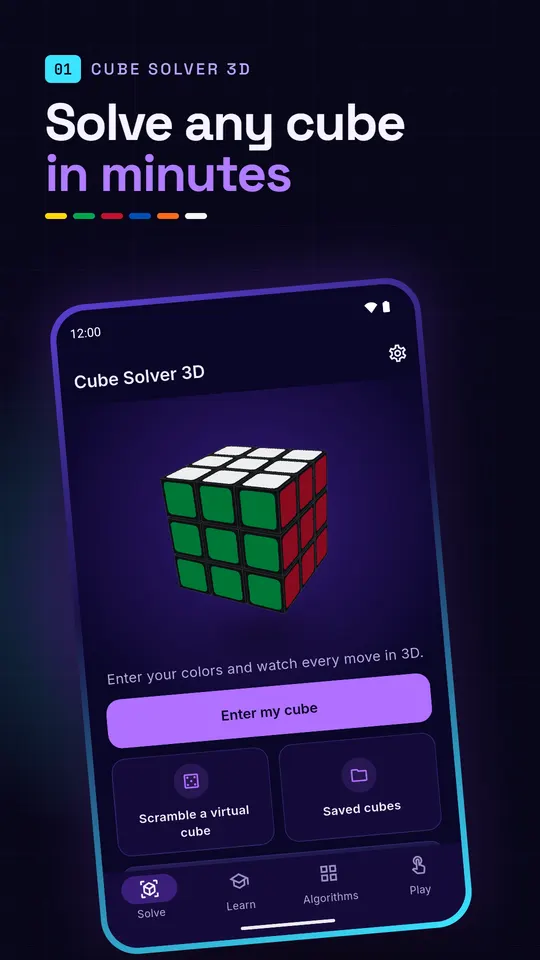
Solve any cube in minutes 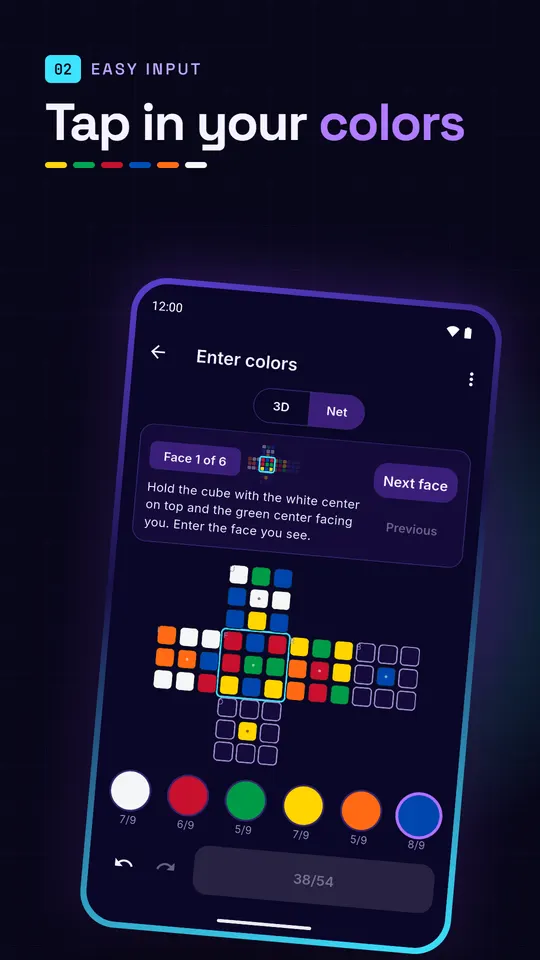
Tap in your colors 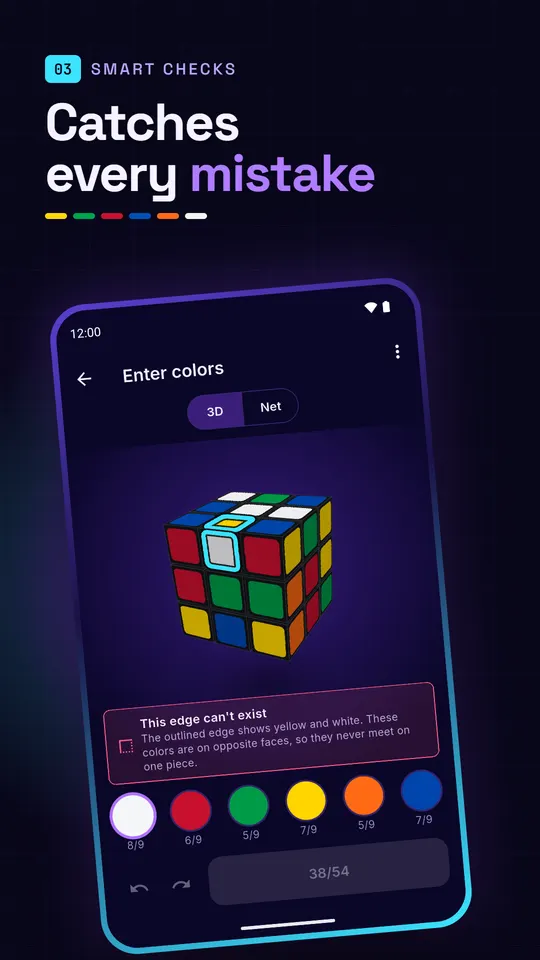
Catches every mistake 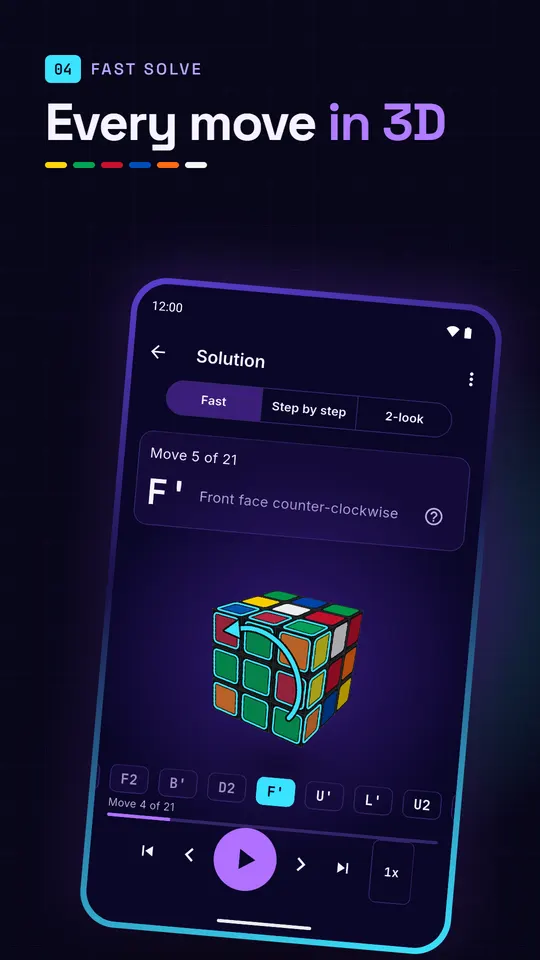
Every move in 3D 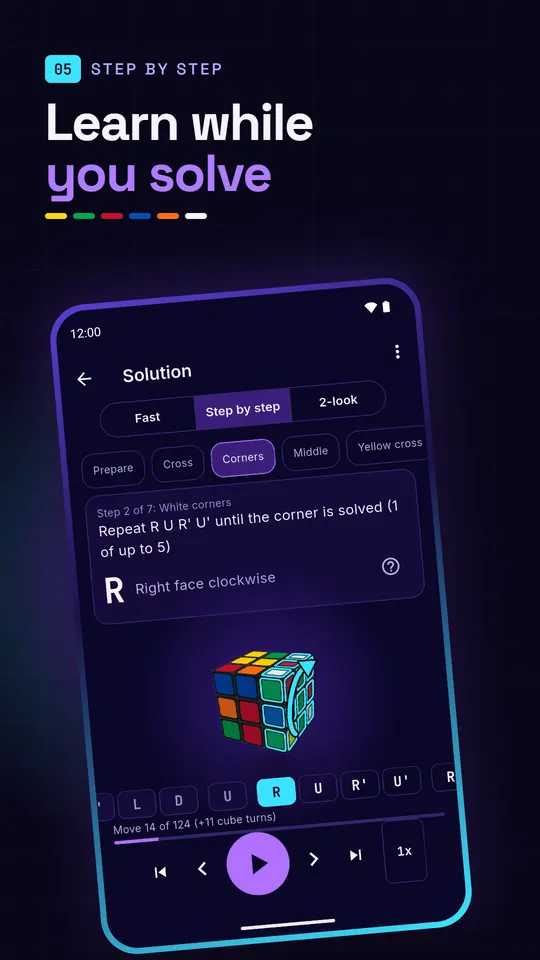
Learn while you solve 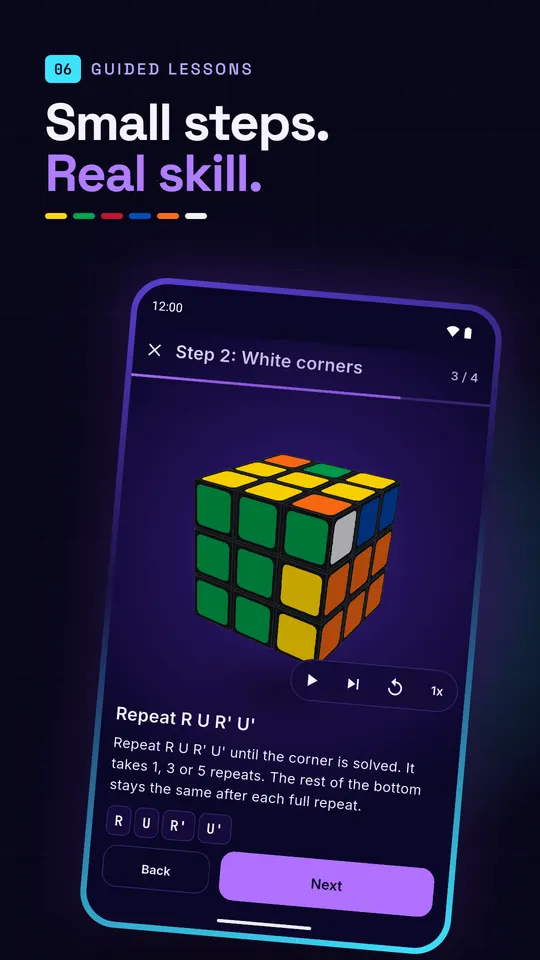
Small steps, real skill 
OLL and PLL algorithms 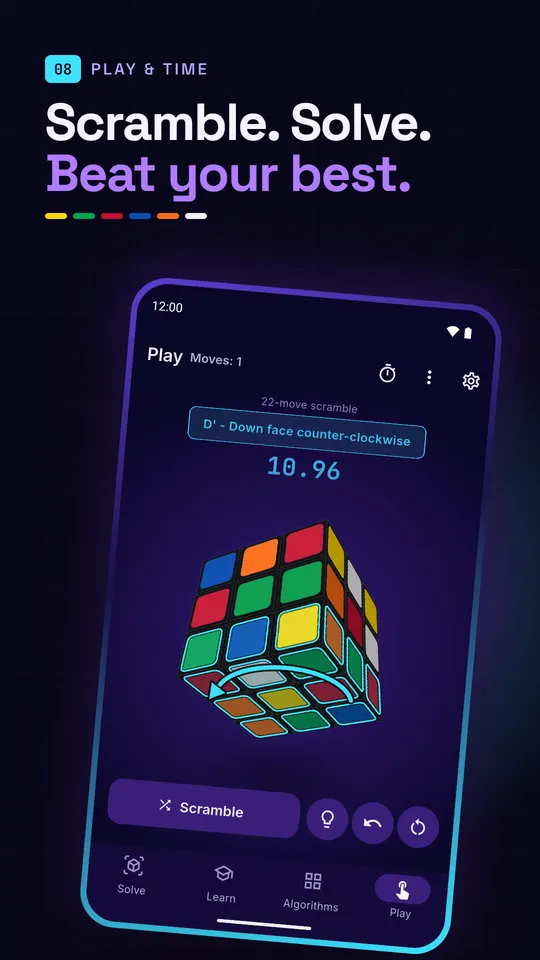
Scramble, solve, beat your best
How to solve a Rubik's Cube for beginners
The beginner method solves the cube one layer at a time, in seven steps. You learn six short move sequences, called algorithms, and use each one over and over. The tool above uses exactly this method, so its answer is one you can follow with your own hands.
- Bottom cross. Make a yellow cross on the bottom face. Each yellow edge must also match the center next to it.
- Bottom corners. Put the four yellow corners in place to finish the bottom layer. A corner above its slot is inserted by repeating R U R' U'. Insert a corner:
R U R' U'. - Middle layer. Place the four edges of the middle layer. An edge in the top layer slides into its slot to the right or to the left. Edge to the right:
U R U' R' U' F' U F. Edge to the left:U' L' U L U F U' F'. - Top cross. Make a white cross on the top face. The side colors do not matter yet. Top cross:
F R U R' U' F'. - Top edges. Move the top edges until each one matches the center on its side. Swap two edges:
R U R' U R U2 R' U. - Top corners. Move the top corners into their own places. Their twist can still be wrong. Cycle three corners:
U R U' L' U R' U' L. - Twist the corners. Turn each top corner in place until its white sticker faces up. The lower layers look scrambled in between and come back at the end. Twist a corner:
R' D' R D.
Hold the cube the same way for the whole solve. Do not turn it over or around between algorithms; only the moves tell you which face to turn. Pick any color for the first layer. With the standard colors it is usually white, with yellow on top at the end.
What do R, U, F and the apostrophe mean in cube notation?
Each letter names a face. A letter alone is a quarter turn clockwise, as if you looked straight at that face. An apostrophe, read as "prime", turns it counter-clockwise. A 2 is a half turn, and it does not matter which way. The system is called Singmaster notation.
| Face | Clockwise | Counter-clockwise | Half turn |
|---|---|---|---|
| right | R | R' | R2 |
| left | L | L' | L2 |
| top (up) | U | U' | U2 |
| bottom (down) | D | D' | D2 |
| front | F | F' | F2 |
| back | B | B' | B2 |
Clockwise is always judged from outside the face you are turning. That is why L moves the front of the cube down and R moves it up: they are clockwise from opposite sides. Longer notations also name two-layer turns (written with a lowercase letter or a w) and whole-cube rotations (x, y, z). The beginner method and this page use neither.
The seven steps in detail
Step 1: the bottom cross
Make a cross of four edges on the bottom face so that the other color of each edge also matches the center beside it. There is no fixed algorithm; you place one edge at a time with a few short turns that leave the edges already placed alone. One common case: an edge sits in the top layer with its bottom color facing up. Turn the top until its other color is above the matching center, then turn that face a half turn and it drops into place. The tool does not use a recipe here: it searches all 190,080 positions of the four cross edges and plays the shortest way, which never takes more than 8 moves.
Step 2: the bottom corners
Bring a bottom-color corner to the top layer, directly above the slot where it belongs. Then repeat R U R' U' until it drops in with its bottom color facing down: one, three or five repeats, depending on which way it is twisted. The mirror version F' U' F U does the same job from the other side, and the tool takes whichever is shorter. A corner already in the bottom layer but in the wrong place or twisted is first popped out with R U R'.
Step 3: the middle layer
Turn the top layer until the side color of a top edge matches the center below it. Its other color tells you which way it goes. To the right use U R U' R' U' F' U F; to the left use U' L' U L U F U' F'. An edge that is in the middle layer but in the wrong place is sent up with the same algorithm. Edges with a top-color sticker never belong in this layer.
Step 4: the top cross
Ignore the side colors and make a cross in the top color. Run F R U R' U' F' and look again. With a dot, run it once from any side and you get an L. With an L, hold it so the two top edges are at the back and on the left, and one run makes a line. With a horizontal line, one run makes the cross. A dot takes three runs in all.
Step 5: the top edges
Turn the top layer until at least two edges match their centers. If two neighboring edges match, hold the cube so they are at the back and on the right, and run R U R' U R U2 R' U once. If the two that match are opposite each other, or only one matches, run it once from any side, turn the top layer, and look again. Three runs are always enough.
Step 6: the top corners
Now put the four top corners where they belong, ignoring how they are twisted. Find a corner that already sits between its three centers and hold it at the front right. Run U R U' L' U R' U' L: that corner stays put and the other three trade places. If no corner is right, run it once from any side and one will be. Repeat until all four are in place.
Step 7: twist the corners
Hold a corner that is not turned correctly at the front right of the top layer and repeat R' D' R D until its top color faces up: two or four times. The lower layers will look scrambled. Ignore them, turn only the top layer to bring the next wrong corner to the front right, and repeat. When the last corner is right, the whole cube is solved.
A worked example
Scramble a solved cube with R U R' U' F2 D L' B2 U' R2 F D2 L and the solver answers in 138 moves:
| Step | Moves |
|---|---|
| Bottom cross | U L F' D B L2 D |
| Bottom corners | U B U B' U' L' U' L F' U' F U L' U' L U2 B' U' B F U F' U' F U F' U' F U F' U' |
| Middle layer | U' F' U F U R U' R' U B' U B U L U' L' U2 R' U R U B U' B' U F U' F' U' L' U L U' F U' F' U' L' U L |
| Top cross | F R U R' U' R U R' U' F' R B U B' U' R' |
| Top edges | none needed |
| Top corners | U F U' B' U F' U' B U F U' B' U F' U' B |
| Twist the corners | U R' D' R D R' D' R D U R' D' R D R' D' R D U R' D' R D R' D' R D U |
How many moves does it take to solve a Rubik's Cube?
Any cube can be solved in 20 face turns or fewer. That number, called God's number, was proved in 2010 by Tomas Rokicki, Herbert Kociemba, Morley Davidson and John Dethridge with a computer search. Counting only quarter turns, the figure is 26, shown by Rokicki and Davidson in 2014.
The beginner method is not trying to be short. Over 1,000 random scrambles tested for this page its solutions averaged about 123 moves (a half turn counts as one move). Most of them go to the corners of the bottom layer and to the middle layer and the corner twists at the end:
| Step | Moves |
|---|---|
| Bottom cross | 5.7 |
| Bottom corners | 21.3 |
| Middle layer | 31.5 |
| Top cross | 8.9 |
| Top edges | 8.0 |
| Top corners | 12.0 |
| Twist the corners | 35.6 |
Faster methods learn more algorithms to skip steps. The layer-by-layer way trades length for being easy to learn and easy to check.
Why does the solver say my cube is impossible?
A cube has 8 corners and 12 edges, and turning the faces cannot reach every way of arranging them. Only one arrangement in twelve can be reached. The full count of reachable positions is 8! × 37 × 12! × 211 ÷ 2 = 43,252,003,274,489,856,000. Three rules cut the others out, and the tool checks all of them:
- Corner twists. Give each corner a twist of 0, 1 or 2. On a real cube the twists always add up to a multiple of 3. One corner turned on its own breaks it.
- Edge flips. Edges flip in pairs, so the number of flipped edges is always even. One flipped edge on its own is impossible.
- Swaps. Corners and edges are always swapped in step. Two edges swapped while everything else is right cannot happen.
Before those, the tool checks that each color appears nine times, that the six centers are six different colors, and that every corner and edge shows a real combination: there is no edge that is both white and yellow, because those faces are opposite. In practice an impossible cube almost always means one sticker was painted wrongly. Look for orange and red mixed up, a face read from the wrong side, or two stickers swapped.
Does it work with a cube that has different colors?
Yes. The center of each face never moves, so the tool treats the color of a center as the name of its face and reads every other sticker against it. Paint the centers as they are on your cube. Since 1988 the usual scheme puts white opposite yellow, blue opposite green and orange opposite red; older and regional cubes differ. Hold the cube like the net before you start: the top face at the top and the front face toward you.
How does this solver work?
Everything runs in your browser; nothing about your cube is sent anywhere. The cube is 54 stickers, and the six face turns are worked out from 3D coordinates, then checked against known facts: four quarter turns are the identity, and R U repeats after 105 turns. After the validity checks, the cross comes from the search above. The other six steps run the algorithms of the method; for each one a short search decides how to hold the cube, and for the corners and the middle edges the cheapest piece goes first. Tests replay the answer for hundreds of random scrambles, the superflip and a few painted schemes, and check after every step that the work of the earlier steps is still intact.
What the Cube Solver 3D app adds
The tool on this page works on a flat net with the beginner method, and it is separate from the app: the app has its own solver, so its moves can differ from the ones here. Cube Solver 3D for Android plays every move in 3D on a cube you can turn and zoom.
- You enter the colors on a 3D cube or a flat net, with a counter for every color, and the app says what is wrong if a sticker cannot exist.
- Fast mode finds a short solution, usually around 20 moves. Step-by-step mode and 2-look mode solve the same cube with the beginner method, stage by stage, with the notation under each move.
- 16 lessons with looping 3D demos cover notation, the beginner method, 2-look OLL and PLL and the first steps of F2L. The algorithm library opens 2-look OLL and PLL; the full OLL (57) and PLL (21) sets unlock with a short video.
- A free-play cube and a solve timer with 15 seconds of inspection, +2 and DNF, best, Ao5 and Ao12, and seven themes including a high-contrast one with letters on the stickers.
It is free with ads, which do not show while you enter colors, follow a solution or take a lesson. It works offline, needs no account, keeps saved cubes and progress on your phone and comes in 50+ languages.
This is an independent tool. It is not affiliated with the makers of the Rubik's Cube.
Sources
- How to solve the Rubik's Cube: beginners method, Ruwix: the seven steps and the algorithms for the middle layer, the top cross, the top edges, the top corners and the corner twist. Opened 2026-11-01.
- Rubik's Cube, Wikipedia: the number of positions, the rules for reachable states, the color scheme and Singmaster notation. Opened 2026-11-01.
- Optimal solutions for the Rubik's Cube, Wikipedia: God's number in half turns and quarter turns. Opened 2026-11-01.
Questions
How do I solve a Rubik's Cube for beginners?
Use the layer-by-layer method: a cross on one face, then that layer's corners, then the middle layer's edges, and last a cross, the edges, the corners and the corner twists on the top. That is seven steps and six short algorithms. The solver above gives the exact moves for your cube, and the guide below explains each step.
What do R, U, F and the apostrophe mean in cube notation?
R, L, U, D, F and B are the right, left, top, bottom, front and back faces. A letter alone is a clockwise quarter turn as you look at that face, an apostrophe means counter-clockwise and a 2 means a half turn. So R U R' U' is right clockwise, top clockwise, right counter-clockwise, top counter-clockwise.
How many moves does it take to solve a 3x3 cube?
Any cube can be solved in 20 face turns or fewer, a result called God's number and proved in 2010. The beginner method used here is much longer, about 120 moves on average, because it is made to be learned and checked, not to be short. The Android app has a fast mode for short solutions, usually around 20 moves, as well as a step-by-step beginner mode.
Why does the solver say my cube is impossible?
A real cube follows three rules: the corner twists add up to a multiple of 3, an even number of edges are flipped, and corners and edges are swapped in step. One wrongly painted sticker breaks one of them. The message names the rule; look for orange and red mixed up, or a face read from the wrong side.
Can I use a cube with different colors?
Yes. Paint the centers as they are on your cube: the solver treats the color of each center as the name of its face. Each of the six colors must appear exactly nine times.
Is my cube sent anywhere?
No. The solver runs in your browser and nothing about your cube leaves the page.
Is there an Android app?
Yes. Cube Solver 3D is a free 3x3 solver with 3D playback, fast, step-by-step and 2-look modes and 16 lessons. It works offline, needs no account and shows ads that stay out of the way while you enter colors, follow a solution or take a lesson.
Take the solver with you
Free on Android, with ads that never show while you enter colors, follow a solution or take a lesson. Offline, no account.
Facts from the Google Play listing, last checked .