DIY hair masks and a weekly hair care routine for your hair type
Tell the builder below your hair type, your scalp and what bothers you, and it picks homemade masks from kitchen ingredients and lays out a week of wash days, masks and night care. The free Android app goes further: 100 mask recipes, 150 tips, a routine planner and a hair journal.
Your hair, your week
Pick your hair type and what bothers you most. The masks and the plan update as you tap.
Masks for you
Aloe and argan smoothing mask
You need
- 2 tbsp pure aloe vera gel
- 3 to 5 drops argan oil
Steps
- Stir the oil into the gel.
- Smooth it over damp lengths and ends with flat palms, keeping it off the roots.
- Leave it for 15 minutes, then rinse and condition lightly.
Use pure gel without alcohol or perfume; add more oil only if your hair is thick.
Banana and olive oil mask
You need
- 1 very ripe banana
- 1 tbsp olive oil
Steps
- Blend the banana until completely smooth; lumps are hard to rinse out.
- Stir in the olive oil.
- Work it through damp lengths and ends, then cover with a shower cap.
- Rinse with lukewarm water, then shampoo and condition as usual.
Skip it if you are allergic to bananas or latex.
Avocado and honey mask
You need
- ½ ripe avocado
- 1 tbsp honey
- 1 tbsp olive or almond oil
Steps
- Mash the avocado with a fork or blend it smooth.
- Mix in the honey and the oil.
- Apply to damp lengths and ends, comb through with your fingers and cover.
- Rinse, then shampoo and condition.
Too rich for fine, straight hair: use half the amount or pick the yogurt mask.
Coconut oil pre-wash treatment
You need
- 1 to 2 tbsp coconut oil, melted
Steps
- Warm the oil between your palms until it is liquid.
- Smooth it over dry lengths and ends before wash day, keeping it off the roots.
- Leave it for 30 minutes or more, then shampoo it out, twice if needed.
Some fine or low-porosity hair feels stiff after coconut oil; try a lighter oil such as argan or almond.
Patch test first: a little on the inside of your arm, wait 24 hours.
Your week 3 wash days
- Mon
- Shampoo and condition
- Towel-blot, heat protectant if styling
- Tue
- Brush or finger-detangle
- Wed
- Shampoo and condition
- Towel-blot, heat protectant if styling
- Thu
- Optional: Banana and olive oil mask before the next wash
- Fri
- Brush or finger-detangle
- Sat
- Pre-wash oil on the lengths, 30 min
- Shampoo and condition
- Mask: Aloe and argan smoothing mask
- Towel-blot, heat protectant if styling
- Sun
- Brush or finger-detangle
Every night: a loose braid or a satin pillowcase cuts friction and morning frizz.
A starting point. Wash sooner if your scalp itches or feels greasy, later if your ends feel dry.
100 masks and your routine on your phone
This page gives you a starting routine and 11 kitchen masks. The Android app suggests masks and steps from your hair type, concern and goal, lets you tick off the week and keeps a journal of what worked:
- 100 DIY hair mask recipes with amounts, steps, timing, difficulty, how often to use them and the hair types they suit
- 150 short tips on wash day, frizz, dry hair, curly and coily hair, oily scalp, color, oiling, heat and night care
- Guide to 40 natural ingredients: what they are used for, which hair they suit, when to skip them and the recipes that use them
- Weekly routine planner with ready-made routines by hair type and goal, and steps you tick off
- Hair journal for masks, wash days, oiling and treatments, with tags and notes
- Personal suggestions for straight, wavy, curly, coily, dry, oily, colored and damaged hair
- Search across masks, tips and ingredients, favorites and recently viewed recipes
- One gentle daily reminder, light and dark themes, 15+ languages

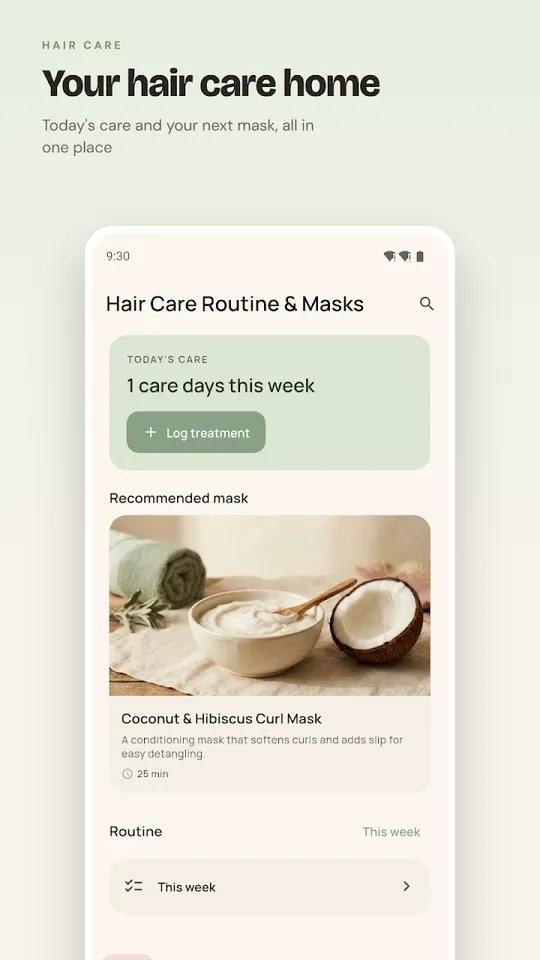
Today's care and your next mask 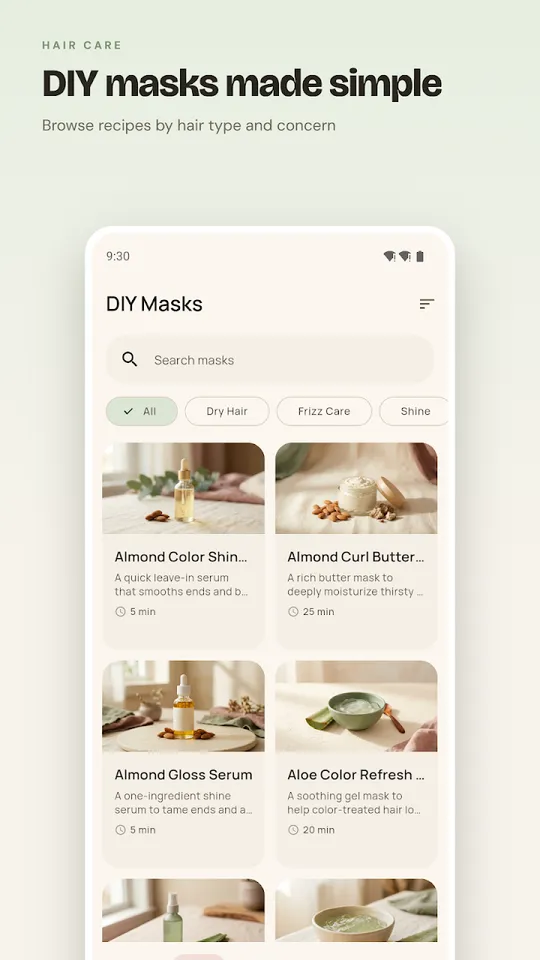
DIY masks by hair type and concern 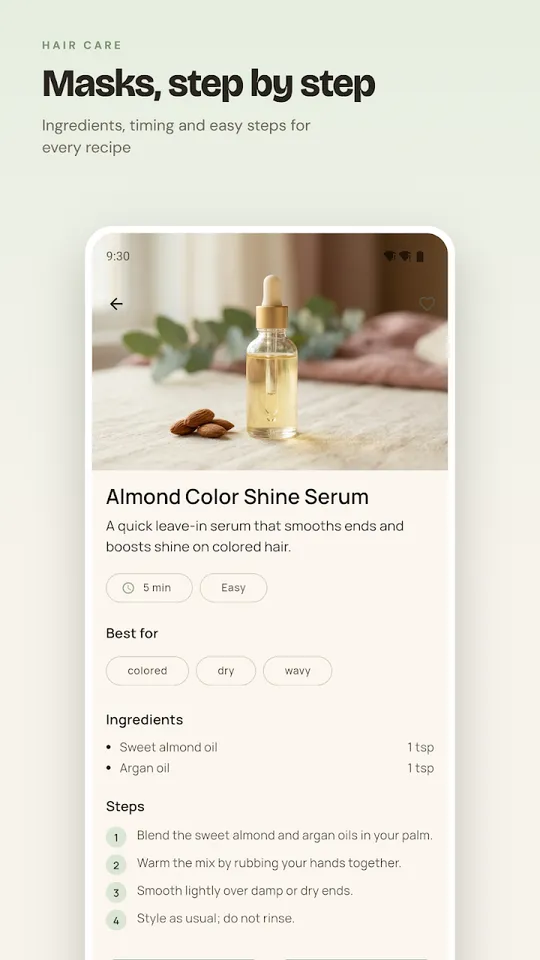
Ingredients, timing and steps 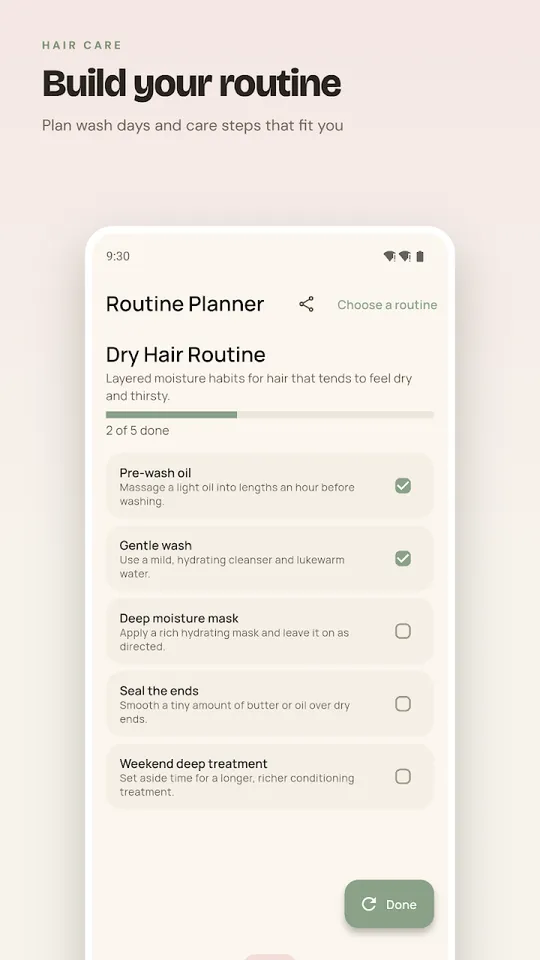
Routine planner 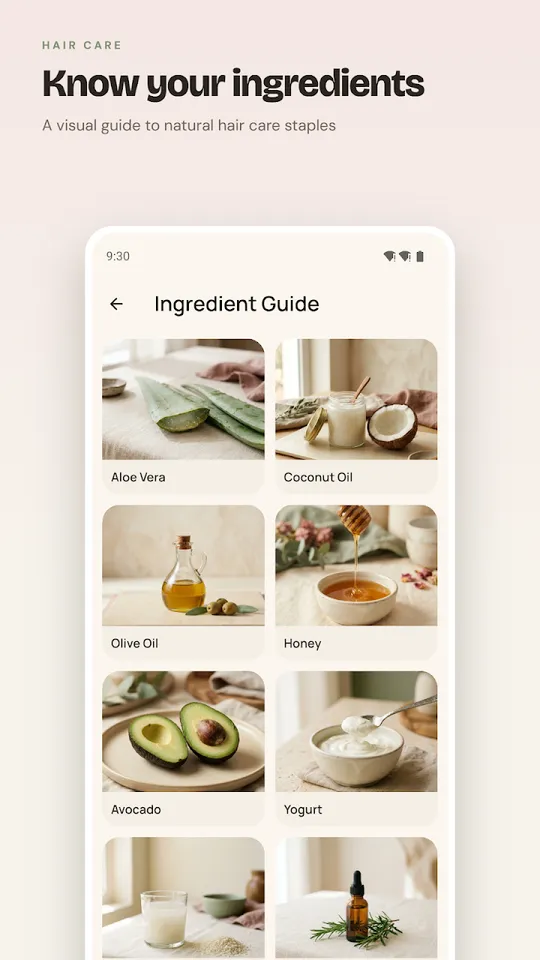
Ingredient guide 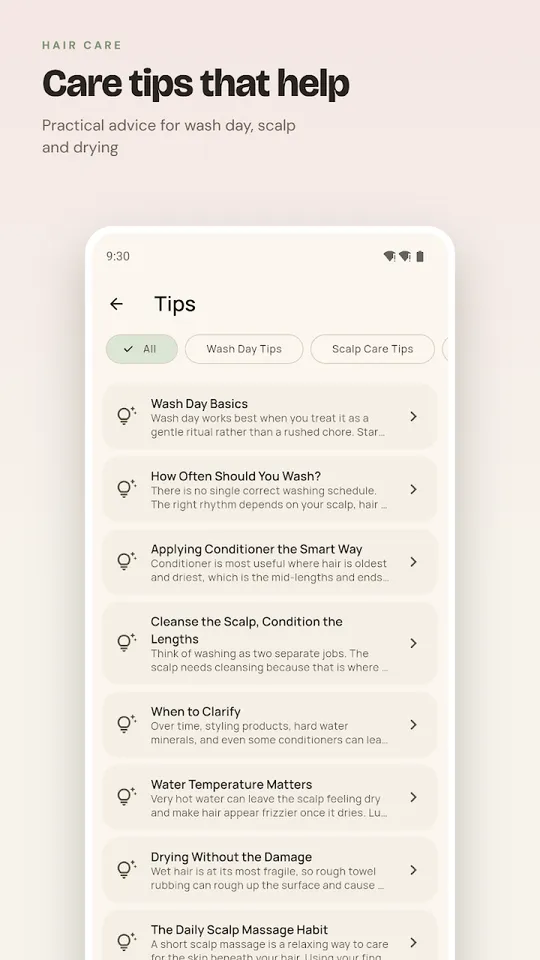
Care tips 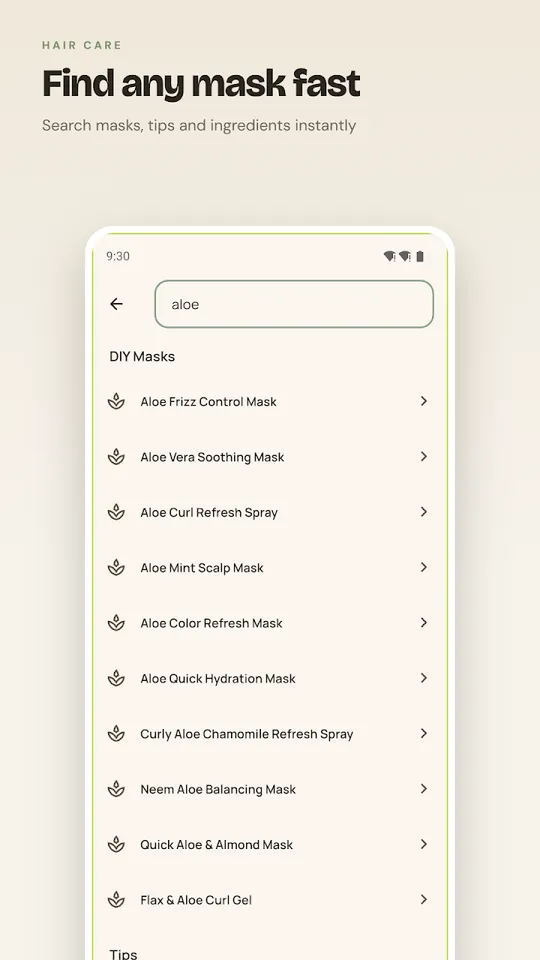
Search masks, tips and ingredients 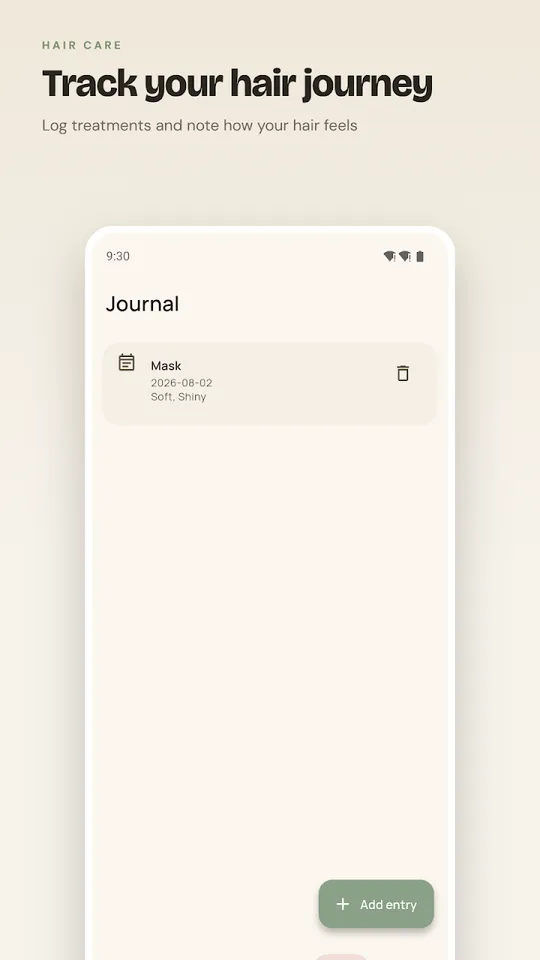
Hair journal
Hair care routine steps, in order
Every routine, from a two-minute wash to a long curly wash day, is built from the same four steps. What changes with your hair type is how often you do each one.
- Cleanse the scalp. Shampoo is for the scalp, where oil and sweat build up. Massage it in at the roots and let the rinse water carry the foam down the lengths; scrubbing the ends dries them out.
- Condition the lengths. Conditioner goes from mid-length to the ends, where hair is oldest and driest. Leave it a minute or two, detangle with your fingers or a wide-tooth comb while it is in, then rinse.
- Treat once a week. A mask or a pre-wash oil is a longer, richer conditioning step. Once a week is enough for most hair; more often can leave fine hair limp.
- Protect. Blot with a towel instead of rubbing, use heat protectant before a dryer or straightener, and sleep on satin or in a loose braid if your hair tangles or frizzes overnight.
Hair care routine by hair type
Natural oil from the scalp slides down straight hair easily and barely reaches the ends of tight curls. That is why straight hair gets greasy faster and coily hair gets dry faster, and why their routines look so different. Pick your row, then open the routine in the builder above.
| Hair type | Wash | Mask | What helps most |
|---|---|---|---|
| Straight | 2 to 4 times a week | Every 1 to 2 weeks, ends only | Light conditioner on the ends, nothing heavy at the roots |
| Wavy | 2 to 3 times a week | Once a week | Light leave-in, scrunching instead of brushing dry hair |
| Curly | 1 to 2 times a week | Once a week | Detangling with conditioner in, leave-in, air-drying or a diffuser |
| Coily | Once a week or every 10 days | Every wash day | Pre-wash oil, working in sections, protective styles and a satin bonnet |
Scalp matters as much as the curl. An oily scalp may need an extra wash a week whatever your hair type; a dry scalp may need one less. Fine hair needs lighter products, thick hair richer ones.
DIY hair mask recipes by concern
Kitchen masks are cheap, simple conditioning treatments. They will not repair split ends or change your hair for good, but they can leave hair softer and easier to manage for a few days. All of these use ingredients you probably have; open any of them in the builder for the full steps.
| Concern | Try | You need |
|---|---|---|
| Dry hair | Banana and olive oil mask · 20 min | 1 very ripe banana, 1 tbsp olive oil |
| Dry, damaged hair | Avocado and honey mask · 20 min | ½ ripe avocado, 1 tbsp honey, 1 tbsp olive or almond oil |
| Curly or frizzy hair | Coconut oil pre-wash treatment · 30 min | 1 to 2 tbsp coconut oil, melted |
| Damaged or colored hair | Egg and olive oil mask · 20 min | 1 egg, 1 tbsp olive oil |
| Dull hair, no shine | Yogurt and honey mask · 15 min | 3 tbsp plain unsweetened yogurt, 1 tsp honey |
| Dry scalp and flakes | Aloe vera scalp mask · 20 min | 2 tbsp pure aloe vera gel, 1 tsp jojoba oil (leave out for oily roots) |
| Itchy, tight scalp | Oat milk soothing mask · 15 min | 2 tbsp fine oats, 4 tbsp warm water, 1 tsp honey |
| Oily roots | Clay and aloe scalp mask · 10 min | 1 tbsp cosmetic clay (kaolin or bentonite), 2 tbsp aloe vera gel or water |
How to make and use a hair mask at home
- Blend it smooth. Banana and avocado lumps stick in hair and are hard to rinse out. A blender or a fine sieve saves a lot of rinsing.
- Start with damp, towel-dried hair. Damp hair spreads a mask more evenly. Oils are the exception: put them on dry hair before you wash.
- Work in sections. Clip hair into four parts and apply from mid-length to the ends, where hair is driest. Only scalp masks go on the roots.
- Cover and wait. A shower cap keeps the mask from drying out and off your clothes. 15 to 30 minutes is plenty; overnight does not add much and can irritate the scalp.
- Rinse with lukewarm water, then shampoo. Rinse egg with cool water. Follow with conditioner if your ends still feel rough.
How often should you use a hair mask?
For most people once a week. Use it more often for very dry or coily hair, less often for fine or oily hair. If hair feels heavy, greasy or limp, you are using too much or too often; if it feels straw-like after a protein mask such as egg, switch to a moisturising one such as banana or avocado for a few weeks.
| Your hair | How often |
|---|---|
| Fine or oily | Every 2 weeks, ends only |
| Normal, wavy | Once a week |
| Dry, curly or colored | Once a week, every wash day if it feels rough |
| Coily, bleached or heat-damaged | Every wash day |
Wash day routine, step by step
On curly and coily hair, wash day is a longer ritual done once or twice a week. A simple version takes about an hour:
- Pre-wash: oil on dry lengths, finger-detangle, 30 minutes.
- Shampoo the scalp only, in sections if your hair is thick.
- Mask or deep conditioner on the lengths, under a cap, 15 to 30 minutes.
- Detangle with the conditioner in, from the ends up.
- Rinse with cool or lukewarm water.
- Leave-in and styler on soaking wet hair, then blot with a cotton T-shirt.
- Air-dry or diffuse on low heat; do not touch it until it is fully dry.
Natural ingredients for hair: what they do
| Ingredient | Commonly used for | Skip or go easy if |
|---|---|---|
| Coconut oil | Pre-wash treatment on dry, curly lengths | Fine or low-porosity hair that turns stiff |
| Olive oil | Softness and slip in masks | Fine hair: use a few drops |
| Avocado | Rich, moisturising masks | Fine, straight hair |
| Banana | Softening masks for dry hair | You cannot blend it fully smooth |
| Honey | Holds moisture in masks | Used alone: it is sticky and hard to rinse |
| Yogurt | Light masks for scalp and lengths | Dairy irritates your skin |
| Egg | Protein mask for weak, overprocessed hair | Egg allergy; hair already feels stiff |
| Aloe vera gel | Soothing scalp masks, light hold on curls | Gel with alcohol or perfume |
| Rice water | Rinse for smoother, shinier-looking hair | Hair feels dry or stiff afterwards |
| Green tea | Cooled rinse for an oily scalp | Very light or bleached hair (may tint) |
Be careful with
- A patch test first. Put a little of any new mix on the inside of your arm and wait 24 hours. Natural does not mean safe for everyone.
- Undiluted essential oils, lemon juice, raw vinegar and baking soda on the scalp. They can burn or irritate skin.
- Masks that promise hair growth. No kitchen mask has been shown to regrow hair. A gentle routine and less breakage can make hair look fuller over time, and that is all.
- Signs that need a doctor, not a mask: sudden or patchy hair loss, a red, sore or scaly scalp, or itching that lasts more than a few weeks.
Questions
What is the best homemade hair mask for dry hair?
A banana and olive oil mask or an avocado and honey mask: both are rich, easy to make and wash out well if blended smooth. Leave them on damp lengths for about 20 minutes once a week.
How often should I use a hair mask?
Once a week suits most hair. Coily, bleached or very dry hair can take one every wash day; fine or oily hair is better with one every two weeks, on the ends only.
Do I put a hair mask on wet or dry hair?
Most masks go on damp, towel-dried hair so they spread evenly. Oils are the exception: put them on dry lengths before you wash and shampoo them out.
How long should I leave a DIY hair mask on?
15 to 30 minutes under a shower cap. Leaving a mask overnight adds little and can irritate the scalp.
Can a hair mask make hair grow faster?
No kitchen mask has been shown to regrow hair. Gentle care reduces breakage, so hair can look longer and fuller over time. See a doctor for sudden or patchy hair loss.
How often should I wash my hair?
It depends on your hair and scalp: often 2 to 4 times a week for straight hair, 1 to 2 for curly and about once a week for coily hair. Wash sooner if your scalp itches or looks greasy.
Is the Hair Care Routine app free?
Yes. It is free with ads and has no in-app purchases or account. It is made for lifestyle and educational use and does not give medical advice.

Keep your routine in your pocket
Free on Android. No account; your journal stays on your device. Lifestyle and educational use, not medical advice.
Facts from the Google Play listing, last checked .