Foods toxic to parrots, and what they can eat
Type a food to see if it is safe, fine in moderation or never to be fed, and why. Then set your experience, noise tolerance and space to see which of eight popular parrots suits you. The free Android app adds lessons on taming, talking, tricks and behaviour.
Can my parrot eat it?
Type a food or tap one below. 54 foods, sorted from never feed to safe.
Which parrot suits you?
- 95Budgie Melopsittacus undulatusPlayful and social; small voice but some learn many words.
- 90Cockatiel Nymphicus hollandicusGentle and affectionate; better whistlers than talkers, males especially.
- 65Lovebird Agapornis spp.Watch out: needs more experience.
- 30African grey Psittacus erithacusWatch out: needs more experience, needs more room.
General guidance from avian vet sources, not veterinary advice.
Lessons for a tamer, chattier parrot
The checker covers food. The Android app is the whole handbook, in short lessons you can follow at your bird's pace, offline:
- Taming and bonding: hand-feeding, target training and the step-up, with signs your bird is ready for the next step
- Teach your parrot to talk: the repetition method, choosing first words, common mistakes and realistic expectations by species
- Tricks as short numbered lessons: spin, wave, fetch, ring the bell, rings on a peg; plus whistling and simple tunes
- Behaviour fixes for biting, screaming, feather plucking (and when to see a vet), fear of new objects and refusing to step up
- Care: seeds vs pellets, fruit and vegetables, cage setup, perches and toys, molting, bathing, nail and beak care, a bird-safe room
- Safe-vs-toxic food reference covering avocado, chocolate, salt and more
- Species guide comparing budgie, cockatiel, lovebird, African grey, macaw, cockatoo, rosella and conure
- Quizzes on care, foods, species and body language; progress, daily streak, favorites, optional reminder, light and dark themes

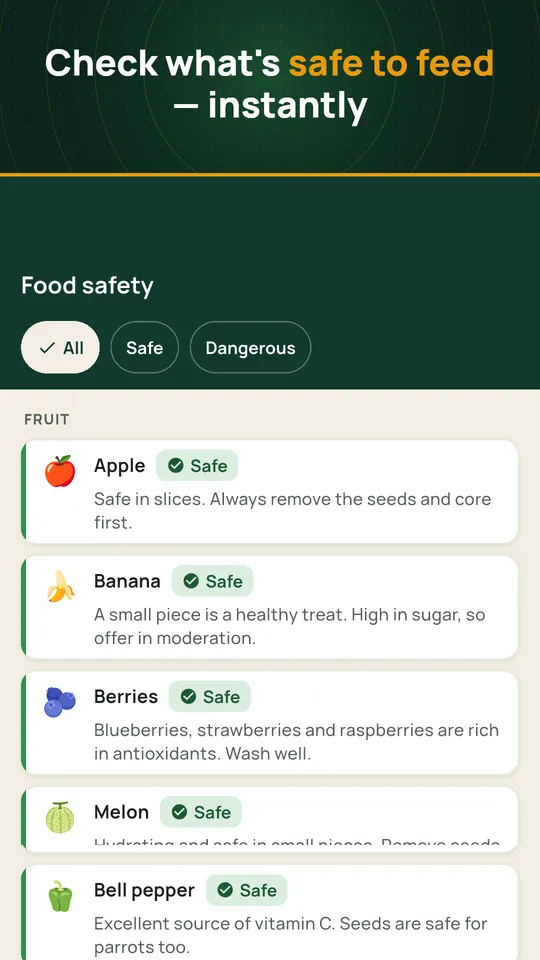
Safe or dangerous 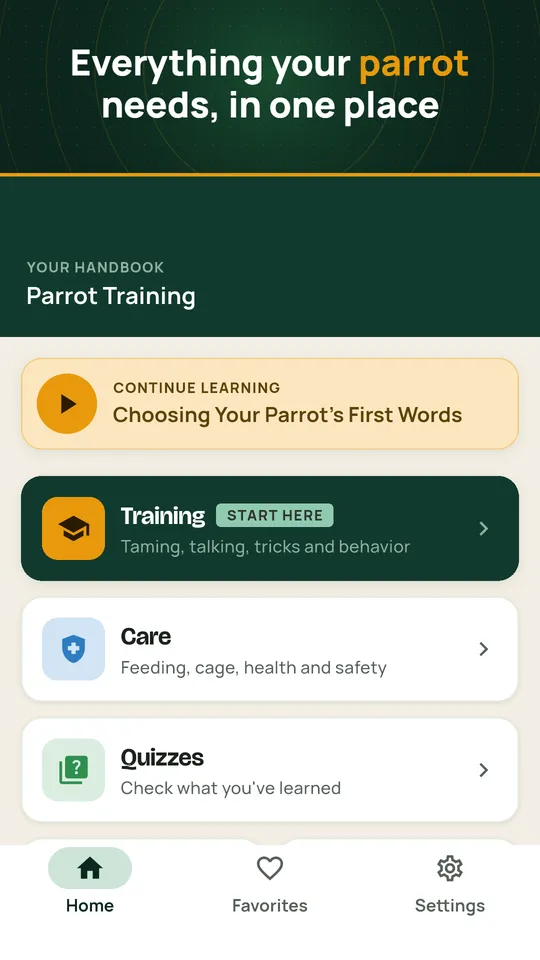
Your handbook 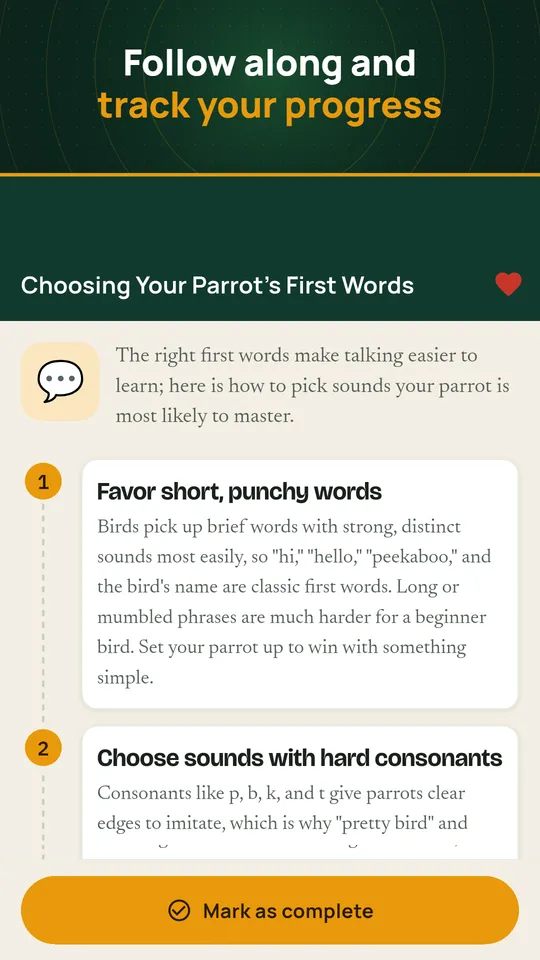
First words lesson 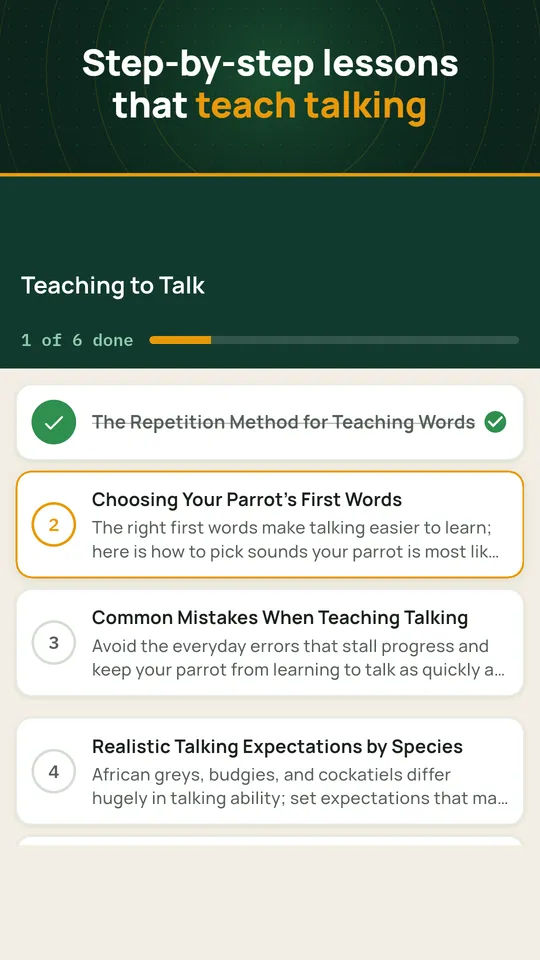
Teaching to talk 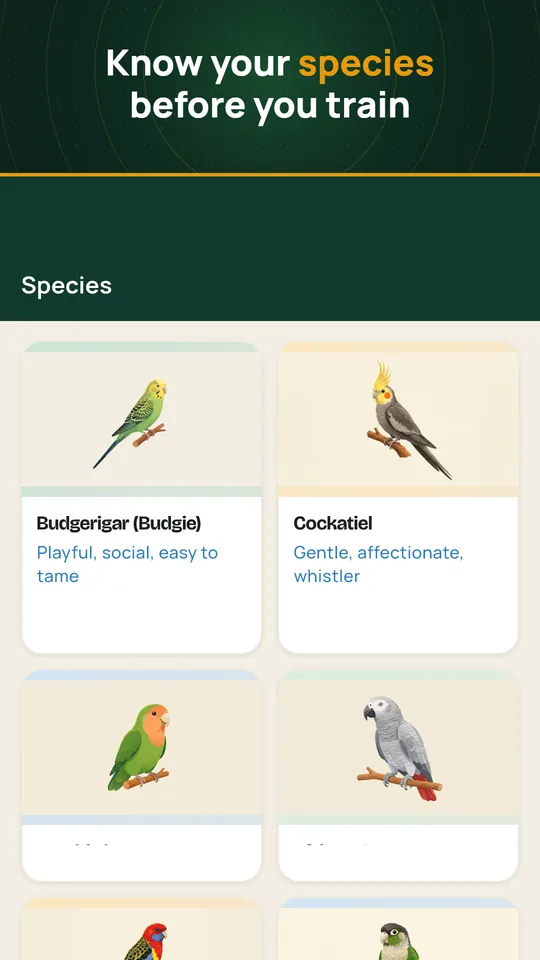
Species guide 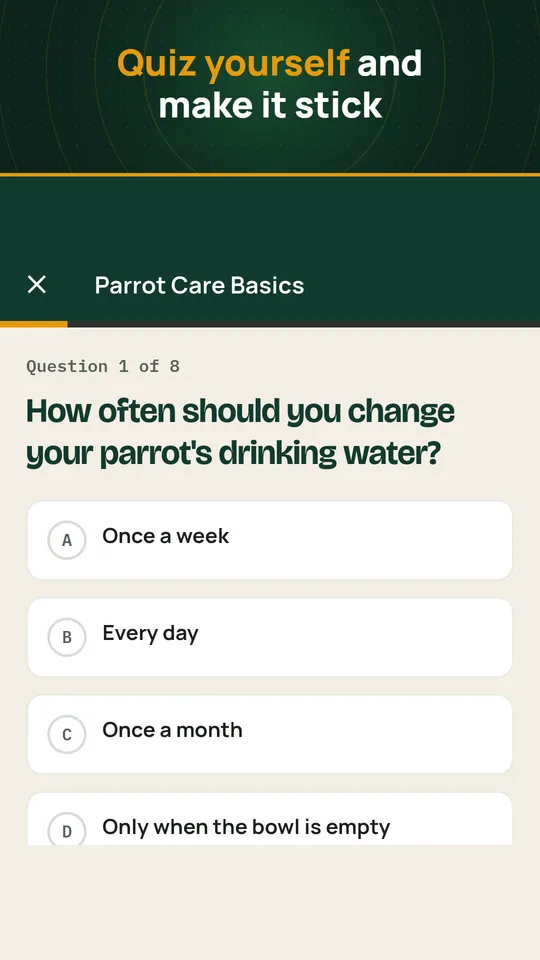
Quizzes
How to tame a parrot and teach the step-up
A new parrot is a prey animal in a strange room, so taming is about trust, not force. Most birds go through the same stages; move on only when the current one is boring for your bird.
- Settle in. Give the first days to routine: sit near the cage, talk quietly, and keep fast movements away from it.
- Hand-feed. Offer a favourite treat (a sunflower seed, a piece of millet) through the bars, then at the open door, until the bird takes it calmly from your fingers.
- Target train. Hold a chopstick near the beak; the moment the bird touches it, say “good” and give the treat. A target lets you guide the bird without hands.
- Step up. Press a finger or a hand-held perch gently just above the feet, against the lower belly, and say “step up”. Reward every step. Practise a few times a day, a couple of minutes each.
Signs the bird is ready for the next stage: relaxed feathers, eating in front of you, beak grinding or preening nearby. Signs to slow down: leaning away, wings held out, pinned eyes or a lunge.
How to teach a parrot to talk
Parrots learn words from repetition with meaning. Short, frequent sessions beat one long one, and words linked to a moment stick best.
- Pick a first word with hard sounds, like “hi”, “peekaboo” or the bird’s name. Consonants such as k, p and t are easier to copy than soft sounds.
- Say it with energy, the same way each time, five to ten minutes, two or three times a day. Morning and evening, when wild flocks call, often work best.
- Tie words to events: “good morning” when you uncover the cage, “want a grape?” when you offer one. Context gives the word a reason.
- Reward any try, even a mumble, with attention or a treat. Never use words you would not want repeated in front of guests.
Expect a range. African greys are known for clear speech; budgies can learn many words in a small voice; cockatiels often whistle instead. Some healthy, happy birds never talk, and that is fine. Recordings help between sessions but do not replace you.
Biting, screaming and feather plucking: what to try
Vet first: any sudden change in behaviour, plucking, fluffed-up sitting, or a change in droppings needs an avian vet before training. Pain and illness look like bad behaviour.
| Problem | What to try |
|---|---|
| Biting | Read the body language first: pinned eyes, raised neck feathers or a lunging beak mean back off. Never pull away hard or punish; ask for a step-up only when the bird is relaxed and reward the calm moments. |
| Screaming for attention | Do not come running to a scream, which rewards it. Wait for a quiet second or a nicer sound, then go over. Give contact calls back from the next room and plenty of foraging toys. |
| Feather plucking | See an avian vet first: plucking has medical causes (skin, liver, parasites, diet) as well as boredom and stress. Then add foraging, bathing, more sleep and a steady routine. |
| Afraid of new objects or hands | Put the new thing at a distance the bird ignores and move it closer over days. For hands, start by hand-feeding a favourite treat through the bars. |
| Won't step up | Go back a stage: target training with a chopstick, then the step-up onto a hand-held perch, then the finger. Keep sessions short and end on a success. |
Foods toxic to parrots
Never feed these. If your bird has eaten any of them, call an avian vet or an animal poison line now, even if it looks fine. Species react differently, so treat this as the minimum list, not the full one.
| Food | Why |
|---|---|
| Avocado | Contains persin, which can cause breathing trouble, heart damage and sudden death, especially in small birds. No part is safe. |
| Chocolate | Theobromine and caffeine can cause vomiting, seizures, heart problems and death. Even a small bite is risky. |
| Coffee, tea and cola | Caffeine raises heart rate and can cause arrhythmia and hyperactivity. Keep drinks out of reach. |
| Alcohol | Depresses the organs and can be fatal at tiny doses for a bird's body weight. |
| Xylitol (sugar-free sweets, gum) | An artificial sweetener linked to dangerous drops in blood sugar and liver damage in animals. |
| Onion | Sulphur compounds can damage red blood cells and cause anaemia; raw or cooked. |
| Garlic | Like onion, contains compounds that can damage red blood cells. |
| Salty snacks (crisps, pretzels, salted nuts) | A little salt upsets a small bird's water and electrolyte balance; can cause excessive thirst, kidney damage and death. |
| Apple seeds and fruit pits | Seeds and pits of apples, pears, cherries, peaches, apricots and plums contain cyanide compounds. Remove them; the flesh is fine. |
| Rhubarb | High in oxalates, which bind calcium and can harm the kidneys. |
| Raw or dried beans | Raw beans contain haemagglutinin. Cook them fully first; cooked beans are a good food. |
| Tomato leaves and stems | The green parts of tomato, potato and aubergine plants contain toxic alkaloids. |
| Fried and fatty food | High fat leads to obesity, fatty liver and atherosclerosis in parrots; often salty too. |
What parrots can eat: a good pellet as the base, plenty of vegetables and leafy greens, some fruit, cooked grains and legumes, and seeds or nuts as treats. Fresh water every day. Use the checker above for a single food.
Parrot species compared
Typical ranges from avian care sheets; individual birds vary a lot. Lifespans are long, so a larger parrot can be a commitment of decades.
| Species | Size | Lifespan, years | Talking | Noise | Suits |
|---|---|---|---|---|---|
| Budgie | 18 cm | 5–10+ | Some words | Low | Beginner |
| Cockatiel | 30–33 cm | 15–20 | Rarely | Medium | Beginner |
| Lovebird | 13–17 cm | 10–15 | Rarely | Medium | Intermediate |
| Conure | 25–30 cm | 15–30 | Rarely | High | Intermediate |
| Rosella | 30–35 cm | 15–20 | Rarely | Medium | Intermediate |
| African grey | 33 cm | 40–60 | Strong talker | Medium | Experienced |
| Cockatoo | 30–60 cm | 40–60+ | Some words | High | Experienced |
| Macaw | 80–90 cm | 35–60 | Some words | High | Experienced |
Best talking parrot for beginners: a budgie. It is small, relatively quiet, easy to house, and many learn words. If talking matters most and you have experience and decades to give, look at an African grey.
Everyday parrot care
- Cage: as large as you can fit, wider than tall, bar spacing small enough that the head cannot pass through. Daily time out in a bird-safe room.
- Perches and toys: natural wood perches of different thickness, and toys to shred and forage; rotate them weekly.
- Bathing: a shallow dish or a light mist of plain water a few times a week helps feathers, especially during molting.
- Nails and beak: rough perches and chew toys wear them naturally. An overgrown beak is a vet matter, never a home trim.
- Air: fumes from non-stick pans (PTFE) when overheated, aerosols and scented candles can kill birds. Cook with the bird in another room.
Questions
What foods are toxic to parrots?
Avocado, chocolate, caffeine, alcohol, xylitol, onion, garlic, salty snacks, fruit pits and apple seeds, rhubarb, raw beans and fatty fried food. If your bird eats any of them, call an avian vet.
Can parrots eat grapes?
Yes, a few washed grapes as a treat. They are sugary, so keep them to small amounts; raisins even more so.
Can parrots eat tomatoes?
Ripe tomato flesh in small amounts is generally fine, but the leaves and stems are toxic and the fruit is acidic, so offer it rarely.
Can birds eat bread?
Bread is not toxic, but it has little nutrition and often salt. A small piece of plain wholegrain bread now and then is the most to give.
How long does it take to teach a parrot to talk?
It varies by species and bird: some say a first word within weeks, others take months, and some never talk. Short daily sessions with one word tied to a moment work best.
What is the best talking parrot for beginners?
A budgie: small, relatively quiet, easy to house, and many learn plenty of words. African greys talk best but need experience and live for decades.
Is the app a replacement for an avian vet?
No. It is educational. For plucking, sudden behaviour changes, fluffed-up sitting or anything eaten from the toxic list, see an avian vet.
Is the app free?
Yes. It is free with ads, needs no account, works offline and is available in 90+ languages.
Train a few minutes every day
Free on Android, in 90+ languages. No account, works offline. Educational only, not a substitute for an avian vet.
Facts from the Google Play listing, last checked .