Pickleball score keeper: how to keep score and who serves
Tap the team that wins each rally and the scorekeeper below keeps the score, shows who serves from which court and calls it the way a referee would, like 4-2-1. It plays side-out and rally scoring, doubles and singles, games to 11, 15 or 21, with undo and an optional voice. The free Android app adds a full-screen landscape scoreboard, match history with stats and a 14-article rules guide, offline.
Pickleball scorekeeper
Tap the side that won the rally. The call, the server and the court follow the rules.
Ready. The first rally decides: if the serving team loses it at 0-0-2, the serve passes at once. Keys: left and right arrows score, Z undo, R repeat, S swap sides.
A courtside scoreboard on your phone
The scorekeeper on this page keeps one game. The Android app is built for a whole session on the court: a big scoreboard you can read from the baseline, a voice that calls every score, and a saved history of every match, all offline:
- Traditional side-out scoring that starts at 0-0-2 with server 1, server 2 and side out, and rally scoring with one server per turn and a two-number call
- Games to 11, 15 or 21, win by 2 or by 1, matches of 1, 3 or 5 games, with switch-ends prompts at 6, 8 or 11 and between games
- Voice score calls after every rally, such as "4-2-1", plus a repeat button that never adds a point and calls for side out, second server, game point and switch ends; your music is turned down while it speaks
- A full-screen landscape scoreboard with a court diagram that highlights the server and every player's position; the screen stays on, with a large layout for tablets
- Undo and redo any rally, and fix the server or the score in two taps
- Every match saved automatically, even if the app closes mid-game, with a player roster, wins, win rate and points per player and partnership
- A match summary with game scores, side-outs and the longest run, and point-by-point stats with CSV export behind a short optional video
- A rules guide of 14 short articles (serving, the two-bounce rule, the kitchen, faults, line calls, how to call the score) and 6 quick reference cards

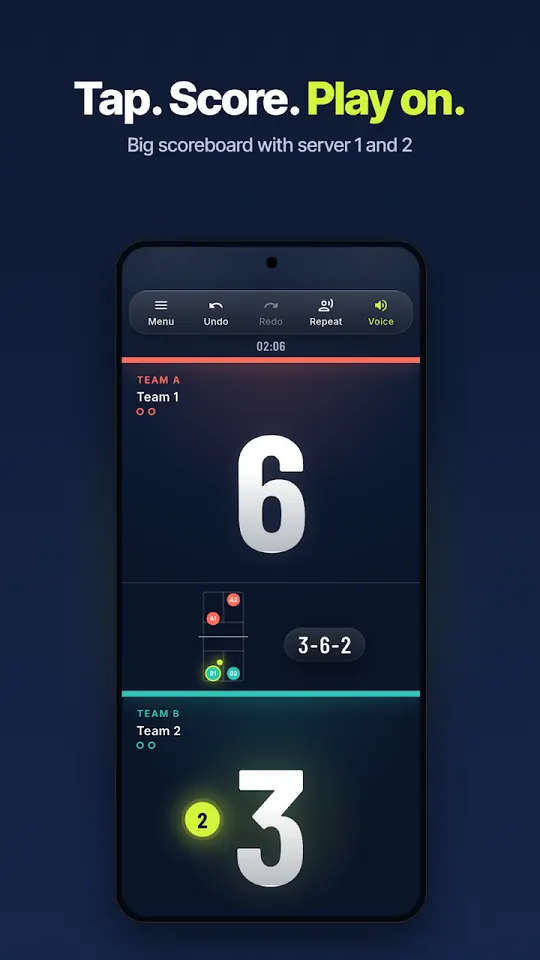
Tap, score, play on 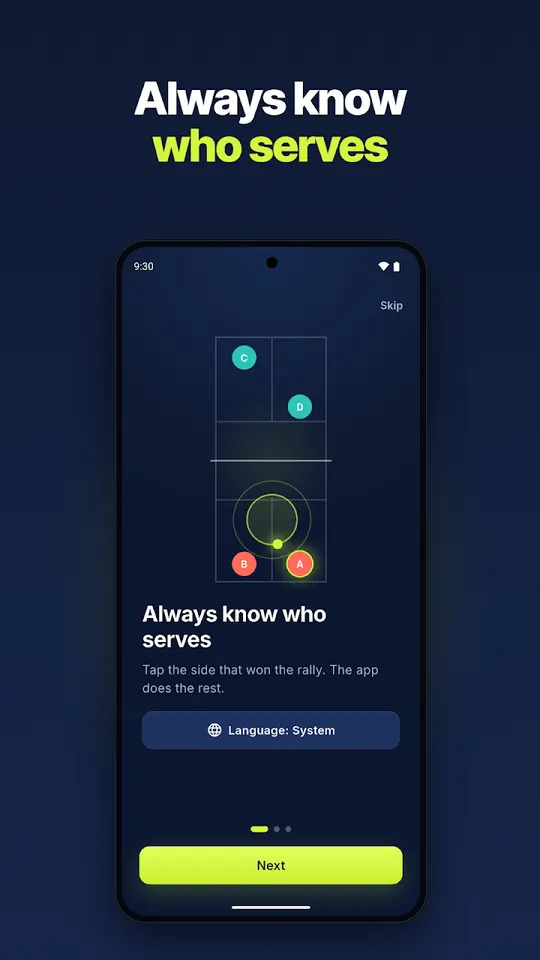
Always know who serves 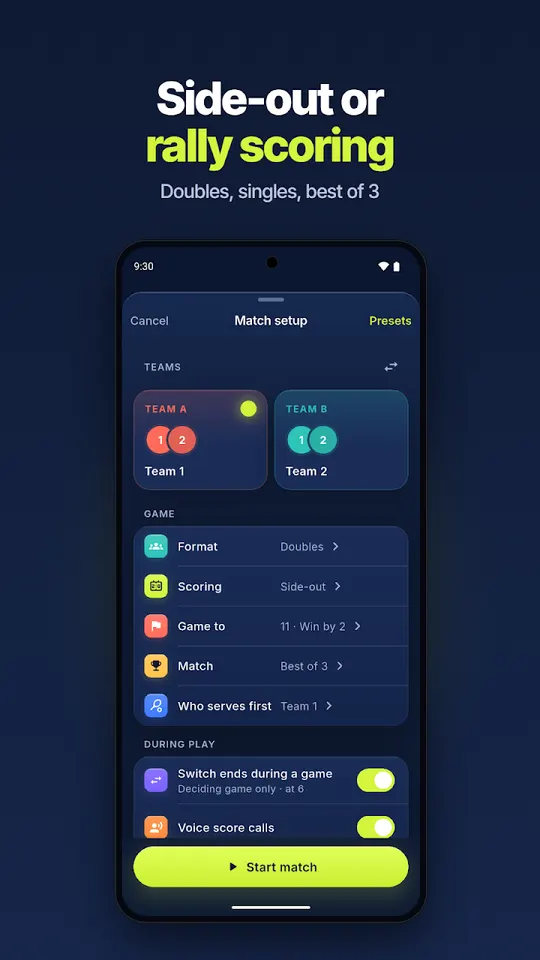
Side-out or rally scoring 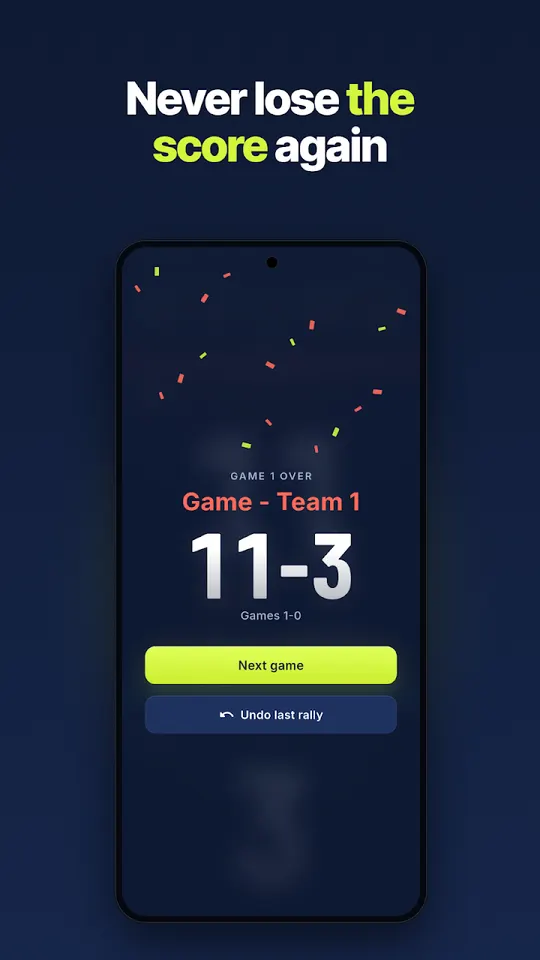
Game over, next game 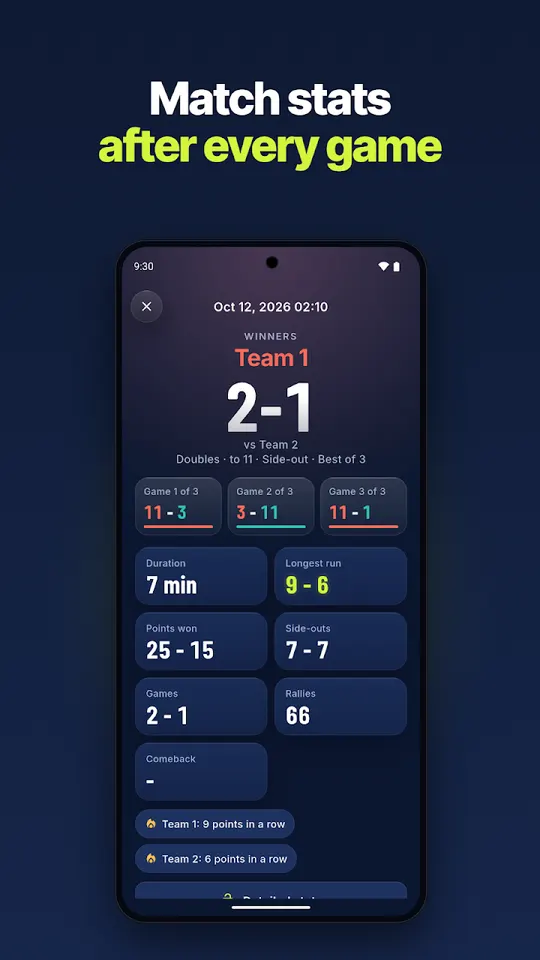
Match stats after every game 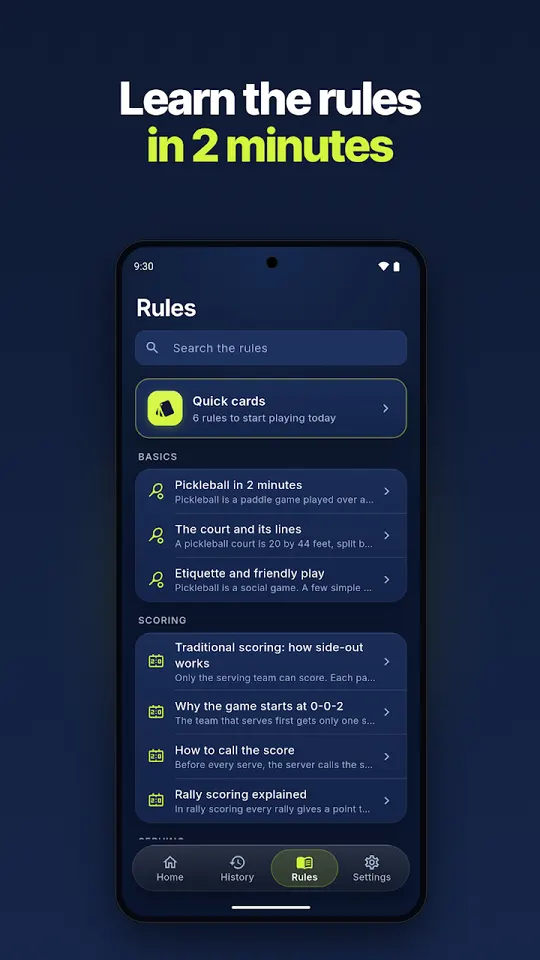
Learn the rules in 2 minutes 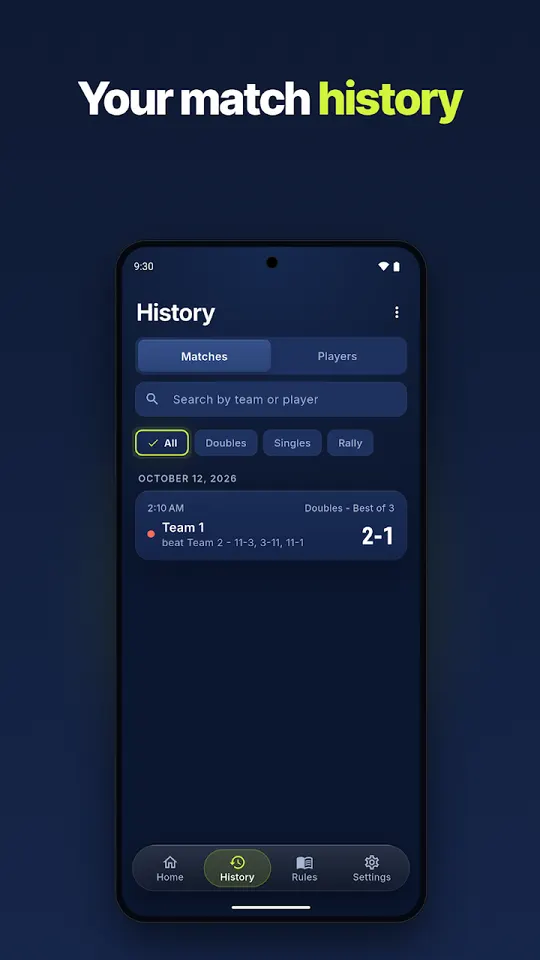
Your match history 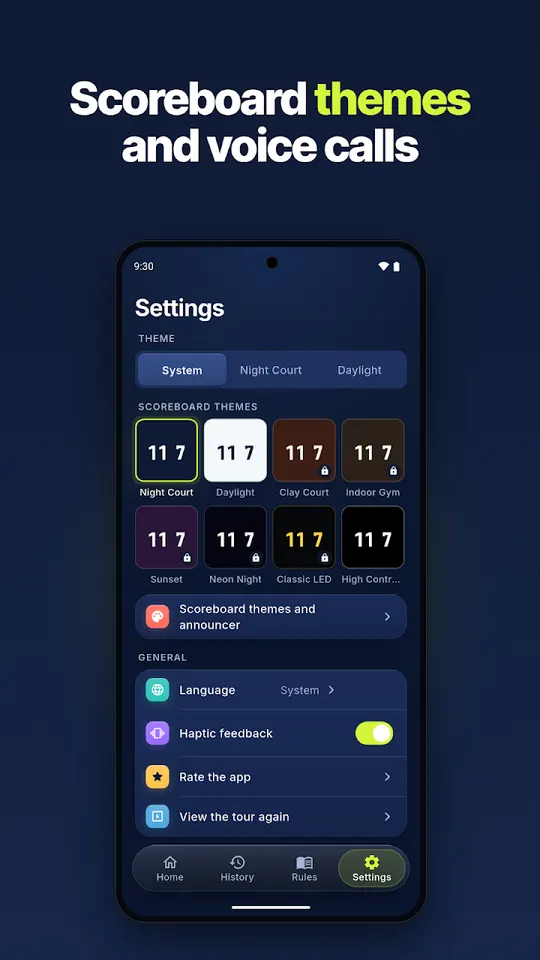
Scoreboard themes and voice calls
How do you keep score in pickleball?
In standard pickleball only the serving team can score. If the server's team wins the rally, it gets a point and the same player serves again from the other side. If it loses the rally, no one scores: the serve passes on. In doubles, the score is called as three numbers, the serving team's score, the receiving team's score and the server number, so a game starts at 0-0-2. The first team to 11 points with a lead of at least 2 wins the game (rules 4.A and 15.C of the 2026 USA Pickleball rulebook).
The scorekeeper above follows exactly this. Tap the team that won the rally and it moves the score, the server and the players for you.
What do the three numbers in the pickleball score mean?
The first number is the serving team's score, the second is the receiving team's score and the third is the server number, 1 or 2. At 4-2-1 the serving team has 4 points, the other team has 2, and the first server of this turn is serving. Singles has no server number, so the call is only two numbers, the server's score and then the receiver's (rules 6.B.1 and 6.B.2). The server normally calls the score, and the whole call has to be finished before the ball is served.
That order is the answer to the old argument of 4-2-1 against 2-4-1: the serving team's number always comes first.
Why does a doubles game start at 0-0-2?
Because the team that serves first gets only one turn at the start. The rulebook says that at the start of each game only the starting server serves as a second server before a side out is declared, so the first call is "zero, zero, two" (rules 5.B and 6.B.2). If that server's team loses the first rally, the serve goes straight to the other team. After that, every team that gets the serve plays two servers: server 1, then its partner as server 2.
Pickleball scoring example, rally by rally
Here is a game of doubles with side-out scoring, played by the same engine as the scorekeeper. Team A serves first. Watch the call change: points only go to the serving team, a lost rally by server 1 gives the partner a turn, and a lost rally by server 2 is a side out.
| Rally | Won by | Serving next | Call | What happened |
|---|---|---|---|---|
| 1 | Team A | Team A | 1-0-2 | Serving team wins the rally and scores. |
| 2 | Team A | Team A | 2-0-2 | Serving team wins the rally and scores. |
| 3 | Team B | Team B | 0-2-1 | The serving team loses the rally. The serve passes, no point. |
| 4 | Team B | Team B | 1-2-1 | Serving team wins the rally and scores. |
| 5 | Team A | Team B | 1-2-2 | Server 1 loses the rally, so the partner serves. No point. |
| 6 | Team B | Team B | 2-2-2 | Serving team wins the rally and scores. |
| 7 | Team A | Team A | 2-2-1 | The serving team loses the rally. The serve passes, no point. |
| 8 | Team A | Team A | 3-2-1 | Serving team wins the rally and scores. |
| 9 | Team A | Team A | 4-2-1 | Serving team wins the rally and scores. |
| 10 | Team A | Team A | 5-2-1 | Serving team wins the rally and scores. |
Rally 9 is the 4-2-1 of the example above: Team A has 4, Team B has 2, and Team A's server 1 is serving.
Which side does the server serve from?
In singles the server serves from the right court when their own score is zero or even, and from the left when it is odd (rule 5.A.1). In doubles, each team's players start on the same sides every time the score changes: when the team's score is even the starting server stands on the right and the partner on the left, and when it is odd they have swapped (rule 5.B.4). After a side out, the first server is the player standing on the right, and the same player moves left and right after each point until the team loses a rally. The second server serves from the court where they stand.
The receiver always stands in the court diagonally across, the one with the same name from the receiver's side: a serve from the right goes to the opponent's right court. The court drawing in the tool shows the server with a lime ring and the receiver with a dashed ring after every rally.
What is the difference between side-out scoring and rally scoring?
| Rule | Side-out (standard) | Rally (provisional option) |
|---|---|---|
| Who scores | Only the serving team | The team that wins the rally, serving or not |
| Score call in doubles | Three numbers, like 4-2-1 | Two numbers, like 12-9 |
| Servers per turn | Two in doubles, except the first turn of a game | One in doubles, then a side out |
| Game start | 0-0-2 in doubles, 0-0 in singles | 0-0 |
| Typical game | To 11, win by 2 | To 15 or 21, win by 2 (your group decides) |
Rule 14.A calls rally scoring a provisional option, so a league or tournament may not use it. Its serving rules are short: the server alternates courts after each point and serves until a rally is lost, then a side out is declared and service begins with the player on the right for the team's score (rules 14.A.4 and 14.A.5). Here is a short game to 15:
| Rally | Won by | Serving next | Call | What happened |
|---|---|---|---|---|
| 1 | Team A | Team A | 1-0 | Serving team wins the rally and scores. |
| 2 | Team B | Team B | 1-1 | The receiving team wins the rally, scores and takes the serve. |
| 3 | Team B | Team B | 2-1 | Serving team wins the rally and scores. |
| 4 | Team A | Team A | 2-2 | The receiving team wins the rally, scores and takes the serve. |
| 5 | Team A | Team A | 3-2 | Serving team wins the rally and scores. |
| 6 | Team B | Team B | 3-3 | The receiving team wins the rally, scores and takes the serve. |
How many points do you need to win a pickleball game?
Eleven, and you must lead by two. A game to 11 therefore goes on until one side is at least two points ahead, so 12-10 and 15-13 are normal results. The rulebook's tournament formats also allow one game to 15 or 21, all win by two, and win by one only for team play (rule 15.C). Matches are best 2 of 3 or best 3 of 5 games to 11, or a single game, as set by the event.
In the tool, set Game to and Win by under Rules. A game point mark appears next to the server whenever the next rally would end the game. With side-out scoring that can only be the serving team.
When do you switch ends in pickleball?
In a single game, and in the deciding game of a match, the players change ends when the first side reaches 6 in a game to 11, 8 in a game to 15 or 11 in a game to 21. The server does not change, and up to one minute is allowed (rule 21.B). Between games the teams change ends and the initial service as well (rule 21.F.2). Teams may also change the starting server between games.
The scorekeeper shows a banner at that score and swaps the two sides on the screen when you press the button, or press Swap sides at any time to flip them by hand.
How does scoring work in singles?
Singles uses the same points but no server number. The server serves from the right when their own score is even and from the left when it is odd, and keeps serving until they lose a rally. A lost rally is a side out and the serve passes to the opponent (rules 5.A.1 to 5.A.3). The game starts at zero-zero.
Common scoring mistakes, and what the rulebook says
- Calling the receiving team's score first. The serving team's score is always first (rule 6.B).
- Giving a point to the team that did not serve. In side-out scoring the receiving team that wins a rally only gets the serve (rule 4.A).
- Forgetting that the game starts with one server. At 0-0-2 the first lost rally is already a side out (rule 5.B).
- Serving before the call is finished. The entire score has to be called first; hitting the serve during the call is a fault against the server (rule 6.C.1). The server then has 10 seconds after the call to serve (rule 6.D).
- Serving or receiving from the wrong side. If a player stops the rally to point out the error and is right, the rally is replayed; if the claim is wrong it is a fault against the player who stopped play. When the error is only noticed after the rally is over, the result stands (rules 5.C.1 and 5.C.2).
If your group loses the thread, fix it with the scorekeeper: undo the last rally, or use Repeat call to hear the score again without changing anything.
Two things that matter for the serve: the two-bounce rule and the kitchen
After the serve, the receiver must let the ball bounce before the first return, and the serving team must let it bounce before its first return too. This is the two-bounce rule. The non-volley zone, called the kitchen, extends 7 feet from the net on each end, and a player may not hit the ball out of the air while standing in it. A serve that lands in the non-volley zone is a fault against the server (rules 7.E.2 and the introduction to the rulebook). The scorekeeper does not judge these, it only keeps the score.
Pickleball scoring terms
- Side out
- The serve passes to the other team after a team loses its turn to serve.
- Server 1 and server 2
- The two players of a doubles team serve in turn. The first server is the player on the right after a side out; the partner is the second server.
- Starting server
- The player who serves first at the start of a game. They serve as the second server of the first turn, which is why the game opens at 0-0-2.
- Fault
- A rules violation that makes the ball dead and loses the rally for the team at fault.
- Replay
- The rally restarts with no point and no change of server.
- Game point
- A rally that would end the game if the team in question wins it.
Sources
The rules above are in my own words from the 2026 USA Pickleball Official Rulebook, opened on 2026-11-01: rules 4, 5, 6, 7.E.2, 14.A, 15.C, 21.B and 21.F. The scorekeeper is an independent tool made for recreational play and is not affiliated with or endorsed by USA Pickleball or any league. Your tournament may use its own rules; ask the referee.
Questions
How do you keep score in pickleball?
Only the serving team scores. When it wins a rally it gets a point and the same player serves again from the other court; when it loses, the serve passes and nobody scores. In doubles you call three numbers, the serving score, the receiving score and the server number, and the game starts at 0-0-2.
What does 0-0-2 mean in pickleball?
Zero points each, and the server is the second server. The team that serves first gets only one turn at the start of a game, so if it loses the first rally the serve goes straight to the other team. After that, each team serves with server 1 and then server 2.
What is the difference between server 1 and server 2?
They are the two players of a doubles team serving in turn. After a side out the player on the right serves first as server 1. When that team loses a rally, the partner serves as server 2, and when server 2 loses a rally it is a side out.
Can you score when you are not serving?
Not in standard scoring: the receiving team only wins the serve. With rally scoring, which the rulebook lists as a provisional option, the team that wins the rally gets the point whether it served or not.
How many points do you need to win a pickleball game?
Eleven, and a lead of at least two. If it is 10-10 the game continues until a team is two ahead, so 12-10 or 14-12 are normal results. Some formats play to 15 or 21 and team events can win by one.
How do you score pickleball singles?
The same way without the server number: you call two numbers, the server's score and then the receiver's. The server serves from the right court when their score is even and from the left when it is odd, and the game starts at zero-zero.
When do you switch sides in pickleball?
In a single game, or the deciding game of a match, when the first team reaches 6 in a game to 11, 8 in a game to 15 or 11 in a game to 21. Teams also change ends between games. The server does not change at the mid-game switch.
Does the scorekeeper call the score out loud?
Yes, if you turn on Voice. The tool on this page reads the call after every rally, and the Android app also announces side out, second server, game point and switch ends, and turns your music down while it speaks.
Is the Pickleball Scorekeeper app free and does it work offline?
Yes to both. It is free with ads, needs no account and works offline. Ads never appear on the scoreboard; one short video can switch all ads off for 10 minutes.

Stop arguing about the score
Free on Android, in 25+ languages. No account, works offline, and ads never appear on the scoreboard. An independent app, not affiliated with any pickleball federation, league or tour.
Facts from the Google Play listing, last checked .