Pool chemical calculator: what to add, how much and in what order
Enter your pool size and the numbers from your test kit and the calculator below gives an ordered dosing plan: which product, how much of it, what else each dose changes and when to retest before the next one. The chlorine target follows your cyanuric acid level. The free Android app adds several pools, a test history with charts and reminders.
Pool dosing plan
Test readings in, an ordered list of what to add out
Your plan for 15,000 gal
Free chlorine 3+ ppm minimumtarget 5 to 7 ppmshock level 16 ppm
Step 1 of 3
Raise total alkalinity
Baking soda (sodium bicarbonate)
6.31 lb
Alkalinity 60 → 90 ppm
- Can nudge pH up a little: retest pH before dosing for it.
Run the pump for at least 30 minutes and retest before the next chemical.
Step 2 of 3
Lower pH
Muriatic acid (hydrochloric)
30.8 fl oz
pH 7.9 → 7.5
- Also lowers alkalinity by about 8 ppm.
Pour slowly in front of a return with the pump running, never into the skimmer. Retest after at least 30 minutes.
Step 3 of 3
Raise free chlorine
Liquid chlorine (sodium hypochlorite)
76.8 fl oz
Free chlorine 1 → 6 ppm
- Adds a little salt and raises pH slightly.
Run the pump, then retest free chlorine with a DPD kit before anyone swims.
| Reading | Value | Range used | State |
|---|---|---|---|
| Free chlorine | 1 ppm | 3+ ppm (target 5 to 7) | Low |
| Combined chlorine | 0 ppm | 0 to 0.5 ppm | In range |
| pH | 7.9 | 7.2 to 7.8 | High |
| Total alkalinity | 60 ppm | 70 to 120 ppm | Low |
| Calcium hardness | 250 ppm | 200 to 400 ppm | In range |
| Cyanuric acid | 40 ppm | 30 to 60 ppm | In range |
Saturation index +0.02. Balanced: within ±0.3 of zero.
A calculator, not a test. It works from the readings you type, does not test or monitor your water and does not say when it is safe to swim. Follow the label on every product, never mix chemicals, add each one separately with the pump running, and retest before anyone gets in.
From one plan to a whole season
This page works out one plan at a time. The Android app keeps every pool and hot tub with its own volume and history, so you can see what the water did last week and what to add today:
- Free chlorine, combined chlorine, pH, total alkalinity, calcium hardness, cyanuric acid and salt in, an ordered plan out, in the units your products come in
- Volume wizard for rectangular, oval, round and kidney shapes, or a volume you already know
- Several pools and hot tubs, each with its own volume, surface, sanitizer and history
- Liquid chlorine, calcium hypochlorite, trichlor, dichlor and lithium hypochlorite with adjustable strength, plus acids, baking soda, soda ash, calcium chloride, cyanuric acid and salt
- Side effects on every dose, safety caps and wait steps between chemicals that should not be added together
- Chlorine target worked out from your cyanuric acid level, a breakpoint target when combined chlorine is present and dilution estimates when stabiliser, calcium or salt are too high
- Saturation index from pH, temperature, hardness, alkalinity and dissolved solids, with alkalinity corrected for cyanuric acid and borate
- Test history with charts, optional reminders and short guides on cloudy water, green water, pH, salt generators and hot tubs; US and metric units

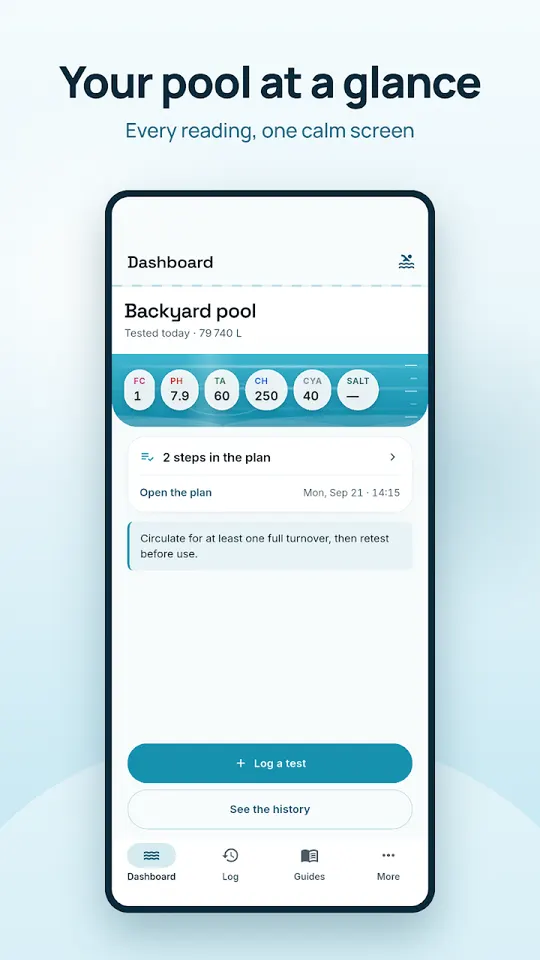
Every reading on one calm screen 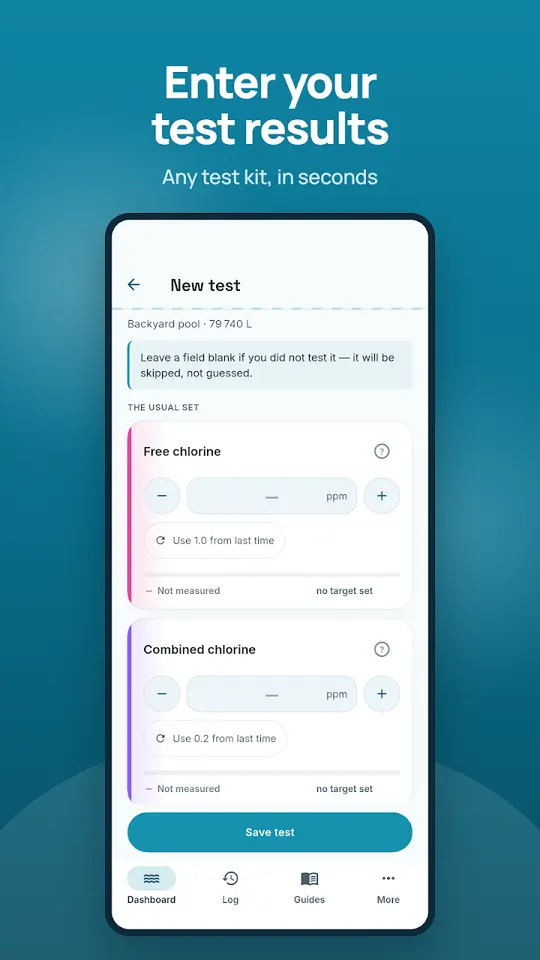
Enter results from any test kit 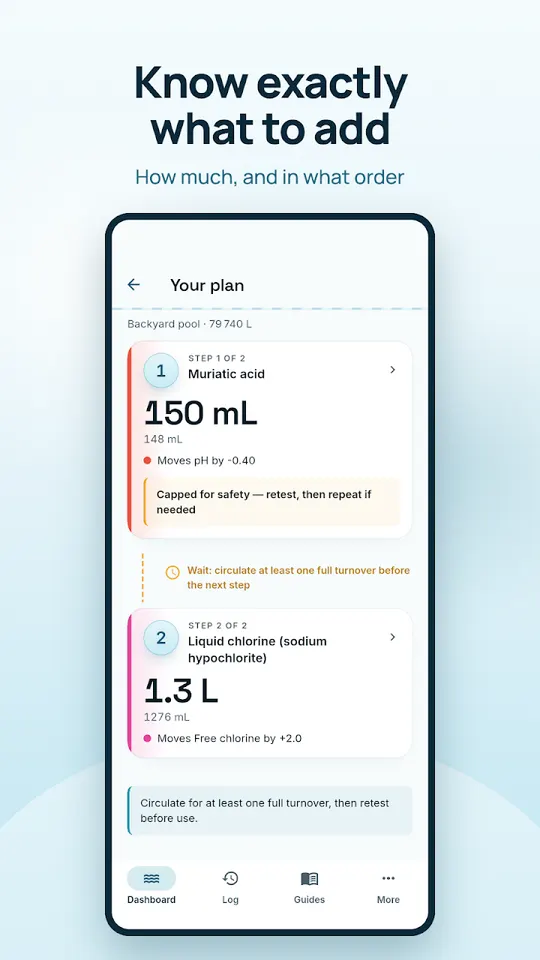
How much to add, and in what order 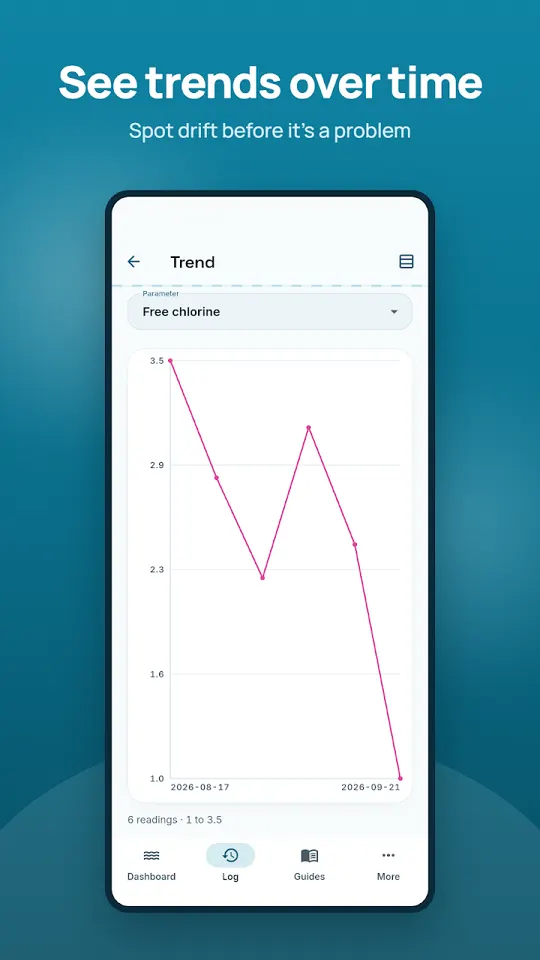
Spot drift before it is a problem 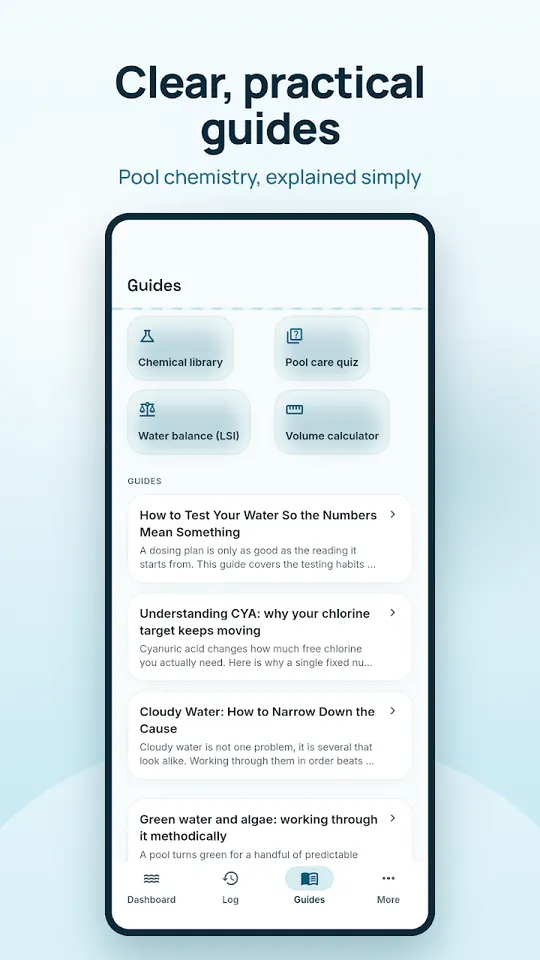
Practical guides
How the dosing plan is worked out
A test kit gives you numbers, not a shopping list. The calculator above turns each reading into an amount of a product, in the order that makes sense, and says what else each dose changes. Three rules sit behind it.
- Chemistry first. One ppm is one milligram per litre. Alkalinity and hardness are counted as calcium carbonate, so a dose is the equivalents you need times the equivalent weight of the product. That is how baking soda, calcium chloride, cyanuric acid, salt and the acids are worked out, and the results match the published rules of thumb below within 10%.
- Published figures where chemistry cannot decide. How far a dose of acid moves pH depends on the water, and sources disagree: about 5 fl oz of 31% acid per 0.1 pH per 10,000 gal in one, 6.4 fl oz in another. The calculator uses the low end, so a dose undershoots instead of overshooting.
- Caps and a retest. No step moves a reading further than a set amount, and the plan tells you to run the pump and retest before the next chemical. If a step is capped, it says so and tells you to repeat it after the retest.
It does not test your water, it cannot see algae and it does not know when it is safe to swim. It only knows what you typed in.
How much chlorine does it take to raise free chlorine?
To raise free chlorine by 1 ppm you need 1 mg of available chlorine per litre of water, whatever the product. What changes is how much product that is, because each one carries a different share of chlorine. In 10,000 gallons that is 37.9 g of chlorine per ppm.
| Product | Per 10,000 gal | Per 10,000 L | Also adds, per ppm |
|---|---|---|---|
| Liquid chlorine 10% | 12.8 fl oz | 100 mL | A little salt |
| Liquid chlorine 12.5% | 10.2 fl oz | 80 mL | A little salt |
| Calcium hypochlorite 65% | 2.05 oz | 15.4 g | 0.71 ppm calcium hardness |
| Dichlor 56% | 2.38 oz | 17.9 g | 0.91 ppm cyanuric acid |
| Trichlor 90% | 1.48 oz | 11.1 g | 0.61 ppm cyanuric acid |
For the Multnomah County Health Department the figures are 1 pint of 10% liquid chlorine and 2 oz of 65% granular chlorine per ppm in 10,000 gallons. The granular figure matches; the pint is a little more than the 12.8 fl oz the chemistry gives, which is why the calculator treats the percentage on a label as grams of chlorine per 100 mL. If your label gives percent by weight, a litre of that product carries slightly more chlorine than the calculator assumes, so the dose errs on the high side of the chemistry and the plan still asks you to retest.
Cal-hypo, dichlor and trichlor each leave something behind. Cal-hypo adds calcium, so a pool that gets all its chlorine from it climbs in hardness. Dichlor and trichlor add cyanuric acid, and trichlor also lowers pH and alkalinity. The calculator lists these under every dose.
What free chlorine level do I need for my cyanuric acid?
Cyanuric acid (CYA, stabiliser) shields chlorine from sunlight, and it also slows chlorine down. The more of it there is, the more free chlorine you need to keep the same sanitising power. A fixed number such as 3 ppm is only right for one CYA level. The chart below is the one the Trouble Free Pool community publishes, and the calculator interpolates between its rows.
| CYA | Minimum | Target | Salt: minimum | Salt: target | Shock level |
|---|---|---|---|---|---|
| 20 | 2 | 3 to 5 | 2 | 3 to 5 | 8 |
| 30 | 2 | 4 to 6 | 2 | 3 to 6 | 12 |
| 40 | 3 | 5 to 7 | 2 | 3 to 7 | 16 |
| 50 | 4 | 6 to 8 | 2 | 3 to 8 | 20 |
| 60 | 5 | 7 to 9 | 3 | 4 to 9 | 24 |
| 70 | 5 | 8 to 10 | 3 | 5 to 10 | 28 |
| 80 | 6 | 9 to 11 | 4 | 6 to 11 | 31 |
| 90 | 7 | 10 to 12 | 4 | 6 to 12 | 35 |
| 100 | 8 | 11 to 13 | 5 | 7 to 13 | 39 |
As rules of thumb: the minimum is about 7.5% of the CYA level (5% with a salt generator), the target about 11.5% and the shock level about 40%. The community recommends a CYA of 30 to 60 for liquid chlorine and 60 to 90 for salt generators; the CDC asks only for at least 1 ppm of chlorine in a pool and at least 3 ppm in a hot tub. Where the two sources differ, the calculator follows the chart for pools, because the chart accounts for the stabiliser the CDC figure ignores. The chart is the Trouble Free Pool community's approach, not a code or a standard, and some local health rules differ. Follow yours if you run a public pool.
Cyanuric acid only goes down by replacing water. If yours is high the calculator gives the share of water to change instead of a product to add, and assumes the fill water has none.
How much muriatic acid lowers pH?
The honest answer is: it depends, and published figures differ by about 30%. Pool Nerd gives 6.4 fl oz of 31.45% muriatic acid per 0.1 of pH in 10,000 gallons; Poolonomics gives 5 fl oz of 31% and 10 fl oz of 15%. Alkalinity plays a part, because the acid is working against the buffer. The calculator starts from the lower figure and caps a step at 0.4 pH, because it is easy to add a bit more after a retest and impossible to take it back.
| Acid strength | pH −0.1 | pH −0.2 | pH −0.4 |
|---|---|---|---|
| 31.45% | 5.13 fl oz | 10.3 fl oz | 20.5 fl oz |
| 20% | 8.49 fl oz | 17 fl oz | 33.9 fl oz |
| 14.5% | 12 fl oz | 24 fl oz | 48 fl oz |
Every dose of acid also lowers total alkalinity. The calculator works that out by the equivalents: 32.1 fl oz of 31.45% acid lowers alkalinity by 12.5 ppm in 10,000 gallons, the same as the quart in the Multnomah sheet. Dry acid (sodium bisulfate) is dosed by the same equivalents, so it takes more weight than the liquid takes in volume. Enter the strength from your label.
To raise a low pH the calculator uses soda ash, about 7 oz per 0.2 pH in 10,000 gallons (Swim University gives 6 to 8 oz), which adds about 5 ppm of alkalinity on the way.
Safe handling, in the words the sources agree on:
- Add acid to water, never water to acid. Pour slowly in front of a return with the pump running, and never into the skimmer.
- Never mix acid with chlorine or any other chemical outside the pool. Add each one separately.
- Wear gloves and eye protection, and keep swimmers out of the water.
- Add part of the dose, circulate and retest. Pool Nerd, Poolonomics and the Multnomah sheet all say it is better to add less and repeat.
Alkalinity, calcium hardness, stabiliser and salt
These four move slowly and are corrected rarely, so the plan treats them with the same rules: work out the equivalents, cap the step and retest. The table gives the amounts the calculator uses for a 10,000 gallon pool and for 10,000 litres.
| To raise | Product | Per 10,000 gal | Per 10,000 L |
|---|---|---|---|
| Alkalinity by 10 ppm | Baking soda | 1.4 lb | 168 g |
| Calcium hardness by 10 ppm | Calcium chloride, 94% | 15.8 oz | 118 g |
| Cyanuric acid by 10 ppm | Cyanuric acid | 13.4 oz | 100 g |
| Salt by 1,000 ppm | Pool salt, 99% | 84.3 lb | 10.1 kg |
Multnomah County gives 1.5 lb of baking soda per 10 ppm of alkalinity and 1 lb of calcium chloride per 11 ppm of hardness in 10,000 gallons. The chemistry gives 1.4 lb and, for pure calcium chloride, 1 lb per 10.8 ppm. The calculator uses the chemistry, which is slightly lower, so it errs on the side of adding less.
The ranges it works to are below. Sources differ, so they are not a standard. Alkalinity is the loosest: published ranges run from 60 to 90, 80 to 120 and 80 to 150 ppm, and the calculator uses 70 to 120 with a target of 90.
| Reading | Range | It aims for | Source |
|---|---|---|---|
| pH | 7.2 to 7.8 | 7.5 | CDC infographic; the CDC page gives 7.0 to 7.8 |
| Total alkalinity, ppm | 70 to 120 | 90 | Calculator rule between published ranges |
| Calcium hardness, plaster, ppm | 200 to 400 | 300 | Multnomah County |
| Calcium hardness, vinyl or fibreglass, ppm | 175 to 300 | 240 | Multnomah County |
| Cyanuric acid, ppm | 30 to 60 (salt generator 60 to 90) | 40 (70) | Trouble Free Pool |
| Salt, ppm | 2700 to 4000 | 3200 | PoolChem Tracker; follow your generator's manual |
Cloudy water, a strong chlorine smell and breakpoint chlorination
A strong "chlorine" smell and stinging eyes usually point to combined chlorine (chloramines), not to too much chlorine. Chloramines form when chlorine combines with nitrogen compounds from swimmers and the environment. The Multnomah County sheet says they are ineffective as a disinfectant, irritate the eyes, encourage algae and bacteria and cause the smell, and that combined chlorine should be kept as low as possible and no higher than 0.5 ppm.
The fix is breakpoint chlorination: add enough chlorine to reach ten times the combined chlorine reading. The sheet's example: 0.8 ppm of combined chlorine calls for 8 ppm of free chlorine, which in a 30,000 gallon pool takes 3 lb of 65% calcium hypochlorite. Do it with the pool closed, and keep swimmers out until free chlorine has fallen back. The calculator does this when you enter combined chlorine above 0.5 ppm, but never past the shock level for your cyanuric acid, because the Trouble Free Pool chart says to keep free chlorine at or below it. When a step is capped, repeat it after the retest.
If the water is cloudy or green, the sources point to the same short list to check first:
- Free chlorine below the minimum for your CYA, so the water cannot keep up.
- Combined chlorine above 0.5 ppm.
- pH above 7.8: high pH cloudies water and makes chlorine less effective.
- Hardness and alkalinity so high that the water scales (see the saturation index below).
The calculator checks all four from your readings. It cannot see algae, so a green pool still needs a good look, a brush and a filter that is running.
How many gallons is my pool?
Every dose scales with the volume, so a wrong volume is the biggest source of error. The volume wizard uses the average of the shallow and deep depth and these shapes:
- Rectangular: length × width × average depth.
- Oval: π/4 × length × width × average depth, which is about 0.785 of the rectangle.
- Round: π/4 × diameter² × average depth.
- Kidney: about 0.9 × length × width × average depth, an estimate.
One cubic foot is 7.48 US gallons and one cubic metre is 1,000 litres. A pool with a steep slope or a deep end that holds most of the water is not captured by an average, so if you know the volume from the builder, enter that instead. Your meter or a fill record is better than any formula.
Hot tubs
The CDC recommends at least 3 ppm of chlorine in a hot tub, against 1 ppm in a pool, a pH of 7.0 to 7.8, testing at least twice a day, and no cyanuric acid or chlorine products that contain it in a hot tub. So the tub setting of the calculator ignores the CYA reading, swaps trichlor and dichlor for liquid chlorine, uses 3 ppm as its minimum and caps a chlorine step at 5 ppm. Its dosing target of 4 ppm is a calculator choice, not a CDC figure. Tubs hold little water, so check your volume and measure small amounts carefully.
What is the saturation index?
The Langelier saturation index (LSI) says whether the water tends to deposit calcium (positive) or to dissolve it from plaster and metal (negative). It is pH minus the pH at which the water would be exactly saturated, which depends on temperature, calcium hardness, alkalinity and dissolved solids: pHs = 9.3 + A + B − (C + D), with A from the dissolved solids, B from the temperature, C from the calcium hardness and D from the alkalinity. In a pool the alkalinity used is the carbonate alkalinity, which is total alkalinity minus the share that comes from cyanuric acid, about a third of the CYA reading near pH 7.6. Orenda treats a range of −0.3 to +0.3 as balanced.
The calculator reports it when you enter pH, alkalinity, calcium hardness and the water temperature. Without a dissolved solids reading it assumes 1,000 ppm, plus any salt you entered. The result is a guide to which way the water is leaning, not a precise value, and it does not change the plan.
What the Android app adds
This page gives you one plan at a time. The app keeps going: pools and hot tubs each with their own volume, surface, sanitizer and history, every test saved so you can see a season, charts of each reading, optional test reminders on days and times you choose, and short guides on cloudy water, green water, salt generators, stabiliser and handling chemicals. It works in US and metric units and converts your saved history when you switch. The app has its own dose model and ranges, so its amounts can differ from the ones on this page. Follow the app, or your product label, over this page.
- It calculates on the device. There is no account and nothing is uploaded.
- It is free with ads and has no in-app purchase. Watching one short video switches all ads off for five minutes.
- Like this page, it works from the readings you enter. It does not test or monitor water and does not say when it is ready to use.
Sources and limits
These are the pages the figures come from, opened for this page. Dose figures differ between sources, so treat the plan as a starting point and always follow the label on the product you hold.
- CDC: Home Pool and Hot Tub Water Treatment and Testing: pH, minimum chlorine, no cyanuric acid in hot tubs, testing twice a day.
- Multnomah County Health Department, Water Treatment: Swimming Pools (EHS-0058, 2016): combined chlorine, breakpoint chlorination, doses per 10,000 gallons, ranges for pH, alkalinity and hardness, safe handling.
- Trouble Free Pool: The Free Chlorine and Cyanuric Acid Relationship and its wiki page: the chlorine chart and the percentages.
- The Pool Nerd: Pool Acid Calculator and Poolonomics: How to Lower pH In a Pool: acid per 0.1 pH, strength scaling, alkalinity per cycle.
- Swim University: How Much of Each Chemical to Add to Your Pool: soda ash, baking soda and calcium chloride doses.
- Orenda: Understanding LSI and Wikipedia: Hard water: the saturation index equation and the cyanuric acid correction.
- PoolChem Tracker: pool chemistry cheat sheet: salt and stabiliser ranges.
Not covered: bromine, minerals, borates, phosphate and metal treatments, algae treatments and commercial or public pools, which have their own rules. For a heavily stained or green pool, or any case that does not match the readings, ask a pool professional. See every Android app from the studio for the rest of the set.
Questions
How much chlorine do I add to raise free chlorine by 1 ppm?
In 10,000 gallons it takes about 10 fl oz of 12.5% liquid chlorine, 12.8 fl oz of 10%, or 2 oz of 65% calcium hypochlorite. The calculator scales this to your volume and the strength on your label.
How much muriatic acid do I need to lower pH?
Published figures run from about 5 to 6.4 fl oz of 31% acid per 0.1 of pH in 10,000 gallons, and alkalinity changes the answer. Add part of the dose with the pump running, wait, retest and repeat. The calculator starts from the low end and caps every step.
What should my free chlorine be for my cyanuric acid level?
It rises with the stabiliser. The Trouble Free Pool chart gives a minimum of about 7.5% of the CYA level and a target of about 11.5%: for a CYA of 40 that is 3 ppm and 5 to 7 ppm. The calculator reads the chart for you.
What is breakpoint chlorination?
Raising free chlorine to ten times the combined chlorine reading to clear chloramines, the cause of a strong chlorine smell. With 0.8 ppm of combined chlorine the aim is 8 ppm. Do it with the pool closed and keep swimmers out until it falls.
Can I add several chemicals at once?
No. Add each one separately with the pump running and never mix them outside the pool. The plan puts a wait and a retest between steps for that reason. Never mix acid with chlorine.
Does a hot tub need cyanuric acid?
The CDC advises against cyanuric acid, and chlorine products that contain it, in hot tubs, and recommends at least 3 ppm of chlorine there. The calculator ignores the CYA reading for a hot tub and uses liquid chlorine instead of trichlor or dichlor.
Is the Pool Chemistry Calculator app free?
Yes. It is free with ads, has no subscription or in-app purchase and needs no account. One short video switches all ads off for five minutes. It works from the readings you enter and does not test your water.

Take the plan to the pool
Free on Android, with ads. No subscription, no account and nothing locked. Everything is calculated on your device.
Facts from the Google Play listing, last checked .