Recorder fingering chart for the soprano, with a mic note check
Pick any note from C5 to A6 and see which holes to cover on a drawn recorder, with a switch for baroque or German fingering. Press Hear it for a reference tone, or play the note and let the microphone check say whether it lands. The free Android app adds 24 lessons, 65 songs and an alto recorder, offline.
Soprano recorder fingering chart
Pick a note, see which holes to cover
Baroque fingering
G5
Cover the thumb hole, hole 1, hole 2 and hole 3.
- covered
- open
- half
Note
Check my note
Play G5 and see whether it lands. The sound is analysed in your browser and is never recorded or sent anywhere.
Tuned to A4 = 440 Hz. Recorders vary, so a few cents either way is normal.
Learn the recorder on your phone
This page is the chart and the note check in the browser. The Android app keeps the chart and the note check with you and adds lessons, songs that wait for your note and practice tracking, all offline:
- Interactive fingering chart for the soprano recorder (C) from low C to high D, with sharps and flats, alternative fingerings, half holes and the pinched thumb; the alto recorder (F) too
- Baroque and German fingering, both free
- Live note detection with the microphone: the note you played, how many cents sharp or flat, and a hint when you jump an octave or a finger is in the wrong place
- 24 step-by-step lessons for beginners: holding the recorder, breath, tonguing, B A G, high C and D, low notes, F and F sharp, the high register and B flat
- 65 public domain songs graded by the notes you know, with three ways to play: listen first, wait for me or play in time with a score
- Tempo from 40% to 120%, loop any bars and the fingering of every note shown as you play
- Reference tone for every note, A4 calibration from 415 to 466 Hz and a metronome from 30 to 240 BPM
- Practice streak, stars for lessons and songs, a practice history you can export, light and dark themes and tablet layouts

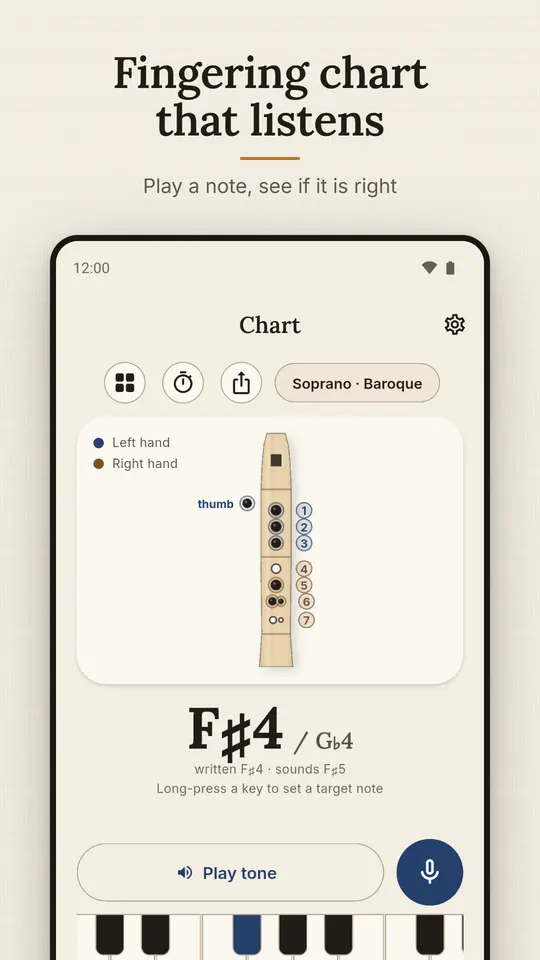
A chart that listens 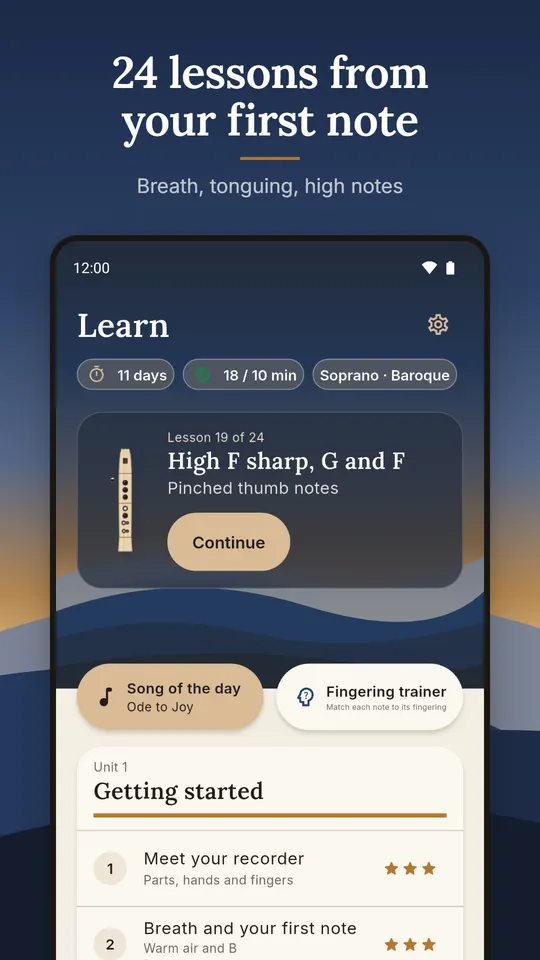
24 lessons from your first note 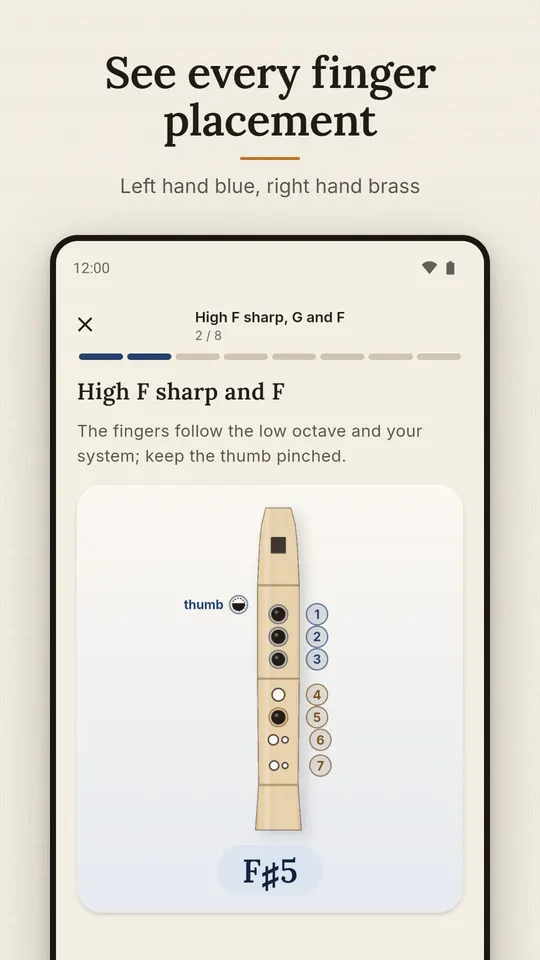
Every finger placement 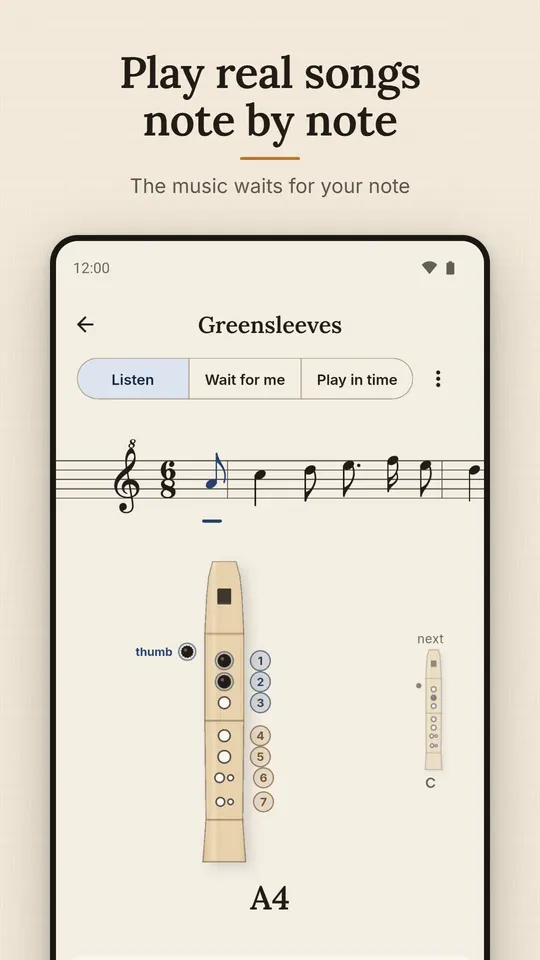
Songs that wait for your note 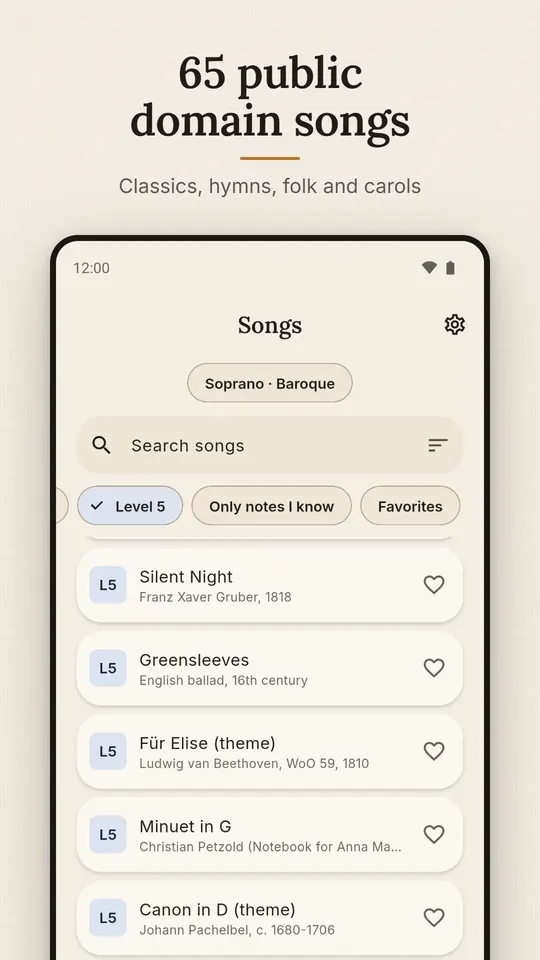
65 public domain songs 
Stars for every lesson 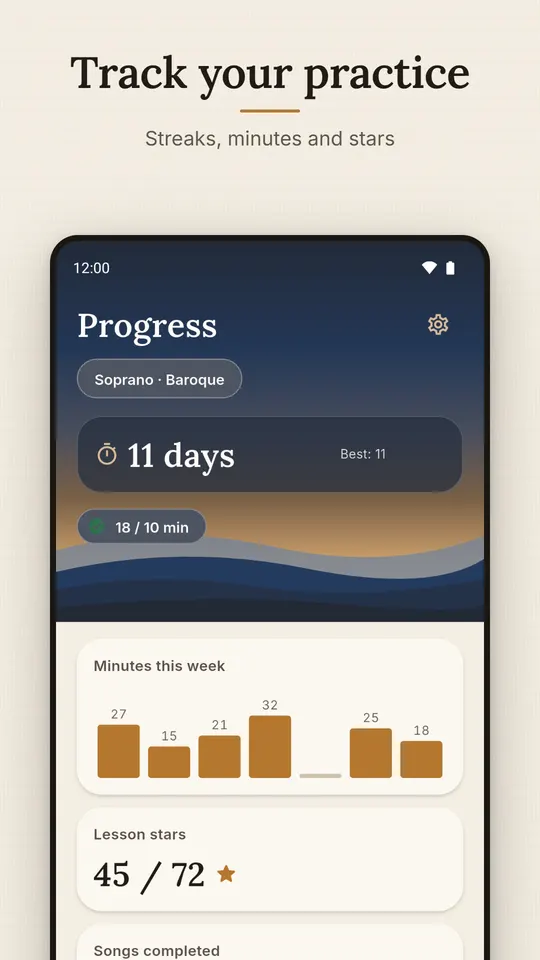
Streaks, minutes and stars 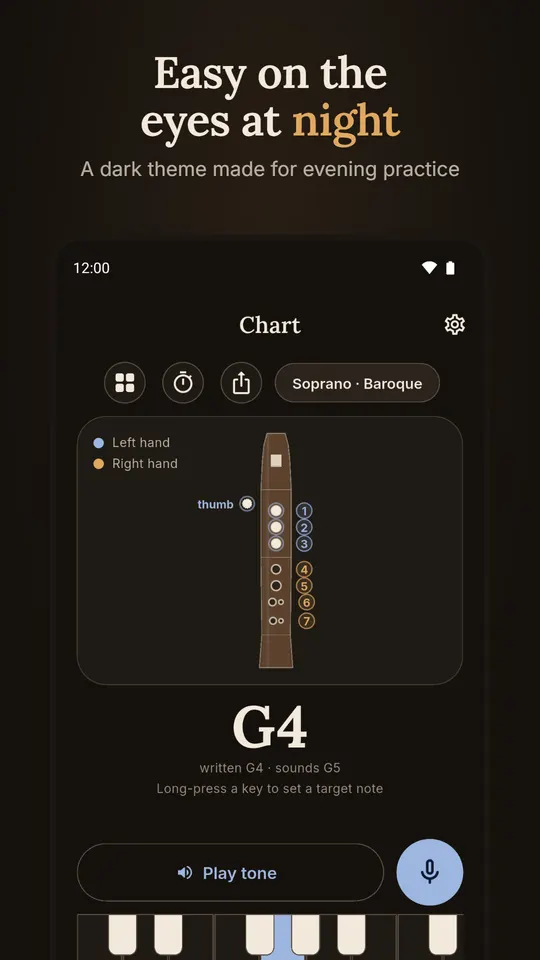
A dark theme for evenings
How to read a recorder fingering chart
A soprano recorder has eight holes you play: a thumb hole on the back and seven on the front. Charts number them from the top, so the thumb hole is 0, the three holes under your left hand are 1, 2 and 3, and the four under your right hand are 4, 5, 6 and 7. A covered hole is drawn filled, an open one is empty, and a half-filled circle means half covered.
- Double holes. On most baroque-style recorders the two lowest finger holes, 6 and 7, are made of two small bores side by side. Cover both for a full hole. Two notes, C♯ and D♯ in the low octave, call for covering just one of the two.
- The half-hole thumb. From E in the second octave the thumb hole is only partly covered. Charts mark it with a half circle, or an x for a pinched thumb.
- Sounding pitch. The notes here are the pitches you hear, from C5, the lowest note of a soprano, to A6.
The tables below come from the same data as the chart at the top, so they always agree with it. In the notation column the left hand is before the bar and the right hand after it, a dash is an open hole and h is a half-covered one.
| Note | Notation | Holes covered |
|---|---|---|
| C5 | 0123 | 4567 | the thumb hole, hole 1, hole 2, hole 3, hole 4, hole 5, hole 6 and hole 7 |
| C♯5 / D♭5 | 0123 | 4567h | the thumb hole, hole 1, hole 2, hole 3, hole 4, hole 5, hole 6 and half of hole 7 |
| D5 | 0123 | 456- | the thumb hole, hole 1, hole 2, hole 3, hole 4, hole 5 and hole 6 |
| D♯5 / E♭5 | 0123 | 456h- | the thumb hole, hole 1, hole 2, hole 3, hole 4, hole 5 and half of hole 6 |
| E5 | 0123 | 45-- | the thumb hole, hole 1, hole 2, hole 3, hole 4 and hole 5 |
| F5 | 0123 | 4-67 | the thumb hole, hole 1, hole 2, hole 3, hole 4, hole 6 and hole 7 |
| F♯5 / G♭5 | 0123 | -56- | the thumb hole, hole 1, hole 2, hole 3, hole 5 and hole 6 |
| G5 | 0123 | ---- | the thumb hole, hole 1, hole 2 and hole 3 |
| G♯5 / A♭5 | 012- | 45-- | the thumb hole, hole 1, hole 2, hole 4 and hole 5 |
| A5 | 012- | ---- | the thumb hole, hole 1 and hole 2 |
| A♯5 / B♭5 | 01-3 | 4--- | the thumb hole, hole 1, hole 3 and hole 4 |
| B5 | 01-- | ---- | the thumb hole and hole 1 |
| Note | Notation | Holes covered |
|---|---|---|
| C6 | 0-2- | ---- | the thumb hole and hole 2 |
| C♯6 / D♭6 | -12- | ---- | hole 1 and hole 2 |
| D6 | --2- | ---- | hole 2 |
| D♯6 / E♭6 | --23 | 456- | hole 2, hole 3, hole 4, hole 5 and hole 6 |
| E6 | 0h123 | 45-- | half of the thumb hole, hole 1, hole 2, hole 3, hole 4 and hole 5 |
| F6 | 0h123 | 4-6- | half of the thumb hole, hole 1, hole 2, hole 3, hole 4 and hole 6 |
| F♯6 / G♭6 | 0h123 | -5-- | half of the thumb hole, hole 1, hole 2, hole 3 and hole 5 |
| G6 | 0h123 | ---- | half of the thumb hole, hole 1, hole 2 and hole 3 |
| G♯6 / A♭6 | 0h12- | 4--- | half of the thumb hole, hole 1, hole 2 and hole 4 |
| A6 | 0h12- | ---- | half of the thumb hole, hole 1 and hole 2 |
Notes above A6 exist, up to about D7 on a soprano, but they are rare, and the charts differ from maker to maker. Only one of the charts used here lists them, so they are left out rather than guessed. Musicplay notes that fingerings can need slight changes between brands, especially in the high register.
Baroque or German fingering: what is the difference
Two fingering systems are in use. Baroque, also called English, is the standard: the vast majority of recorders made today use it. German fingering was developed by Peter Harlan and became popular in Germany in the 1930s because it promised an easier F. It later declined, and German-fingered recorders are now made mainly for schools. Wikipedia adds that German fingering makes many of the other chromatic notes too out of tune to use.
The difference sits in a few low notes. A baroque recorder plays F with a forked fingering (hole 5 open between closed holes 4 and 6); a German recorder plays it with holes 0 to 4 and nothing below, in sequence with G and E. The Woodwind Federation chart lists the fingerings that differ:
| Note | Baroque | German |
|---|---|---|
| F5 | 0123 | 4-67 | 0123 | 4--- |
| F♯5 / G♭5 | 0123 | -56- | 0123 | -567 |
| G♯5 / A♭5 | 012- | 45-- | 012- | 4--- |
Which one is yours? Check the box or the maker’s website first. Musicplay gives a practical test: if your recorder sounds higher in pitch than a piano, it needs the baroque fingering, the forked F. The switch at the top of the chart changes the F, F♯ and G♯ fingerings. The sources used here give no German chart above B5, so the tool says so instead of guessing.
The C major scale on the soprano recorder
C major uses no sharps or flats, so it is the usual first scale. It starts on C5, the lowest note, with every hole covered, and ends on C6, where the fingering changes shape: the thumb stays on and only the second finger joins it.
| Note | Notation | Holes covered |
|---|---|---|
| C5 | 0123 | 4567 | the thumb hole, hole 1, hole 2, hole 3, hole 4, hole 5, hole 6 and hole 7 |
| D5 | 0123 | 456- | the thumb hole, hole 1, hole 2, hole 3, hole 4, hole 5 and hole 6 |
| E5 | 0123 | 45-- | the thumb hole, hole 1, hole 2, hole 3, hole 4 and hole 5 |
| F5 | 0123 | 4-67 | the thumb hole, hole 1, hole 2, hole 3, hole 4, hole 6 and hole 7 |
| G5 | 0123 | ---- | the thumb hole, hole 1, hole 2 and hole 3 |
| A5 | 012- | ---- | the thumb hole, hole 1 and hole 2 |
| B5 | 01-- | ---- | the thumb hole and hole 1 |
| C6 | 0-2- | ---- | the thumb hole and hole 2 |
How to hold a recorder
- Left hand on top. Holes 1, 2 and 3 and the thumb hole belong to the left hand, holes 4 to 7 to the right. The hole layout suits that order; with the right hand on top the fingers do not line up with the holes, as Dynamic Music Room puts it.
- Seal every hole. If a hole leaks, lay the finger flatter and more securely rather than pressing harder. Bax Music gives the same advice.
- Start each note softly. Tap the tongue gently just above the teeth, as if saying “du” or “tu”. Wikipedia calls stopping and starting the air with the tongue articulation.
Why does my recorder squeak
Almost always one of two things. First, too much air: a recorder needs very little air pressure, and blowing too hard makes it squeak. It is a sign you are giving it too much air, not a fault. Second, a hole that is not fully covered. A small gap is enough to disturb the note.
- Blow gently and steadily, with just enough air to sound the note.
- Check each covered hole with the pad of the finger. On holes 6 and 7, cover both small bores.
- Play the note and use the microphone check above. If it reports an octave off, look at the thumb hole first: its main job is to act as an octaving vent, so a thumb that covers or opens the hole wrongly shifts the note by an octave.
F sharp and B flat on the recorder
F♯ and B♭ are the first notes outside C major that beginners meet, for example in G major and F major.
| Note | Notation | Holes covered |
|---|---|---|
| F♯5 / G♭5 | 0123 | -56- | the thumb hole, hole 1, hole 2, hole 3, hole 5 and hole 6 |
| A♯5 / B♭5 | 01-3 | 4--- | the thumb hole, hole 1, hole 3 and hole 4 |
| F♯6 / G♭6 | 0h123 | -5-- | half of the thumb hole, hole 1, hole 2, hole 3 and hole 5 |
F♯5 is the fingering of G with the right hand’s holes 5 and 6 added and hole 4 left open. B♭5 skips hole 2: thumb, 1, 3 and 4. On a German recorder F♯5 is different (holes 0 to 3, then 5, 6 and 7). A B♭ in the second octave is not on this chart because only one source lists it.
High notes and the half-hole thumb
From E6 up, the thumb hole is half open. Dynamic Music Room advises shifting the thumb down slightly and focusing the air. D6 and the notes around it use the thumb differently: C♯6, D6 and D♯6 have the thumb hole fully open, while C6 closes it. If a high note will not speak, check the thumb first and keep the breath gentle.
What the Android app adds
The Android app is a recorder flute fingering chart with a microphone note check, 24 lessons and 65 public domain songs, free with ads and offline. It covers the soprano recorder (C) and the alto recorder (F), in baroque or German fingering. A song can be played three ways: listen first, wait for me (the music waits until you play the right note) or in time with a metronome and a score. This page is the chart and the note check in the browser; the lessons, songs and practice tracking are in the app. Phone microphones differ, so the cents readout is a practice guide, not a lab measurement.
Sources
Opened on 1 November 2026. The baroque fingerings were checked between the first two charts; where they differ, the difference is noted above.
- Dolmetsch: Baroque/English fingerings for the recorder in text format (hole numbering, double holes, pinched thumb)
- Dynamic Music Room: notes on recorder (soprano chart, hand position, half-hole thumb)
- Woodwind Fingering Guide: recorder (English and German fingerings for F, F♯ and G♯)
- Musicplay: soprano recorder fingerings, German and baroque (forked F, the pitch test, maker differences)
- Wikipedia: Recorder (range, fingering systems, double holes, breath)
- Bax Music: 7 tips for beginners (squeaks, covering holes, tonguing, hand position)
Questions
How do I read a recorder fingering chart?
Holes are numbered from the top: 0 is the thumb hole on the back, 1 to 3 are under your left hand and 4 to 7 under your right. A filled circle means cover the hole, an empty one means leave it open and a half-filled one means half cover it. Holes 6 and 7 are double holes on most recorders, so cover both small bores.
What is the lowest note on a soprano recorder?
C5, played with every hole covered. A soprano, also called a descant, plays from C5 up to about D7.
What is the difference between baroque and German fingering?
They differ on a few low notes. Baroque, the standard today, plays F with a forked fingering (hole 5 open between closed holes 4 and 6). German fingering plays F with holes 0 to 4 and also changes F sharp and G sharp. If your recorder sounds higher than a piano, it needs the baroque fingering.
What are the notes of the C major scale on the recorder?
C5 (all holes), D5 (all but hole 7), E5 (0 to 5), F5 (0 to 4, then 6 and 7), G5 (0 to 3), A5 (0 to 2), B5 (0 and 1) and C6 (thumb and hole 2). The chart above shows each one.
Why does my recorder squeak?
Usually too much air or a hole that is not fully covered. Blow gently and steadily, and lay each finger flat so it seals the hole instead of pressing harder. On holes 6 and 7, cover both small bores.
How do I play F sharp and B flat on the recorder?
On a baroque soprano F sharp is thumb, 1, 2, 3, 5 and 6, and B flat is thumb, 1, 3 and 4 (hole 2 open). The guide above has both in a table.
Does the microphone check record me?
No. The browser hands the sound to code on this page, which measures the pitch and throws the audio away. Nothing is stored or sent to a server, and the app works the same way on the phone.
Is the recorder app free and does it work offline?
Yes to both. It is free with ads, needs no account and works offline. The lessons, the full chart in both fingering systems and 45 songs are open to everyone; the alto recorder, 20 advanced songs and a few extras open with one short video each, and no ad appears while the app is listening to you play.
Which recorders does the app cover?
The soprano recorder (C) and the alto recorder (F), each in baroque or German fingering. Phone microphones differ, so the cents readout is a practice guide, not a lab measurement.
Take the chart to your practice
Free on Android, with ads, offline and with no account. The microphone is used on your device only: nothing is recorded, saved or sent, and no ad appears while the app is listening to you play.
Facts from the Google Play listing, last checked .