Rune translator: write your name in Elder Futhark runes
Type a name and see it in the Elder Futhark, the oldest runic alphabet, written by sound the way rune carvers worked. Tap any rune to see why it was chosen, then explore all 24 runes with what the old rune poems say and, kept apart, the modern meanings. The free Android app holds the whole reference offline.
Write your name in runes
Elder Futhark · modern transliteration by sound
Tap a rune to see why it was chosen.
The 24 runes in three ætts · tap one
Freyr's ætt
Hagal's ætt
Tyr's ætt
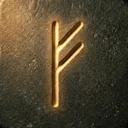
Fehu /f/
Name means: cattle, movable wealth
- Attested · rune poems
- Old English: feoh: wealth is a comfort to all, but each must share it freely to win honour. Norse poems: fé: wealth, a source of strife among kinsmen.
- Modern · divination
- abundance, earned wealth, a fresh start. A 20th-century reading, not found in old sources.
All 24 runes in your pocket
This page is a quick translator and chart. The Android app is the full reference, offline, with history and modern meaning on separate tabs for every rune:
- All 24 Elder Futhark runes, each with its name in Proto-Germanic, Old Norse and Old English, sound, etymology, where and when it was carved, and famous inscriptions
- Modern meanings (keywords, upright and reversed, life areas) on a separate tab, so history and interpretation never mix
- A rune translator that writes a name by sound and explains every rune it chose, with the alternatives; save favourite results
- Rune of the day and five spreads: one rune, three runes, five runes, the cross and a relationship spread, with a private journal on the device
- Flashcard practice that brings back the runes you miss until you know the whole futhark
- A library on transliteration rules and runic history
- A home-screen widget with the rune of the day and an optional daily reminder, off by default
- Offline, no account, stone or parchment palette, dark or light, 45+ languages

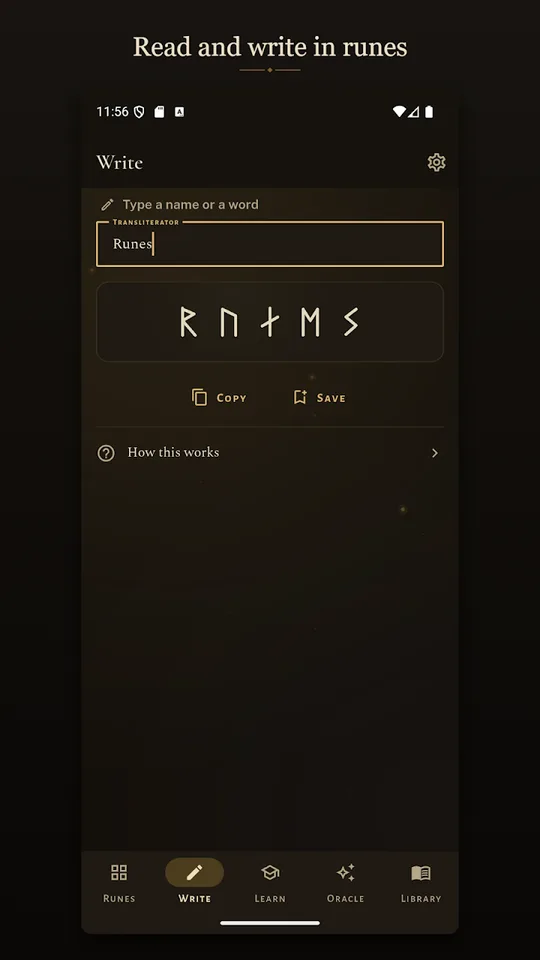
Read and write in runes 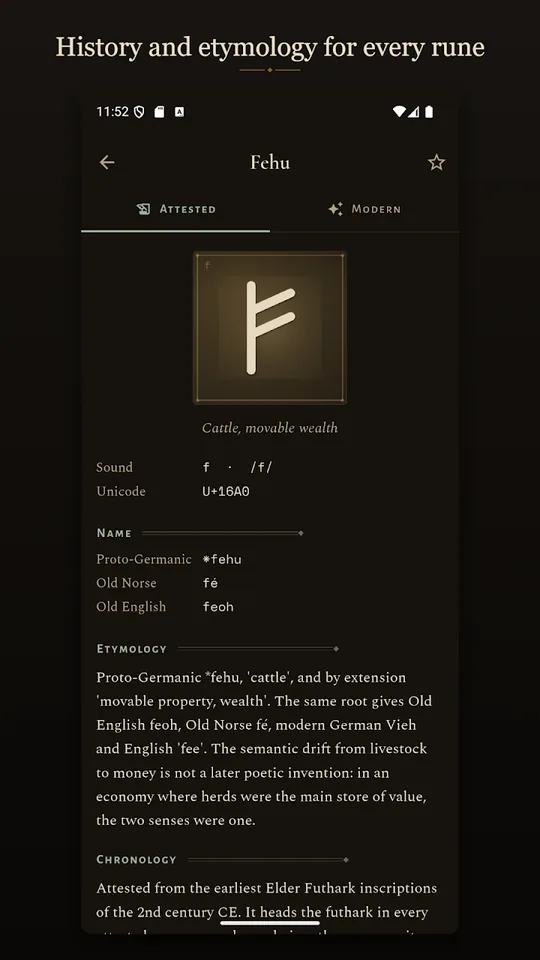
History and etymology for every rune 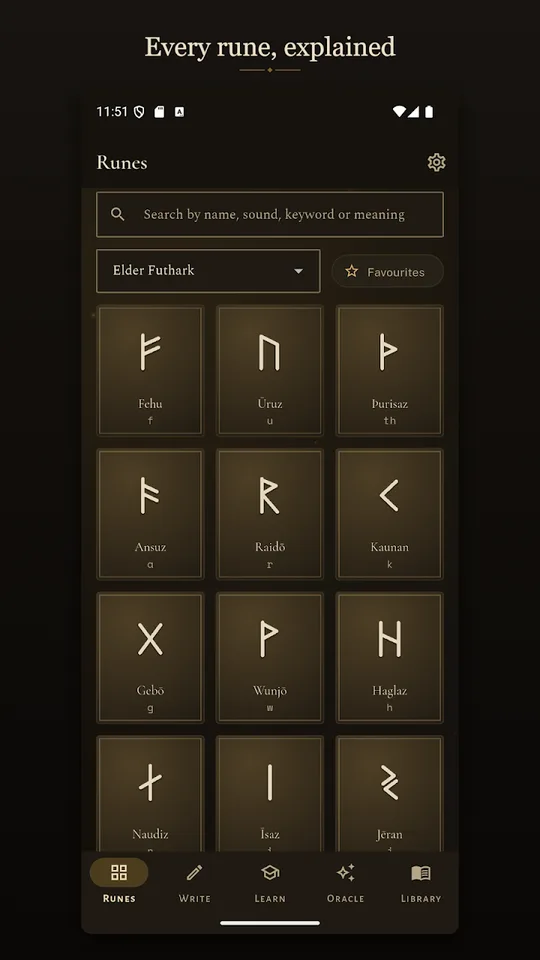
Every rune, explained 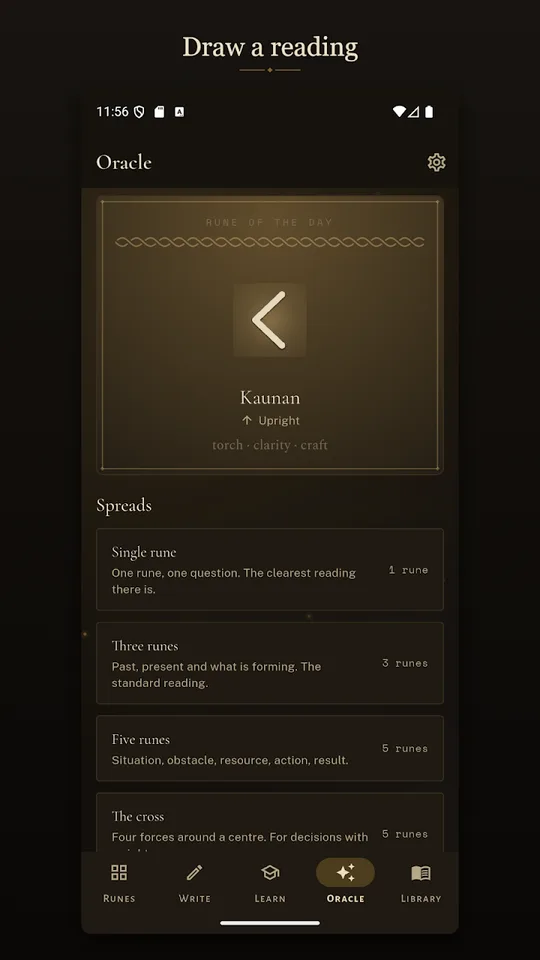
Draw a reading 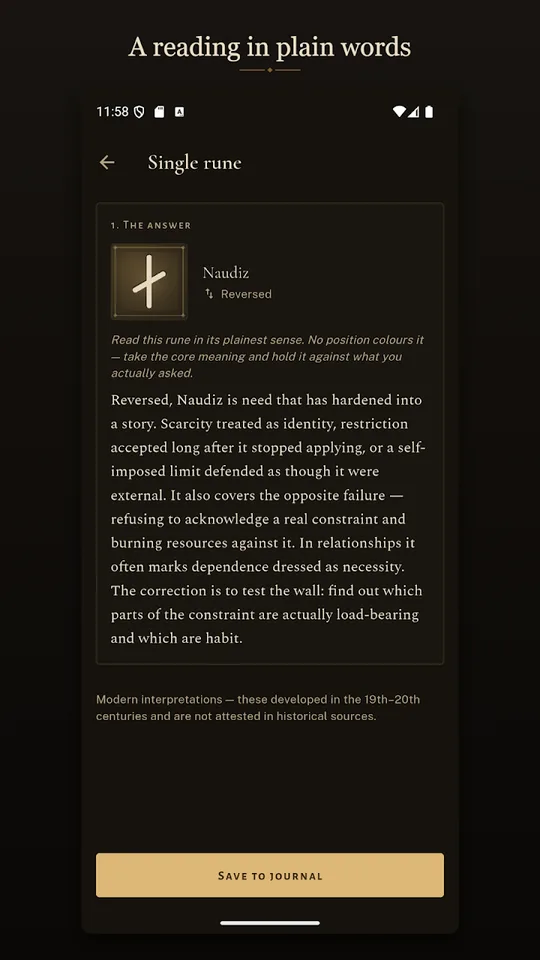
A reading in plain words 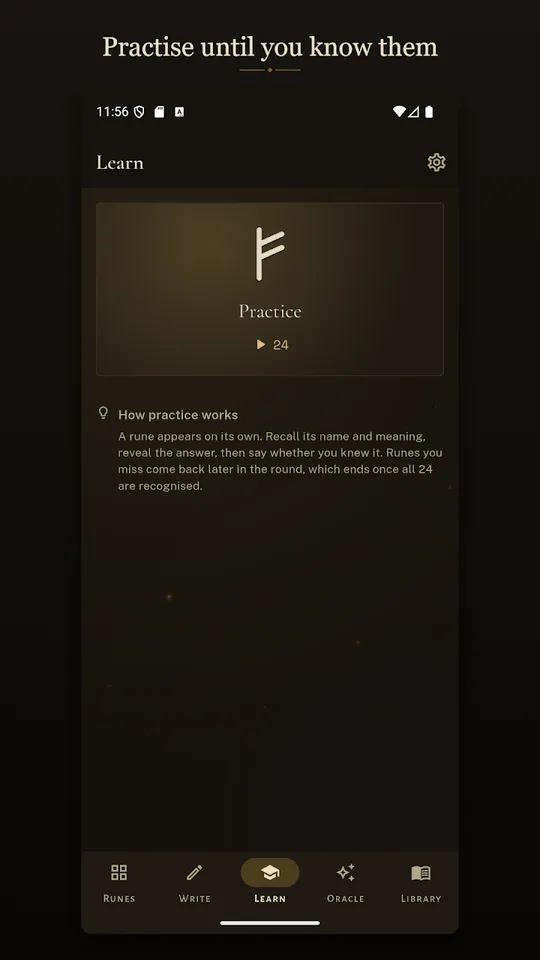
Practise until you know them 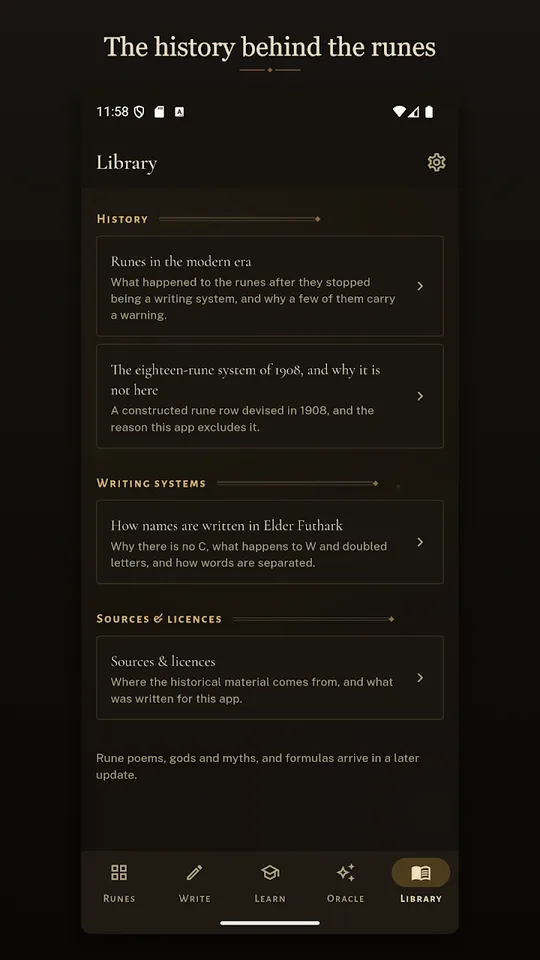
The history behind the runes 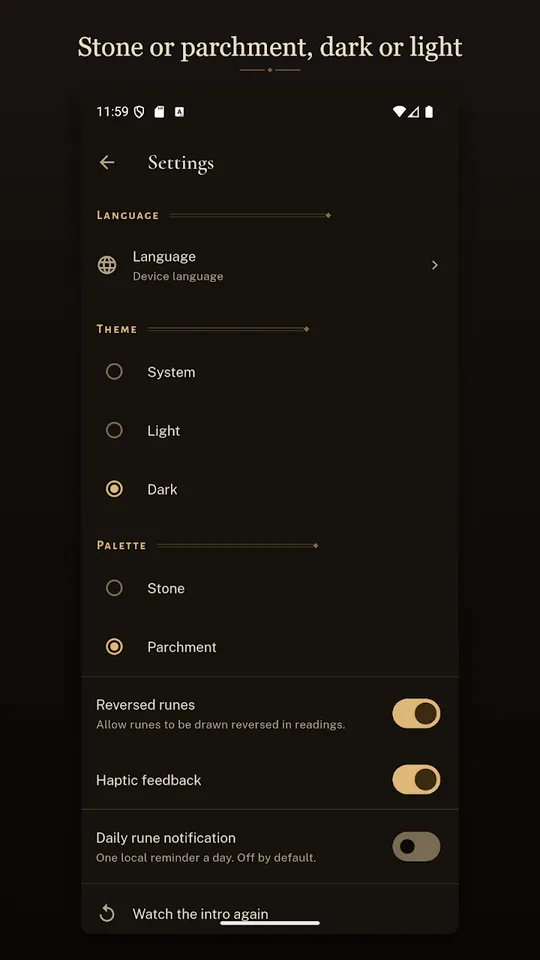
Stone or parchment, dark or light
The Elder Futhark alphabet: 24 runes in three ætts
The Elder Futhark is the oldest runic alphabet, used by Germanic-speaking peoples from about the 2nd to the 8th century CE. It is named after its first six letters, f u þ a r k, the way “alphabet” is named after alpha and beta. Its 24 runes are traditionally split into three rows of eight, called ætts (Old Norse ættir, “families”). The split is old: the 6th-century Vadstena bracteate from Sweden already shows the row in three groups of eight.
- Freyr's ætt. The first eight runes, from ᚠ fehu: f u þ a r k g w.
- Hagal's ætt. The second eight, from ᚺ hagalaz: h n i j ï p z s.
- Tyr's ætt. The last eight, from ᛏ tiwaz: t b e m l ŋ d o.
The names of the ætts after Freyr, Hagal and Tyr are a later Icelandic custom. The rune names themselves are also not written down for the Elder Futhark: forms such as fehu and ansuz are scholars’ reconstructions in Proto-Germanic, worked back from the names recorded in the Old English, Norwegian and Icelandic rune poems.
Elder Futhark rune meanings: the full table
“Meaning” here is what the name means as a word. The last column is the modern divinatory reading, kept separate because no old source gives runes those meanings.
| Rune | Name | Sound | Name means | Modern reading |
|---|---|---|---|---|
| ᚠ | Fehu | /f/ | cattle, movable wealth | abundance, earned wealth, a fresh start |
| ᚢ | Uruz | /u/ | aurochs, the wild ox | strength, health, raw vitality |
| ᚦ | Thurisaz | /θ/ as in thin | giant (Old Norse þurs) | defence, conflict, a reactive force |
| ᚨ | Ansuz | /a/ | a god, one of the Æsir | communication, insight, messages |
| ᚱ | Raido | /r/ | riding, a journey | travel, rhythm, the right path |
| ᚲ | Kaunan | /k/ | ulcer, sore (uncertain) | knowledge, creativity, a guiding light |
| ᚷ | Gebo | /g/ | gift | gifts, partnership, exchange |
| ᚹ | Wunjo | /w/ | joy | joy, harmony, belonging |
| ᚺ | Hagalaz | /h/ | hail | disruption, forces beyond control |
| ᚾ | Naudiz | /n/ | need, distress | necessity, resistance, patience |
| ᛁ | Isa | /i/ | ice | stillness, a standstill, focus |
| ᛃ | Jera | /j/ as in yes | year, good harvest | harvest, cycles, reward for effort |
| ᛇ | Eihwaz | /ï/ or /æ/ (uncertain) | yew tree | endurance, transformation |
| ᛈ | Pertho | /p/ | unknown; the name is not understood | mystery, chance, fate |
| ᛉ | Algiz | /z/, later /R/ | elk, or protection (uncertain) | protection, a higher self |
| ᛊ | Sowilo | /s/ | sun | success, energy, wholeness |
| ᛏ | Tiwaz | /t/ | the god Tyr | justice, honour, courage |
| ᛒ | Berkanan | /b/ | birch | birth, growth, care |
| ᛖ | Ehwaz | /e/ | horse | movement, trust, teamwork |
| ᛗ | Mannaz | /m/ | man, human being | the self, humanity, community |
| ᛚ | Laguz | /l/ | water, lake | flow, intuition, emotion |
| ᛜ | Ingwaz | /ŋ/ as in sing | the god Ing | completion, fertility, gestation |
| ᛞ | Dagaz | /d/ | day | breakthrough, dawn, clarity |
| ᛟ | Othala | /o/ | inherited land, homestead | heritage, home, what you inherit |
The rune poems: where the meanings come from
Almost everything we know about what the runes were called comes from three medieval poems that give one short stanza per rune name:
- The Old English rune poem covers the Anglo-Saxon futhorc, 29 runes. Its only manuscript burned in the Cotton library fire of 1731; the text survives because George Hickes printed it in 1705.
- The Norwegian rune poem (13th century) and the Icelandic rune poem (15th century) cover the 16 runes of the Younger Futhark, so runes such as gebo, wunjo, ehwaz and dagaz have no Norse stanza at all.
The poems are Christian-era, often riddling, and they sometimes disagree. Ūr is the aurochs in English but slag or drizzle in the Norse poems; ōs is the mouth in English but a god or an estuary in the North. The rune card above quotes each tradition in paraphrase instead of picking one.
A short history of runes
The oldest securely dated runic inscriptions, such as the Vimose comb from Denmark, are from the 2nd century CE. Most scholars think the letters were adapted from an Old Italic or Latin alphabet, which explains shapes like ᚱ, ᛒ and ᛏ. Runes were carved on wood, bone, metal and stone, which is why they avoid curves and horizontal strokes that would split along the grain. The Kylver stone from Gotland, about 400 CE, carries the earliest known full row of the futhark.
Elder Futhark inscriptions are short: owner’s names, maker’s marks, single words like alu whose meaning is debated. The long Viking-age runestones belong to the later Younger Futhark.
Younger Futhark and the Anglo-Saxon futhorc
In Scandinavia, around the 8th century, the row was cut to 16 runes, even though the language had more sounds: one rune now stood for several. This Younger Futhark is the alphabet of the Viking age and of most runestones. In England and Frisia the row went the other way and grew to about 28 to 33 runes, the futhorc, to keep up with Old English vowels. A rune translator that says “Norse runes” should tell you which of the three it uses; this page uses the Elder Futhark only.
How to write your name in runes
There is no official spelling of a modern name in runes. Rune carvers wrote by sound, so the useful rule is to spell your name the way it sounds, not the way English spells it:
- One sound, one rune: th is ᚦ thurisaz, ng is ᛜ ingwaz, ph is ᚠ fehu.
- Hard c, k and q are all ᚲ kaunan; x is the two sounds k + s, ᚲᛊ.
- There is no rune for v, ch or sh; the nearest sounds are used (ᚹ, ᚲ, ᛊ). A soft c, as in Cecilia, is better written with ᛊ: retype it as an s.
- Old inscriptions often wrote a double letter once; the “Double letters once” switch does that.
- Words were often separated by dots, here the runic punctuation ᛫.
This is a modern transliteration convention, close to the one the app uses, not a rule from any old text. Before a tattoo, check every rune against the table above, and know that some fonts draw ᛜ and ᛇ differently.
A note on rune divination
Rune casting as most people know it today is modern. The Roman writer Tacitus (Germania, chapter 10, around 98 CE) describes Germanic people casting lots of marked twigs, but he does not say the marks were runes. The keyword meanings, upright and reversed readings and the blank rune in most rune sets go back to 20th-century authors, especially Ralph Blum’s The Book of Runes (1982). The 18-rune “Armanen” row of Guido von List (1908) is a different, invented system. That is why the rune card above labels its modern line as modern: use it for reflection if you like, not as history.
Questions
How do I write my name in runes?
Spell it by sound, one rune per sound: th is ᚦ, ng is ᛜ, c, k and q are ᚲ, and x is ᚲᛊ. Type your name in the translator at the top of this page and tap each rune to see why it was chosen.
How many runes are in the Elder Futhark?
24, in three rows of eight called ætts. The Younger Futhark of the Viking age has 16, and the Anglo-Saxon futhorc has about 28 to 33.
Are rune meanings historical?
Only partly. The names and their word meanings (fehu is cattle or wealth, isa is ice) come from the medieval rune poems. Keyword meanings for divination, and reversed runes, are 20th-century additions.
Did the Vikings use the Elder Futhark?
Mostly not. By the Viking age, from about 800, Scandinavians wrote with the 16-rune Younger Futhark. The Elder Futhark was used from about the 2nd to the 8th century.
Can I copy and paste runes?
Yes. Runes are part of Unicode (U+16A0 to U+16FF), so the Copy runes button gives real text you can paste anywhere that has a font with runic letters.
Is the Runes app free?
Yes. It is free with ads, with no paywall or subscription, and works fully offline without an account.
The Elder Futhark, history first
Free on Android. All 24 runes, a name transliterator, a rune of the day and readings, offline, in more than 45 languages.
Facts from the Google Play listing, last checked .