Slavic gods and mythology creatures, with their sources
Filter the gods, spirits and symbols of the East, West and South Slavs and see at a glance which ones a medieval source actually names, which ones scholars doubt, and which ones were invented in the last century. A folk calendar works out this year's movable holidays. The free Android app holds the whole collection offline.
Slavic gods and creatures
36 of 36 entries
Perun
AttestedThe thunder god and the best documented Slavic deity. Prince Volodymyr set up his idol, wooden with a silver head and a golden moustache, on the hill in Kyiv in 980.
Source Primary Chronicle (980; Rus'–Byzantine treaty oaths) · East Slavs
Veles
AttestedAlso Volos
Called the god of cattle, which also meant wealth. Rus' envoys swore by Perun and Volos when they made peace with Byzantium. The myth of a battle between Perun and Veles is a modern scholarly reconstruction.
Source Primary Chronicle (treaty of 971) · East Slavs
Mokosh
AttestedAlso Mokoš, Makosh
The only goddess among Volodymyr's idols in Kyiv. Later church sermons still warn against praying to her. Her link with spinning and women's work comes from later folk belief.
Source Primary Chronicle (980); medieval sermons · East Slavs
Dazhbog
AttestedAlso Dazhboh, Dažbog
A god among Volodymyr's idols. A Slavic gloss to the chronicle of John Malalas calls him the sun and the son of Svarog.
Source Primary Chronicle (980); Malalas gloss; The Tale of Igor's Campaign · East Slavs
Stribog
Thinly attestedAlso Stryboh
Named among Volodymyr's idols, but no source says what he governed. He is usually read as a wind god because The Tale of Igor's Campaign calls the winds Stribog's grandchildren.
Source Primary Chronicle (980); The Tale of Igor's Campaign · East Slavs
Khors
Thinly attestedAlso Hors, Chors
Named next to Dazhbog among the Kyiv idols, possibly as one figure. Often read as a sun god; the name is probably Iranian.
Source Primary Chronicle (980) · East Slavs
Simargl
Thinly attestedAlso Semargl
Named only in the list of Kyiv idols. Whether it was one god or two (Sem and Rgel in a later sermon), and whether it was a winged dog, is still debated.
Source Primary Chronicle (980) · East Slavs
Svarog
Thinly attestedAlso Svaroh
Known from one gloss in a Slavic translation of John Malalas, which equates him with the Greek smith god Hephaestus. Popular pantheons that make him the father of all gods go far beyond the source.
Source Malalas gloss in the Hypatian Codex · East Slavs
Rod
Thinly attestedNamed with the rozhanitsy in medieval sermons against pagan customs. Scholars do not agree whether he was a major god or a spirit of family and fate.
Source Old East Slavic sermons, 12th–15th century · East Slavs
Svetovit
AttestedAlso Svantevit, Sventovit
The god of the Rani at Arkona on Rügen. Saxo describes a four-headed statue holding a horn of wine, a white horse used for divination, and the temple's destruction by the Danes in 1168.
Source Saxo Grammaticus, Gesta Danorum; Helmold · West Slavs
Triglav
AttestedThe three-headed god of the Pomeranians, with temples in Szczecin and Wolin. The biographers of Bishop Otto of Bamberg describe his statue and a black horse used for divination.
Source Lives of Otto of Bamberg (Ebbo, Herbord), 12th century · West Slavs
Radegast
AttestedAlso Svarozhich, Redigast
Thietmar names Svarozhich as the chief god of the temple at Riedegost (Rethra) of the Lutici; Adam of Bremen calls the god himself Redigast.
Source Thietmar of Merseburg; Adam of Bremen · West Slavs
Rugievit
AttestedA seven-faced oak statue at Karenz (Garz) on Rügen, with seven swords, described by Saxo alongside Porevit and Porenut.
Source Saxo Grammaticus, Gesta Danorum · West Slavs
Chernobog
Thinly attestedAlso Czernobog, Zcerneboch
Helmold says the Baltic Slavs pass a bowl at feasts and curse the bad god, Zcerneboch, the black god. That one line is the whole source.
Source Helmold, Chronica Slavorum (1160s) · West Slavs
Belobog
DisputedAlso Bielobog
A white god paired with Chernobog. No medieval source names him; he was inferred from Helmold's mention of a bad god.
Source None; a later inference · West Slavs
Lada
DisputedCalled a goddess of love and spring from the 15th century on (Długosz and others). Most scholars think the name comes from a refrain in wedding and spring songs.
Source Jan Długosz and later writers; song refrains · East Slavs, West Slavs
Jarilo
DisputedAlso Yarilo, Yarylo
A spring figure in East and South Slavic folk rites, often buried as an effigy. Whether behind it stood a pagan god is doubted by many scholars.
Source Folk customs recorded from the 18th century · East Slavs, South Slavs
Kupala
DisputedAlso Kupalo
Kupala Night is a real midsummer festival. Kupala as a god first appears in the 17th-century Hustyn Chronicle, and most scholars treat him as a name made from the holiday.
Source Hustyn Chronicle (17th century) · East Slavs, West Slavs
Morana
DisputedAlso Marzanna, Mara, Morena
A straw effigy of winter or death drowned or burned in spring, a custom still kept in Poland, Czechia and Slovakia. The rite is well recorded; a goddess behind it is not.
Source Jan Długosz (15th century); folk custom · West Slavs, East Slavs, South Slavs
Domovoy
FolkloreAlso Domovyk
The house spirit, often an old man living behind the stove. Treated well, he looks after the household and livestock; offended, he makes noise and mischief.
Source East Slavic folklore · East Slavs
Leshy
FolkloreAlso Lisovyk, Lesovik
The master of the forest, who can be as tall as the trees or as small as grass and leads travellers astray.
Source East Slavic folklore · East Slavs
Vodyanoy
FolkloreAlso Vodianyk
The water spirit of rivers and mill ponds who drowns the careless. Millers and fishermen made offerings to him.
Source East Slavic folklore · East Slavs
Rusalka
FolkloreA spirit of a woman who died young, often drowned, seen in fields and by water during Rusalia week in early summer. The beautiful mermaid image owes much to 19th-century literature.
Source East Slavic folklore · East Slavs
Mavka
FolkloreAlso Navka
A Ukrainian forest maiden, in folk belief the soul of a dead child or girl, sometimes with no back so that her insides show. Lesya Ukrainka's play The Forest Song made her famous.
Source Ukrainian folklore · East Slavs
Poludnitsa
FolkloreAlso Lady Midday, Południca, Polednice
A woman in white who walks the fields at noon in summer and punishes those working in the heat, a personification of sunstroke.
Source Slavic folklore · East Slavs, West Slavs
Kikimora
FolkloreA small female house spirit who spins at night and tangles the yarn, a bad sign for the household.
Source Russian folklore · East Slavs
Baba Yaga
FolkloreAlso Baba Yaha, Baba Jaga
The forest witch of fairy tales who lives in a hut on chicken legs and flies in a mortar. She both threatens and helps the hero.
Source Folk tales, collected by Afanasyev and others · East Slavs, West Slavs
Vila
FolkloreAlso Víla, Wila
Female spirits of mountains, clouds and water in South Slavic epic and belief, who can help heroes or kill them.
Source South Slavic epic songs and folklore · South Slavs, West Slavs
Upyr
FolkloreAlso Upir, Upiór, Vampir
The restless dead who rise to harm the living, the source of the word vampire. 'Upir Likhyi' already appears as a man's name in a Novgorod manuscript of 1047.
Source Folklore; Novgorod manuscript of 1047 (as a name) · East Slavs, West Slavs, South Slavs
Vovkulaka
FolkloreAlso Vukodlak, Wilkołak, werewolf
A person who turns into a wolf by birth, curse or witchcraft. In South Slavic belief the vukodlak also merges with the vampire.
Source Slavic folklore · East Slavs, West Slavs, South Slavs
Zmey
FolkloreAlso Zmiy, Zmaj, Smok
The dragon of tales and epics, often many-headed, fought by heroes. In South Slavic belief a zmaj can also protect a village from hail.
Source Folk tales and epic songs · East Slavs, West Slavs, South Slavs
Rozhanitsy
AttestedAlso Sudice, Sudičky, Orisnitsi
Three fate spirits who visit a newborn and decide its life. Medieval sermons condemn offerings to Rod and the rozhanitsy; the belief lived on in folklore.
Source Medieval sermons; folklore · East Slavs, West Slavs, South Slavs
Thunder mark
FolkloreAlso Gromovnik, hexafoil, six-petal rosette
A six-petal rosette carved on beams and gables to guard a house from lightning. Reading it as Perun's own sign is a modern interpretation.
Source Ethnography of folk carving · East Slavs, West Slavs, South Slavs
Kolovrat
Modern inventionThe eight-armed swastika sold as an ancient Slavic sun sign was popularised by Russian neopagans in the 1990s and is used by far-right groups. No ancient source names it.
Source Modern neopagan origin · East Slavs
Book of Veles
Modern inventionAlso Velesova kniga
A text supposedly written on wooden boards and lost in 1941; no one has ever seen the boards. Scholars regard it as a 20th-century forgery.
Source Published from the 1950s, linked to Yuri Mirolyubov · East Slavs
Slavic runes
Modern inventionAlso Slavic-Aryan Vedas
Pagan Slavs had no proven writing system of their own. The 'runic' alphabets and Vedas sold today come from 1990s neopagan movements; Glagolitic was created by Christian missionaries in the 9th century.
Source Modern neopagan origin · East Slavs
- Attested
- Named in medieval written sources
- Thinly attested
- Named, but rarely or with no clear role
- Folklore
- Recorded by ethnographers in the 19th and 20th centuries
- Disputed
- Most scholars doubt it was a real pagan deity
- Modern invention
- Created or forged in the last two centuries
The whole collection in your pocket
The index above is a sample. The Android app is the full reference, offline, with every card showing where it comes from and how firm the ground is:
- Gods and goddesses of the East, West and South Slavs, with domains, epithets and attested sources
- Spirits and creatures of folklore: domovyk, rusalka, mavka, lisovyk, vodianyk, poludnytsia, upyr, vovkulaka, Baba Yaha, zmiy, vila and more
- Symbols and amulets, with what archaeology and ethnography actually show
- Four evidence levels on every entry: well attested, thinly attested, reconstructed by scholars, or disputed
- Folk holidays from Koliada to Didy, with movable dates worked out for the current year on the Gregorian or Julian Paschal cycle
- Optional reminders before each holiday
- A reading path built from a short questionnaire, a matching game and full-text search
- Favourites, light and dark themes, offline, in 70+ languages

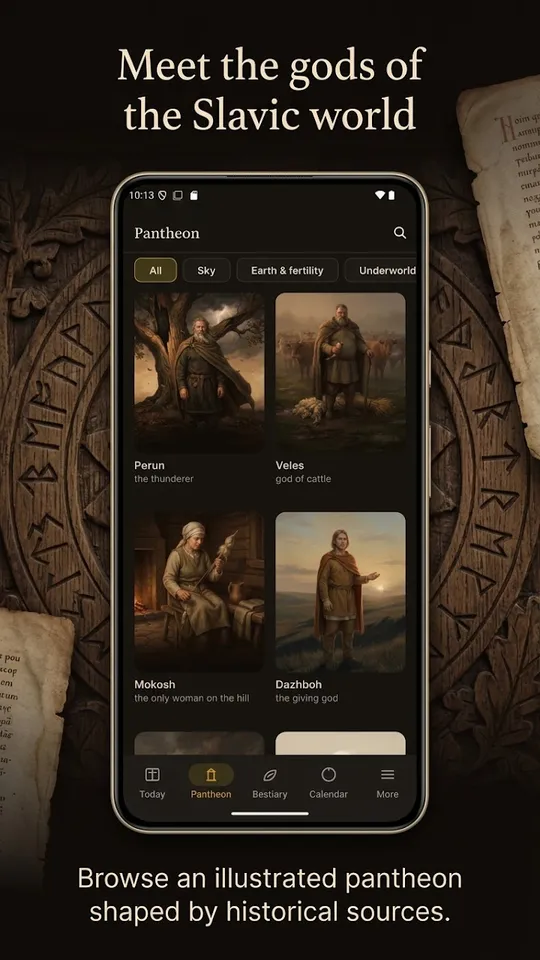
An illustrated pantheon 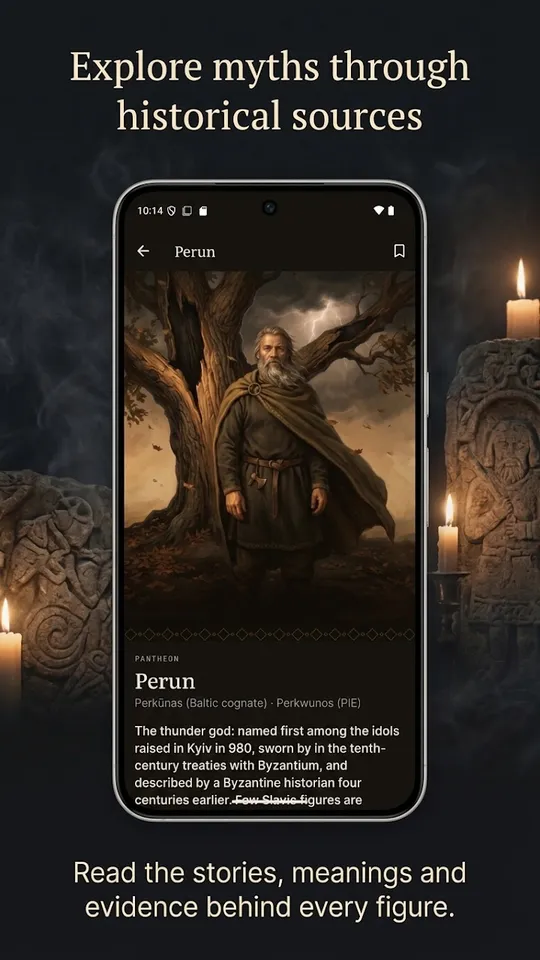
Every figure with its sources 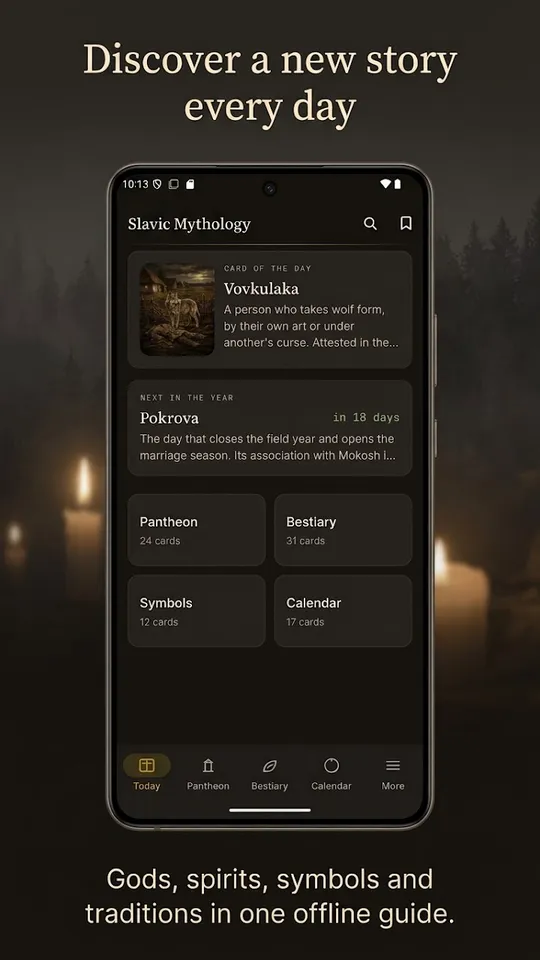
A card a day, the next holiday 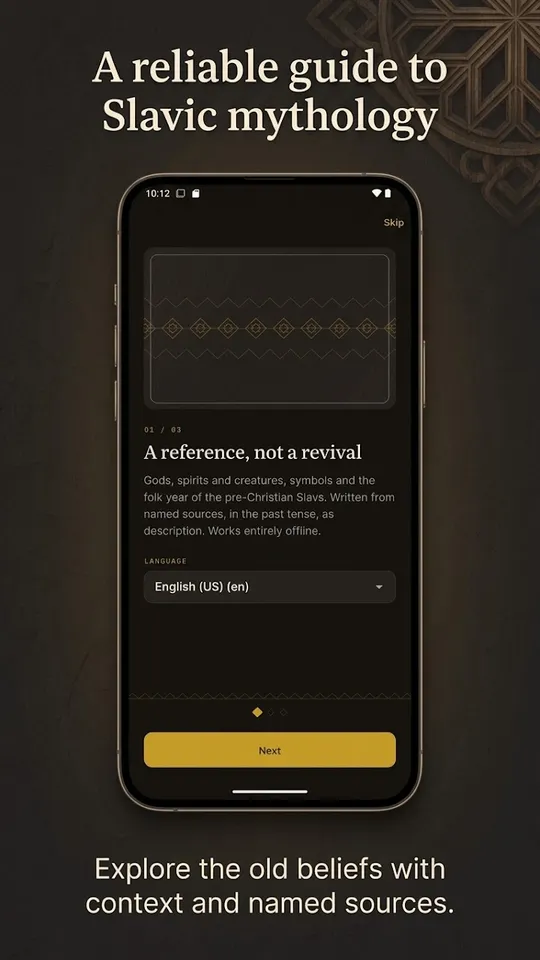
A reference, not a revival 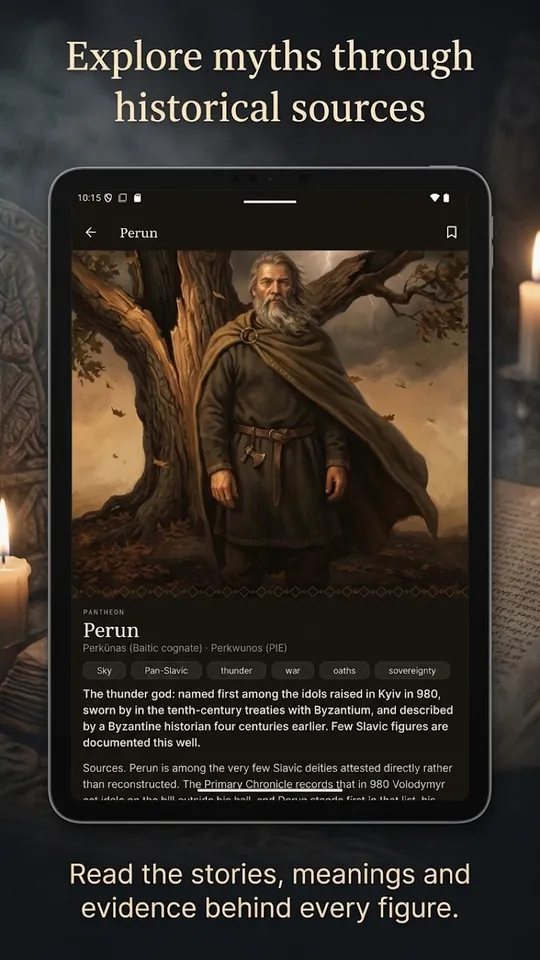
Sources named on every card
Slavic gods list: which gods are actually attested
No pagan Slav wrote down a myth. Everything we know comes from Christian chroniclers, missionaries and churchmen, written down after conversion or by outsiders, plus folk customs recorded centuries later. That is why lists of Slavic gods online vary so much: many mix gods named in medieval sources with figures that scholars of the last two centuries reconstructed or simply invented.
| God | Who worshipped him | Earliest source |
|---|---|---|
| Perun | Rus’ (East Slavs) | Primary Chronicle: treaty oaths and the Kyiv idols of 980 |
| Veles / Volos | Rus’ | Primary Chronicle: treaty of 971, “the god of cattle” |
| Khors, Dazhbog, Stribog, Simargl, Mokosh | Rus’ | Primary Chronicle: the Kyiv idols of 980 |
| Svarog | Rus’ | A gloss in the Slavic translation of John Malalas |
| Svetovit, Rugievit, Porevit, Porenut | Rani of Rügen (West Slavs) | Saxo Grammaticus, on the fall of Arkona in 1168 |
| Triglav | Pomeranians (West Slavs) | Lives of Bishop Otto of Bamberg, 12th century |
| Svarozhich / Radegast | Lutici (West Slavs) | Thietmar of Merseburg; Adam of Bremen |
| Chernobog | Baltic Slavs | Helmold, Chronica Slavorum |
The South Slavs left almost no named gods in medieval sources. Their old beliefs survive in folklore: vilas, dragons, fate spirits and the festival year.
Perun and Veles
Perun is the one Slavic god nobody doubts. The Rus’ swore by him in their treaties with Byzantium, and in 980 Prince Volodymyr set up his idol in Kyiv; eight years later, after the baptism, it was dragged to the Dnieper and thrown in. His name is related to words for striking, and in the 6th century the Byzantine historian Procopius already wrote that the Slavs worshipped one god, the maker of lightning, as lord of all.
Veles, or Volos, appears in the treaty of 971 as “the god of cattle”, and cattle meant wealth. The popular story of Perun the thunderer fighting Veles the serpent of the underworld is a reconstruction by the linguists Vyacheslav Ivanov and Vladimir Toporov, pieced together from folklore and comparison with other Indo-European myths. It is a serious scholarly hypothesis, not a story any medieval source tells.
Slavic goddesses: Mokosh, Lada and Morana
Mokosh is the only goddess on the list of Volodymyr’s idols and the only one church sermons kept warning about. Lada, often called the goddess of love and beauty, is first named in the 15th century, and most scholars think the name was taken from a refrain sung in spring and wedding songs. Morana, Marzanna in Polish, is the straw figure of winter that is drowned or burned every spring in Poland, Czechia and Slovakia; the custom is real and old, but a goddess behind it is not proven.
Slavic mythology creatures and spirits
The richest part of Slavic belief is not the gods but the spirits people lived with every day, recorded by 19th and 20th century ethnographers in thousands of village accounts.
- In the house: the domovoy behind the stove, the kikimora who spins at night, the bannik in the bathhouse.
- In the forest and fields: the leshy who leads travellers astray, the mavka, and the poludnitsa, Lady Midday, who punishes those working in the noon heat.
- In the water: the vodyanoy of mill ponds and the rusalka, the spirit of a woman who died young.
- The dead and the changed: the upyr, which gave the world the word vampire, and the vovkulaka or werewolf.
- In tales and epics: Baba Yaga in her hut on chicken legs, the many-headed zmey, and the South Slavic vila.
Slavic symbols and their meaning: what is real
Real folk ornament is old: embroidery and carving full of rhombuses, rosettes and solar signs, and the six-petal “thunder mark” carved on houses against lightning. What those signs meant to the people who made them is mostly unrecorded, so any precise meaning is interpretation.
Much of what is sold as ancient Slavic symbolism is modern. The eight-armed Kolovrat was popularised by Russian neopagans in the 1990s and is used by far-right groups. The Book of Veles, a supposed text on wooden boards that no one has ever seen, is regarded by scholars as a 20th-century forgery. “Slavic runes” and the Slavic-Aryan Vedas come from the same 1990s movements; the first proven Slavic alphabet, Glagolitic, was created by Christian missionaries in the 9th century.
Kupala Night and the folk year
The festival year survived far better than the gods, folded into the church calendar. Kupala Night, the midsummer eve of St John the Baptist, falls on the night of 23 to 24 June, or 6 to 7 July where the church keeps the Julian calendar, which is why it is celebrated on different dates in Poland and in Russia. Koliada is the winter carolling season, Maslenitsa the butter week before Lent, and the Green holidays at Trinity were the time of the rusalky. The movable feasts hang on Easter, so they move every year; the calendar in the tool above works them out for both church calendars.
Where Slavic mythology comes from
- Chronicles: the Primary Chronicle of Kyiv (early 12th century); Thietmar of Merseburg, Adam of Bremen, Helmold and Saxo Grammaticus on the Baltic Slavs.
- Church sermons against “double faith”, which name the gods people still prayed to.
- Archaeology: the temples of Arkona and Rethra, the Zbruch idol and the sanctuary at Peryn near Novgorod.
- Folklore and language: songs, tales, customs and place names recorded from the 18th century on.
Every entry in the index above names its source. A short reading list for going deeper: Aleksander Gieysztor, Mitologia Słowian; Mike Dixon-Kennedy, Encyclopedia of Russian and Slavic Myth and Legend; and W. F. Ryan, The Bathhouse at Midnight, on Russian folk belief.
Questions
Who are the main Slavic gods?
The best attested are Perun, the thunder god, and Veles, the god of cattle and wealth, both named in the Primary Chronicle. Among the Baltic Slavs, Svetovit of Arkona and Triglav of Szczecin are well described by medieval writers.
Is Lada a real Slavic goddess?
Probably not. She is first named in the 15th century, and most scholars think her name was taken from a refrain in spring and wedding songs.
Is the Kolovrat an ancient Slavic symbol?
No source shows it. The eight-armed Kolovrat was popularised by Russian neopagans in the 1990s and is also used by far-right groups.
When is Kupala Night?
On the night of 23 to 24 June, the eve of St John the Baptist. Where the church follows the Julian calendar, as in Russia, it falls on 6 to 7 July.
Is the Book of Veles real?
Scholars regard it as a forgery, most likely from the mid-20th century. The wooden boards it was supposedly copied from have never been produced.
Is the Slavic Mythology app free?
Yes, it is free with ads and has no in-app purchases. All reference content works offline.
Slavic mythology, honestly sourced
Free on Android. Gods, spirits, symbols and the folk year, offline, in more than 70 languages.
Facts from the Google Play listing, last checked .