Tire size calculator: compare sizes and read the DOT date
Type the size from the sidewall and the calculator below gives the overall diameter, width, sidewall height and revolutions per kilometre, draws the tire to scale and explains the load index and speed rating. Compare two sizes to see the speedometer error, or enter the DOT code to read how old a tire is. The free Android app adds more tools, a garage for your vehicles and reference tables, offline.
Tire size calculator
Read a sidewall, compare two sizes, check a tire's age
Overall diameter
631.9 mm
24.88 in · 205/55R16
- Section width
- 205 mm8.1 in
- Sidewall height
- 112.8 mm4.44 in
- Rim diameter
- 16 in406.4 mm
- Circumference
- 1,985.2 mm78.16 in
- Revolutions per km
- 503.7810.7 per mile
- Aspect ratio
- 55 %of section width
What is printed on the sidewall
- 91Load index. Each tire carries up to 615 kg (1,356 lb) at its maximum pressure.
- VSpeed rating. Up to 240 km/h (149 mph) when the tire is carrying its rated load.
Formula with your numbers
Sidewall height = 205 mm × 55 % = 112.8 mm
Rim diameter = 16 in × 25.4 = 406.4 mm
Overall diameter = 406.4 + 2 × 112.8 = 631.9 mm
Circumference = π × 631.9 = 1,985.2 mm
Revolutions per km = 1,000,000 ÷ 1,985.2 = 503.7
Revolutions per mile = 1,609,344 ÷ 1,985.2 = 810.7
Diameter difference
+1.72 %
+10.9 mm
Within the usual 3 % guidelineWhen the speedometer shows
| 225/45R17 | 235/40R18 | Change | |
|---|---|---|---|
| Overall diameter | 634.3 mm | 645.2 mm | +10.9 mm |
| Section width | 225.0 mm | 235.0 mm | +10.0 mm |
| Sidewall height | 101.3 mm | 94.0 mm | −7.3 mm |
| Circumference | 1,992.7 mm | 2,027.0 mm | +34.2 mm |
| Revolutions per km | 501.8 | 493.4 | -8.5 |
| Axle height | base | +5.5 mm | higher |
- The new tire is taller, so it turns fewer times per kilometre. The speedometer reads lower than your real speed and the odometer records fewer kilometres.
- The rim changes from 17 to 18 inches, so the new tire needs wheels of that diameter.
- A taller tire also raises the axle, so check the clearance to the arch and suspension at full lock and full compression.
Formula with your numbers
Diameter of 225/45R17 = 634.3 mm, of 235/40R18 = 645.2 mm
Difference = 645.2 − 634.3 = +10.9 mm
Percent = +10.9 ÷ 634.3 × 100 = +1.72 %
Real speed when the speedometer shows 100 km/h = 100 × 645.2 ÷ 634.3 = 101.7 km/h
Axle height change = +10.9 ÷ 2 = +5.5 mm
Look on both sidewalls: the full code can be moulded on one side only.
Made in
Week 47 of 2021
Nov 22, 2021 to Nov 28, 2021
Working out the age from today's date.
- Only the date was typed. The plant code and size code come before it in the full DOT code.
Formula with your numbers
Date code 4721: first two digits are the week = 47, last two are the year = 2021
ISO week 47 of 2021 runs Nov 22, 2021 to Nov 28, 2021
Age limits here are manufacturer guidance, not law. Michelin and the British Rubber Manufacturers Association are the sources, listed under the guide below.
Calculated from the size you type, with nominal dimensions. A real tire measures a little differently by brand, rim width, pressure and wear. For information only: it does not replace the vehicle maker's tire advice or the placard on your door jamb.
More tire and wheel tools in your pocket
This page decodes a size, compares two and reads a DOT date. The Android app adds a garage for your vehicles, wheel and pressure tools and reference tables, and it works offline:
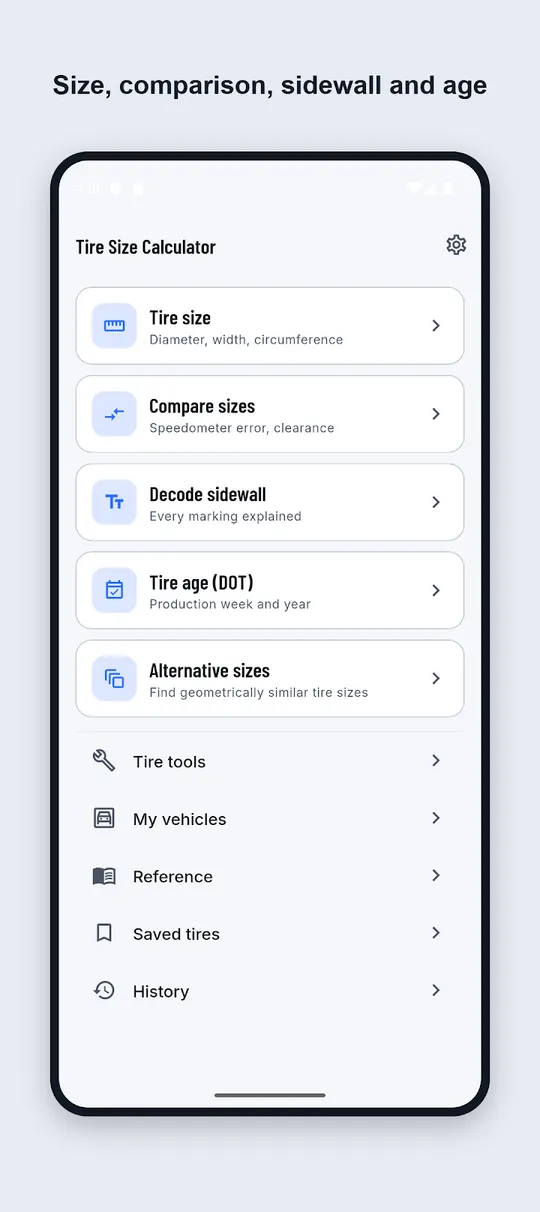
- Size calculator for metric, flotation (33x12.50R15) and old numeric (7.50-16) sizes: overall diameter, section width, sidewall height, circumference and revolutions per mile and per kilometre, with every formula on screen
- Compare two sizes, or up to four at once: diameter difference in percent, speedometer error at real speeds, change in ground clearance and width, and a verdict on whether the swap works
- Equivalent sizes for your rim and plus sizing with a bigger rim at the same rolling diameter
- Sidewall decoder: load index in kilograms and pounds, speed rating in km/h and mph, XL, Run Flat, M+S, 3PMSF, Load Range and the UTQG treadwear, traction and temperature grades
- DOT code and tire age: week and year of manufacture, how old the tire is today, the plant that built it and a verdict based on tire manufacturer guidance
- Tire and wheel tools: wheel offset, a PSI, bar and kPa converter, tread depth and tread life, a bolt pattern reference, load index from an axle weight, a size from a target diameter, gear ratio after a size change and rotation patterns
- Garage and history: saved vehicles with their original tire size, saved tires, print or save any result as PDF and optional monthly and spring and autumn tire check reminders
- Reference tables for load index, speed rating and UTQG, based on UNECE R30, 49 CFR 574 and the public NHTSA plant code dataset

Size, comparison, sidewall and age 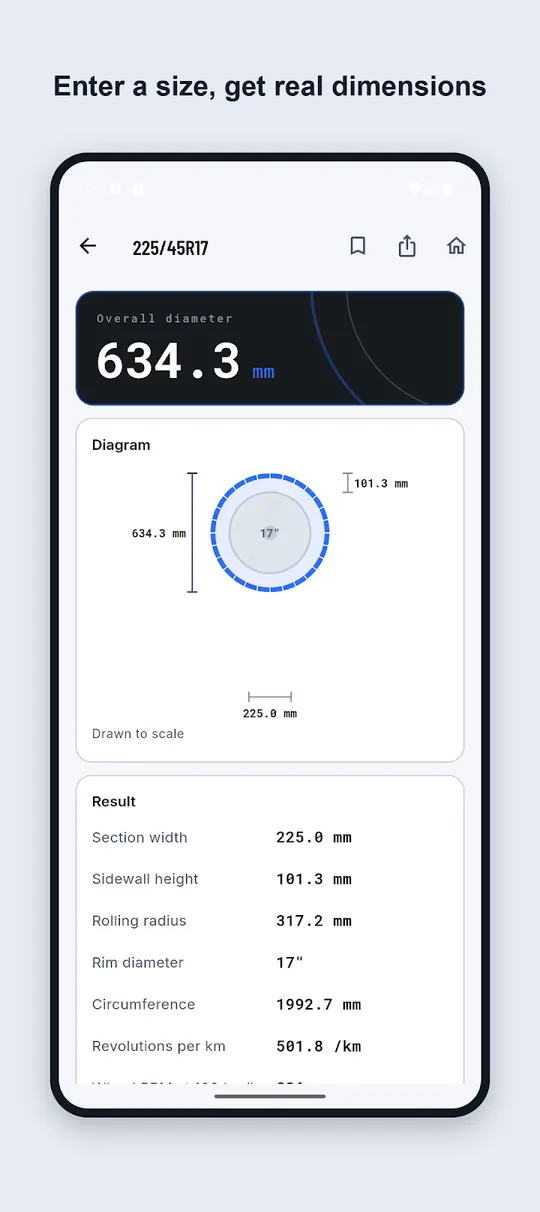
Enter a size, get real dimensions 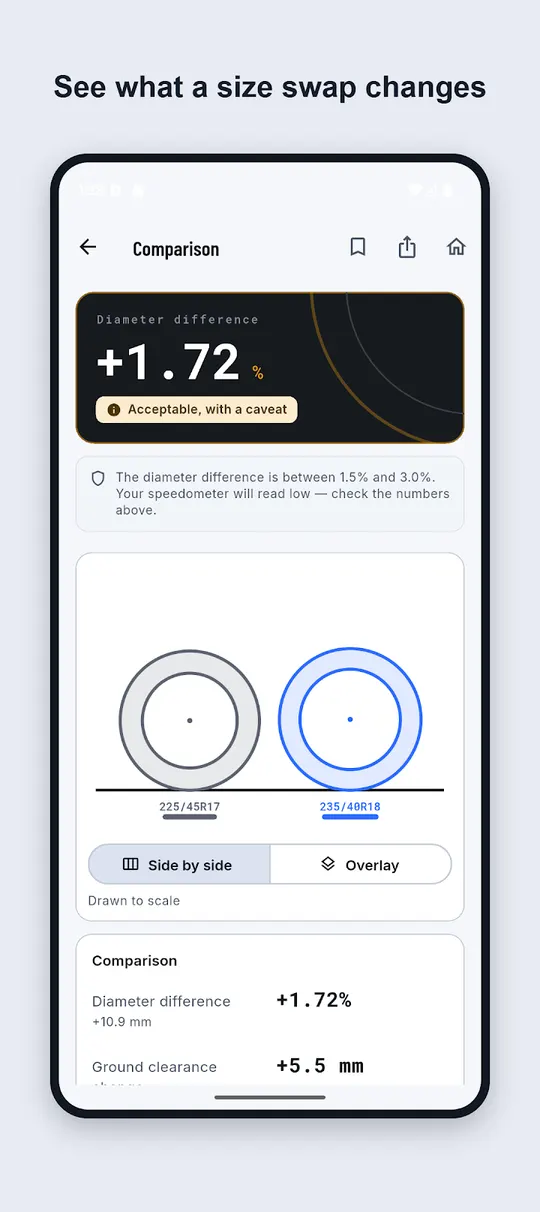
See what a size swap changes 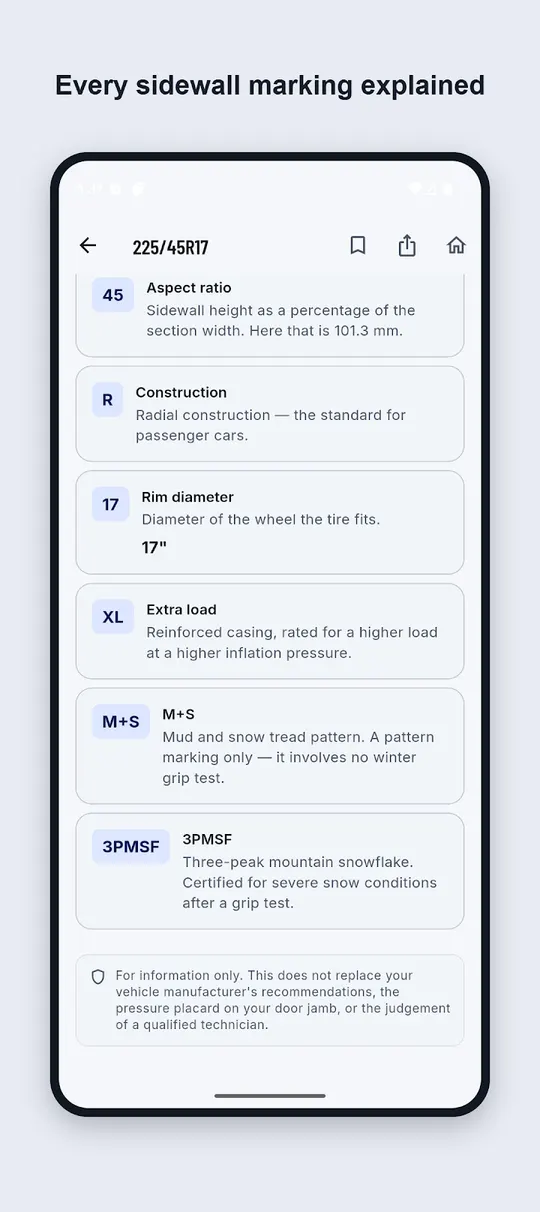
Every sidewall marking explained 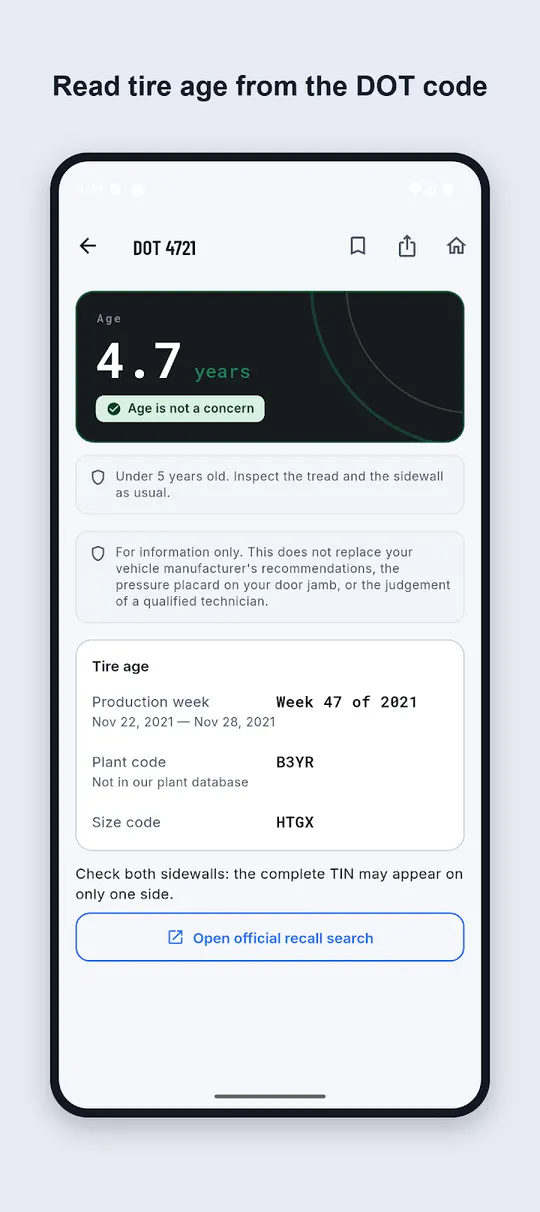
Read tire age from the DOT code 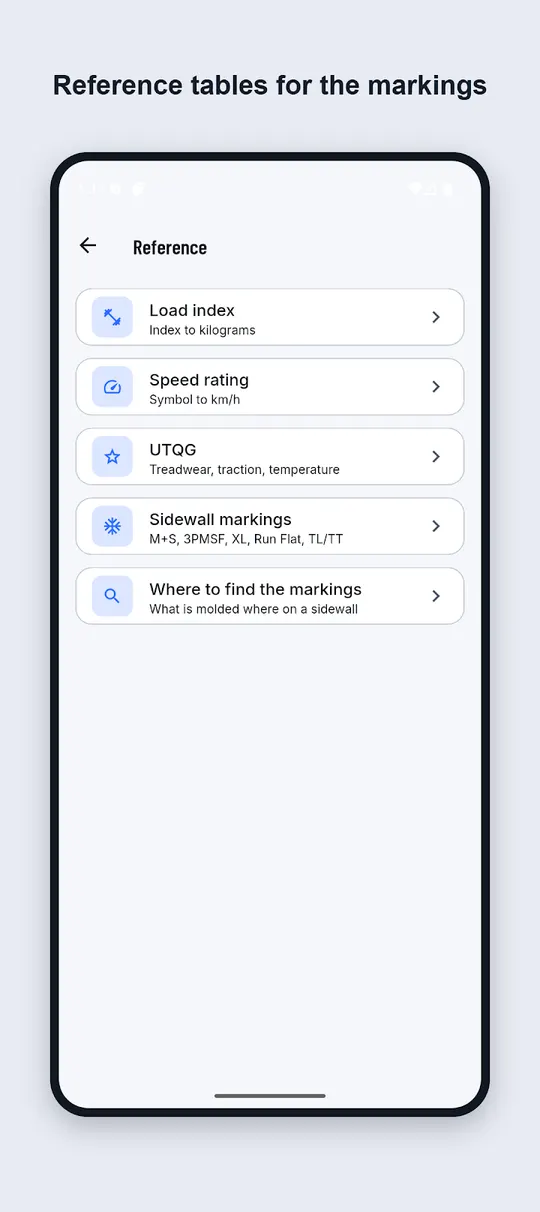
Reference tables
How to read a tire size: 225/45R17 94W
The size on the sidewall is a short code. Take 225/45R17 94W apart and every piece has a job:
| Part | Means | In this tire |
|---|---|---|
| 225 | Nominal section width, sidewall to sidewall, in millimetres | 225 mm, 8.86 in |
| 45 | Aspect ratio: sidewall height as a percentage of the section width | 101.3 mm, 3.99 in |
| R | Radial construction, the standard for passenger cars | Radial |
| 17 | Rim diameter in inches | 431.8 mm |
| 94 | Load index: a code for the maximum load of one tire | 670 kg, 1,477 lb |
| W | Speed rating: the top speed the tire is rated for | 270 km/h, 168 mph |
A letter before the size says what the tire is for: P for a passenger tire in the P-metric system and LT for a light-truck tire. Other markings such as XL, M+S or 3PMSF follow the size and are explained further down. The decoder above reads all of them from what you type, in any of the usual spellings.
Two other size styles exist. A flotation size such as 33x12.50R15 states the overall diameter (33 in), then the section width (12.50 in), the construction and the rim. An old numeric size such as 7.50-16 gives only the width in inches and the rim. Because it has no aspect ratio, the calculator assumes 82 %, the value that Wikipedia gives for an omitted aspect ratio, and says so next to the result.
How to calculate tire diameter and circumference
The overall diameter is the rim plus two sidewalls. With the width W in millimetres, the aspect ratio A in percent and the rim R in inches:
- Sidewall height = W × A ÷ 100
- Overall diameter in mm = 2 × W × A ÷ 100 + R × 25.4. In inches that is W × A ÷ 1,270 + R.
- Circumference = π × diameter
- Revolutions per kilometre = 1,000,000 ÷ circumference in mm
Wikipedia works the same formula for a 195/55R16: 2 × 195 × 55 ÷ 100 + 16 × 25.4 = 621 mm, or 24.44 in. For the 225/45R17 above, the sidewall is 225 × 45 ÷ 100 = 101.25 mm, the diameter is 431.8 + 2 × 101.25 = 634.3 mm, the circumference is 1,992.7 mm and the wheel turns 501.8 times per kilometre.
These are nominal figures from the size code. A tire on a rim of a different width, at a different pressure or from another brand measures a little differently, and the rolling radius under load is smaller than half the diameter. For comparing sizes, the nominal diameter is the standard yardstick.
Tire size chart: diameter and revolutions for common sizes
| Size | Diameter, mm | Diameter, in | Sidewall, mm | Circumference, mm | Revs per km |
|---|---|---|---|---|---|
| 175/65R14 | 583.1 | 22.96 | 113.8 | 1,832 | 545.9 |
| 195/65R15 | 634.5 | 24.98 | 126.8 | 1,993 | 501.7 |
| 205/55R16 | 631.9 | 24.88 | 112.8 | 1,985 | 503.7 |
| 205/60R16 | 652.4 | 25.69 | 123.0 | 2,050 | 487.9 |
| 215/55R17 | 668.3 | 26.31 | 118.3 | 2,100 | 476.3 |
| 225/45R17 | 634.3 | 24.97 | 101.3 | 1,993 | 501.8 |
| 225/50R17 | 656.8 | 25.86 | 112.5 | 2,063 | 484.6 |
| 235/45R18 | 668.7 | 26.33 | 105.8 | 2,101 | 476.0 |
| 225/65R17 | 724.3 | 28.52 | 146.3 | 2,275 | 439.5 |
| 245/45R18 | 677.7 | 26.68 | 110.3 | 2,129 | 469.7 |
| 265/70R17 | 802.8 | 31.61 | 185.5 | 2,522 | 396.5 |
| 275/55R20 | 810.5 | 31.91 | 151.3 | 2,546 | 392.7 |
| 31x10.50R15 | 787.4 | 31.00 | 203.2 | 2,474 | 404.3 |
| 33x12.50R15 | 838.2 | 33.00 | 228.6 | 2,633 | 379.8 |
Type any size into the calculator above to see the rest, including revolutions per mile and a drawing to scale.
How much bigger can a tire be? The 3% rule
The usual guideline is to keep the new overall diameter within 3 % of the factory size. Jalopnik states it as an industry standard, without naming a standards body or study, and calls it not set in stone. Its worked example uses 215/55R17: the stock diameter is 26.3 in, 3 % of that is 0.789 in, and the range runs from 25.52 to 27.10 in.
Beyond the limit the trouble is practical. The speedometer and odometer drift, ABS and traction control read wheel speed and can be thrown off, and a taller tire can rub on the arch or suspension. The same article says pickups and SUVs are often fitted with tires 5 % or even 10 % larger, especially with a lift, and that doing so calls for recalibration of the speedometer through the vehicle computer. The calculator marks a swap as close (within 1 %), inside the guideline (up to 3 %) or outside it.
Plus sizing: same height, bigger rim
To fit a larger wheel without changing the diameter, the sidewall gets lower as the rim grows. For a 225/45R17 (634.3 mm) these sizes stay within 1.5 %:
| Rim | Size | Diameter, mm | Difference |
|---|---|---|---|
| 18 in | 225/40R18 | 637.2 | +0.46 % |
| 18 in | 215/40R18 | 629.2 | −0.80 % |
| 18 in | 245/35R18 | 628.7 | −0.88 % |
| 18 in | 205/45R18 | 641.7 | +1.17 % |
| 19 in | 225/35R19 | 640.1 | +0.91 % |
| 19 in | 215/35R19 | 633.1 | −0.19 % |
| 19 in | 245/30R19 | 629.6 | −0.74 % |
| 19 in | 205/35R19 | 626.1 | −1.29 % |
The wheel itself has to suit the new tire: its approved width range, the bolt pattern and the offset are separate checks that a diameter calculator cannot make.
How to work out speedometer error after a tire change
The speedometer counts wheel turns and assumes the old tire. If the new tire is taller, it covers more road per turn, so you travel faster than the speedometer shows. The error in percent equals the diameter difference in percent:
- Real speed = shown speed × new diameter ÷ old diameter
- Error % = (new diameter − old diameter) ÷ old diameter × 100
Example: 225/45R17 to 235/40R18. The diameter goes from 634.3 mm to 645.2 mm, a difference of 10.9 mm or 1.72 %. When the speedometer shows 100 km/h you are really doing 101.7 km/h, and the odometer records about 1.7 % fewer kilometres than you drive. The axle also sits 5.5 mm higher, half the diameter change.
| Diameter change | Shows 50 km/h | Shows 100 km/h | Shows 60 mph |
|---|---|---|---|
| +1 % | 50.5 km/h | 101.0 km/h | 60.6 mph |
| +2 % | 51.0 km/h | 102.0 km/h | 61.2 mph |
| +3 % | 51.5 km/h | 103.0 km/h | 61.8 mph |
| +5 % | 52.5 km/h | 105.0 km/h | 63.0 mph |
A shorter tire does the opposite: the speedometer reads higher than your real speed. The comparison tab above works the figures for any two sizes and shows the working.
Load index chart
The load index is a code, not a weight. Find it in the table to read the most one tire may carry. Pounds are the kilograms times 2.20462, rounded. The chart below covers the indexes that fit most cars, vans and light trucks; the calculator knows all of 0 to 150.
| 70 to 83 | 84 to 97 | 98 to 111 | 112 to 125 | ||||||||
|---|---|---|---|---|---|---|---|---|---|---|---|
| Index | kg | lb | Index | kg | lb | Index | kg | lb | Index | kg | lb |
| 70 | 335 | 739 | 84 | 500 | 1,102 | 98 | 750 | 1,653 | 112 | 1,120 | 2,469 |
| 71 | 345 | 761 | 85 | 515 | 1,135 | 99 | 775 | 1,709 | 113 | 1,150 | 2,535 |
| 72 | 355 | 783 | 86 | 530 | 1,168 | 100 | 800 | 1,764 | 114 | 1,180 | 2,601 |
| 73 | 365 | 805 | 87 | 545 | 1,202 | 101 | 825 | 1,819 | 115 | 1,215 | 2,679 |
| 74 | 375 | 827 | 88 | 560 | 1,235 | 102 | 850 | 1,874 | 116 | 1,250 | 2,756 |
| 75 | 387 | 853 | 89 | 580 | 1,279 | 103 | 875 | 1,929 | 117 | 1,285 | 2,833 |
| 76 | 400 | 882 | 90 | 600 | 1,323 | 104 | 900 | 1,984 | 118 | 1,320 | 2,910 |
| 77 | 412 | 908 | 91 | 615 | 1,356 | 105 | 925 | 2,039 | 119 | 1,360 | 2,998 |
| 78 | 425 | 937 | 92 | 630 | 1,389 | 106 | 950 | 2,094 | 120 | 1,400 | 3,086 |
| 79 | 437 | 963 | 93 | 650 | 1,433 | 107 | 975 | 2,150 | 121 | 1,450 | 3,197 |
| 80 | 450 | 992 | 94 | 670 | 1,477 | 108 | 1,000 | 2,205 | 122 | 1,500 | 3,307 |
| 81 | 462 | 1,019 | 95 | 690 | 1,521 | 109 | 1,030 | 2,271 | 123 | 1,550 | 3,417 |
| 82 | 475 | 1,047 | 96 | 710 | 1,565 | 110 | 1,060 | 2,337 | 124 | 1,600 | 3,527 |
| 83 | 487 | 1,074 | 97 | 730 | 1,609 | 111 | 1,090 | 2,403 | 125 | 1,650 | 3,638 |
Example: 94 is 670 kg per tire, so four of them carry up to 2,680 kg. Check the load index the vehicle maker specifies for your car.
Speed rating chart
| Symbol | km/h | mph | Symbol | km/h | mph |
|---|---|---|---|---|---|
| J | 100 | 62 | K | 110 | 68 |
| L | 120 | 75 | M | 130 | 81 |
| N | 140 | 87 | P | 150 | 94 |
| Q | 160 | 100 | R | 170 | 106 |
| S | 180 | 112 | T | 190 | 118 |
| U | 200 | 124 | H | 210 | 130 |
| V | 240 | 149 | Z | over 240 | over 149 |
| W | 270 | 168 | (W) | over 270 | over 168 |
| Y | 300 | 186 | (Y) | over 300 | over 186 |
Example: V stands for 240 km/h (149 mph) and H for 210 km/h (130 mph). The table starts at J; the calculator also knows the slower ratings A1 to G. Z, (W) and (Y) mean the tire is rated above the figure shown.
XL, run-flat, M+S, 3PMSF, LT and load range: what they mean
| Marking | Meaning |
|---|---|
| XL | Extra load. A reinforced tire that allows a higher inflation pressure, and so a higher maximum load, than a standard-load tire. |
| RFT, RF, ZP | Run-flat tire. Michelin marks its run-flat tires ZP. |
| M+S | Mud and snow. Meets the all-season definition of the RMA and RAC. It is a tread description, not a winter performance test. |
| 3PMSF | Three-peak mountain snowflake: rated for severe snow conditions. Studded tires add a Cyrillic Ш. |
| LT | Light truck. Written before the size (LT265/70R17) or after it (31x10.50R15LT). These tires carry a load range. |
| Load range | A letter for the ply rating: A = 2, B = 4, C = 6, D = 8, E = 10, F = 12, G = 14, H = 16, J = 18, L = 20, M = 22, N = 24. Load range E, for example, is a 10-ply rating. |
| UTQG | Uniform Tire Quality Grading on passenger tires: a treadwear number, a traction grade and a temperature grade. The Android app has a reference for them. |
How to read a DOT code and find the date a tire was made
The full code starts with DOT and is moulded into the sidewall, sometimes on one side only, so look on both. The date is the last part, four digits since 2000:
- The first two digits are the week of manufacture, 01 to 53.
- The last two are the year. 4721 is week 47 of 2021, and 0121 is week 1 of 2021.
- Before 2000 the date had three digits: the week and one digit for the year. 042 is week 4, and the single year digit cannot tell 1992 from 1982, so the code alone leaves the decade open.
- The plant code comes first: three characters since 2015, two before. It is assigned by NHTSA, and the plants are listed in NHTSA's public data.
- Between the plant and the date sit a size code and a manufacturer-defined type code, which are not standardised.
Weeks follow ISO 8601, so week 47 of 2021 runs from Monday 22 November to Sunday 28 November. The tire tab above gives that range and today's age.
How old is too old for a tire?
There is no law-like number, and the sources differ in tone, so the tool prints what each one says rather than one verdict of its own:
- Michelin says the maximum lifespan of a tyre is 10 years and does not recommend using tyres past that, whatever the mileage. It also advises a check by an expert at least once a year and gives five years as a general age to replace tyres. A tyre kept properly in storage counts as new.
- The British Rubber Manufacturers Association, in a recommended practice from June 2001 quoted by Wikipedia, said unused tires should not be put into service if they are over six years old, and that all tires should be replaced ten years from the date of manufacture.
So the calculator marks a tire under five years as no concern, five to ten years as one to inspect every year, and ten years or more as past the limit. Age is only one factor. Tread depth, cracks, bulges, repairs and the way the tire was stored matter as much, and the vehicle maker's own advice comes first.
What the Android app adds
- The same size calculator, with revolutions per mile and per kilometre, for metric, flotation and old numeric sizes, and every formula shown.
- Comparison of two sizes or up to four at once, equivalent sizes for your rim and plus sizing, with the speedometer error at real speeds and the change in ground clearance.
- A sidewall decoder, the DOT code with the plant, and reference tables for load index, speed rating and UTQG, based on UNECE R30, 49 CFR 574 and the public NHTSA plant code dataset.
- Tire and wheel tools: wheel offset, a pressure converter, tread depth and tread life, a bolt pattern reference, the load index needed from an axle weight, a size from a target diameter, the gear ratio after a size change and rotation patterns.
- A garage for your vehicles and original sizes, saved tires and history, PDF export and optional monthly and seasonal tire-check reminders.
Honest notes
- The app is free with ads, needs no account and works offline, in 15+ languages, according to its listing. This page works without a connection once it has loaded.
- This page works from the size you type and covers sizes, comparison and age. It does not list plant codes, UTQG grades or the app's other tools.
- The 3 % guideline, the age figures and the tables come from the sources below. The listing says its own tables are based on UNECE R30, 49 CFR 574 and the NHTSA plant code dataset. This page does not cite those documents directly, because it takes its tables from Wikipedia's Tire code article.
- Dimensions are nominal. For a safety decision, such as a load index or a tire past its age, follow the vehicle maker's placard and ask a tire professional.
Sources
- Wikipedia, Tire code: size code parts, the diameter formula, the load index and speed rating tables, load range, markings and the DOT date code. Opened 1 November 2026. The article prints the pounds for load index 66 and 148 wrongly, so this page works pounds out from kilograms.
- Wikipedia, Tire: the British Rubber Manufacturers Association recommended practice of June 2001 on tire age. Opened 1 November 2026.
- Jalopnik, What The 3% Rule Means For Your Tires (Alvin Reyes, April 2026): the 3 % guideline and its 215/55R17 example. The article cites no standard for it.
- Michelin Malaysia, tyre manufacturing date: how to read the date and the 5 and 10 year advice. Opened 1 November 2026.
Questions
How do I read a tire size like 225/45R17?
225 is the section width in millimetres, 45 is the sidewall height as a percentage of that width, R means radial and 17 is the rim diameter in inches. After it come the load index and speed rating, such as 94W. Type the size in the calculator above and it explains each part.
How do I calculate the diameter of a tire?
Add the rim to two sidewalls. The sidewall is the width times the aspect ratio divided by 100, so for 225/45R17 it is 101.25 mm. The diameter is 431.8 mm for the rim plus 2 × 101.25 mm, which gives 634.3 mm, or 24.97 in.
How much bigger can a tire be before the speedometer is wrong?
The usual guideline is to stay within 3 % of the original overall diameter, and the speedometer error in percent equals the diameter difference in percent. Going from 225/45R17 to 235/40R18 is +1.72 %, so when the speedometer shows 100 km/h you are doing about 101.7 km/h.
How do I find out how old a tire is?
Look at the last four digits of the DOT code moulded into the sidewall. The first two are the week and the last two the year, so 4721 is week 47 of 2021. A three-digit code means the tire was made before 2000. The full code can be on one sidewall only.
How old is too old for a tire?
Michelin calls 10 years the maximum lifespan and advises a check by an expert at least once a year, and the British Rubber Manufacturers Association advised replacing tires ten years from manufacture. These are manufacturer guidance, and the vehicle maker's advice comes first.
What does a load index like 94 mean?
It is a code for the most one tire may carry. Index 94 is 670 kg (1,477 lb) per tire. The calculator decodes any index from 0 to 150 and the speed rating that follows it, such as W for 270 km/h.
Is the Tire Size Calculator app free and does it work offline?
Yes. It is free, supported by ads, works offline, needs no account and is available in 15+ languages, in metric or imperial units.

Read any sidewall in seconds
Free on Android, supported by ads. No account and no registration, metric or imperial units, and every formula is shown on screen so you can check it.
Facts from the Google Play listing, last checked .