Duct size calculator: a free ductulator for CFM and friction rate
Enter the airflow and a friction rate and the ductulator below gives the round duct size, the air velocity and a rectangular equivalent, with the formula worked out in your numbers. It also checks a duct you already have. The free Android app adds guided charge and airflow checks, load estimates and refrigerant pressure-temperature charts, all offline.
Ductulator
Equal-friction duct sizing, round and rectangular
Round duct, exact
13.36 in
- Next size up
- 14 in
- Velocity there
- 748 fpm OK
- Friction there
- 0.063 in. w.g./100 ft
- Rectangle
- 8 in × 20 in
Formula with your numbers
D = (0.109136 × Q^1.9 / f)^(1/5.02) = (0.109136 × 800.0^1.9 / 0.08)^(0.1992) = 13.36 in
Next size up 14.00 in: A = pi × (14.00 / 24)² = 1.069 ft², V = Q / A = 800.0 / 1.069 = 748 fpm
Friction at 14.00 in: f = 0.109136 × 800.0^1.9 / 14.00^5.02 = 0.0631 in. w.g./100 ft
Rectangle with side 8.00 in: 1.30 × (8.00 × b)^0.625 / (8.00 + b)^0.25 = 13.36 gives b = 19.58 in
Rounded to 8.00 × 20.00 in: equivalent 13.48 in, f = 0.0763 in. w.g./100 ft, V = 800.0 / 1.111 ft² = 720 fpm
| Side | Other side | Ratio | Velocity |
|---|---|---|---|
| 6 in | 29 in | 4.8:1 | 662 fpm |
| 8 in | 20 in | 2.5:1 | 720 fpm |
| 10 in | 16 in | 1.6:1 | 720 fpm |
| 12 in | 13 in | 1.1:1 | 738 fpm |
| 14 in | 11 in | 1.3:1 | 748 fpm |
| 16 in | 10 in | 1.6:1 | 720 fpm |
Friction rate
0.063 in. w.g./100 ft
- Velocity
- 748 fpm OK
Formula with your numbers
f = 0.109136 × 800.0^1.9 / 14.00^5.02 = 0.0631 in. w.g./100 ft
V = Q / A = 800.0 / (pi × (14.00 / 24)²) = 800.0 / 1.069 ft² = 748 fpm
Airflow to expect
1,200 CFM
- Capacity
- 36,000 Btu/h
- Largest air drop
- 27.8 °F
The largest drop assumes all the cooling is sensible. Part of it removes moisture, so a measured drop is smaller. Less air per ton gives a colder coil that removes more moisture; more air per ton gives more sensible capacity (ACCA).
Formula with your numbers
Q = tons × CFM per ton = 3 × 400 = 1,200 CFM
Btu/h = tons × 12,000 = 3 × 12,000 = 36,000 Btu/h
Largest air drop if all the cooling were sensible: delta T = 12,000 / (1.08 × 400) = 27.8 °F
Indicative only. Sizing uses the round duct friction curve for galvanized steel at standard air and ignores fittings, altitude, duct material and flexible duct. It does not replace a design calculation (ACCA Manual D, ASHRAE) or your local code. The tonnage check is a rough sanity check and is not a Manual J load calculation.
Field checks, not just formulas
This page sizes ducts and converts tons to airflow. The Android app is a full offline toolkit for HVAC and refrigeration work, built around guided checks that tell you what the readings mean together:
- Guided Charge Check: refrigerant and metering device, suction and liquid pressures and line temperatures in, superheat, subcooling and target superheat out, with fixed orifice and TXV systems handled differently
- Airflow Check: supply, return and total external static pressure against the rated maximum, temperature split and, in cooling, estimated CFM and CFM per ton with likely restriction points
- Load Estimate for one room or a whole house, envelope by envelope, with a suggested capacity range and an oversizing warning
- Ductulator for round and rectangular duct, round to rectangular equivalents, velocity, friction rate, velocity pressure and fan laws, with galvanized, duct board and extended or compressed flexible duct
- Pressure-temperature charts for R-410A, R-32, R-454B, R-22, R-134a, R-404A, R-407C, R-290, R-744 and more, with bubble and dew points shown separately for blends
- Psychrometrics from a supported pair of air properties, mixed air, coil sensible and latent load and sensible heat ratio
- Altitude set once: air density, the 1.08, 0.68 and 4.5 constants, friction rates and absolute pressures are recalculated
- Saved jobs with site name and notes, shared as text or PDF and kept on the device, imperial and metric, 40+ languages


Guided checks and 80+ calculators 
Readings that explain themselves 
Organized the way you work 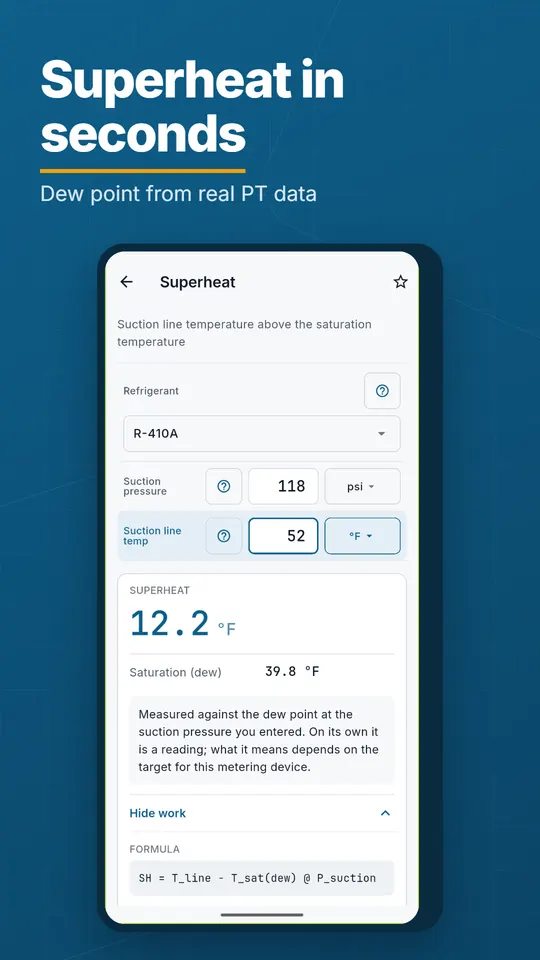
Superheat with its working shown 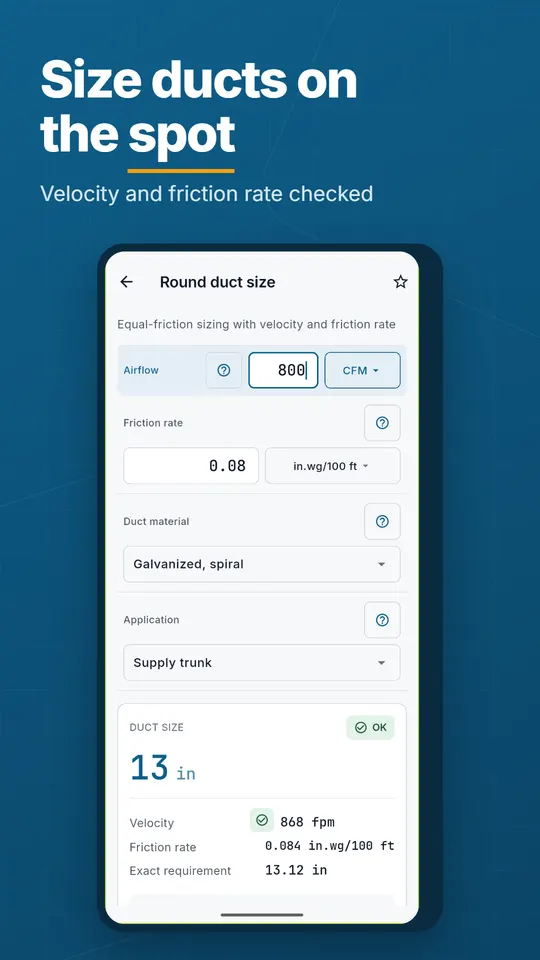
Size ducts on the spot 
Find any tool by name
How a ductulator works: equal friction, velocity and static pressure
A ductulator, or duct calculator, links three numbers for one duct: the airflow it carries (CFM), the pressure it loses per length (the friction rate) and the size. Fix the airflow and the friction rate and the size follows. That is the equal-friction method: you choose one friction rate for the whole system, size every run to it, and the pressure loss per foot is the same everywhere.
- Friction rate is the pressure lost to the duct walls, in inches of water gauge (in. w.g.) per 100 ft of duct, or in Pa per metre.
- Velocity is airflow divided by cross-section, in feet per minute (fpm). It drives duct noise.
- Static pressure is the push the blower has. The sum of the friction along the longest run plus the coil, filter and grilles must fit inside what the blower can give at the airflow you want.
The round duct curve used here is Δh = 0.109136 × Q1.9 / d5.02, with Q in CFM, d in inches and Δh in in. w.g. per 100 ft. Turned round, d = (0.109136 × Q1.9 / Δh)1/5.02. It describes galvanized steel duct with turbulent flow. Velocity is Q divided by π × (d / 24)² square feet.
Worked example: 800 CFM at 0.08 in. w.g. per 100 ft gives d = 13.36 in. The next whole inch is 14 in, where the air moves at 748 fpm and the friction rate drops to 0.063. The calculator above does the same sum and prints each step with your numbers. The arithmetic is reproducible against published values: 1,000 CFM at 0.08 gives 14.5 in in a published ductulator, and 2,000 CFM at 0.14 gives 16.9 in, the row in the Engineering ToolBox chart.
Other tools can differ by a few percent. The Android app asks for the duct material, which changes the surface roughness. Its screenshot for 800 CFM at 0.08 on spiral galvanized duct shows 13.12 in; this curve gives 13.36 in.
What friction rate should I use?
There is no single right number. The friction rate is whatever pressure you can spend on the ducts, spread over the longest run:
friction rate = available static pressure × 100 / total effective length
Available static pressure is the blower's rated external static pressure minus the losses of the coil, filter, grilles and dampers. Total effective length is the straight duct plus the equivalent length of every fitting on the longest supply and return path. Example with made-up numbers: 0.20 in. w.g. available over 250 ft of effective length is 0.08 in. w.g. per 100 ft. The HVAC School and Energy Vanguard articles in the sources show the same method and why a fixed rate is only a starting point.
The Energy Vanguard example works out to 0.073 in. w.g. per 100 ft. A duct design study guide gives 0.08 to 0.15 as the usual range for comfort systems, which is only a starting point: a rate picked without the sum above can ask more of the fan than it has. When the numbers do not fit, lower the friction rate, which gives bigger ducts, or shorten the run.
Round to rectangular duct: the equivalent size
A rectangular duct moves the same air at the same friction as a round duct of its equivalent diameter. The common conversion is the Huebscher equation:
de = 1.30 × (a × b)0.625 / (a + b)0.25
Here a and b are the two sides in the same unit. It cannot be solved for b in closed form, so the calculator finds b numerically. Two things trip people up. First, equal friction does not mean equal area: the rectangle has a larger cross-section than its round twin, so the air in it is slower. 1,000 CFM in the 14.5 in round duct is 868 fpm; in the matching 8 in by 24 in rectangle it is 750 fpm. Second, a long thin rectangle has more wall for the same area. A study guide puts the aspect ratio at 3:1 or less and 4:1 as an absolute limit; at 5:1 and above it reports heavier metal, drumming noise and higher installation cost.
| Round, in | a = 6 in | a = 8 in | a = 10 in | a = 12 in |
|---|---|---|---|---|
| 6 | 5.0 in | 3.9 in | 3.2 in | n/a |
| 8 | 9.0 in | 6.7 in | 5.5 in | 4.7 in |
| 10 | 14.6 in | 10.5 in | 8.4 in | 7.1 in |
| 12 | 22.2 in | 15.5 in | 12.1 in | 10.1 in |
| 14 | n/a | 21.8 in | 16.7 in | 13.7 in |
| 16 | n/a | 29.6 in | 22.3 in | 18.0 in |
Read a row as: a 10 in round duct is the same as 6 in × 14.6 in. Round up to the next size you can buy.
How fast should air move in a duct?
In homes, noise sets the limit. The figures below come from the sources listed at the end. They are guidelines for comfort, not code limits, and published tables disagree with each other, so check the one your job uses.
| Duct | Velocity | Source |
|---|---|---|
| Residential supply duct | 900 fpm maximum | ACCA Manual D, quoted by Energy Vanguard |
| Residential return duct | 700 fpm maximum | ACCA Manual D, quoted by Energy Vanguard |
| Residential trunk, branch | 700 to 900 fpm, 500 to 700 fpm | HVAC School tech tip, 2021 |
| Return grille face | 500 fpm or lower | HVAC School tech tip, 2021 |
| Commercial main above occupied space | 1,200 to 1,500 fpm | Study guide table, no primary source given |
The calculator checks the first two rows: 900 fpm for a supply duct and 700 fpm for a return. It flags the size when the air moves faster. For commercial work the maximum depends on where the duct runs and the noise target; ASHRAE publishes that table, and this page does not reproduce it.
Duct size chart: CFM to round duct size
The table is computed with the same code as the calculator, at three friction rates, with the velocity in the exact size at 0.08. Sizes are exact diameters in inches; use the next size up.
| CFM | 0.06 in. w.g./100 ft | 0.08 in. w.g./100 ft | 0.10 in. w.g./100 ft | Velocity at 0.08 |
|---|---|---|---|---|
| 50 | 5.0 in | 4.7 in | 4.5 in | 419 fpm |
| 100 | 6.4 in | 6.1 in | 5.8 in | 496 fpm |
| 150 | 7.5 in | 7.1 in | 6.8 in | 548 fpm |
| 200 | 8.4 in | 7.9 in | 7.6 in | 587 fpm |
| 300 | 9.8 in | 9.2 in | 8.8 in | 648 fpm |
| 400 | 10.9 in | 10.3 in | 9.8 in | 695 fpm |
| 600 | 12.7 in | 12.0 in | 11.5 in | 767 fpm |
| 800 | 14.1 in | 13.4 in | 12.8 in | 822 fpm |
| 1,000 | 15.4 in | 14.5 in | 13.9 in | 868 fpm |
| 1,200 | 16.5 in | 15.6 in | 14.9 in | 908 fpm |
| 1,600 | 18.4 in | 17.4 in | 16.6 in | 973 fpm |
| 2,000 | 20.0 in | 18.9 in | 18.1 in | 1,027 fpm |
Friction rises with the 1.9 power of the airflow. A 6 in round duct loses 0.085 in. w.g. per 100 ft at 100 CFM and 0.185 at 150 CFM: half as much air again, 2.2 times the friction.
How many CFM per ton?
The usual rule of thumb is 400 CFM per ton of cooling. One ton is 12,000 Btu/h (3.517 kW), so a 3 ton system points at 1,200 CFM. The sensible heat equation shows where the figure comes from: Q = 1.08 × CFM × ΔT, with 1.08 = 0.075 lb/ft³ × 0.24 Btu/lb·°F × 60 for air at 70 °F and sea level. At 400 CFM per ton the air would cool by 12,000 / (1.08 × 400) = 27.8 °F if all the cooling were sensible.
- Humid climates do better with less air, around 350 CFM per ton, because a colder coil removes more moisture. Green Building Advisor gives 300 to 350.
- Dry climates can use more, around 450 CFM per ton, which gives more sensible capacity. Green Building Advisor gives 450 to 550.
- Elevation, humidity and the equipment all move the right number, which is why ACCA calls 400 a rule of thumb and not an answer. The equipment data sheet has the airflow range the manufacturer allows.
The third tab of the calculator converts tons, Btu/h and airflow at 350, 400 or 450. It is a sanity check on a nameplate or a measured airflow. It is not a load calculation.
What size AC do I need?
The honest answer is a load calculation: ACCA Manual J for a house, which counts the envelope, windows, insulation, air leakage, people and equipment room by room. Square footage rules ignore all of that and are often wrong in both directions, and an oversized system short-cycles and handles humidity badly. This page does not give a square-foot table for that reason.
The Android app has a Load Estimate for one room or a whole house, built envelope by envelope, with a suggested capacity range and an oversizing warning. Its listing states that it is not a substitute for a full load calculation.
Charge check and airflow check: what the app walks you through
Most calculator apps give a formula and stop. The listing describes the app as guiding the check itself. The descriptions below are the listing's, not a procedure from this page.
- Charge Check. Pick the refrigerant and the metering device, enter suction and liquid pressures and line temperatures, and get superheat, subcooling, target superheat and a plain reading of what the numbers say together. Fixed orifice and TXV systems are handled differently. Superheat in the app is the line temperature minus the saturation temperature at the suction pressure.
- Airflow Check. Supply static, return static and total external static pressure against the rated maximum, the temperature split and, in cooling, estimated CFM and CFM per ton, with likely restriction points listed.
- Duct Sizing Run. Sizes a run to the static pressure it actually has to spend, which is the friction rate method above.
Refrigerant pressure-temperature data and target superheat or subcooling values depend on the refrigerant and on the manufacturer's charging procedure. They are not on this page, and a table copied from a website is a poor basis for charging a system. Use the manufacturer's data. Refrigerant work belongs to qualified, certified technicians.
Static pressure in a duct system
Total external static pressure (TESP) is the sum of the pressure drops outside the blower's cabinet, measured as supply static plus the absolute value of return static. The equipment has a rated maximum TESP. If the measured TESP is above it, the blower cannot deliver the rated airflow: the usual causes are small or long ducts, restrictive filters, a dirty coil and closed dampers. Measuring it is how you find out whether the duct system or the equipment is the limit.
To use the figure in design, subtract the component losses from the rated TESP to get the available static pressure, then divide by the total effective length as above. The ductulator then gives a size per run.
What the Android app adds
- Ductulator for round and rectangular duct, round to rectangular, velocity, friction rate, velocity pressure, TESP, CFM from temperature rise and from ΔT, air changes per hour and fan laws.
- Duct material: galvanized, duct board, and flexible duct both extended and compressed.
- Altitude set once: air density, the 1.08, 0.68 and 4.5 constants, friction rates and absolute pressures are recalculated.
- Pressure-temperature charts for R-410A, R-32, R-454B, R-22, R-134a and other refrigerants, with bubble and dew points separate for blends.
- Psychrometrics, electrical (see the Ohm's law calculator and voltage drop and wire size calculator), energy cost, COP and EER, and hydronics.
- Saved jobs with site name and notes, shared as text or PDF, imperial and metric, 40+ languages, offline. Every result shows its formula, inputs and assumptions.
Honest notes
- The app is free with ads. The listing says no subscription, no account and no paywall.
- It works without a connection. The calculator on this page does too once loaded.
- Results are estimates. The app's listing says it does not replace a full load calculation, a licensed design, manufacturer charging procedures or local code, and the same goes for this page. Check the equipment data and the code that applies to the job.
- This page sizes by one friction rate for galvanized steel duct. It does not model fittings, flexible duct, altitude or the noise in a specific grille.
Sources
- Engineering ToolBox, Air Duct Friction Loss: the round duct equation and constants.
- Engineering ToolBox, Fluid Flow - Equivalent Diameter: the Huebscher equation, credited to Huebscher (1948).
- Energy Vanguard, Duct Design 5: Sizing the Ducts (Allison Bailes, 2017): the ductulator walk-through and the Manual D velocity limits.
- HVAC School, Determine Friction Rate for Residential Duct Design (2018) and Air Velocity Quick Tips (2021).
- HVAC School, Sensible Heat in Air and Water (2018): the 1.08 constant.
- ACCA, 400 CFM Per Ton, Or Is It? (2021) and Green Building Advisor, Getting the Right Airflow for an Air Conditioning System (2024).
- Ton of refrigeration: 12,000 Btu/h.
- Duct design study guide: aspect ratio and friction rate ranges. A study guide, not a standard.
Questions
How do I size a duct for a given CFM?
Pick a friction rate, then d = (0.109136 × Q^1.9 / f)^(1/5.02) gives the round diameter in inches for Q in CFM. For 800 CFM at 0.08 in. w.g. per 100 ft that is 13.4 in, so a 14 in duct, where the air moves at 748 fpm. The ductulator on this page does the sum and shows each step.
What friction rate should I use for duct sizing?
Work it out: the available static pressure times 100, divided by the total effective length of the longest run. For example 0.20 in. w.g. over 250 ft is 0.08. A duct design guide gives 0.08 to 0.15 as the usual range for comfort systems, but a fixed number picked without the sum can ask too much of the fan.
How do I convert a round duct to rectangular?
Use the Huebscher equation, de = 1.30 × (a × b)^0.625 / (a + b)^0.25, and solve for the other side. A 10 in round duct equals 6 in × 14.6 in. The rectangle has more area than its round twin, so the air in it is slower, and the ratio of the sides should stay at 3:1 or less, 4:1 at most.
What is the maximum air velocity in a duct?
In homes, ACCA Manual D as quoted by Energy Vanguard gives 900 fpm for supply ducts and 700 fpm for returns, mainly for noise. Commercial limits are higher and depend on where the duct runs; ASHRAE publishes the table and the page links its sources.
How many CFM per ton of cooling?
The rule of thumb is 400 CFM per ton, so a 3 ton system points at 1,200 CFM. ACCA suggests about 350 in hot, humid climates and 450 in drier ones. It is a rule of thumb: elevation, humidity and the equipment data change the right figure.
What size AC do I need for my house?
That takes a load calculation (ACCA Manual J) that counts the envelope, windows, leakage and occupants room by room. Square footage rules ignore most of it. The app has a Load Estimate with an oversizing warning, and its listing says it is not a substitute for a full load calculation.
Is the HVAC Calculator app free?
Yes. It is free with ads, and the listing says no subscription, no account and no paywall. Every calculation works offline.

Take the ductulator to the job
Free on Android with ads, offline, imperial and metric. No subscription, no account and no paywall, and every result shows its formula and assumptions.
Facts from the Google Play listing, last checked .