Voltage drop calculator and wire size calculator
Enter the current, the cable length and the voltage, and the calculator below finds the smallest cable that keeps the voltage drop within your limit, in mm² and AWG, with the physics written out so you can check it. The free Android app does the same offline with 25 electrical calculators.
Voltage drop calculator
Minimum wire size for an allowed drop, in mm² and AWG
Minimum cross-section
9.56 mm²
Metric10 mm²
AWG6 AWG
How it is worked out (DC)
ΔVmax = 12 V × 3.0 % = 0.360 V
ρ = 0.0172 × (1 + 0.00393 × (20 − 20)) = 0.01720 Ω·mm²/m
A = 2 × L × ρ × I / ΔVmax = 2 × 5.00 m × 0.01720 × 20.0 A / 0.360 V = 9.56 mm²
With 10 mm²: ΔV = 2 × 5.00 × 0.01720 × 20.0 / 10 = 0.34 V (2.87 %), 11.66 V at the load
| Size | Area | Drop |
|---|---|---|
| 4 mm² | 4.00 mm² | 0.86 V · 7.17 % |
| 6 mm² | 6.00 mm² | 0.57 V · 4.78 % |
| 10 mm²smallest that fits | 10.00 mm² | 0.34 V · 2.87 % |
| 16 mm² | 16.00 mm² | 0.21 V · 1.79 % |
| 25 mm² | 25.00 mm² | 0.14 V · 1.15 % |
| Size | Area | Drop |
|---|---|---|
| 10 AWG | 5.26 mm² | 0.65 V · 5.45 % |
| 8 AWG | 8.37 mm² | 0.41 V · 3.43 % |
| 6 AWGsmallest that fits | 13.30 mm² | 0.26 V · 2.16 % |
| 4 AWG | 21.15 mm² | 0.16 V · 1.36 % |
| 3 AWG | 26.67 mm² | 0.13 V · 1.07 % |
Voltage drop only. This does not check ampacity (how much current a cable can carry without overheating), fault protection or breaker size. Resistive estimate at power factor 1; reactance is ignored, which matters on large AC cables. Your local code (NEC, IEC 60364, BS 7671) and a qualified electrician decide.
The full cable toolkit on site
This page sizes one run. The Android app covers the whole job offline, in a basement or on a roof with no signal, and shows the formula behind every result:
- Voltage drop in volts and percent, minimum wire size for an allowed drop and maximum run length
- Total drop over several runs, feeder plus branch, against one budget
- AWG/kcmil and IEC mm² as separate size series, always rounded up to the larger conductor
- Power factor, cable reactance, conductor temperature and parallel runs as inputs
- Power loss in watts, percent and kWh per year, plus cable weight and cost
- Ohm's law, power triangle, power factor correction, motors, transformers, batteries and solar strings: 25 calculators
- Every result shows its formula and assumptions; charts show the drop against length and size
- Save runs into projects, dark theme, 76 languages, fully offline

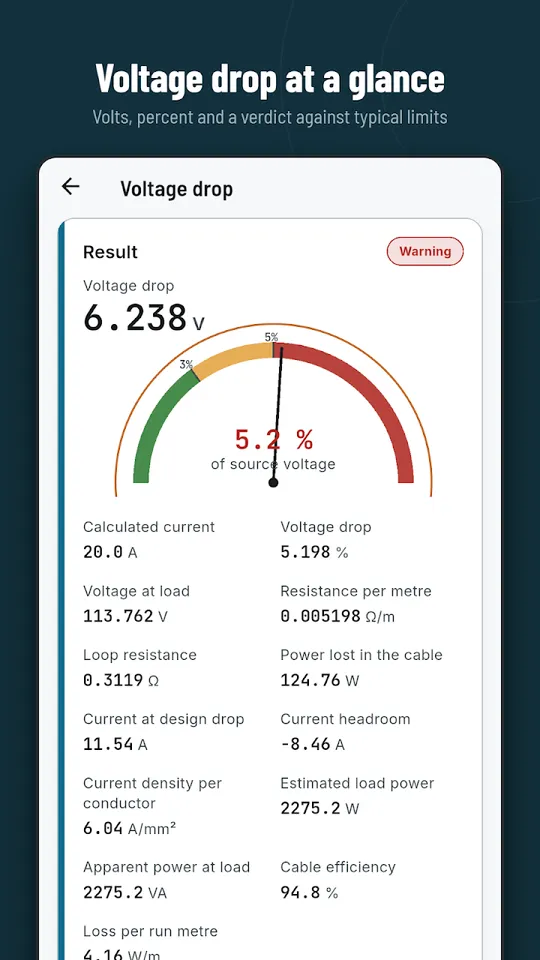
Volts, percent and a verdict 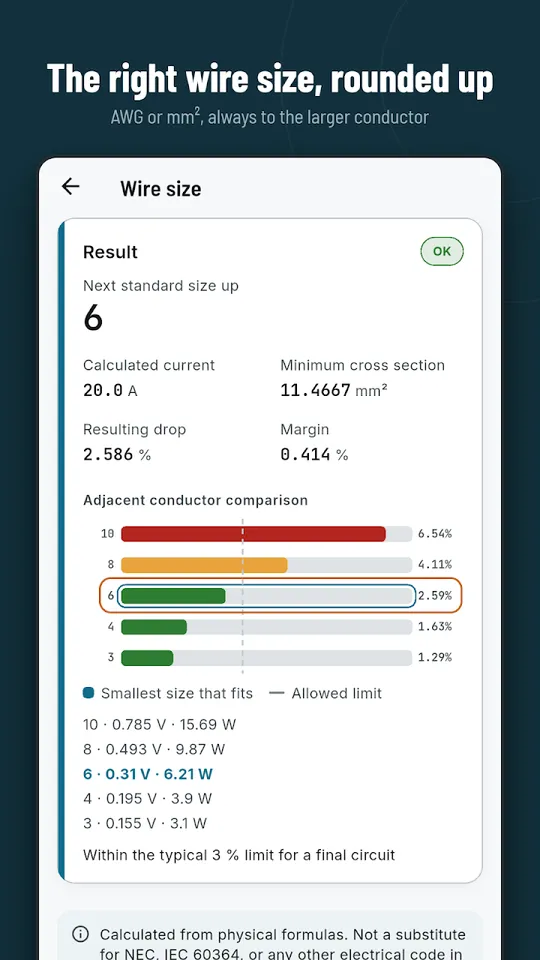
The right size, rounded up 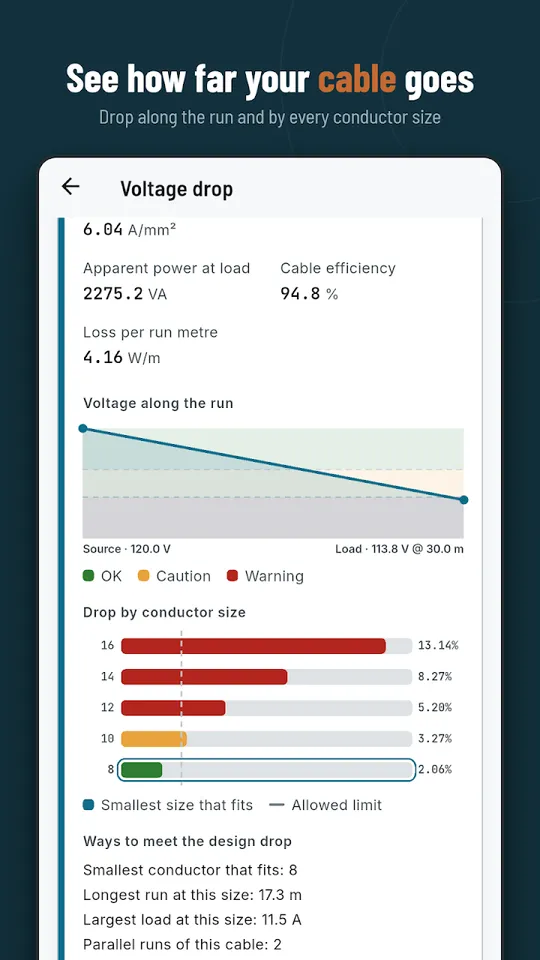
See how far a cable goes 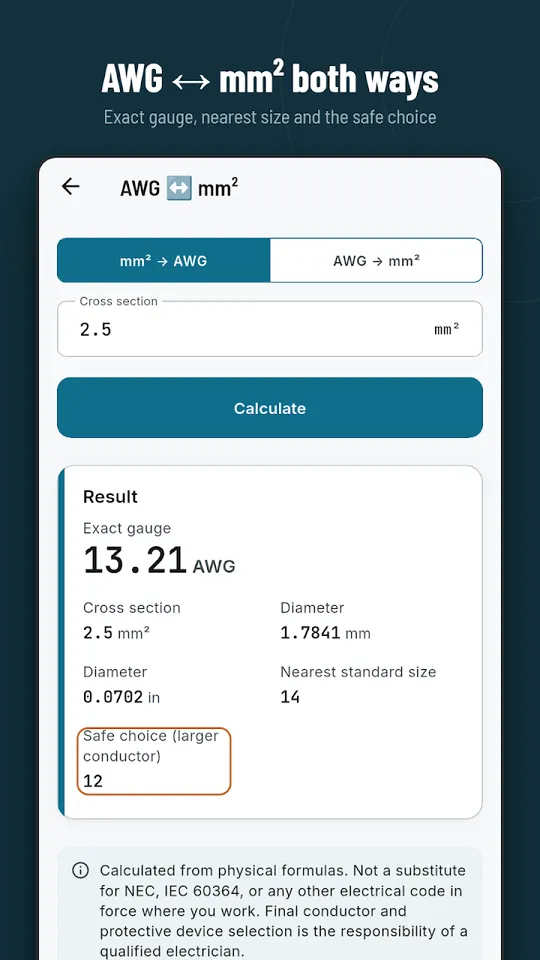
AWG ↔ mm² both ways 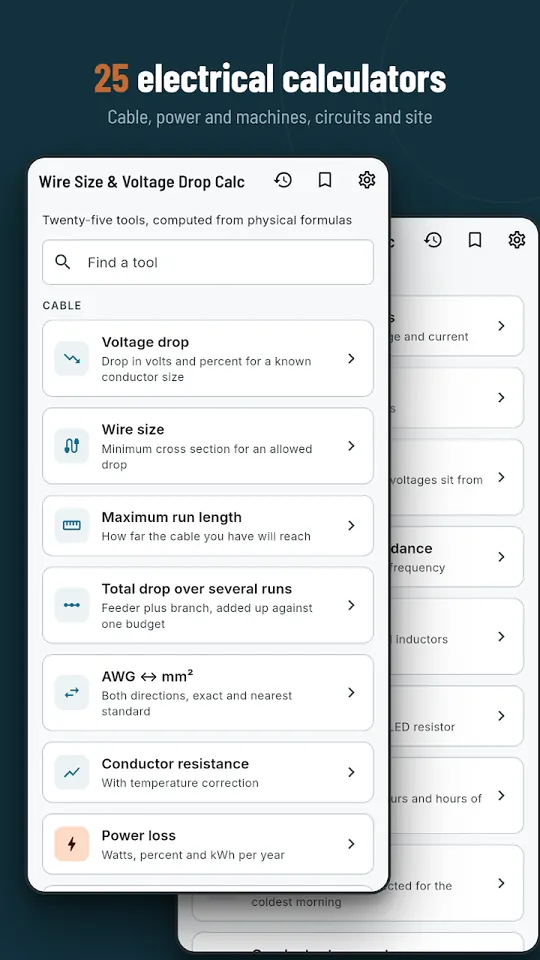
25 calculators in one app 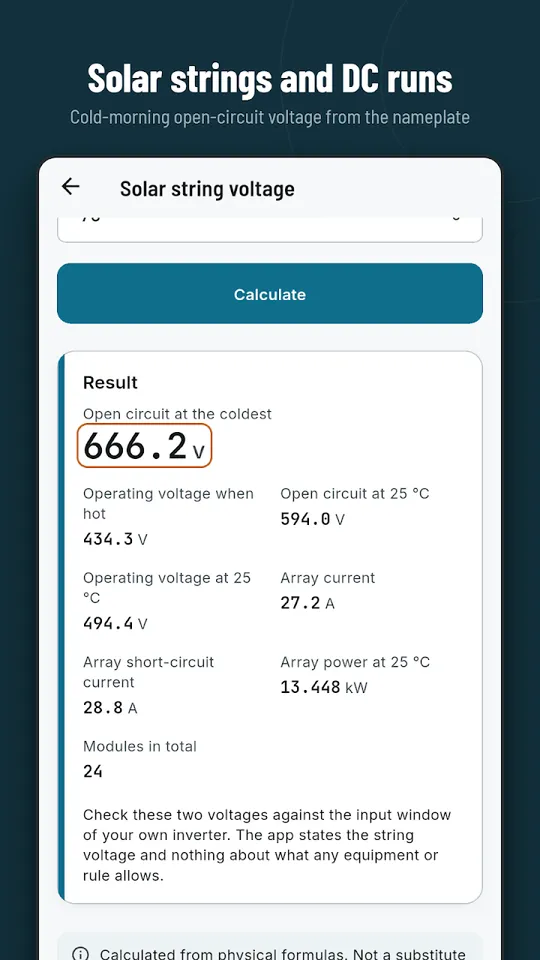
Solar strings and DC runs 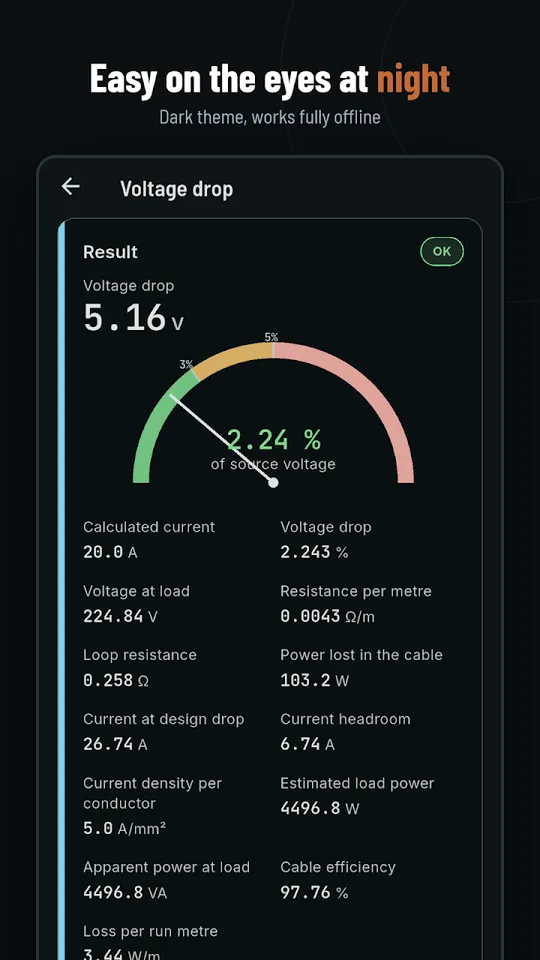
Dark theme for site work
Voltage drop formula for DC, single phase and three phase
A cable is a resistor. Its resistance is R = ρ × L / A: resistivity of the metal (ρ, in Ω·mm²/m) times the length (L, in metres) divided by the cross-section (A, in mm²). The voltage it loses is that resistance times the current.
- DC and single-phase AC: ΔV = 2 × L × ρ × I / A. The current goes out on one conductor and back on the other, so the loop is twice the one-way length.
- Balanced three phase: ΔV = √3 × L × ρ × I / A, measured line to line. The return currents of the three phases cancel, and the √3 turns the drop in one conductor into the drop between two lines.
- Wire size for an allowed drop: turn it round. A = k × L × ρ × I / ΔVmax, where k is 2 or √3 and ΔVmax is the system voltage times the allowed percentage. Then round up to the next standard size, never down.
Resistivity used here: copper 0.0172 and aluminium 0.0282 Ω·mm²/m at 20 °C. These are simple resistive formulas at power factor 1. On large AC cables the reactance of the cable adds to the drop, and motors with a low power factor change the picture; the Android app takes power factor and reactance as inputs for that.
How to calculate voltage drop in a wire: three worked examples
- 12 V, 20 A, 5 m one way, copper, 3 % allowed. ΔVmax = 12 × 0.03 = 0.36 V. A = 2 × 5 × 0.0172 × 20 / 0.36 = 9.56 mm². The next sizes up are 10 mm² and 6 AWG (13.3 mm²; 8 AWG at 8.37 mm² is too small).
- 230 V, 16 A, 30 m of 2.5 mm² copper. ΔV = 2 × 30 × 0.0172 × 16 / 2.5 = 6.60 V, which is 2.9 % of 230 V.
- 400 V three phase, 32 A, 50 m of 6 mm² copper. ΔV = 1.732 × 50 × 0.0172 × 32 / 6 = 7.94 V, which is 2.0 % of 400 V.
Type the same numbers into the calculator above and it shows each step.
What is the maximum voltage drop allowed?
It depends on the code you work under, and the numbers below are common reference points, not a substitute for reading it:
- NEC (United States): informational notes suggest about 3 % on a branch circuit or feeder and 5 % in total. They are recommendations, not hard rules, except where a specific article requires them.
- IEC 60364-5-52 and BS 7671: 3 % for lighting and 5 % for other uses on installations supplied from the public low-voltage network, measured from the origin of the installation.
- 12 V and 24 V systems: many installers aim for 3 % or less on critical loads such as electronics, pumps and charging, and 10 % only on non-critical lighting. At 12 V even 3 % is just 0.36 V, which is why low-voltage cables get thick so fast.
Voltage drop is not ampacity
Voltage drop asks whether enough voltage reaches the load. Ampacity asks whether the cable can carry the current without overheating its insulation, and that depends on the insulation type, how the cable is installed, the ambient temperature and how many cables are bundled together. It comes from tables in your wiring code, not from a formula.
A cable has to pass both tests. On short runs ampacity usually decides the size; on long runs and at low voltage, voltage drop does. This page and the app check voltage drop only and never recommend a breaker or fuse rating. That decision belongs to your local code (NEC, IEC 60364, BS 7671 or the national equivalent) and a qualified electrician.
AWG to mm² chart
American Wire Gauge is defined by a formula: d = 0.127 mm × 92(36 − n)/39, where n is the gauge and 1/0, 2/0, 3/0 and 4/0 count as 0, −1, −2 and −3. Every 3 gauges roughly doubles the area, every 6 gauges doubles the diameter. Metric cables come in their own series (1.5, 2.5, 4, 6, 10 mm² and up), so an AWG size has no exact metric twin. The safe choice is the next metric size up, as below.
| AWG | Diameter, mm | Area, mm² | Next metric size up | Copper, Ω/km |
|---|---|---|---|---|
| 20 | 0.812 | 0.52 | 0.75 mm² | 33.229 |
| 18 | 1.024 | 0.82 | 1 mm² | 20.898 |
| 16 | 1.291 | 1.31 | 1.5 mm² | 13.143 |
| 14 | 1.628 | 2.08 | 2.5 mm² | 8.266 |
| 12 | 2.053 | 3.31 | 4 mm² | 5.198 |
| 10 | 2.588 | 5.26 | 6 mm² | 3.269 |
| 8 | 3.264 | 8.37 | 10 mm² | 2.056 |
| 6 | 4.115 | 13.30 | 16 mm² | 1.293 |
| 4 | 5.189 | 21.15 | 25 mm² | 0.813 |
| 2 | 6.544 | 33.63 | 35 mm² | 0.511 |
| 1 | 7.348 | 42.41 | 50 mm² | 0.406 |
| 1/0 | 8.251 | 53.48 | 70 mm² | 0.322 |
| 2/0 | 9.266 | 67.43 | 70 mm² | 0.255 |
| 3/0 | 10.405 | 85.03 | 95 mm² | 0.202 |
| 4/0 | 11.684 | 107.22 | 120 mm² | 0.160 |
Some charts list 14 AWG as 2.5 mm² and 12 AWG as 4 mm². That is the nearest metric cable you would buy, not the conversion: 14 AWG is 2.08 mm² and 12 AWG is 3.31 mm².
12V wire size: why low-voltage runs need thick cable
The drop in volts depends only on current, length and cable. The same 0.5 V loss is 4 % at 12 V but 0.2 % at 230 V. For the same power, a 12 V circuit also draws about 19 times the current of a 230 V one. Together that makes cable for vans, boats, solar and LED strips much thicker than mains cable for the same job.
The cures are short runs, higher voltage (24 V or 48 V halves or quarters the current for the same power) and a bigger conductor. Remember the length in the formula is one way; the calculator doubles it for the return wire.
Copper or aluminium wire size
Aluminium has about 1.64 times the resistivity of copper (0.0282 against 0.0172 Ω·mm²/m), so it needs about 1.64 times the cross-section for the same voltage drop, roughly two AWG sizes larger. It is lighter and cheaper per ampere, which is why it is used for service entrances and large feeders, with terminations rated for aluminium.
Does temperature change voltage drop?
Yes. Resistance rises with temperature: ρ(T) = ρ20 × (1 + α × (T − 20)), with α about 0.00393 per °C for copper and 0.00403 for aluminium. A copper conductor at 70 °C, the limit for PVC insulation, has about 20 % more resistance than at 20 °C, so its drop is 20 % higher. Choose the conductor temperature in the calculator to see the difference.
Questions
How do you calculate voltage drop?
For DC and single phase: ΔV = 2 × L × ρ × I / A, with L the one-way length in metres, ρ the resistivity (copper 0.0172 Ω·mm²/m at 20 °C), I the current and A the cross-section in mm². For balanced three phase replace 2 with √3.
What size wire do I need for 12V?
It depends on current and length. Enter both in the calculator with 12 V DC and your allowed drop; for example 20 A over 5 m at 3 % needs at least 9.56 mm², so 10 mm² or 6 AWG.
What is the maximum voltage drop allowed?
NEC informational notes suggest about 3 % for a branch circuit and 5 % in total; IEC 60364 gives 3 % for lighting and 5 % for other loads on a public supply. Your local code decides.
Does this calculator tell me the ampacity or breaker size?
No. It checks voltage drop only. Ampacity depends on insulation, installation method and ambient temperature and comes from your wiring code's tables; breaker and fuse sizes are for a qualified electrician.
How many mm² is 12 AWG?
3.31 mm² (2.05 mm diameter). 14 AWG is 2.08 mm² and 10 AWG is 5.26 mm². The nearest metric cable sizes up are 4, 2.5 and 6 mm².
Is the Wire Size & Voltage Drop Calc app free?
Yes. All calculators and the reference are free with ads. An optional one-time Pro purchase, no subscription, removes ads and adds PDF reports and CSV export.

Size the cable before you pull it
Free on Android with 25 electrical calculators, offline, AWG/kcmil and mm². An optional one-time Pro purchase removes ads.
Facts from the Google Play listing, last checked .