Ohm's law calculator: volts, amps, ohms and watts
Type any two of voltage, current, resistance and power and the other two appear as you type, with the formula and your numbers written out. The tabs next to it work out power and kVA, energy cost and an LED resistor. The free Android app does the same offline, with nine tools in one place.
Ohm's law calculator
12 V and 500 mA give 24 Ω and 6 W.
- Voltage
- 12 V
- Current
- 500 mA
- Resistance
- 24 Ω
- Power
- 6 W
Formula with your numbers
R = V / I = 12 V / 500 mA = 24 Ω
P = V × I = 12 V × 500 mA = 6 W
For reference and learning. Ohm's law holds for resistive parts; results do not replace wiring rules, datasheets or a qualified design calculation.
Nine electrical tools in one app
This page covers the everyday calculations. The Android app keeps them on your phone with no signal needed, adds a history of every result and goes further into resistor colour codes, cable sizing and unit conversion:
- Live Ohm's law calculator: fill in any two of voltage, current, resistance and power and the other two appear as you type, with no Calculate button
- Shows the applied formula with your numbers, for example R = V / I = 12 V / 0.5 A = 24 Ω, and highlights what it calculated
- Power and kVA for DC, single-phase and three-phase AC, with power factor and reverse calculations
- Resistor colour code in both directions (3, 4, 5 and 6 bands) and SMD markings: 3-digit, 4-digit, EIA-96 and decimal-point codes
- Series and parallel networks for resistors, capacitors and inductors, up to ten components
- Voltage drop and wire size in metric and AWG, an LED series resistor with the nearest E24 value, energy cost per day, month and year, and a unit converter
- Offline reference: Ohm's wheel, AC and cable formulas, E12, E24 and E96 series, colour code tables, symbols and prefixes
- History that keeps each result with its inputs and formula; works offline, light, dark and system themes, 50 languages

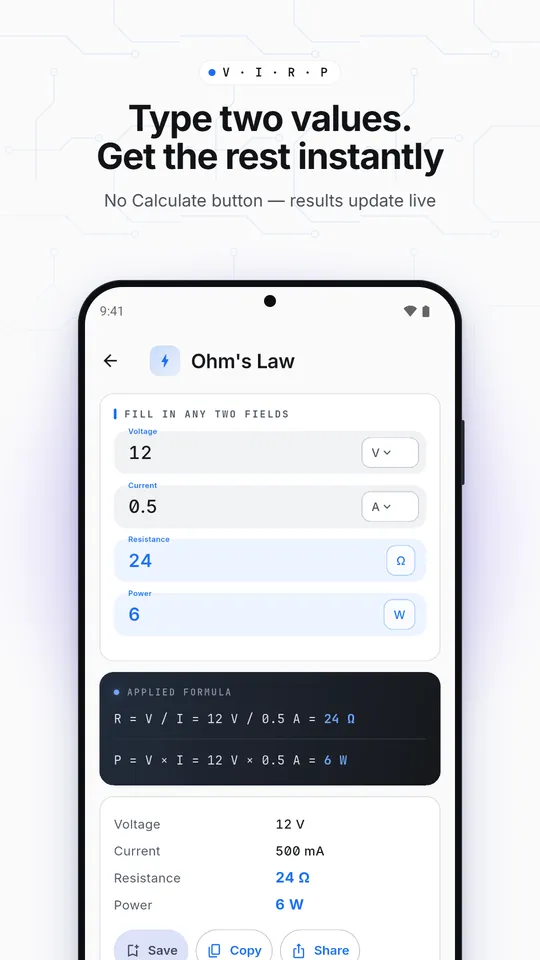
Type two values, get the rest 
Nine electrical calculators 
Resistor colour code both ways 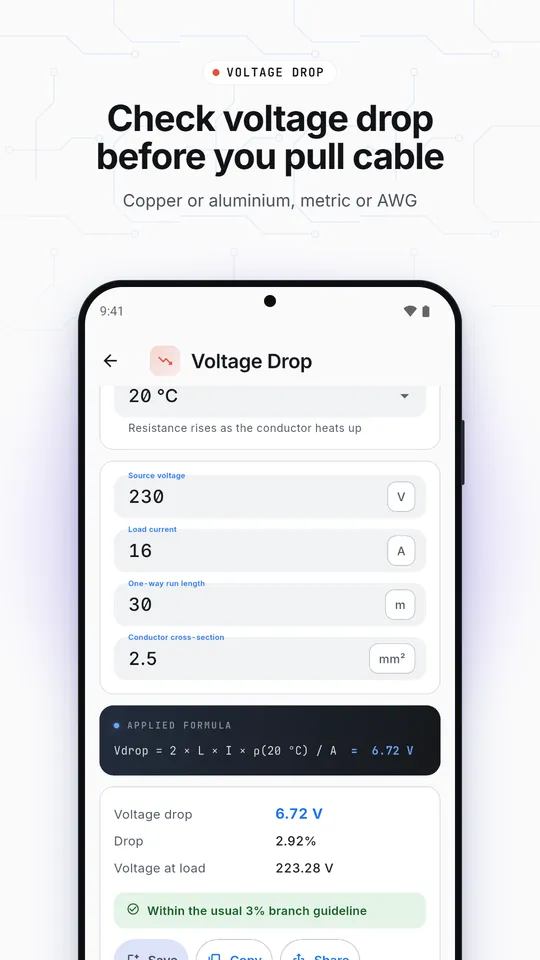
Voltage drop before you pull cable 
Series and parallel networks 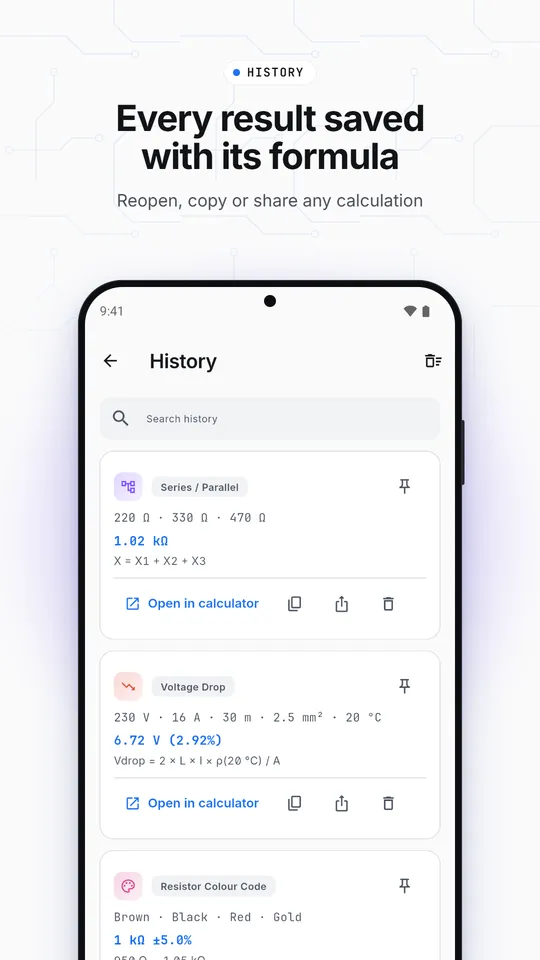
Every result saved with its formula 
Dark theme for night shifts
What is Ohm's law?
Ohm's law says the current through a resistor is proportional to the voltage across it: V = I × R. Voltage V is in volts, current I in amperes and resistance R in ohms. Double the voltage across a fixed resistor and the current doubles. Double the resistance at the same voltage and the current halves.
The triangle that shows up in every textbook is a memory aid: put V on top and I and R side by side underneath, cover the one you want, and what is left is the formula. Cover V and you get I × R. Cover I and you get V / R.
Example: a 12 V supply across a 24 Ω resistor. I = V / R = 12 / 24 = 0.5 A. Type any two of the four values into the calculator above and it fills in the rest, so 12 V and 0.5 A give R = 24 Ω and P = 6 W.
Ohm's law formula wheel: all 12 formulas
The wheel adds power P (in watts) to the triangle. Four quantities, and any two of them fix the other two, so each quantity can be found three ways. Pick the row for the value you need, then the formula that uses the two values you know.
| Find | First way | Second way | Third way |
|---|---|---|---|
| Voltage V | I × R from I and R | P / I from P and I | √(P × R) from P and R |
| Current I | V / R from V and R | P / V from P and V | √(P / R) from P and R |
| Resistance R | V / I from V and I | V² / P from V and P | P / I² from P and I |
| Power P | V × I from V and I | I² × R from I and R | V² / R from V and R |
The squared forms come from substituting V = I × R into P = V × I. P = I² × R is the one to use for heat in a resistor or a cable, because the loss grows with the square of the current.
Ohm's law with watts: how power fits in
Power is voltage times current: P = V × I. Ohm's law then gives two more forms, P = V² / R and P = I² × R. Use the one that matches the two values you have.
- A 2 kW heater on 230 V. I = P / V = 2000 / 230 = 8.696 A. Its resistance is V² / P = 26.45 Ω.
- A 13 A appliance with an 18 Ω element. V = I × R = 234 V and P = I² × R = 3.042 kW.
The calculator shows these steps under every result, with your numbers in place of the letters, so you can check the arithmetic by hand.
Ohm's law for series and parallel circuits
Ohm's law applies to the whole circuit once you replace the parts with one equivalent resistance.
- Series: R = R1 + R2 + R3. The same current flows through every part and the voltages add up. 220 Ω + 330 Ω + 470 Ω = 1.02 kΩ.
- Parallel: 1 / R = 1 / R1 + 1 / R2 + 1 / R3. The same voltage is across every part and the currents add up. Two equal resistors halve the value: 100 Ω ∥ 100 Ω = 50 Ω. The same three resistors as above give 103.1 Ω, which is lower than the smallest part.
Then use V = I × R on the combined value. To read the bands of a resistor or decode an SMD marking, use the resistor colour code calculator.
Does Ohm's law work for AC and three phase?
For a resistive load such as a heater, an incandescent lamp or a kettle, yes. Voltage and current rise and fall together, and V = I × R holds with RMS values. Motors, transformers and anything with a coil or a capacitor shift the current out of step with the voltage. Resistance is then replaced by impedance, and a power factor (PF) between 0 and 1 tells you how much of the apparent power does real work.
- Single phase: S (VA) = V × I, and P (W) = V × I × PF.
- Three phase, line voltage: S = √3 × V × I, and P = √3 × V × I × PF.
- DC: P = V × I. There is no power factor.
Example: a 400 V three-phase motor drawing 32 A at PF 0.85. S = 1.732 × 400 × 32 = 22.17 kVA, P = 18.84 kW and the reactive part is 11.68 kvar. The Power and kVA tab above shows the same steps.
How to calculate kVA, and kVA to amps for three phase
kVA is apparent power. From current: kVA = V × I / 1000 for single phase and √3 × V × I / 1000 for three phase. From kW: kVA = kW / PF. Going the other way, I = kVA × 1000 / (√3 × V) for three phase and I = kVA × 1000 / V for single phase.
Example: a single-phase 2.3 kW load at 230 V and PF 0.8 is 2.875 kVA and draws 12.50 A.
| kVA | 208 V | 400 V | 480 V |
|---|---|---|---|
| 10 kVA | 27.8 A | 14.4 A | 12.0 A |
| 25 kVA | 69.4 A | 36.1 A | 30.1 A |
| 50 kVA | 138.8 A | 72.2 A | 60.1 A |
| 100 kVA | 277.6 A | 144.3 A | 120.3 A |
| 250 kVA | 693.9 A | 360.8 A | 300.7 A |
| 500 kVA | 1,387.9 A | 721.7 A | 601.4 A |
This is the rated current of the equipment. It says nothing about conductor size or breaker rating, which come from your local wiring rules. For voltage drop and cable size see the voltage drop and wire size calculator.
Watts to amps: the formula and a table
Divide the power by the voltage: I = P / V for DC and for resistive loads on AC. With a power factor, I = P / (V × PF) on single phase and I = P / (√3 × V × PF) on three phase. Amps to watts runs the same formulas in reverse.
| Watts | 12 V | 120 V | 230 V |
|---|---|---|---|
| 100 W | 8.33 A | 0.83 A | 0.43 A |
| 500 W | 41.67 A | 4.17 A | 2.17 A |
| 1000 W | 83.33 A | 8.33 A | 4.35 A |
| 1500 W | 125.00 A | 12.50 A | 6.52 A |
| 2000 W | 166.67 A | 16.67 A | 8.70 A |
The same 1500 W is 125 A at 12 V and 6.52 A at 230 V. That is why low-voltage circuits need much thicker cable.
How much does it cost to run a device?
Energy in kilowatt-hours is power in kilowatts times hours: kWh = W × h / 1000. Multiply by the price per kWh on your bill. The price below is only an example.
A 1500 W heater that runs 3 hours a day uses 4.5 kWh a day. At 0.20 per kWh that is 0.90 a day, 27.38 a month and 328.50 a year (365 days, a month as a twelfth of that).
How do I pick a resistor for an LED?
An LED is not an ohmic part: its voltage stays near its forward voltage (Vf) whatever the current, so the resistor takes the rest. R = (Vs − n × Vf) / I, where n is the number of LEDs in series and I is the current you want, often 20 mA for a small indicator LED (check the datasheet). Round up to the next standard value, so the current never ends above target.
- 5 V, 2 V LED, 20 mA: (5 − 2) / 0.02 = 150 Ω, which is an E24 value. It dissipates 60 mW.
- 9 V, 3.2 V LED, 20 mA: (9 − 3.2) / 0.02 = 290 Ω. The next E24 value up is 300 Ω, which gives 19.33 mA.
- 12 V, three 2 V LEDs in series, 20 mA: (12 − 3 × 2) / 0.02 = 300 Ω.
As a rule of thumb, choose a resistor rated for at least twice the power it dissipates. The calculator does this for you on the LED resistor tab.
Units and prefixes
Ohm's law needs base units: volts, amperes and ohms. A value in milliamps or kilohms must be converted first. 500 mA is 0.5 A, and 4.7 kΩ is 4700 Ω. The unit selector next to each field does this for you, and results come back in a readable prefix, so 0.0047 Ω shows as 4.7 mΩ.
Where Ohm's law stops
- Non-ohmic parts. Diodes, LEDs and transistors do not have a fixed resistance, so V / I changes with the operating point.
- Temperature. A lamp filament has far lower resistance cold than hot, and copper wire gains about 0.4 % resistance per °C.
- Reactive AC loads. Coils and capacitors need impedance and a power factor, as above.
- Safety and sizing. A calculator gives a number, not a design. Cable ampacity, fuses and breakers come from your local wiring rules and a qualified electrician.
Questions
How do you use Ohm's law when you know two values?
Pick the formula that has your two values and solve for the third: V = I × R, I = V / R or R = V / I. With power in the mix, any two of V, I, R and P give the other two.
What is the Ohm's law formula for watts?
Power is P = V × I. Substituting V = I × R gives P = I² × R, and substituting I = V / R gives P = V² / R. Use the form that matches the two values you already have.
How do you convert kVA to amps for three phase?
Divide kVA × 1000 by √3 × the line voltage. For example, 100 kVA at 400 V is 100000 / (1.732 × 400) = 144.3 A. For single phase divide by the voltage alone.
How do you convert watts to amps?
Divide the watts by the volts: 1500 W at 230 V is 6.52 A. For AC loads with a power factor, divide by volts times PF as well, and by √3 × volts × PF on three phase.
What resistor do I need for an LED?
Subtract the LED forward voltage from the supply and divide by the LED current: (5 V − 2 V) / 20 mA = 150 Ω. Round up to the next standard value so the current never exceeds the target.
Is the Ohm's law app free and does it work offline?
Yes. The Google Play listing says it is free with ads, has no subscription, paywall or locked Pro features, and runs every calculation on the device without a connection.

Keep the formulas in your pocket
Free on Android with ads. No subscription, no paywall, works offline, 50 languages, light and dark themes.
Facts from the Google Play listing, last checked .