Resistor color code calculator for 3, 4, 5 and 6 bands
Pick the colors you see and get the resistance, tolerance and range, or type a value like 4k7 and get the bands back. SMD codes (103, 4R7, 01C) work both ways, and every result shows its arithmetic. Below are the color chart, the EIA-96 table and the E-series. The free Android app adds a 3D resistor, a practice quiz and the electronics calculators.
Resistor color code calculator
3, 4, 5 and 6 bands, SMD codes and standard values. Everything runs in your browser.
Hold the part so the tolerance band (gold or silver, or the one set apart) is on the right and read from the left.
1 Digit 1
2 Digit 2
3 Multiplier
4 Tolerance
4.7 kΩ ±5%
4,700 Ω, between 4.465 kΩ and 4.935 kΩ
47 × 100 Ω = 4,700 Ω
Yellow – Violet – Red – Gold
Standard value, found in E3, E6, E12 and E24.
Bench tools in your pocket
The calculator here handles color bands, SMD codes and standard values. The Android app works fully offline and adds the rest of the bench:
- 3, 4, 5 and 6 band resistors, including the temperature coefficient band, built on IEC 60062:2016
- Value to color code: enter 4k7, 4.7k or 4700 and see every valid band layout
- SMD codes: 3-digit, 4-digit, EIA-96 with all 96 codes, R notation and jumpers, in both directions
- E3 to E192 series with the nearest standard values
- Ohm's law, LED series resistor, voltage divider, power derating and series or parallel with a target finder
- Inductor color code in µH
- Practice quiz, reference articles, color-blind mode with every band named
- History of your last 50 calculations and a labelled Saved list
- Camera view next to the drawn resistor for comparing by eye, with no auto-detection

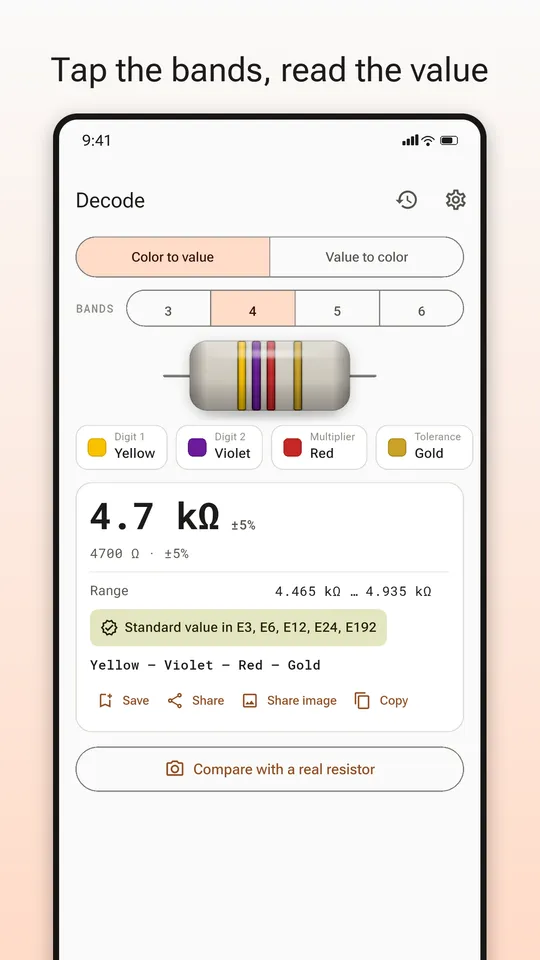
Tap the bands, read the value 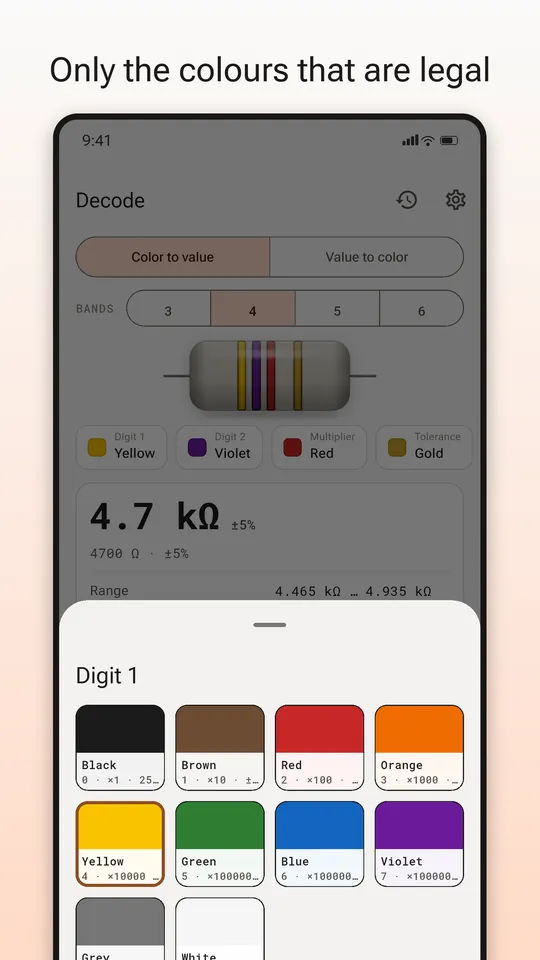
Only the legal colors 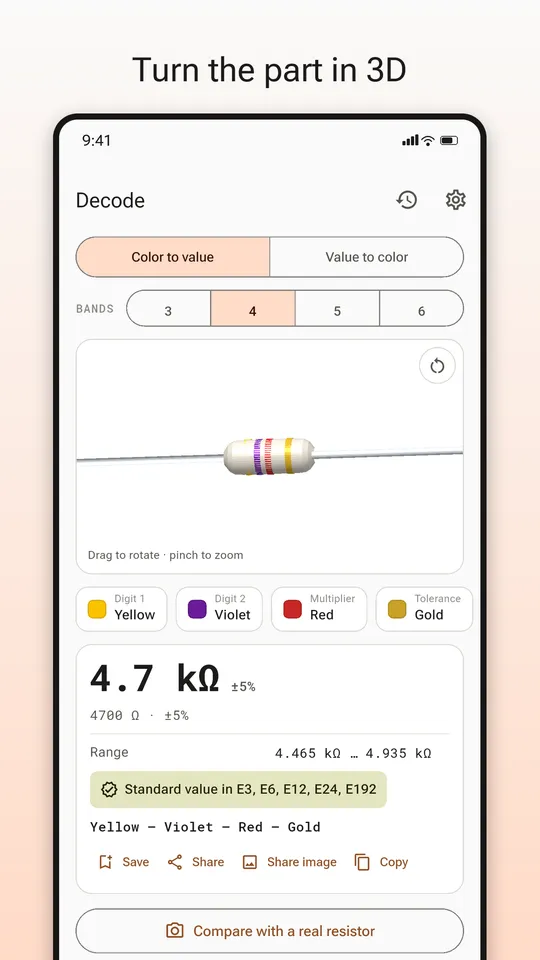
Turn the part in 3D 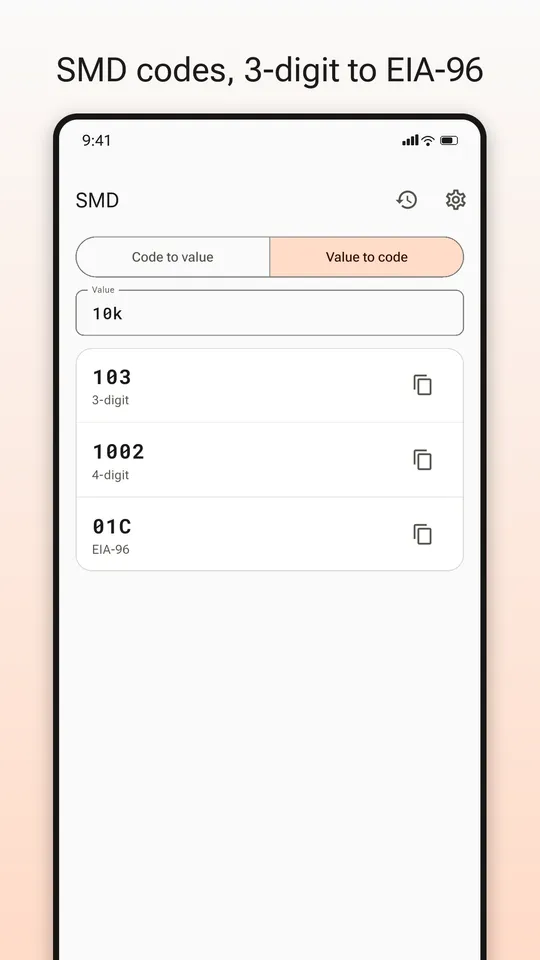
SMD codes, 3-digit to EIA-96 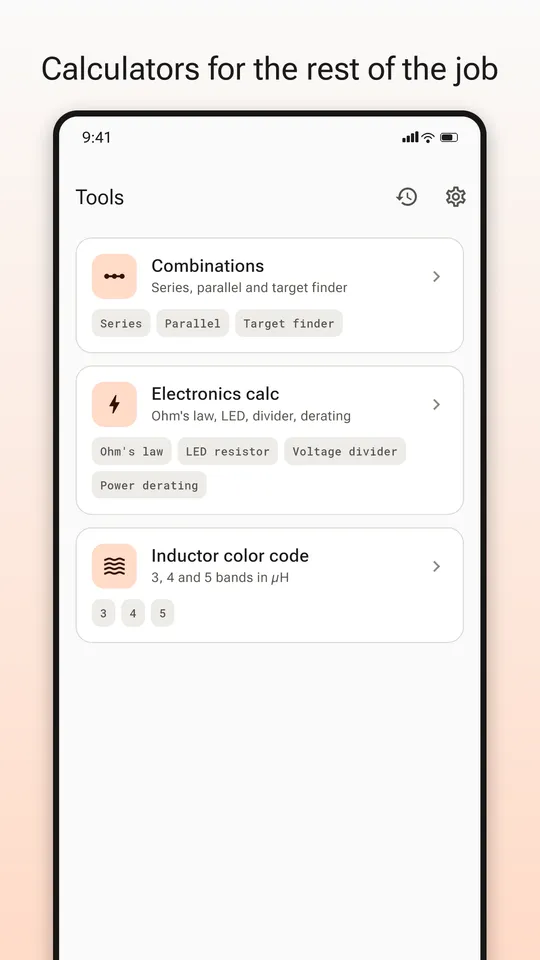
More calculators for the bench 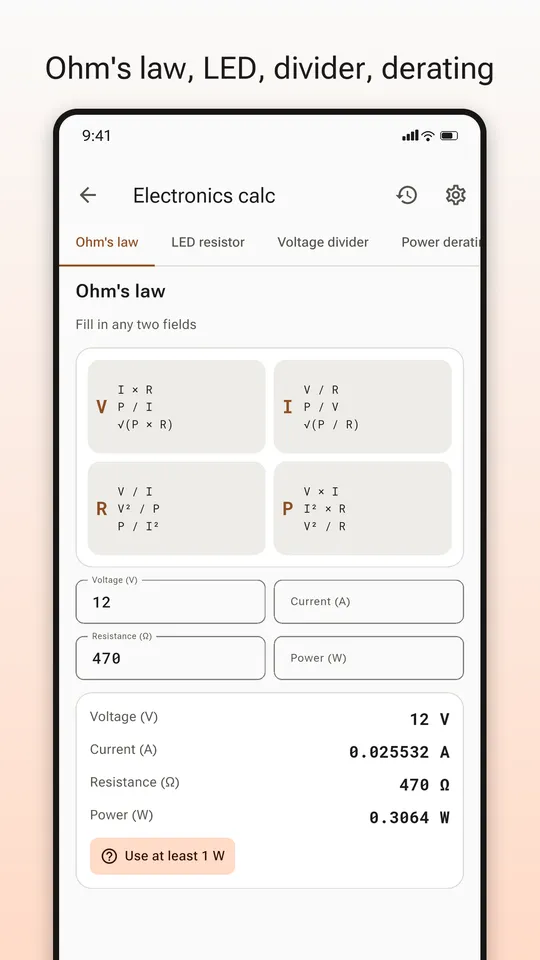
Ohm's law, LED, divider, derating 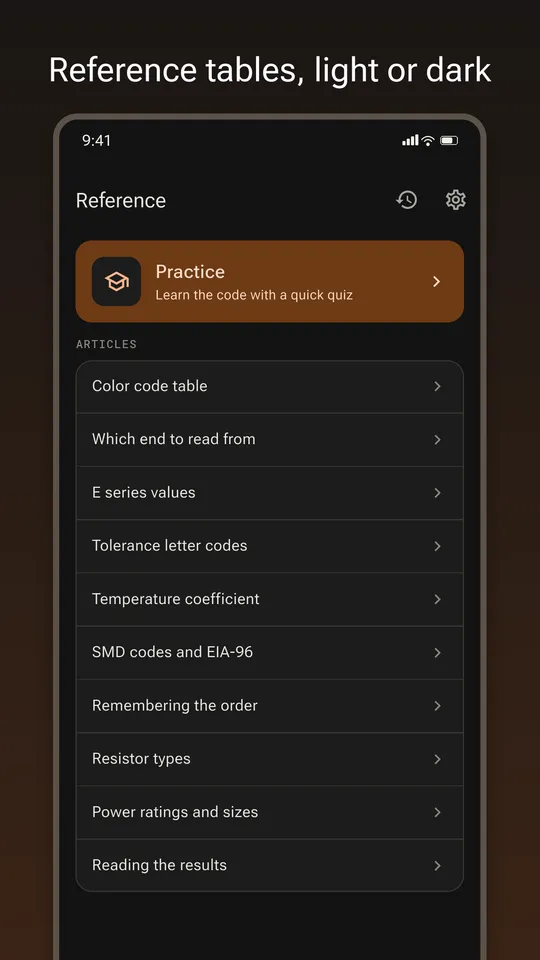
Reference tables, light or dark 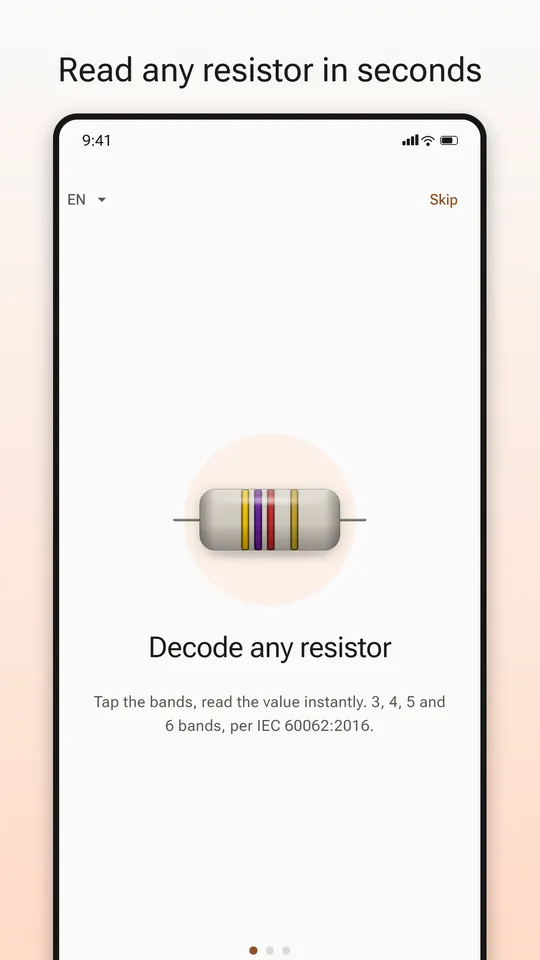
Read any resistor in seconds
How to read a resistor color code
Every color band is a number. On a 4-band resistor the first two bands are the digits, the third is the multiplier and the fourth is the tolerance. Write the two digits side by side, multiply by the multiplier and you have the resistance in ohms.
- Turn the resistor so the tolerance band (gold or silver) is on the right.
- Read the first color as a digit, then the second.
- Read the third color as the multiplier: how many zeros to add, or a decimal shift for gold and silver.
- The last band is the tolerance: how far the real value may sit from the printed one.
Example: yellow, violet, red, gold. Yellow is 4, violet is 7, red is ×100, gold is ±5%. So 47 × 100 = 4 700 Ω, which is 4.7 kΩ, and the part may measure anywhere from 4 465 Ω to 4 935 Ω.
On a 5-band resistor there are three digits, then the multiplier, then the tolerance. Red, red, black, brown, brown reads 220 × 10 = 2 200 Ω at ±1%. The extra digit is why 5-band parts are used for 1% and tighter tolerances.
Resistor color code chart
Digits 0 to 9 run black to white. Gold and silver exist only as multipliers (×0.1 and ×0.01) and tolerances (±5% and ±10%). A part with no tolerance band is ±20%. Color abbreviations are the IEC 60757 letter codes.
| Color | Code | Digit | Multiplier | Tolerance | Tempco |
|---|---|---|---|---|---|
| Black | BK | 0 | ×1 | – | – |
| Brown | BN | 1 | ×10 | ±1% | 100 ppm/K |
| Red | RD | 2 | ×100 | ±2% | 50 ppm/K |
| Orange | OG | 3 | ×1 000 | – | 15 ppm/K |
| Yellow | YE | 4 | ×10 000 | – | 25 ppm/K |
| Green | GN | 5 | ×100 000 | ±0.5% | – |
| Blue | BU | 6 | ×1 000 000 | ±0.25% | 10 ppm/K |
| Violet | VT | 7 | ×10 000 000 | ±0.1% | 5 ppm/K |
| Gray | GY | 8 | ×100 000 000 | ±0.05% | – |
| White | WH | 9 | ×1 000 000 000 | – | – |
| Gold | GD | – | ×0.1 | ±5% | – |
| Silver | SR | – | ×0.01 | ±10% | – |
The temperature coefficient column applies to the sixth band of a 6-band resistor and lists the six colors in common use. It says how much the resistance drifts per kelvin: 100 ppm/K on a 10 kΩ part moves it by 1 Ω for every 1 °C.
Which end do you start from?
Start from the end where the bands are bunched together. The tolerance band is usually set a little apart from the rest, and it is gold or silver on most parts. Gold and silver cannot be a first digit, so if one of them sits at an end, that end is the right-hand one.
Precision resistors (5 and 6 bands) often use brown, red or green for tolerance, and the spacing gets harder to judge. When the order is still unclear, read the value both ways. Only one direction gives a standard value from the E-series below. If both do, or the colors are faded, measure the part with a multimeter out of circuit.
3, 4, 5 and 6 band resistors
| Bands | Digits | Multiplier | Tolerance | Tempco |
|---|---|---|---|---|
| 3 | 1 and 2 | 3rd | ±20%, not printed | – |
| 4 | 1 and 2 | 3rd | 4th | – |
| 5 | 1, 2 and 3 | 4th | 5th | – |
| 6 | 1, 2 and 3 | 4th | 5th | 6th |
Worked examples
| Bands | Working | Result |
|---|---|---|
| Brown, Black, Red, Gold | 10 × 100, the classic 1 kΩ | 1 kΩ ±5% |
| Yellow, Violet, Red, Gold | 47 × 100, the 4.7 kΩ pull-up | 4.7 kΩ ±5% |
| Orange, Orange, Brown, Gold | 33 × 10, a 330 Ω LED resistor | 330 Ω ±5% |
| Brown, Black, Orange, Silver | 10 × 1 000 with ±10% | 10 kΩ ±10% |
| Red, Red, Black, Brown, Brown | 220 × 10 with ±1% | 2.2 kΩ ±1% |
| Green, Blue, Black, Red, Brown | 560 × 100, 56 kΩ at ±1% | 56 kΩ ±1% |
| Brown, Black, Black, Black, Brown, Red | 100 × 1 with ±1% and 50 ppm/K | 100 Ω ±1% |
Remembering the order
The ten digit colors always come in the same order: black, brown, red, orange, yellow, green, blue, violet, gray, white. A sentence with the same initials helps. Here is one: Black Bears Rarely Outrun Yellow Giraffes, Because Vultures Get Winded. Make up a sillier one of your own and it will stick better.
The rainbow gives you the middle of the run: red, orange, yellow, green, blue, violet are 2 to 7. Brown is 1 and black is 0 below it, gray and white are 8 and 9 above it.
SMD resistor codes: 3-digit, 4-digit, R and EIA-96
Surface-mount resistors are too small for color bands, so the value is printed as digits. The calculator above decodes all four schemes.
- 3-digit: the first two digits are the value, the third is the number of zeros. 103 is 10 × 103 = 10 kΩ, and 472 is 4.7 kΩ.
- 4-digit: three digits then the zeros, used on 1% parts. 1002 is 100 × 102 = 10 kΩ and 4701 is 4.7 kΩ.
- R notation: the letter R stands for the decimal point. 4R7 is 4.7 Ω, R47 is 0.47 Ω and 47R is 47 Ω. K and M in the same place mean kilo and mega, so 4K7 is 4.7 kΩ.
- Zero-ohm jumpers: printed 0, 000 or 0R0, they carry current like a wire link.
- EIA-96: two digits and a letter, used on 1% parts. The two digits (01 to 96) pick one of the 96 values below, and the letter is the multiplier.
| Letter | Z | Y | X | A | B | C | D | E | F |
|---|---|---|---|---|---|---|---|---|---|
| Multiplier | ×0.001 | ×0.01 | ×0.1 | ×1 | ×10 | ×100 | ×1000 | ×10000 | ×100000 |
Some older parts use R, S and H for the multipliers also written Y, X and B. Example: 01C is code 01 (100) × 100 = 10 kΩ, and 68X is 499 × 0.1 = 49.9 Ω. A code such as 10R can mean 10 Ω in R notation or 1.24 Ω in EIA-96, so the calculator lists both.
| Codes 1 to 24 | Codes 25 to 48 | Codes 49 to 72 | Codes 73 to 96 | ||||
|---|---|---|---|---|---|---|---|
| 01 | 100 | 25 | 178 | 49 | 316 | 73 | 562 |
| 02 | 102 | 26 | 182 | 50 | 324 | 74 | 576 |
| 03 | 105 | 27 | 187 | 51 | 332 | 75 | 590 |
| 04 | 107 | 28 | 191 | 52 | 340 | 76 | 604 |
| 05 | 110 | 29 | 196 | 53 | 348 | 77 | 619 |
| 06 | 113 | 30 | 200 | 54 | 357 | 78 | 634 |
| 07 | 115 | 31 | 205 | 55 | 365 | 79 | 649 |
| 08 | 118 | 32 | 210 | 56 | 374 | 80 | 665 |
| 09 | 121 | 33 | 215 | 57 | 383 | 81 | 681 |
| 10 | 124 | 34 | 221 | 58 | 392 | 82 | 698 |
| 11 | 127 | 35 | 226 | 59 | 402 | 83 | 715 |
| 12 | 130 | 36 | 232 | 60 | 412 | 84 | 732 |
| 13 | 133 | 37 | 237 | 61 | 422 | 85 | 750 |
| 14 | 137 | 38 | 243 | 62 | 432 | 86 | 768 |
| 15 | 140 | 39 | 249 | 63 | 442 | 87 | 787 |
| 16 | 143 | 40 | 255 | 64 | 453 | 88 | 806 |
| 17 | 147 | 41 | 261 | 65 | 464 | 89 | 825 |
| 18 | 150 | 42 | 267 | 66 | 475 | 90 | 845 |
| 19 | 154 | 43 | 274 | 67 | 487 | 91 | 866 |
| 20 | 158 | 44 | 280 | 68 | 499 | 92 | 887 |
| 21 | 162 | 45 | 287 | 69 | 511 | 93 | 909 |
| 22 | 165 | 46 | 294 | 70 | 523 | 94 | 931 |
| 23 | 169 | 47 | 301 | 71 | 536 | 95 | 953 |
| 24 | 174 | 48 | 309 | 72 | 549 | 96 | 976 |
SMD tolerance is not always printed. When a letter follows a value in a catalogue or on a datasheet it means: W ±0.05%, B ±0.1%, C ±0.25%, D ±0.5%, F ±1%, G ±2%, J ±5%, K ±10%, M ±20%.
Standard values: the E-series
Resistors are not made in every value. The E-series (IEC 60063) spaces values so that each step is about the same percentage of the last, which is why you see 4.7 kΩ and 5.6 kΩ in the shop but never 5 kΩ in the E12 range. The number is how many values fit in one decade.
| Series | Values per decade | Usual tolerance |
|---|---|---|
| E3 | 3 | ±40% or more |
| E6 | 6 | ±20% |
| E12 | 12 | ±10% |
| E24 | 24 | ±5% |
| E48 | 48 | ±2% |
| E96 | 96 | ±1% |
The E24 values in one decade are 10, 11, 12, 13, 15, 16, 18, 20, 22, 24, 27, 30, 33, 36, 39, 43, 47, 51, 56, 62, 68, 75, 82, 91. Multiply by 1, 10, 100 and so on to get every value from 10 Ω up. The calculator tells you which series a value first appears in and shows the nearest standard neighbours when it is not standard, which usually means a band was misread.
Need the resistor for a circuit rather than to identify one? Ohm's law, series and parallel and LED resistor maths are on the Ohm's law calculator page, and cable runs are covered by the voltage drop calculator.
Common mistakes when reading resistors
- Reading from the wrong end. Read gold, red, violet, yellow from the left and the first band is not a legal digit, which is the clue to flip the part.
- Mixing up brown, red and orange on a worn body, or blue and violet. Use daylight, not warm bulb light.
- Treating gold as yellow. Gold is a metallic shade, usually on the tolerance or multiplier band.
- Forgetting the ±20% default on 3-band parts.
- Misreading a 1% 5-band part as 4 bands. Count the bands first, then pick the layout.
- Trusting colors in a photo. Cameras shift hues, which is why the Android app only shows a live view next to the drawn resistor and does not guess the value.
- Skipping the meter. A resistor on a board is in parallel with the rest of the circuit, so measure it out of circuit, or lift one leg.
If you cannot tell the colors apart, color-blind mode in the app labels every band with its name, and the calculator above prints the color name on every swatch.
Questions
How do you read a 4-band resistor color code?
Read the first two bands as digits, the third as the multiplier and the fourth as the tolerance. Yellow, violet, red, gold is 47 × 100 = 4.7 kΩ at ±5%.
Which end of a resistor do you start reading from?
Start from the end where the bands are closer together, with the gold or silver tolerance band on the right. Gold and silver cannot be digits, so one of them marks the end you read last.
How do you read a 5-band resistor?
The first three bands are digits, the fourth is the multiplier and the fifth is the tolerance. Red, red, black, brown, brown is 220 × 10 = 2.2 kΩ at ±1%, and 5-band parts are common for 1% tolerance.
What does 103 mean on an SMD resistor?
The first two digits are the value and the last is the number of zeros, so 103 is 10 followed by three zeros: 10 kΩ. A 4-digit code works the same way with three digits, so 1002 is also 10 kΩ.
What is an EIA-96 resistor code?
Two digits and a letter on 1% SMD parts. The digits pick one of 96 base values and the letter is the multiplier, so 01C is 100 × 100 = 10 kΩ.
How do I know if a resistor value is a standard value?
Check it against the E-series: E12 for 10% parts, E24 for 5% and E96 for 1%. A value outside the series usually means a band was misread, so flip the part or measure it.
Is the Resistor Color Code app free?
Yes. It is free with ads, needs no account and works offline. The camera is used only for a visual comparison and nothing you enter leaves the phone.

Keep the chart at your bench
Free on Android, with ads. No account, and nothing you enter leaves your phone. Everything works offline.
Facts from the Google Play listing, last checked .