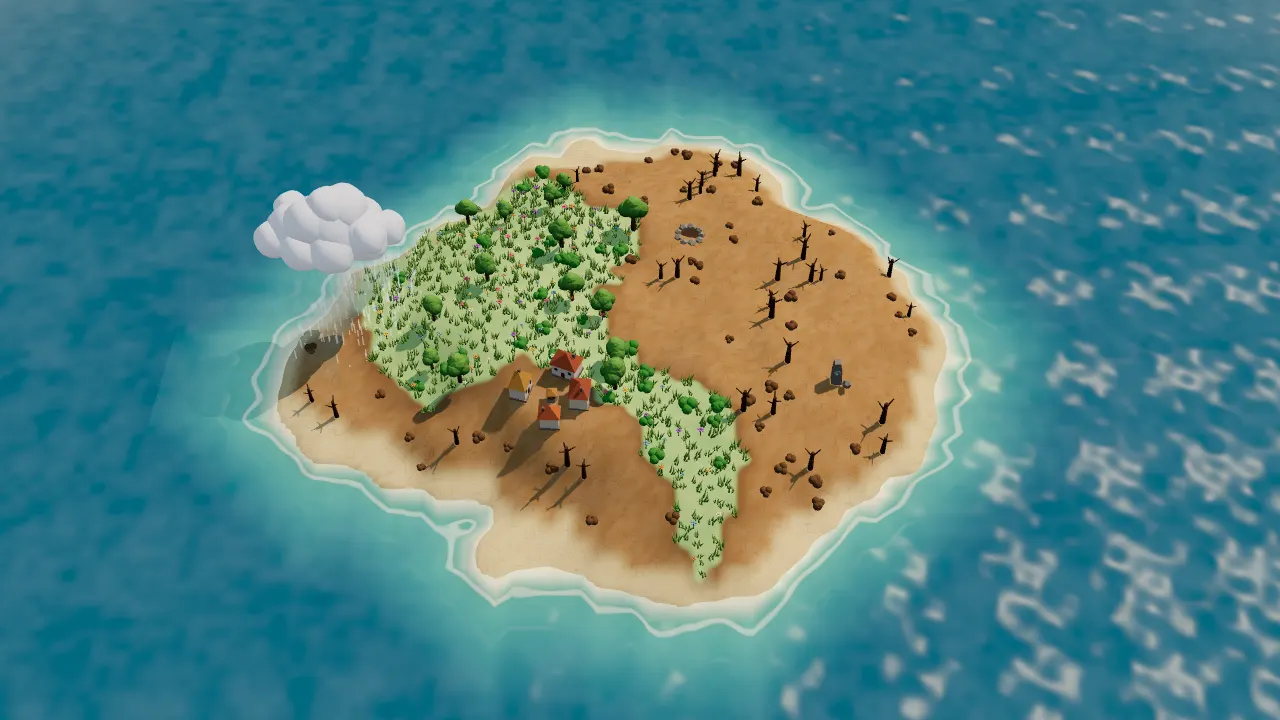
Nimbus is a 3D game where the player is a rain cloud: soak up the sea, rain on a dry island until it blooms, and spend the dew it pays on upgrades. One run is one day, from dawn to sunset.
Simulation apart from rendering. Everything that decides the game lives in plain TypeScript with no Three.js: a 64 × 64 grid per island holds moisture, bloom, fire and ash; the cloud soaks, rains with a soft radial falloff and dries in the sun; springs water the cells along a stream traced downhill from the spring to the sea; fires spread on dry forest and go out under rain. It steps at a fixed 60 Hz, so the same seed gives the same day, and it is covered by Vitest.
Tuned by a bot. A small autopilot (soak until mostly full, fly to the nearest dry ground, rain until nearly empty) plays the whole campaign in a test, buying the cheapest upgrade after each day. The test checks that the first day pays for the first upgrade and that upgrades stay one to four days apart, and its log shows how many days each island takes.
Islands from heightmaps. Each of the eight islands is a seeded noise field shaped by its own function (terraces, a coral ring around a lagoon, a volcanic cone with a crater, a mesa cut by a canyon, two islands on a sandbar, six islets, a cliff plateau). The same grid drives the terrain mesh, the ground types (sand, soil, hot rock, dry forest) and the painted map thumbnails in the menu.
One ground shader. The island is a single displaced plane. Its standard material is extended with a small shader that reads the moisture grid from a 64 × 64 data texture and blends cracked dry soil into dark wet soil and then into grass, with ash and flickering fire glow on burning cells. The texture is uploaded at most twenty times a second and only when a cell changed.
Instanced plants. Grass tufts, flowers, shrubs, dead trunks, canopies and rocks are six instanced meshes placed per cell. When a cell blooms its instances grow in with a short delay per kind (grass first, flowers and canopies after), shrubs turn from brown to green and trunks lose their bleached tint; a burned cell takes them away again.
Landmarks built in code. Cottages with thatched roofs, chimneys and lit windows, a well, villagers who come out and wave, a spring basin whose stream ribbon fills down the hill, windmills whose sails spin up, spirit stones with a glowing glyph that only lightning wakes, and a Great Tree that leafs out in five stages.
A day of light. The sun crosses the sky during the run: the sky gradient, sun colour and intensity, fog and the sea's highlights follow it from dawn through noon to sunset, and the cloud's soft shadow and the real shadow map move with it.
Sound without files. Rain is filtered noise that swells with the cloud's load, soaking is a bubbling band-pass, blooming plays kalimba notes on a pentatonic scale that climb with the combo, thunder is a falling low-pass burst with a sub boom, and a warm pad brightens as the island greens.
Ready for other hosts. The game talks to its host only through a small platform interface (load and save, pause and resume, audio permission, ready, score). The Lab page uses local storage and the page visibility; a build for a game portal can swap in that portal's SDK without touching the game.
Dusk and night. The sky runs through five keys (dawn, noon, afternoon, golden hour, sunset); in the last part of the day the light warms and the edges of the screen darken, and when the day ends the night falls in two seconds: a moonlit sky, stars, crickets, fireflies over the meadows the player grew and lit windows in the villages they woke. Short title cards mark dawn, noon and the last fifteen seconds.
Life coming back. Butterflies settle over freshly bloomed ground, a flock of gulls arrives once a quarter of the island is green, and each village gets a jetty with a rowboat; sea stacks stand in the shallows and sailboats tack far out. The cloud itself has a face that blinks, looks where it flies, smiles while raining and frowns when it runs dry.