Brick and block calculator: how many do you need for a wall?
Enter the wall, take out the doors and windows, pick the brick or block size and the joint, and the calculator below gives the number to order with waste, the courses, the mortar and the cost, and draws the wall as you type. Every number comes with its working. The free Android app puts 16 of these calculators, from mortar to concrete and tile, in one offline toolkit.
Brick and block calculator
Order about
896 bricks
854 for 14.4 m² of wall + 5% waste (42 spare)
- Wall area
- 14.4 m²
- Rate
- 59.3 per m²
- Courses
- 32
- Wall thickness
- 103 mm
- Mortar
- 0.41 m³
How is this calculated?
- Laid size with joint: 225 mm × 75 mm (215 mm × 65 mm plus a 10 mm joint).
- Units per m²: 1 000 000 ÷ (225 × 75) = 59.26.
- Units per ft²: 5.51. Wall thickness: 102.5 mm.
- Net wall area: 14.4 m² − openings 0 m² = 14.4 m².
- Units = 14.4 × 59.26 = 853.3 → 854; plus 5% waste → 896.
- Courses: wall height ÷ (65 + 10 mm) = 32 for the tallest wall.
- Mortar: joint volume around each brick × a published-rate allowance of 1.62 = 0.411 m³ (14.5 ft³).
An estimate for planning. Mortar and waste depend on the mason and the wall, and structural walls need an engineer and local code.
Sixteen building calculators on your phone
The calculator on this page counts walls. The Android app adds concrete, aggregate, finishing and geometry tools next to it, shows the formula behind every result and works on site without a connection:
- 16 calculators in one: masonry, concrete, aggregate, finishing and geometry
- Concrete blocks (CMU) in a joint-aware mode and a simple mode, and bricks in modular, standard, queen and king sizes
- Mortar by unit count or by volume, block fill for hollow cores and a retaining wall with base gravel and backfill
- Concrete slab with 80 lb bags, footing, column or tube and stairs; gravel, sand and soil by density
- Plaster or render, tile with adhesive, paint in litres and cans, area and volume
- Tap "How is this calculated?" for the formula and every assumption; results update as you type
- Waste factor from 0 to 20%, doors and windows subtracted, cost from a unit price, millimetres to yards
- Saved projects and history, PDF export and share, light and dark themes, large numbers for gloves, offline with no account

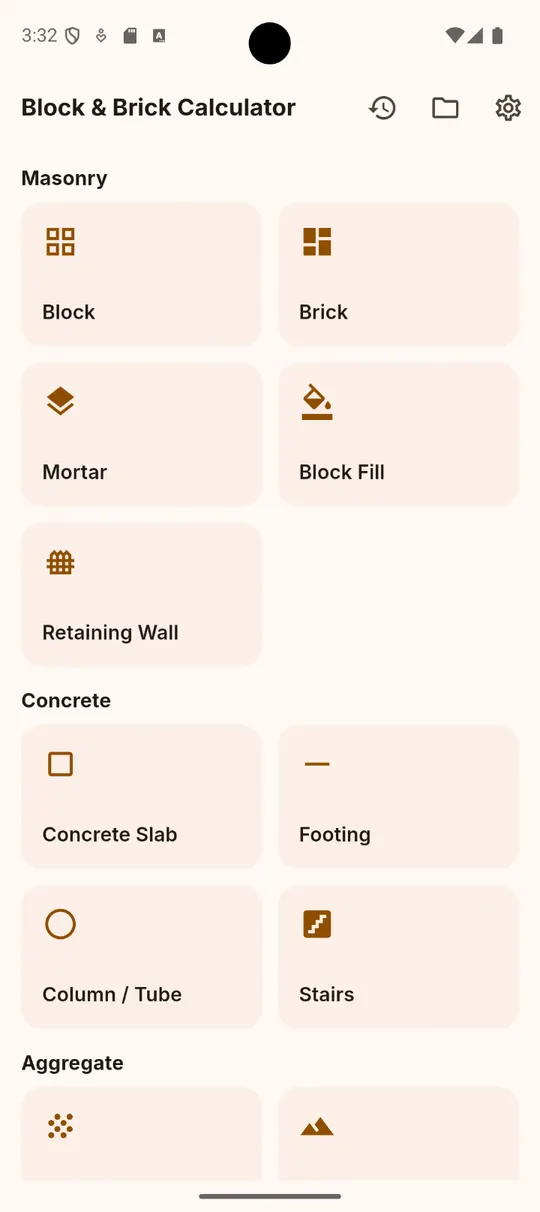
16 calculators in one 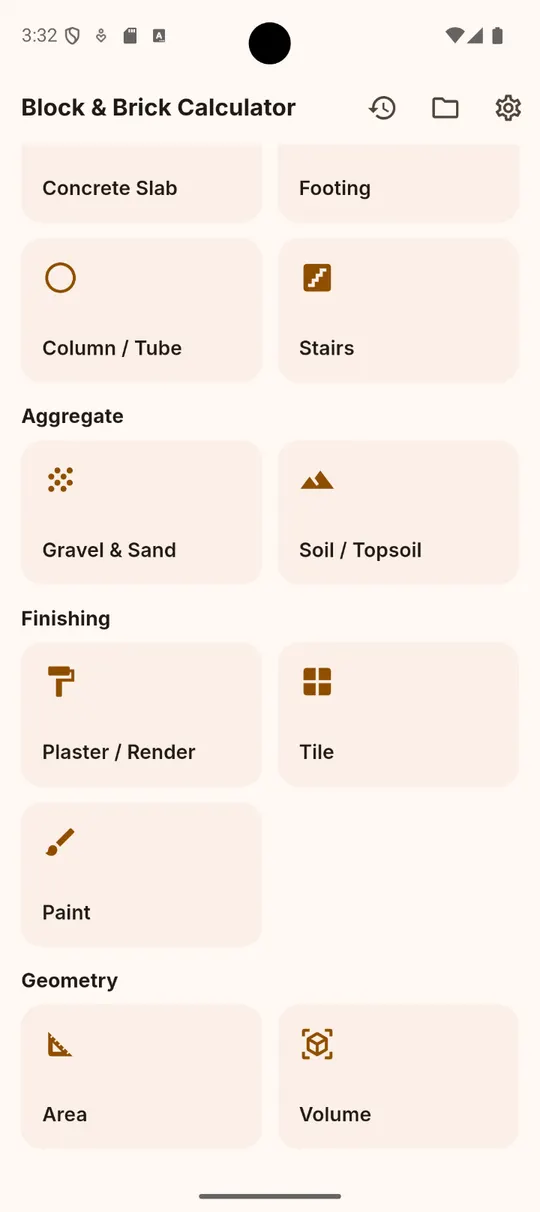
Concrete, aggregate, finishing, geometry 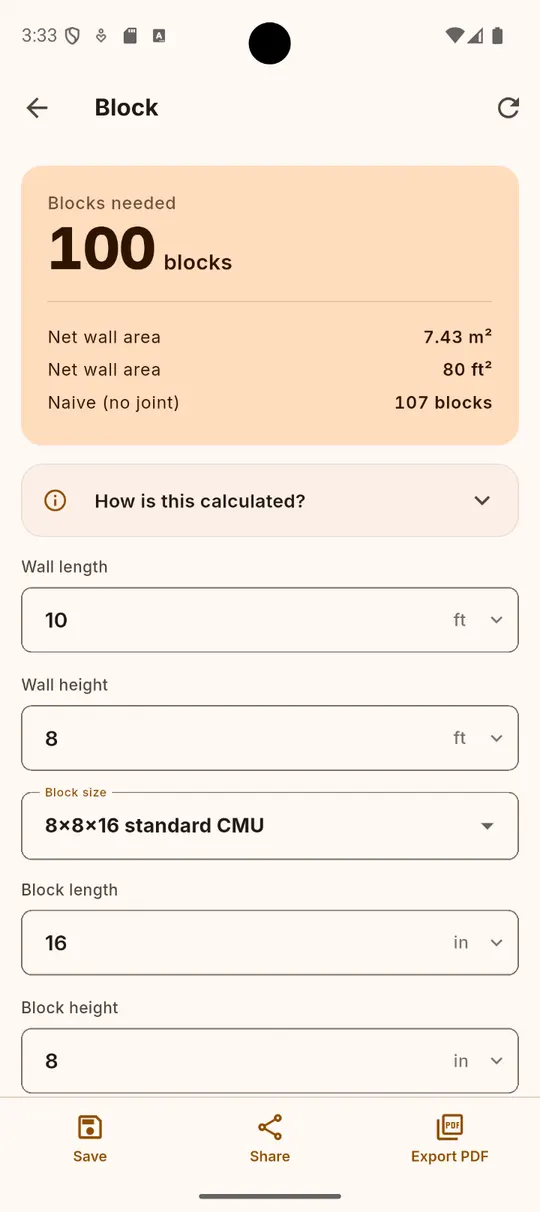
Precise count next to the naive estimate 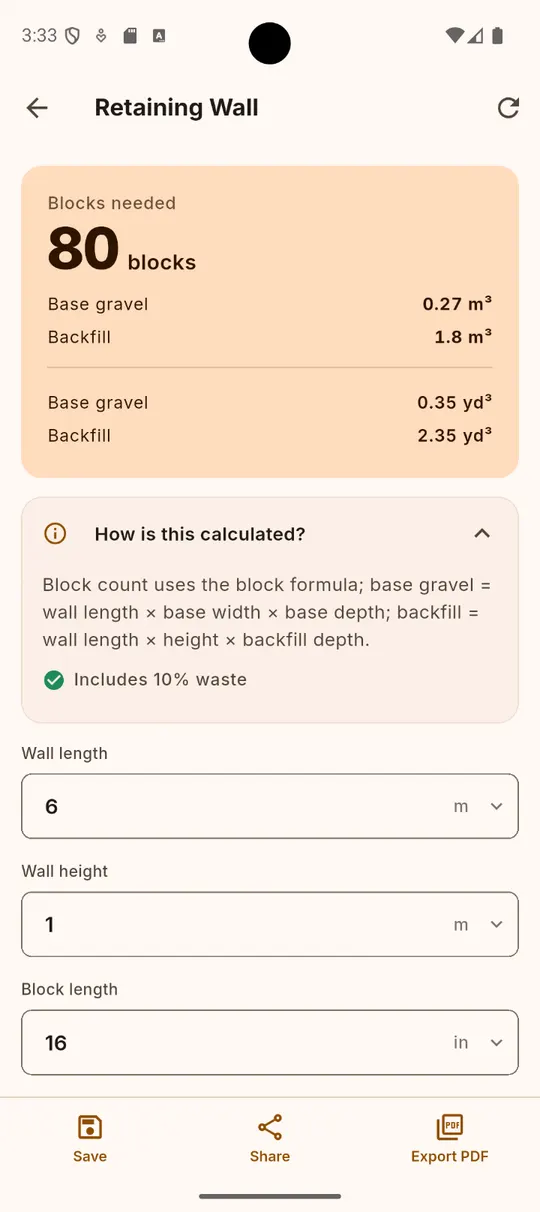
Retaining wall with gravel and backfill 
Estimates in seconds 
Every result shows its formula
How many bricks do I need per square metre?
Every brick takes up its own size plus one mortar joint, on its length and on its height. Divide the area of one square metre by that laid size:
bricks per m² = 1,000,000 ÷ ((length + joint) × (height + joint)), sizes in mm
A UK standard brick is 215 × 65 mm with a 10 mm joint, so one brick covers 225 × 75 mm, which is 59.26 bricks per m². Rounded, that is the 60 per m² that UK guides quote for a half-brick wall. In the US a modular brick with a 3/8 in joint covers 8 × 2⅝ in, which is 6.86 per ft².
That is the count for a wall one brick long thick, called a half-brick or single-skin wall. A wall that is one whole brick thick has two skins, so it needs twice as many (118.5 per m² for the UK brick).
Worked example: how many bricks for a wall?
A wall 6 m long and 2.4 m high, built of UK standard bricks in a half-brick wall, with a 10 mm joint and 5% waste:
- Area = 6 × 2.4 = 14.4 m².
- Bricks = 14.4 × 59.26 = 853.3, rounded up to 854.
- Add 5% for cuts and breakage: 854 × 1.05 896 bricks.
- Courses = 2,400 ÷ 75 = 32, so the wall is 32 courses high.
Now cut a door (0.9 × 2.1 m) and a window (1.2 × 1.2 m) out of it. The openings take 3.33 m², the wall is 11.07 m² and the order drops to 689 bricks. Enter the openings in the calculator above and it subtracts them for you. Bricks cut around the openings are what the waste allowance is for.
In feet: a wall 20 ft long and 8 ft high is 160 ft². With modular brick at 6.86 per ft² that is 1098 bricks, and 1152 with 5% waste.
Brick sizes and how many fit in a wall
Brick sizes differ between countries and makers, so use the size printed on the pack. The table lists the sizes in the calculator, each laid with its usual joint.
| Brick | Joint | Laid size, mm | Per m² | Per ft² |
|---|---|---|---|---|
| UK standard | 10 mm | 225 × 75 | 59.3 | 5.51 |
| US modular | 3/8 in | 203.2 × 66.7 | 73.8 | 6.86 |
| US standard | 3/8 in | 212.7 × 66.7 | 70.5 | 6.55 |
| Queen | 3/8 in | 203.2 × 79.4 | 62.0 | 5.76 |
| Norman | 3/8 in | 304.8 × 66.7 | 49.2 | 4.57 |
| Roman | 3/8 in | 304.8 × 50.8 | 64.6 | 6.00 |
| Utility | 3/8 in | 304.8 × 101.6 | 32.3 | 3.00 |
The US figures match the bricks-per-square-foot values Glen-Gery lists at a 3/8 in joint (modular 6.86, standard 6.55, queen 5.76, Roman 6.0, utility 3.0). UK dimensions come from Designing Buildings: a brick of 215 × 102.5 × 65 mm and a co-ordinating size of 225 × 112.5 × 75 mm.
How many concrete blocks do I need?
The common concrete block is called 8 × 8 × 16 in. That is its nominal size, which includes the mortar joint; the block itself is 7⅝ × 15⅝ in on the face, so with a 3/8 in joint each block covers 8 × 16 in, about 0.89 ft². One square foot of wall takes 1.125 blocks, so 100 ft² takes 112.5. The width of the block (4, 6, 8, 10 or 12 in) does not change the count.
For a wall 20 ft long and 8 ft high (160 ft²) that is 180 blocks, 189 with 5% waste and 198 with 10%. The CMHA/NCMA tech note TEK 04-02A states the same thing: about 119 blocks per 100 ft² including a 5% allowance; the calculator gives 119 for a 10 × 10 ft wall.
| Block | Face with joint | Per m² | Per ft² | Per 100 ft² |
|---|---|---|---|---|
| 8 × 8 × 16 in | 16 × 8 in | 12.11 | 1.125 | 112.5 |
| 440 × 215 mm | 450 × 225 mm | 9.88 | 0.918 | 91.8 |
Metric blocks of 440 × 215 mm laid with a 10 mm joint cover 450 × 225 mm, which is 9.88 per m². A 6 × 2.4 m wall takes 143 blocks, 150 with 5% waste. Count corners, bond beams and half blocks separately if the design needs them.
How much mortar for 1,000 bricks?
Mortar use depends on the joint thickness, the bricks and how the mason beds them. Engineering ToolBox publishes rates for common bricks (2¼ × 8 × 3¾ in): 9 ft³ of mortar per 1,000 bricks at a ¼ in joint, 14 ft³ at ⅜ in and 20 ft³ at ½ in. In metric that is about 0.25, 0.40 and 0.57 m³ per 1,000 bricks.
The calculator works out the joint volume around each brick from its size and joint, then multiplies it by 1.62, the ratio between that published 14 ft³ figure and the plain joint volume for the same brick. The extra covers mortar squeezed out of beds, spills and the joint between skins in a double wall. For the 854 bricks in the example wall that is 0.41 m³. Divide by the yield printed on your bag to get a number of bags; the calculator does it when you enter the yield.
For concrete block, mortar goes on the face shells only. The CMHA/NCMA tech note says one 70 lb bag of masonry cement lays about 30 hollow units. A home-pro estimate is about 3 bags of 80 lb mortar mix per 100 blocks. They are different products and rules of thumb, so the calculator shows both: a 20 × 8 ft block wall needs about 5 bags of 80 lb mix or 6 bags of masonry cement before waste.
How much extra should I order for waste?
Order 5 to 10% more than the count. Concrete block guides recommend 5 to 10% for breakage and cuts, and lean to 10% for walls with many openings or corners. The CMHA/NCMA figure of 119 blocks per 100 ft² has 5% built in. The same 5 to 10% is the usual advice for mortar, to cover spills and tooling.
Use the lower end for a plain wall of full units. Use the upper end, or more, for small walls with lots of openings, for bricks you have to cut to a pattern, and for hand-made or irregular bricks. Keep a few spare bricks from the same batch for repairs: colours drift between batches.
Half-brick wall, header bond or double skin?
The bond decides which face of the brick you see, and so how many bricks a square metre needs. The calculator has three settings, shown here for the UK brick:
| Wall | Bricks per m² | Thickness | For the 6 × 2.4 m wall |
|---|---|---|---|
| Half-brick, stretchers | 59.3 | 102.5 mm | 896 |
| One brick, ends out (header) | 118.5 | 215 mm | 1792 |
| Double skin, stretchers | 118.5 | 215 mm | 1792 |
A cavity wall is two skins with a gap between them, usually with an inner skin of block. Count the outer brick skin as a half-brick wall and the inner skin as blocks, using the two settings in turn and adding the results. Bonds such as Flemish or English alternate stretchers and headers and are not modelled here; ask your supplier for the count.
How to measure a wall for bricks or blocks
- Measure the length and the finished height of each wall. Count a gable by its average height.
- Measure every door and window opening: width and height. The calculator takes the opening size, not the frame.
- Enter walls one at a time; the calculator adds them and rounds once at the end.
- Check the brick size on the pack and the joint your mason will use. A thicker joint means fewer bricks.
- Add the waste percentage, then add mortar, ties and lintels from the supplier's list.
Courses are the horizontal layers. The wall height divided by the brick height plus the joint gives them; for a UK brick that is 75 mm a course, so 13 courses make about 975 mm. The calculator draws the courses for the wall you pick.
What this estimate does not cover
This is a planning estimate from the sizes and joints you give it. It leaves out lintels, quoins, special shapes, reinforcement, grout in the cores, damp-proof courses, wall ties and foundations. It is not a structural design: load-bearing and retaining walls need an engineer and must follow your local code. For the concrete side of a build, use the concrete calculator; for finishes on the wall, the tile calculator.
Sources
- Designing Buildings, Brick sizes: UK brick 215 × 102.5 × 65 mm, co-ordinating size 225 × 112.5 × 75 mm, 10 mm joint, 60 bricks per m².
- Glen-Gery, Brick sizes: US brick sizes and bricks per square foot at a 3/8 in joint.
- Engineering ToolBox, Bricks - Quantity and Mortar Consumption: mortar per 1,000 common bricks at ¼, ⅜ and ½ in joints.
- CMHA / NCMA, TEK 04-02A Estimating Concrete Masonry Materials: 119 units per 100 ft² with 5% waste, one 70 lb bag of masonry cement per about 30 units.
- DG Floors, Concrete block size: nominal and actual block sizes, 112.5 blocks per 100 ft², 5 to 10% waste.
- Housecall Pro, Concrete block calculator: about 3 bags of 80 lb mortar per 100 blocks, 5 to 10% extra for blocks and mortar (an estimate with no cited study).
The mortar figures are rules of thumb and the sources do not agree to the last bag. Treat every number here as an estimate and order a little over.
Questions
How many bricks do I need per square metre?
About 59 to 60 for a UK standard brick (215 × 65 mm) with a 10 mm joint in a half-brick wall, and about twice that, 118, for a wall one brick thick. In the US a modular brick with a 3/8 in joint is 6.86 per square foot.
How do I work out how many bricks I need for a wall?
Multiply the wall area, minus doors and windows, by the bricks per square metre, then add 5 to 10% for waste. A 6 × 2.4 m wall of UK bricks is 14.4 m², 854 bricks, and 896 with 5% waste.
How many concrete blocks are in 100 square feet?
112.5 for the common 8 × 8 × 16 in block, which covers 8 × 16 in with its joint, whatever its thickness. With a 5% waste allowance that becomes 119 per 100 ft², the figure in the CMHA tech note TEK 04-02A.
How many blocks do I need for a 20 ft wall?
For a wall 8 ft high that is 160 ft², so 180 blocks, 189 with 5% waste and 198 with 10%. Subtract any doors and windows before you multiply.
How much mortar do I need for 1,000 bricks?
Engineering ToolBox gives 14 ft³ (about 0.40 m³) of mortar per 1,000 common bricks at a 3/8 in joint, 9 ft³ at 1/4 in and 20 ft³ at 1/2 in. For hollow blocks, one 70 lb bag of masonry cement lays about 30 units.
How much extra brick or block should I buy?
5 to 10%. Use the top of the range for small walls with many openings or corners, and for bricks that must be cut.
Can I use this for a load-bearing or retaining wall?
The count is only a material estimate. Load-bearing and retaining walls need an engineer and must follow local code. The Android app has a retaining wall tool that counts blocks, base gravel and backfill.
Is the Block & Brick Calculator app free?
Yes. It is free with ads, works offline and needs no account. The listing shows no in-app purchases.

Take the estimate to the job site
Free on Android, with ads. No account and no internet needed to calculate. Estimates for planning; check structural work with a professional.
Facts from the Google Play listing, last checked .