Concrete calculator: how many yards or bags you need, with waste
Pick the shape, type the sizes and the calculator below gives the volume in yd³, m³ and ft³, the bags to buy, a ready-mix order rounded the way suppliers sell it and an optional cost, with every sum written out and a sketch that fills as you type. The free Android app adds mix design by region, a rebar estimate, saved projects and a PDF, offline.
Concrete calculator
Pick the shape, type the sizes: volume, bags and the ready-mix order update as you type.
A flat pour: patio, driveway, shed base, garage floor.
Sizes
Add prices (optional)
This pour: 1.235 yd³
Concrete needed
1.235 yd³ of concrete before waste.
0.944 m³ · 1.235 yd³ · 33.3 ft³
- With 10% waste
- 1.358 yd³
- Bags of 80 lb
- 62
- Ready-mix to order
- 1.5 yd³
- Weight, about
- 5,133 lb
Under 4 yd³ (3.1 m³) many suppliers add a short-load fee. Ask for the minimum before you choose between a truck and bags.
- Length × width × thickness = 10 × 10 × 0.333 ft = 33.333 ft³
- 33.333 ft³ ÷ 27 = 1.235 yd³
- 33.333 ft³ × (1 + 10%) = 36.667 ft³
- 36.667 ÷ 0.6 ft³ per 80 lb bag = 61.11, so 62 bags
- 1.358 yd³ rounded up to the next quarter yard = 1.5 yd³
Bag yields are from the Quikrete Concrete Mix data sheet (80 lb ≈ 0.60 ft³). Other brands and mixes differ; read the yield on your bag.
An estimate, not a design. Round up, check your supplier's minimum, and ask an engineer or your local rules for anything structural.
Plan the whole job, offline
This page works out one project at a time. The Android app has a calculator for every kind of pour, mix design for your region and saved projects, with no connection needed:
- Rectangular and circular slabs, footings, poured walls, round columns, post holes and stairs
- Concrete bags, a cement : sand : aggregate mix, gravel sub-base and a basic rebar estimate
- Volume in m³, yd³ and ft³, with a waste-adjusted quantity to order
- Bags needed for 20, 25, 30, 40 and 50 kg and 40, 60 and 80 lb sizes
- Mix ratios by region: India M-grades, European EN 206 C-classes, CIS B-classes, US psi and Australia and New Zealand N-grades
- Beginner mode with dimensions, waste and bag size; Pro mode adds concrete density, custom bag yield and cost per unit
- Optional cost estimate in your currency, shareable estimate text, PDF export and saved projects
- Metric or imperial, light and dark themes, works offline with no account

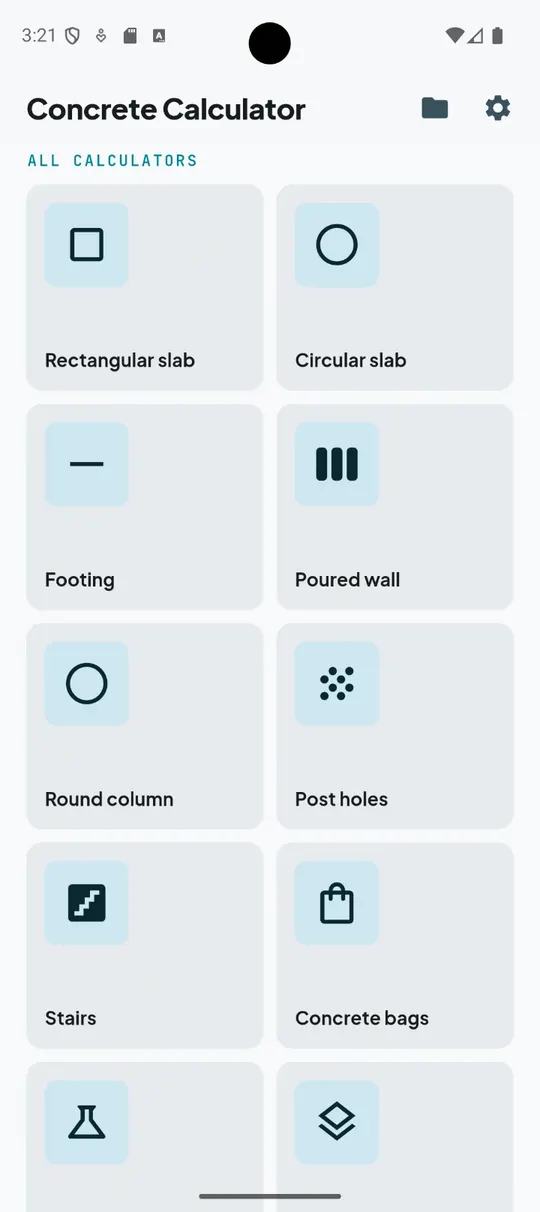
A calculator for every pour 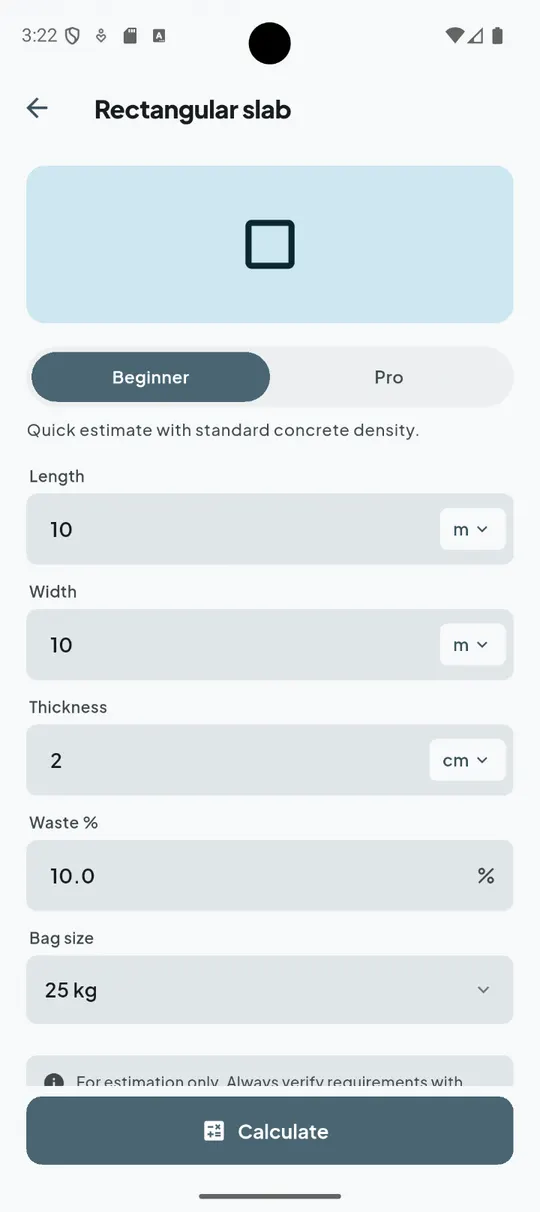
Sizes, waste and bag size 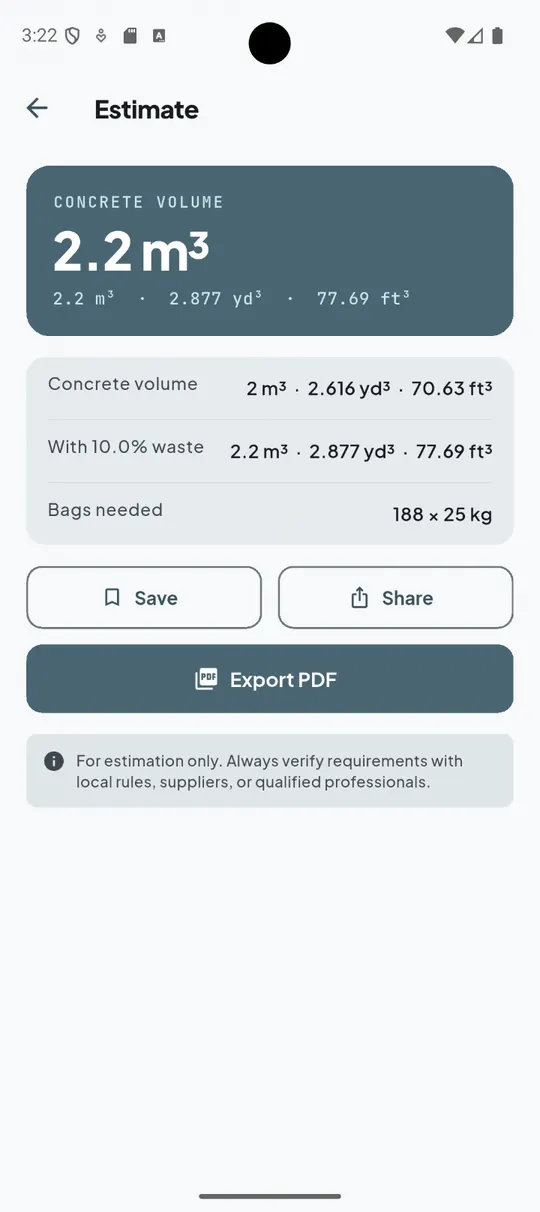
Volume, waste and bags 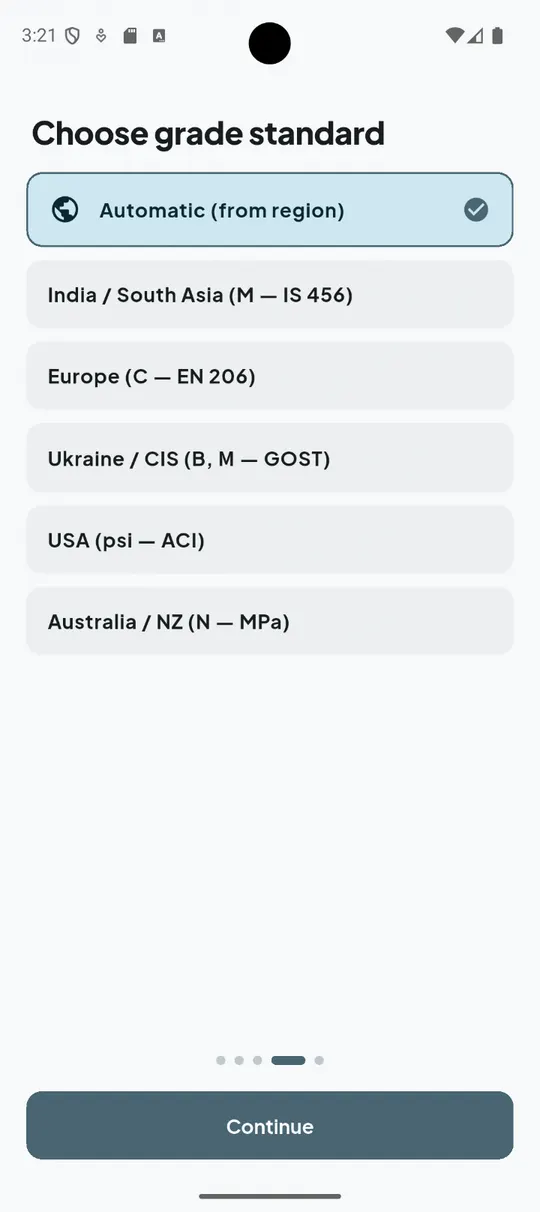
Mix grades by region 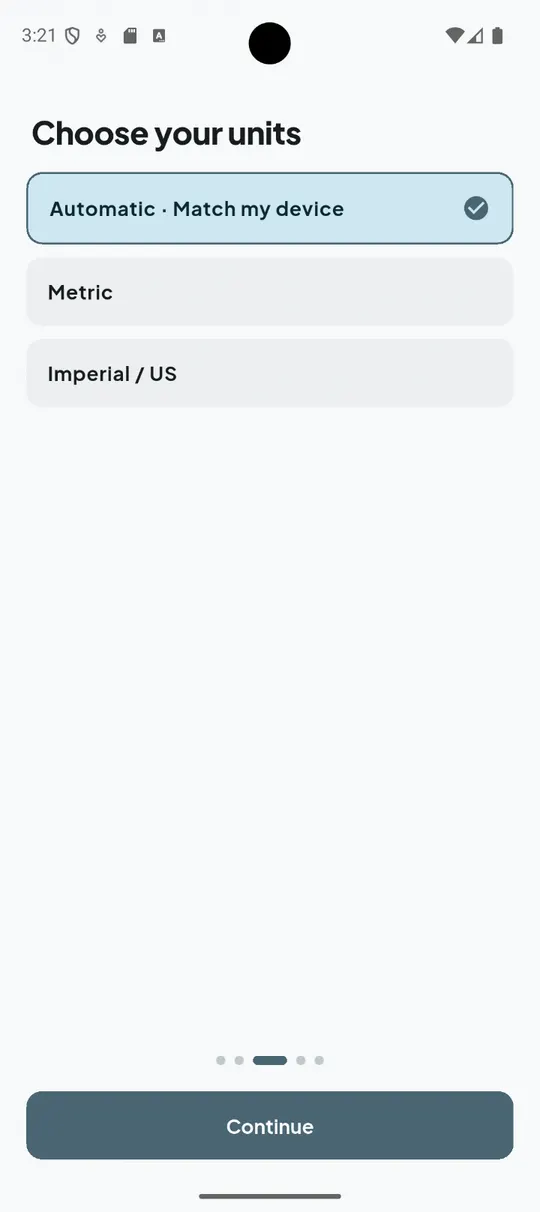
Metric or imperial 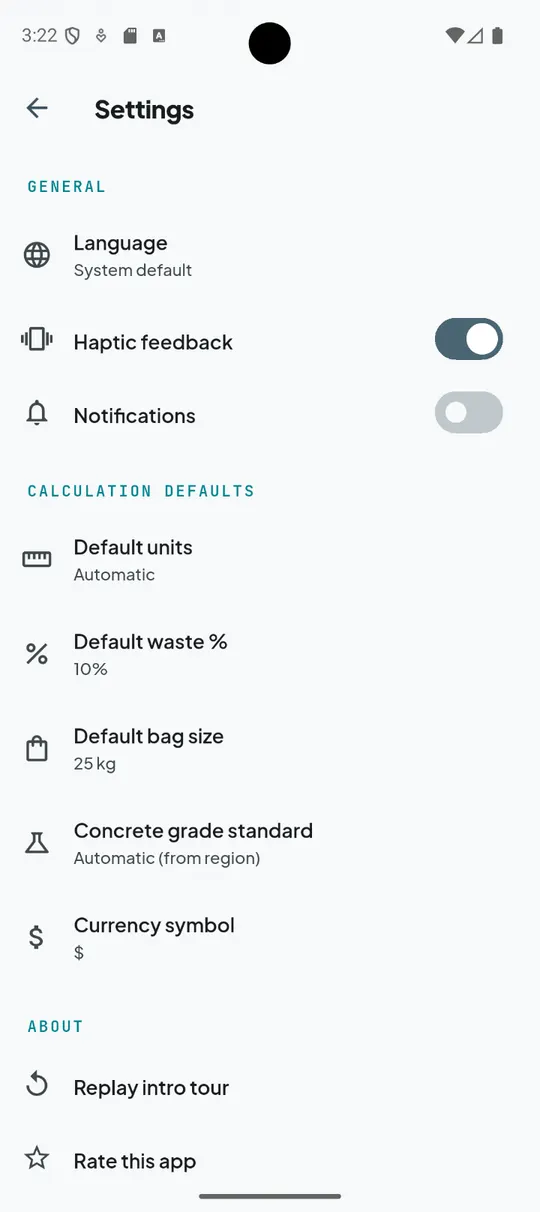
Defaults that stick 
Offline, no sign-up
How much concrete do I need? The formula
Concrete is sold by volume, so the job is always length × width × thickness, with all three in the same unit. A 10 ft by 10 ft patio poured 4 in thick is 10 × 10 × (4 ÷ 12) = 33.33 ft³. A cubic yard is 3 × 3 × 3 = 27 ft³, so that is 33.33 ÷ 27 = 1.235 yd³. In metric the same patio, 3 m by 3 m by 10 cm, is 3 × 3 × 0.10 = 0.9 m³; one cubic metre is 1.308 yd³.
Other shapes follow the same idea. A round column or post hole is π × (diameter ÷ 2)² × height. A poured wall is length × height × thickness, minus doors and windows. Stairs are a stack of blocks: three solid steps are 1 + 2 + 3 = 6 step blocks. The calculator above writes the sum out with your numbers under The sums.
Then add a margin. Ground is never perfectly level, forms bulge a little and some concrete stays in the barrow. That extra is the waste allowance, covered below.
How many bags of concrete do I need for a slab?
Divide the volume, with waste, by what one bag yields. The Quikrete Concrete Mix data sheet gives approximate yields of 0.30 ft³ for a 40 lb bag, 0.375 ft³ for 50 lb, 0.45 ft³ for 60 lb and 0.60 ft³ for 80 lb. One cubic yard (27 ft³) is therefore 90 bags of 40 lb, 60 bags of 60 lb or 45 bags of 80 lb. For the 10 ft by 10 ft slab at 4 in: 33.33 ft³ plus 10% is 36.67 ft³, and 36.67 ÷ 0.60 = 61.1, so 62 bags of 80 lb.
| Slab (ft) | Area (ft²) | Volume (yd³) | With 10% (yd³) | 80 lb bags | 60 lb bags | 40 lb bags |
|---|---|---|---|---|---|---|
| 4 × 8 | 32 | 0.4 | 0.43 | 20 | 27 | 40 |
| 8 × 8 | 64 | 0.79 | 0.87 | 40 | 53 | 79 |
| 10 × 10 | 100 | 1.23 | 1.36 | 62 | 82 | 123 |
| 10 × 12 | 120 | 1.48 | 1.63 | 74 | 98 | 147 |
| 12 × 12 | 144 | 1.78 | 1.96 | 88 | 118 | 176 |
| 12 × 16 | 192 | 2.37 | 2.61 | 118 | 157 | 235 |
| 16 × 20 | 320 | 3.95 | 4.35 | 196 | 261 | 392 |
| 20 × 20 | 400 | 4.94 | 5.43 | 245 | 326 | 489 |
Bags are practical up to a point. Quikrete advises allowing at least 1 ft³ of mixer capacity for each 80 lb bag and adding about 6 pints of water to each bag (6 to 9 pints in all). A 10 ft by 10 ft slab is 62 bags, which is more than two tons of dry mix to carry and mix before it starts to set, so a truck is worth pricing at that size.
How thick should a slab be, and how much does thickness change the order?
Quikrete’s sidewalk and small-slab guide says sidewalks should be at least 4 in thick and that simple slabs for small foundations and bases are normally 4 to 6 in, depending on the load they carry. Its Concrete Mix is designed for pours 2 in or thicker. Control joints should reach about a quarter of the slab thickness and be spaced every 6 to 8 ft in 4 in slab work.
Thickness is the cheapest number to get wrong, because it multiplies everything. One cubic yard covers 81 ft² at 4 in, but only 54 ft² at 6 in.
| Thickness | One yd³ covers (ft²) | One m³ covers (m²) | 10 × 10 ft slab (yd³) | 80 lb bags, with 10% |
|---|---|---|---|---|
| 2 in | 162 | 19.7 | 0.62 | 31 |
| 3 in | 108 | 13.1 | 0.93 | 46 |
| 4 in | 81 | 9.8 | 1.23 | 62 |
| 5 in | 64.8 | 7.9 | 1.54 | 77 |
| 6 in | 54 | 6.6 | 1.85 | 92 |
How much extra concrete should I order?
Vertigraph’s estimating guide (updated May 2026) gives the allowances below. This calculator starts at 10% and lets you move the slider from 0 to 30%.
| Pour | Add |
|---|---|
| Large, simple slabs, such as warehouse floors | 5–8% |
| General default | 10% |
| Complex pours: curved walls, several columns, congested rebar | 12–15% |
| Awkward small pours, where a short-load fee makes over-ordering safer | 15–20% |
A little left over is cheaper than a second delivery. If the ground is soft, over-dug or uneven, measure the average depth, not the depth at the forms.
Ready-mix truck or bags? Minimum loads and the break-even
For a truck, Vertigraph says to round the volume with waste up to the next quarter yard, because suppliers price in quarter-yard steps, and that trucks typically carry 9 to 10 yd³. It also says suppliers charge a flat fee on orders under 4 to 5 yd³, and the fee varies by market. The calculator rounds up to a quarter yard in imperial units. In metric it rounds up to 0.1 m³, which is this page’s own choice, so use your supplier’s step instead.
The honest way to compare is with your own prices. Take the 10% slab above: 62 bags at 7 each is 434. As ready-mix, 1.5 yd³ at 190 per yd³ plus a 90 short-load fee is 375. Those prices are examples, not quotes. Type yours under Add prices in the calculator and it shows which route is cheaper. Price is not the only factor: a truck gives one continuous pour, which matters for a slab, and bags leave you with a mixing job.
Weight matters for access. Quikrete’s data sheet puts the unit weight at about 140 lb/ft³ (2,242 kg/m³), so a cubic yard of placed concrete weighs about 3,780 lb (1,715 kg).
How much concrete for footings, columns and fence posts?
A strip footing is length × width × depth. Footing size depends on the load, the soil and your local code, so take it from the plans or the building department, not from a calculator. The table gives the volume for 10 ft of footing at common sizes so you can scale it.
| Width × depth (in) | ft³ | yd³ | 80 lb bags, with 10% |
|---|---|---|---|
| 12 × 8 | 6.67 | 0.247 | 13 |
| 16 × 8 | 8.89 | 0.329 | 17 |
| 16 × 12 | 13.33 | 0.494 | 25 |
| 20 × 12 | 16.67 | 0.617 | 31 |
| 24 × 12 | 20 | 0.741 | 37 |
For fence and deck posts, the volume is the hole, π × (diameter ÷ 2)² × depth. The post takes up some of it, so the figures below are slightly high, which is the safe side. Frost depth sets how deep a hole must be where you live; check local rules.
| Hole (diameter × depth, in) | ft³ | 80 lb bags | 60 lb bags | 40 lb bags |
|---|---|---|---|---|
| 8 × 24 | 0.7 | 1.2 | 1.6 | 2.3 |
| 10 × 30 | 1.36 | 2.3 | 3 | 4.5 |
| 10 × 36 | 1.64 | 2.7 | 3.6 | 5.5 |
| 12 × 36 | 2.36 | 3.9 | 5.2 | 7.9 |
| 12 × 48 | 3.14 | 5.2 | 7 | 10.5 |
Multiply by the number of holes and round up the total, not each hole. For the bricks, blocks and mortar that go on top of a footing, see the Block & Brick calculator.
Mixing concrete yourself: cement, sand and stone
Nominal mixes are written as cement : sand : coarse aggregate by volume. They suit small jobs. They are not a designed mix, so for anything structural use a designed or pre-bagged structural mix and ask an engineer. The grades below are the list on civilengineeronline.com; Engineer Fix describes 1 : 2 : 4 as a general-purpose mix for walkways, patios and small footings and gives a water-to-cement ratio of about 0.5 to 0.6 by weight.
The quantities assume the dry materials take up 1.54 times the wet volume and that cement weighs 1,440 kg/m³, the same assumptions as that calculator. Sand and stone are shown by volume, because their weight depends on moisture.
| Grade | Cement : sand : stone | Cement (kg) | 50 kg bags | Sand (m³) | Stone (m³) |
|---|---|---|---|---|---|
| M5 | 1 : 5 : 10 | 139 | 2.8 | 0.48 | 0.96 |
| M7.5 | 1 : 4 : 8 | 171 | 3.4 | 0.47 | 0.95 |
| M10 | 1 : 3 : 6 | 222 | 4.4 | 0.46 | 0.92 |
| M15 | 1 : 2 : 4 | 317 | 6.3 | 0.44 | 0.88 |
| M20 | 1 : 1.5 : 3 | 403 | 8.1 | 0.42 | 0.84 |
| M25 | 1 : 1 : 2 | 554 | 11.1 | 0.39 | 0.77 |
Too much water weakens concrete: it is easier to place and has less strength and durability. Use Mix it yourself in the calculator to scale a grade to your pour.
What this calculator does not do
- It does not design anything. Footing sizes, slab thickness over soft ground, reinforcement and mix strength come from the plans, an engineer or your local code.
- It does not subtract rebar, post volume or voids. Those are small next to the waste allowance.
- Bag yields are Quikrete’s published figures. Other bags differ by brand and mix, and the metric bag yields are scaled from the 80 lb bag. Read the yield on your bag.
- Pouring and finishing take timing and curing care. Quikrete’s guide has the steps, and its slab guide suggests removing forms after about 48 hours.
Sources
- Quikrete, Concrete Mix 1101 data sheet: bag yields, unit weight of about 140 lb/ft³, minimum thickness of 2 in, mixing water.
- Quikrete, Concrete Sidewalks and Small Slabs: 4 in minimum for sidewalks, 4 to 6 in for small slabs, control joints, forms.
- Vertigraph, How to calculate concrete yardage (May 2026): formulas, 27 ft³ per yard, waste percentages, quarter-yard ordering, short-load fees.
- CE Calculators, Nominal mix design: nominal mix ratios, the 1.54 dry volume factor, cement density.
- Engineer Fix, Standard concrete mix ratio for 1:2:4 (2025): uses of 1 : 2 : 4 and the water-to-cement ratio.
Questions
How many bags of concrete do I need for a 10 x 10 slab?
At 4 in thick the slab is 33.3 ft³, which is 56 bags of 80 lb, and 62 bags once you add 10% for waste. With 60 lb bags it is 82 bags and with 40 lb bags 123, from the yields on the Quikrete data sheet.
How do I calculate cubic yards of concrete?
Multiply length × width × thickness in feet (4 in is 4 ÷ 12 ft), then divide by 27, because a cubic yard is 3 × 3 × 3 ft. A 10 × 10 ft slab 4 in thick is 33.3 ÷ 27 = 1.23 yd³.
How many bags of concrete make a cubic yard?
45 bags of 80 lb, 60 bags of 60 lb or 90 bags of 40 lb, using Quikrete's yields of 0.60, 0.45 and 0.30 ft³ per bag. Other brands and mixes vary, so check your bag.
How much extra concrete should I order?
About 10% as a default, 5 to 8% for a large simple slab and 12 to 20% for awkward or small pours. A small surplus costs less than a second delivery.
How much concrete do I need for a fence post?
A hole 10 in across and 36 in deep holds about 1.6 ft³, which is roughly 3 bags of 80 lb. The post takes up some of that, so the figure is slightly high. Frost depth and local rules set how deep the hole must be.
What is the smallest ready-mix delivery?
It depends on the supplier. One estimating guide says suppliers charge a flat short-load fee on orders under 4 to 5 yd³, and trucks typically carry 9 to 10 yd³. Ask for the minimum and the fee before you decide between a truck and bags.
Can I mix concrete myself with cement, sand and stone?
Yes, for small non-structural jobs. A 1 : 2 : 4 mix by volume is a common general-purpose choice, with about 0.5 to 0.6 water to cement by weight. For anything structural, use a designed mix and ask an engineer.
Is the Concrete Calculator app free?
Yes. It is free with ads, works offline and needs no account or sign-up. It gives estimates only, so check them with your supplier and local rules.

Take the numbers to the yard
Free on Android, with ads. No account, works fully offline. An estimate only: check with your supplier and local rules.
Facts from the Google Play listing, last checked .