The five Tibetan rites: steps, reps and a ten-week plan
Pick your week, press Start and the player below walks you through the five movements: numbered steps, how to breathe, an easier, standard or stronger version, a tap counter and a rest timer. The first movement is a spin that makes many people dizzy, so it has its own count. The free Android app keeps your streak and history, offline.
Set up today’s session
The spin has its own count, so it can stay low while the other four build up. Zero skips it.
- 1. The spinStanding turn on the spot, arms out× 3
- 2. Leg and head raiseLying on your back, lift the legs and head together× 3
- 3. Kneeling archKneeling, open the chest and tip the head back× 3
- 4. Table topSeated, lift the hips into a table× 3
- 5. Two dogsMove between upward-facing and downward-facing dog× 3
The ten-week plan and your history on your phone
This page runs one session at a time. The Android app tracks where you are in the ten-week build-up, moves you up when you are ready, and keeps a calendar of every session, with no advertising of any kind while a session is running:
- Five movements in order: a standing spin, a lying leg and head raise, a kneeling back bend, a table top lift and an alternating down-and-up position
- Numbered steps, a breathing pattern, an illustration and notes on the usual mistakes for each one
- Ten-week build-up from three repetitions of each movement, plus two a week up to twenty-one; set your own level if you already practise
- The spin handled on its own: a separate progression, a spotting technique, permission to turn slowly, clear signs to stop and a full alternative movement
- Easier, standard and stronger versions of every movement; the easier ones reduce the bend at the lower back and neck
- Session player that counts repetitions, times the rests and reads the cues aloud, with no advertising while it runs
- Optional warm-up and cool-down, a calendar of sessions, streak and level history, and a daily reminder you can switch off
- Optional extras open for a day after one short video: deeper statistics, custom sessions, a five-minute mobility set and per-day reminders

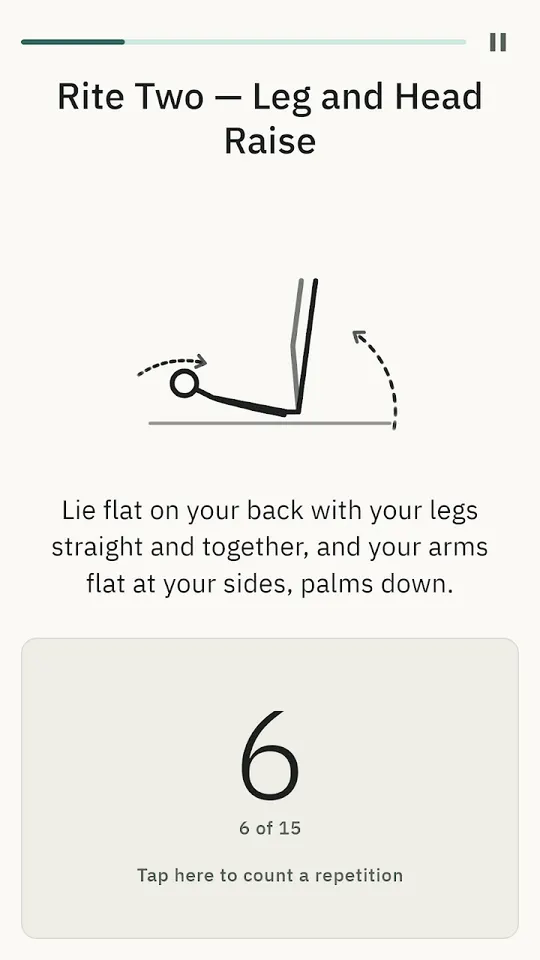
Session player with a rep counter 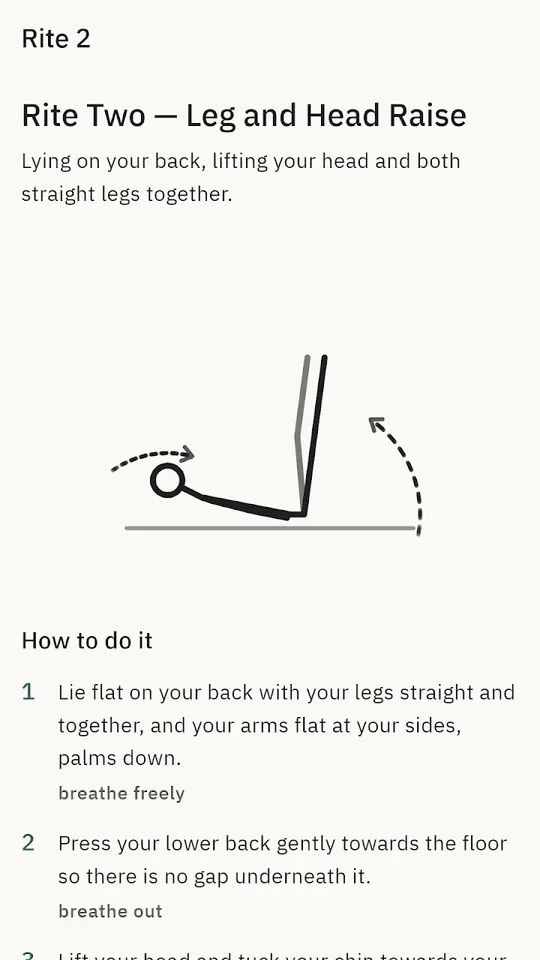
Numbered steps and breathing 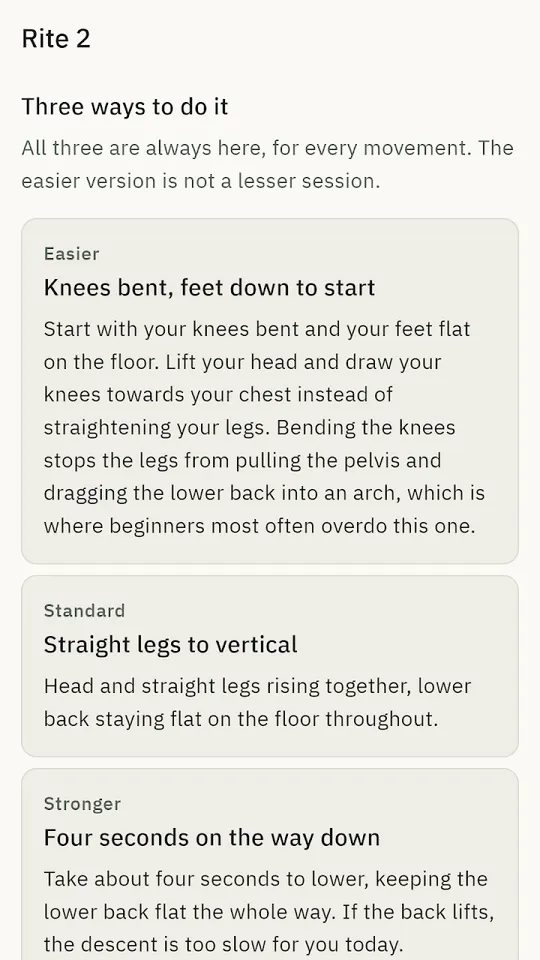
Easier, standard and stronger 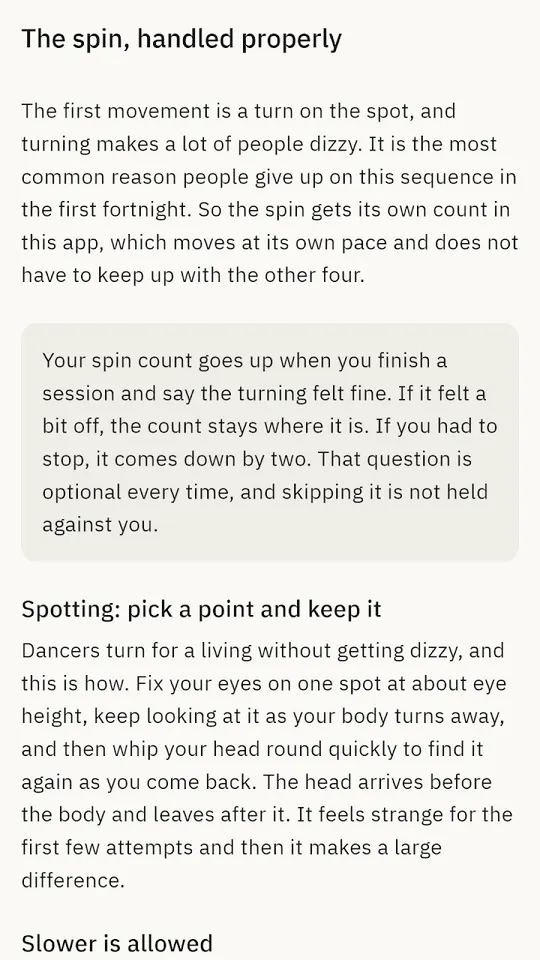
The spin, handled properly 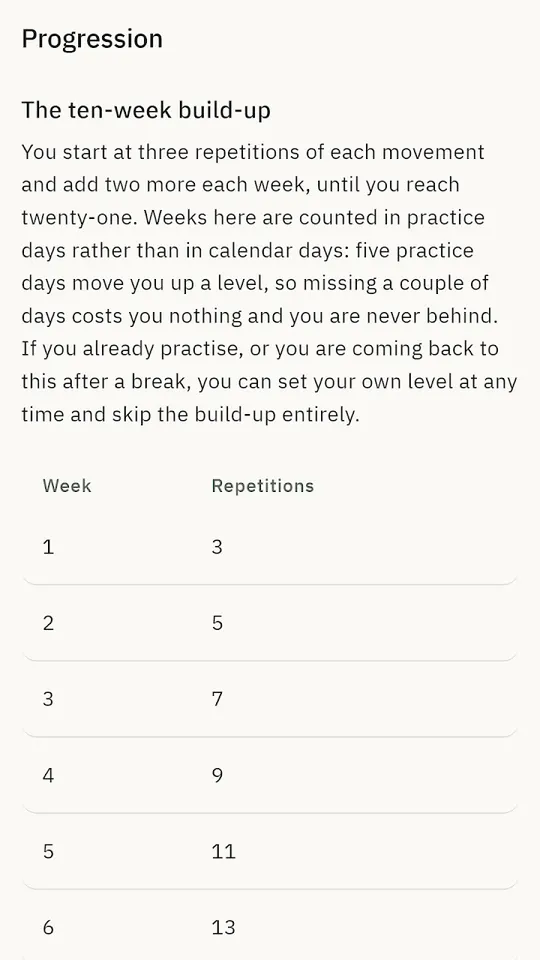
Ten-week build-up 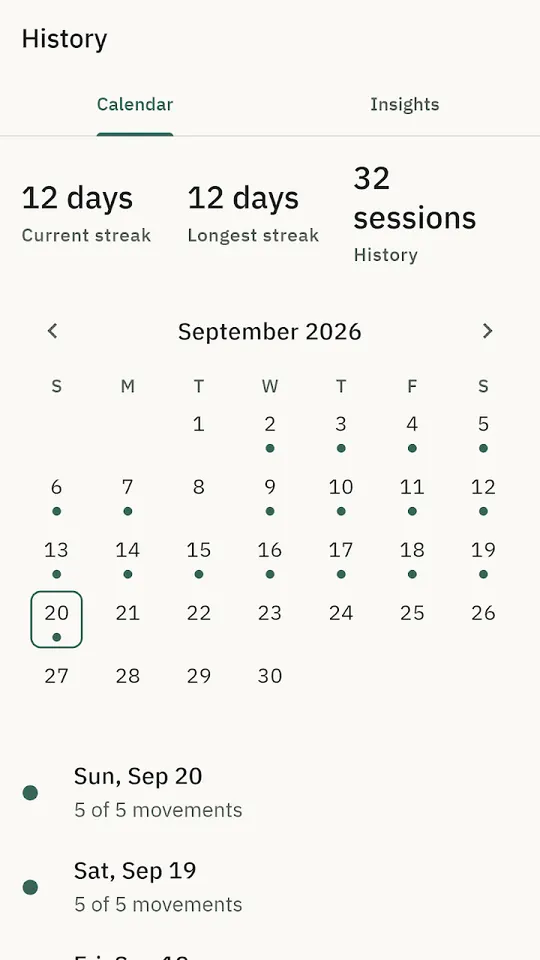
Calendar and streak 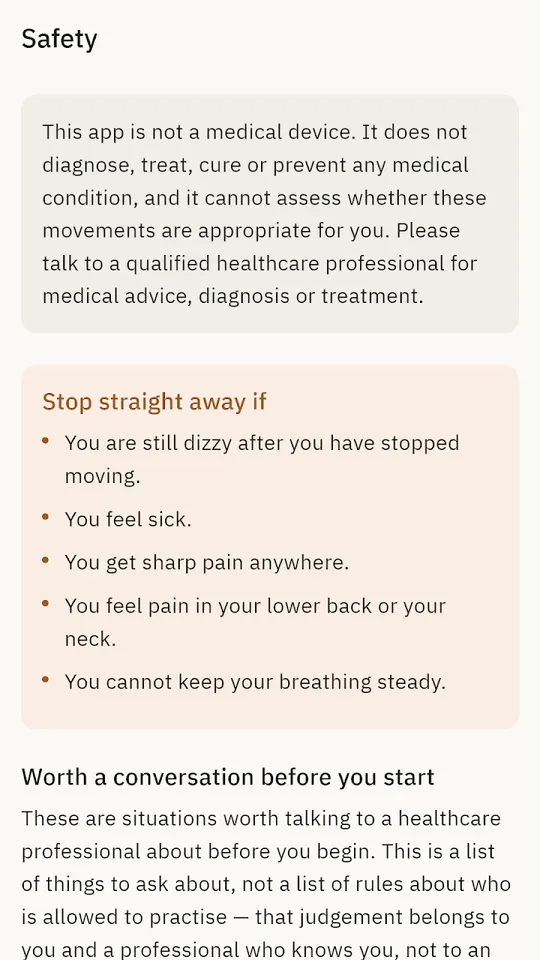
Safety, in plain words 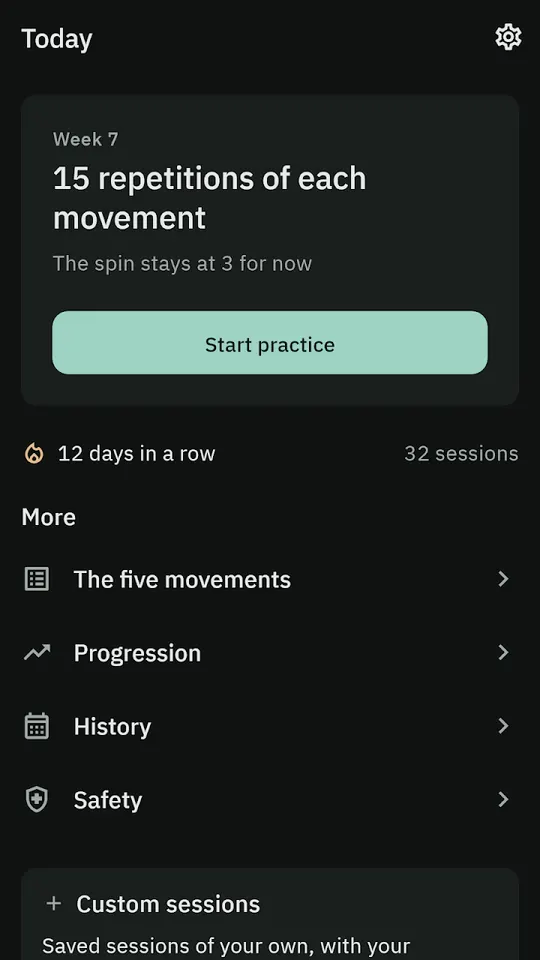
Today screen in dark mode
The five Tibetan rites in order, with steps
Five movements, always in the same order, done once through as a session: a standing spin, a lying leg and head raise, a kneeling back bend, a table top and a flow between two “dog” positions. The steps below are the ones the player above uses. Each has an easier and a stronger version; the easier ones reduce how far you bend at the lower back and neck, which is where beginners most often overdo it.
Rite 1: The spin
- Stand tall with your arms out at shoulder height, palms down.
- Pick a point at eye level and look at it for as long as you can as you turn.
- Turn slowly clockwise on the spot, one full turn is one repetition.
- When you finish, stand with your hands on your hips and your feet about shoulder-width apart until any dizziness has gone.
Breathing. Breathe steadily through the nose. There is no set pattern for this one.
- Easier. Turn very slowly, and only as many turns as feel steady. Stop the moment the room starts to move.
- Standard. Turn at an easy pace with your eyes on a point, then stand still until you are clear.
- Stronger. Once the standard version never makes you dizzy, add a few turns the other way. Never push through dizziness.
Rite 2: Leg and head raise
- Lie flat on your back with your legs together and your arms by your sides, palms down.
- Press your lower back gently towards the floor so there is no gap underneath.
- Breathing in, lift your head towards your chest and raise your legs towards the ceiling.
- Breathing out, lower your head and legs slowly and let the whole body relax.
Breathing. In as you lift, out as you lower, slow and even.
- Easier. Keep your knees bent and your feet flat to start. Lift the head and draw the knees towards your chest instead of straightening the legs.
- Standard. Straight legs lifted to vertical, head lifted, lower back staying down.
- Stronger. Take about four seconds on the way down, keeping the back flat the whole way.
Rite 3: Kneeling arch
- Kneel with your knees about shoulder-width apart and your hips over your knees.
- Place your palms on the backs of your thighs, just below the buttocks.
- Breathing in, tip your head back and open your chest, arching the spine gently.
- Breathing out, bring your chin towards your chest and return to upright. Your hands stay on your thighs the whole time.
Breathing. In as you open the chest, out as you come back to upright.
- Easier. Make the arch small and keep the head tipped back only a little, or not at all.
- Standard. A comfortable arch with the head tipped back, then chin towards the chest.
- Stronger. Move slowly, pausing for a breath in the arch without forcing the range.
Rite 4: Table top
- Sit with your legs straight out, feet about shoulder-width apart and your palms on the floor beside your hips, fingers pointing forwards.
- Tuck your chin towards your chest.
- Breathing in, tip your head back, lift your hips and bend your knees until your body forms a table.
- Breathing out, lower your hips and bring your chin back to your chest. Your hands and heels stay where they are.
Breathing. In as you lift, out as you lower. No breath holds.
- Easier. Lift the hips only partway, keep your head level instead of tipping it back, and keep your knees bent.
- Standard. Lift to a flat table with the head tipped back, then lower under control.
- Stronger. Pause for one slow breath at the top, then lower in about four seconds.
Rite 5: Two dogs
- Sit with your palms on the floor in front of you, then slide your feet back, shoulder-width apart, toes curled under.
- Straighten your arms and lift into upward-facing dog, chest open, looking slightly up.
- Breathing in, lift your hips into an upside-down V and bring your chin towards your chest.
- Breathing out, lower back into upward-facing dog. Bend your knees between positions to protect your lower back.
Breathing. In as the hips rise, out as the hips lower.
- Easier. Keep your knees on the floor or bent, make the arch small and look straight ahead instead of up.
- Standard. Move between the two positions with straight arms and a gentle arch.
- Stronger. Hold each position for one slow breath before changing.
Between movements, stand with your hands on your hips and take one or two deep breaths. That is the only advice on rest in the original 1939 booklet. The easier and stronger versions here follow common teaching advice and are not from that booklet.
How many repetitions: the ten-week build-up
The usual advice, repeated by Healthline and several yoga teachers, is to start with three repetitions of each movement, add two a week and stop at 21. At that pace you reach 21 in week ten. Do the whole session once a day, not 21 of one movement and then the next.
| Week | Repetitions of each movement | Repetitions in a session |
|---|---|---|
| 1 | 3 | 15 |
| 2 | 5 | 25 |
| 3 | 7 | 35 |
| 4 | 9 | 45 |
| 5 | 11 | 55 |
| 6 | 13 | 65 |
| 7 | 15 | 75 |
| 8 | 17 | 85 |
| 9 | 19 | 95 |
| 10 | 21 | 105 |
There is no single rule. Some teachers start with one repetition in the first week, some build up in steps of three, and one yoga health fund says not to go above 21. If a week feels like too much, repeat it. If you are short of time, three repetitions of each still count as a session.
Dizzy on the first rite? How to handle the spin
The first movement is a turn on the spot, and it makes a lot of people dizzy. It is the main reason beginners give up on the sequence. Most guides say only “stop when you feel slightly dizzy”. Here is a calmer way to deal with it.
- Give the spin its own count. Let it stay at three turns while the other four movements build up. There is no rule that all five must match.
- Turn slowly. Speed does not matter, and fast turns cause most of the dizziness.
- Spot a point. Dancers turn without getting dizzy by fixing their eyes on one spot at about eye height, keeping the gaze on it as long as possible while the body turns away, then whipping the head round quickly to find it again. It feels strange at first and then makes a large difference.
- Stand still afterwards. Feet about shoulder-width apart, hands on your hips, until the dizziness has passed. If it does not pass, end the session.
- Skip it when you need to. You can do the other four movements and still have done a session. Do not turn the other way or add turns until the standard version has stopped bothering you.
The app handles the count for you: it goes up by two after a session where the turning felt fine, stays put if it felt a bit off, and comes down by two if you had to stop. It also has a full alternative movement for people who should not spin. If you have vertigo, a balance problem, or dizziness from medication, ask a professional before you spin at all.
Stop straight away if
- You are still dizzy after you have stopped moving.
- You feel sick.
- You get sharp pain anywhere.
- You feel pain in your lower back or neck.
- You cannot keep your breathing steady.
Common mistakes
| Movement | What goes wrong |
|---|---|
| 1. The spin | Spinning fast. Speed does not matter, and fast turns are what make people dizzy. Staring at the floor with the head dropped instead of keeping it upright. Carrying on after the first sign of dizziness or nausea. |
| 2. Leg and head raise | Letting the lower back arch off the floor as the legs come down. Dropping the legs quickly instead of lowering them under control. Straining the neck. Lift the head only as far as is comfortable. |
| 3. Kneeling arch | Throwing the head back hard. Move the neck smoothly. Pushing the hips forward and collapsing into the lower back instead of opening the chest. Taking the hands off the thighs. |
| 4. Table top | Letting the hands or heels slide. Dropping the head back further than is comfortable for the neck. Holding the breath at the top. |
| 5. Two dogs | Dumping into the lower back in upward dog. Keep the arms strong and the arch gentle. Locking the knees in the upside-down V. Bend them as much as you like. Rushing the change and losing the breath. |
Two mistakes cut across all five: adding repetitions faster than the plan, and pushing through pain. You should not feel pain in these movements. If you do, stop and ask a health professional.
How long does it take?
A full session of five movements takes about ten to fifteen minutes at twenty-one repetitions, including the rests. In the first weeks, at three to nine repetitions, it takes only a few minutes. A short warm-up and cool-down are optional extras; they are not part of the traditional sequence, and the app says so.
Who should check with a professional first
Talk to a healthcare professional before you start if:
- You are pregnant.
- You have a spinal, heart, blood pressure, balance or eye condition.
- You are recovering from surgery.
Healthline adds heart or breathing problems, neurological conditions that affect balance, conditions that cause dizziness and surgery in the last six months to that list. This page and the app are movement guides, not medical devices. They do not diagnose, treat, cure or prevent any condition.
Where the rites come from, and what is not known
The sequence was published in a small 1939 booklet, The Eye of Revelation, by Peter Kelder. It tells of a retired British colonel who learned the exercises from lamas in a remote monastery. The colonel appears under a pseudonym, and no independent record of the monastery or the colonel has been found.
The booklet claimed the exercises were more than 2,500 years old and could reverse ageing. There is no evidence for either claim. Wikipedia states plainly that there is no evidence the exercises are authentic Tibetan practices, and Healthline notes that research on them is limited and the reported benefits rest on practitioners’ accounts. Some writers see Indian yoga influences and an American origin. The movements are ordinary bodyweight exercises, and people practise them because they like the routine, not because of that story.
The booklet gave little breathing advice: just one or two deep breaths between movements. The breathing patterns taught today were added by later teachers.
Sources
Questions
What are the five Tibetan rites?
A sequence of five movements done in order: a standing spin, a lying leg and head raise, a kneeling back bend, a table top lift and a flow between upward-facing and downward-facing dog. A full session takes about ten to fifteen minutes at the top level.
How many repetitions of the five Tibetan rites should a beginner do?
Three of each movement in the first week, then two more a week until you reach 21, which is week ten. Some teachers start lower, and repeating a week that felt hard is fine. The player on this page uses that plan.
Why does the first rite make me dizzy, and what can I do?
Turning on the spot upsets your sense of balance, and the faster you turn the worse it gets. Turn slowly, fix your eyes on a point, keep the spin count low, stand with your hands on your hips until it passes, and skip it that day if it does not. Ask a professional if dizziness keeps coming back.
Are the five Tibetan rites really Tibetan or ancient?
There is no evidence of it. They were published in a 1939 booklet by Peter Kelder, whose story of a colonel and a Tibetan monastery has never been confirmed. The booklet's claims about reversing ageing have no evidence behind them either.
Who should not do the five Tibetan rites?
Talk to a healthcare professional first if you are pregnant, have a spinal, heart, blood pressure, balance or eye condition, or are recovering from surgery. Stop straight away if you feel pain, sickness or dizziness that does not pass.
Should I do the five Tibetan rites every day?
The usual advice is once a day, building up over ten weeks. In the app, weeks are counted in practice days rather than calendar days, so missing a day costs you nothing. Take a rest day whenever your body asks for one.
Is the Five Tibetan Rites Workout app free?
Yes, with ads, and there is nothing to buy. Every movement, variation, the safety section, the spin protocol, the progression and your history are open to everyone. There is no advertising at all while a session is running.

Make it a ten-minute habit
Free on Android. Works offline, no account, nothing to buy. A movement guide, not a medical device.
Facts from the Google Play listing, last checked .