Lux meter and lux to PPFD calculator for plants, photos and rooms
Enter a light level, pick it from a typical scene or read it from your device's light sensor where the browser offers one, and the tool below tells you whether a spot is too dim or too bright for a plant, estimates PPFD and DLI for a grow light, suggests camera settings and checks a desk against the office standard. The free Android app measures live, maps a room and logs light over time.
Light meter and converter
A light level in, plant, grow light, camera and room checks out
500 lux
46.5 foot-candles
Between office lighting (320 to 500 lx) or a clear sunrise and an overcast day or a TV studio.
Medium light means 500 to 1000 foot-candles, which is 5,382 to 10,764 lx. Pick the level the plant's care guide asks for.
This spot for a medium light plant
Too dim. 500 lx is below 5,382 lx. Move the plant closer to the window or add a lamp.
Under 50 foot-candles (about 538 lx) a plant will not last long, says the Mississippi State guide. Extension services draw the low, medium and high lines in slightly different places, so treat this as a guide.
Factor used: 0.015 µmol m⁻² s⁻¹ per lux (bioRxiv 2018: 1000 lx ≈ 15 µmol m⁻² s⁻¹).
Estimated PPFD
7.5 µmol m⁻² s⁻¹
DLI over 12 h
0.32 mol m⁻² d⁻¹
Estimate only: lux is weighted to the human eye, so the same lux can carry different amounts of plant light under different lamps. A quantum (PAR) sensor is the proper tool.
This treats the reading as incident light on a flat receptor: EV = log₂(lux × ISO / 250), then time = f² / 2^EV. Point the phone's sensor at the camera from the subject, not at the subject.
EV at ISO 100
7.6 EV
Shutter at f/4
1/15 s
Exact: 1/12 s
A starting point for a meter reading, not a replacement for the histogram. Lux does not know how reflective your subject is.
EN 12464-1 asks for a maintained illuminance of 500 lx here, and 1000 lx where the work is demanding or accuracy matters.
Writing, typing, reading, data processing
Meets the requirement: 500 lx is 100% of 500 lx.
A self-check, not a lighting survey: a real check measures on a grid at the task height, and the standard asks for the level to hold over the life of the installation.
Estimates only. A phone's light sensor is not a calibrated lux meter, PPFD and DLI are converted from lux, and the exposure and room checks are rules of thumb. Nothing leaves this page.
A light meter that stays out of the way
This page converts a number you give it. The Android app measures the light itself with the phone's ambient light sensor, keeps min, average and max, and adds tools for plants, rooms, sleep and photography:
- Live lux on a large display with minimum, average and maximum, a stability indicator and a real-time trend chart, in lux or foot-candles
- Plant, room and photo profiles with a target range that says at once whether a spot is too dim, good or too bright
- Grow light mode: estimated PPFD and DLI from your light source (sunlight, white LED, HPS, metal halide, fluorescent) and daily light hours
- Room heatmap: walk a grid and see where the light falls, with the uniformity of the room
- Circadian light: an estimate of melanopic EDI from lux and a colour temperature, with day, evening and night targets
- Workplace check against EN 12464-1 maintained illuminance, as a self-check and not a formal survey
- Timed logging with CSV export, a profile trend, comparing two readings, notes, sharing as an image and spoken readings
- Calibration with an offset and a multiplier, an optional camera colour temperature estimate, light and dark themes, 50+ languages

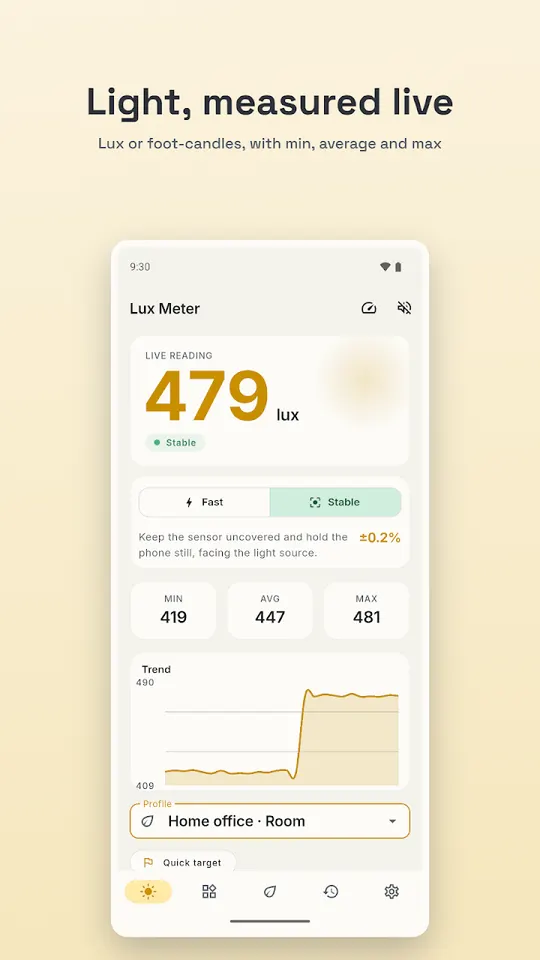
Live lux with min, average and max 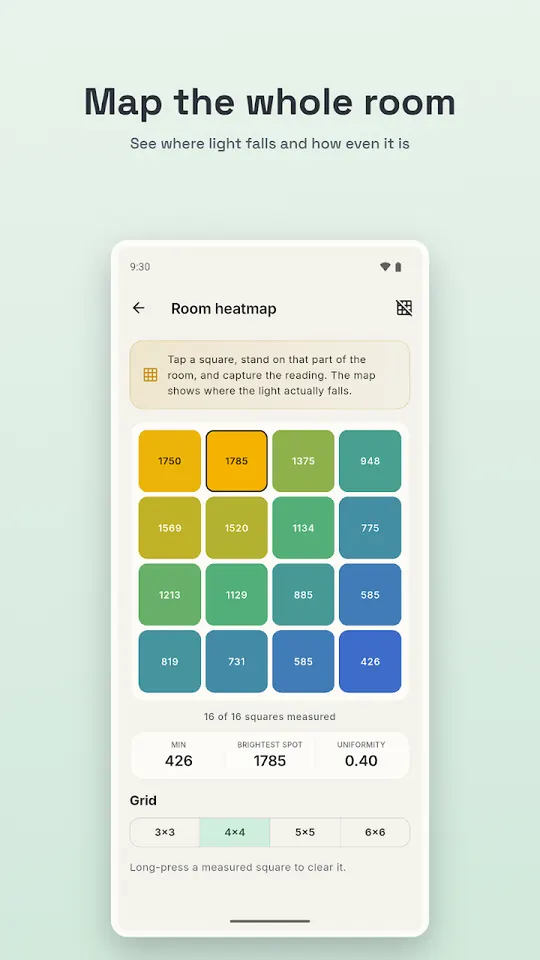
Map the whole room 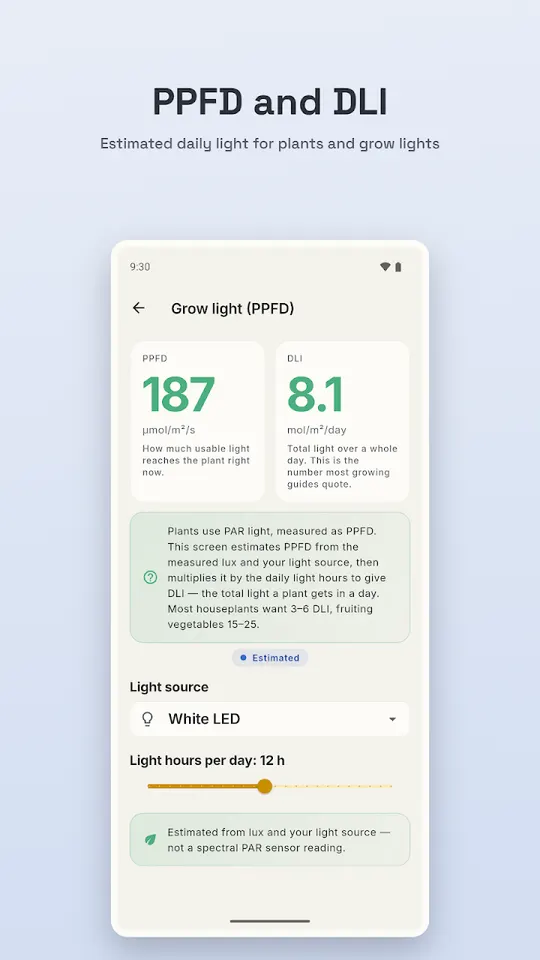
Estimated PPFD and DLI 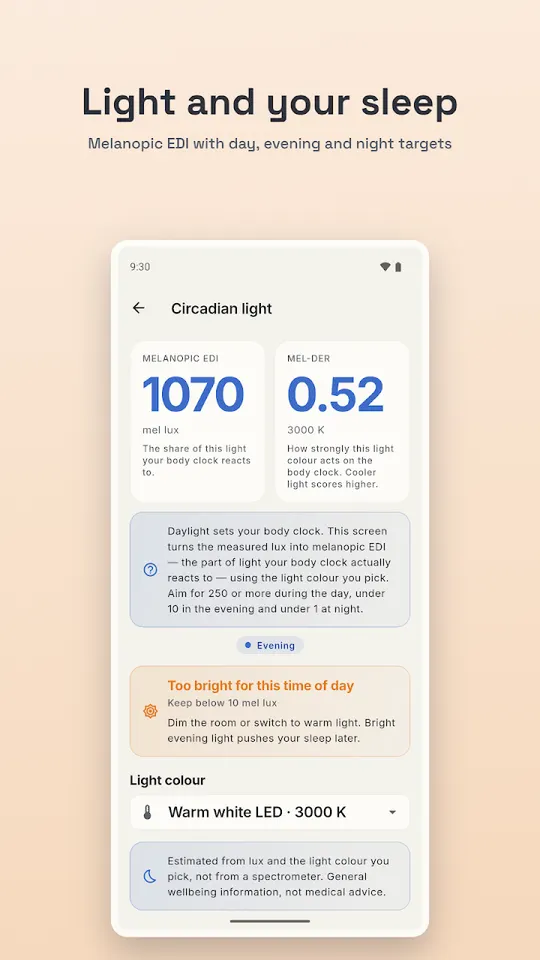
Light and your sleep 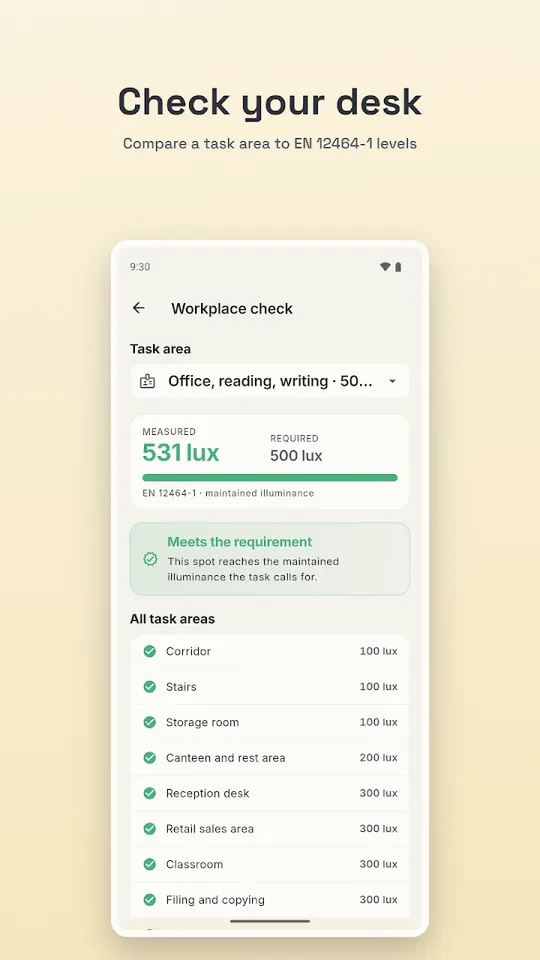
Check your desk 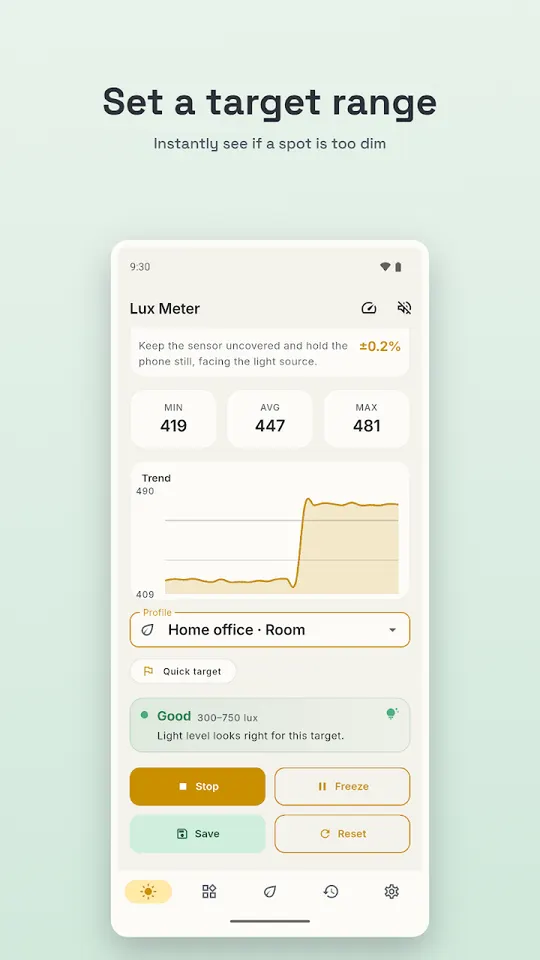
A target range for every spot 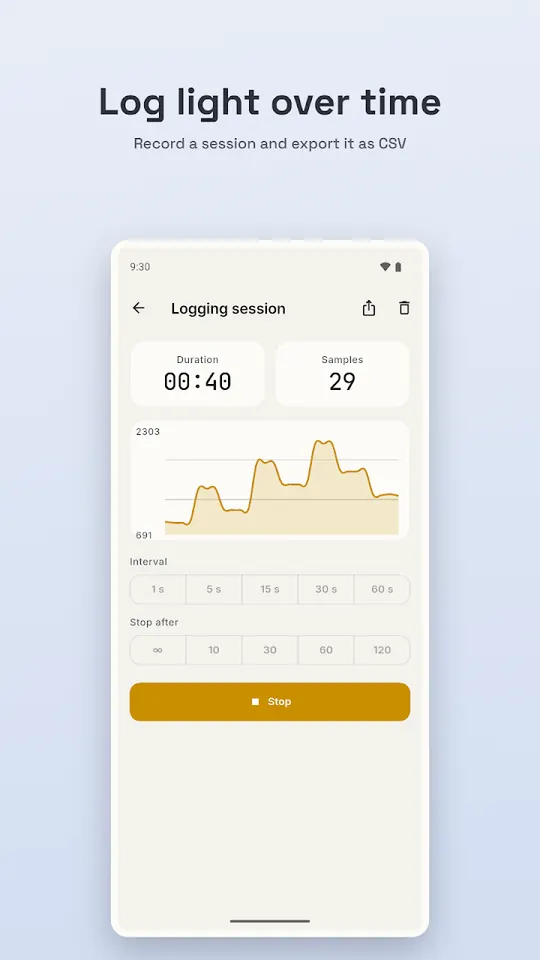
Log light over time 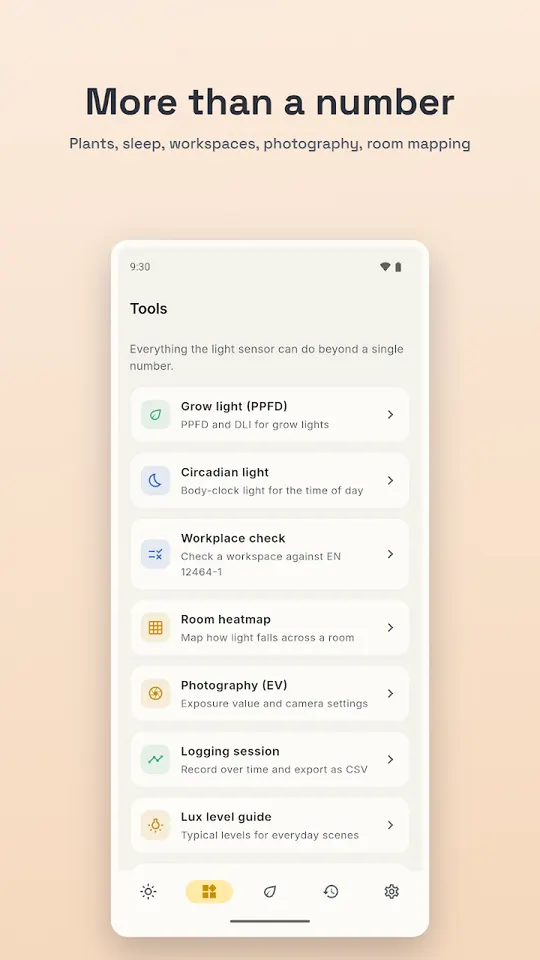
More than a number
What is a lux, and how is it different from a lumen?
A lux is one lumen of light falling on one square metre: 1 lx = 1 lm/m². Lumens count the light a lamp gives off in total. Lux counts how much of it lands on a surface. The same 1,000 lumens spread over 1 m² give 1,000 lux and spread over 10 m² give 100 lux, which is why a bulb's lumen rating tells you little about how bright a desk will be: the distance, the shade and the room change the answer.
| Where | Lux |
|---|---|
| Full moon on a clear night | 0.05 to 0.3 |
| Family living room lights | 50 |
| Office building hallway | 80 |
| Very dark overcast day | 100 |
| Railway station platform | 150 |
| Office lighting | 320 to 500 |
| Sunrise or sunset on a clear day | 400 |
| Overcast day, TV studio | 1,000 |
| Full daylight, not direct sun | 10,000 to 25,000 |
| Direct sunlight | 32,000 to 100,000 |
The scale is steep: an overcast day is about 1,000 lux outside, where an office is lit to a few hundred, and direct sun is thirty times that or more. Your eye adapts so well that you will not notice the differences without a meter.
Can I use my phone as a light meter, and how accurate is it?
Many Android phones have an ambient light sensor, used to set the screen brightness. An app can read it in lux. The web can too, in principle: the browser's AmbientLightSensor interface returns the light level in lux, but MDN lists it as experimental, it needs a secure connection and the user's permission, and it does not work in some of the most widely used browsers. That is why the meter at the top of this page falls back to a number you type or pick when your browser has no sensor.
To get a steadier reading from a phone app:
- Keep the sensor uncovered and hold the phone still, facing the light source.
- Measure where the light is used: at leaf height for a plant, on the desk surface for reading, at the subject's position for a photo.
- Take several readings and look at the average, not the first number. Light flickers, clouds pass and your own shadow counts.
- To compare two bulbs or two spots, use the same phone in the same position each time. Comparisons are far more trustworthy than absolute numbers.
A phone sensor is not a calibrated lux meter. Its response depends on the model and on where the sensor sits, and it was built to set the screen brightness, not to measure. Treat the number as a good guide. A professional meter, tested against a reference, is what a lighting survey or a legal check needs.
How many lux do houseplants need?
Plant guides talk about low, medium and high light. Mississippi State University Extension puts the lines in foot-candles, and the table converts them to lux:
| Level | Foot-candles | Lux |
|---|---|---|
| Low light | 50 to 500 | 538 to 5,382 |
| Medium light | 500 to 1,000 | 5,382 to 10,764 |
| High light | 1,000 and up | 10,764 and up |
The same guide says light under 50 foot-candles, about 538 lux, “will not sustain plant life for very long”, and that it can fall off sharply within a few feet of a window. Other guides draw the lines in different places, so use the table as a guide and your plant's own care notes as the deciding word.
For plants under a grow light, the same Mississippi State publication says they need about 12 to 14 hours of that light a day for good growth, with a timer to keep it regular.
What is the difference between lux and PPFD?
Lux measures light as the human eye sees it, so it leans on green and yellow. Plants use light between about 400 and 700 nm, counted as photons: PPFD, photosynthetic photon flux density, in µmol m⁻² s⁻¹. The two do not convert with one number, because the lamp's spectrum decides the ratio. Apogee Instruments publishes factors for several lamps, and a 2018 bioRxiv preprint puts white LEDs at about 15 µmol m⁻² s⁻¹ per 1,000 lux.
| Light source | Factor per lux | 1,000 lux | 10,000 lux |
|---|---|---|---|
| Sunlight | 0.0185 | 18.5 | 185 |
| White LED | 0.015 | 15.0 | 150 |
| Cool white fluorescent | 0.0135 | 13.5 | 135 |
| High pressure sodium | 0.0122 | 12.2 | 122 |
| Metal halide | 0.0141 | 14.1 | 141 |
Treat these as estimates. White LEDs differ with colour temperature, and light with a very different spectrum, such as a coloured grow light, can be far off any white-light factor. For a fixture, the manufacturer's PPFD map or a quantum sensor is the right tool.
What is DLI, and how do I work it out?
The daily light integral is all the plant light a square metre receives in a day, in mol m⁻² d⁻¹. If the light is steady, DLI = 0.0036 × PPFD × hours of light. The 0.0036 turns micromoles per second into moles per hour. For example, 200 µmol m⁻² s⁻¹ for 16 hours is 11.5 mol m⁻² d⁻¹, and 1 µmol m⁻² s⁻¹ held for 24 hours is 0.0864.
| PPFD | 8 h a day | 12 h a day | 16 h a day |
|---|---|---|---|
| 50 µmol m⁻² s⁻¹ | 1.4 | 2.2 | 2.9 |
| 100 µmol m⁻² s⁻¹ | 2.9 | 4.3 | 5.8 |
| 200 µmol m⁻² s⁻¹ | 5.8 | 8.6 | 11.5 |
| 400 µmol m⁻² s⁻¹ | 11.5 | 17.3 | 23.0 |
How much DLI a plant wants depends on the plant. Wikipedia notes that in growth chambers values between 10 and 30 are the most common, and that shade-tolerant plants under taller ones can live on less than 1. Look up the figure for your species rather than reading it off a general chart. To change DLI, change the hours, not just the lamp: doubling the hours doubles the dose.
How do I convert lux to foot-candles?
One foot-candle is about 10.764 lux. Divide lux by 10.764 to get foot-candles, multiply foot-candles by 10.764 to get lux. For a quick estimate, divide lux by 10 and you are within about 7%.
| Lux | Foot-candles |
|---|---|
| 50 | 4.6 |
| 100 | 9.3 |
| 300 | 28 |
| 500 | 46 |
| 1,000 | 93 |
| 10,000 | 929 |
How do I turn lux into camera settings?
A light meter held at the subject, pointing back at the camera, reads incident light. For a flat (cosine-responding) receptor the exposure equation is N²/t = E × S / C, where N is the f-number, t the shutter time in seconds, E the illuminance in lux, S the ISO and C a calibration constant of about 250. In stops, EV = log₂(E × S / C), and at ISO 100 that is log₂(lux / 2.5). Then t = N² / 2EV.
| Lux | EV | f/2.8 | f/8 |
|---|---|---|---|
| 50 | 4.3 | 1/2 s | 4 s |
| 100 | 5.3 | 1/4 s | 2 s |
| 500 | 7.6 | 1/30 s | 1/4 s |
| 1,000 | 8.6 | 1/60 s | 1/8 s |
| 10,000 | 12.0 | 1/500 s | 1/60 s |
This is a starting point. A phone sensor is not shaped like a meter's receptor and cannot tell you how reflective the subject is, so check the first frame and adjust. For steady, even light on a set, a lux reading is most useful for comparing one spot with another and for repeating a setup from one shoot to the next.
How bright should a room or a desk be?
For workplaces, the European standard EN 12464-1 sets a maintained illuminance for each kind of task: the level the lighting must not fall below over its whole life, not just when the lamps are new. These office values are as printed by Performance in Lighting, with a higher “modified” figure for demanding work:
| Task area | Required | Modified |
|---|---|---|
| Writing, typing, reading, data processing | 500 | 1000 |
| Conference and meeting rooms | 500 | 1000 |
| Technical drawing | 750 | 1500 |
| Filing, copying | 300 | 500 |
| Reception desk | 300 | 750 |
| Archiving | 200 | 300 |
At home nothing forces these numbers, but they are a useful target for a desk or a reading chair: 500 lux for reading and screen work. Compare it with the typical levels above: a living room lit for relaxing sits near 50 lux, a tenth of what the standard asks at a desk. A formal check needs a calibrated meter and a grid of measurements at the task height; a phone reading tells you which side of the line you are on.
What the Android app adds
- Live lux from the phone's light sensor with minimum, average and maximum, a stability indicator and a real-time trend chart, in lux or foot-candles.
- Plant, room and photo profiles with a target range that says whether a spot is too dim, good or too bright, and a history with date, time and profile.
- Grow light mode: estimated PPFD and DLI from your light source (sunlight, white LED, HPS, metal halide, fluorescent) and daily light hours.
- Room heatmap: walk a grid and see where the light falls, with the uniformity (minimum over average). Readings stay in memory only.
- Circadian light: an estimate of melanopic EDI from lux and a colour temperature you choose, with day, evening and night targets. Wellbeing information, not medical advice.
- Workplace check against EN 12464-1 maintained illuminance, as a self-check and not a formal survey.
- Timed logging with CSV export, a profile trend against its target range, comparing two readings, notes, sharing a reading as an image and spoken readings.
- Calibration with an offset and a multiplier to match a reference meter, an optional camera mode that estimates colour temperature, a home-screen widget, and backup and restore to a file.
- Light and dark themes, 50+ languages, no account, core measuring works offline.
Honest notes
- The app is free with ads. No account is needed.
- The listing says a phone light sensor is not a calibrated professional lux meter, readings vary by device and by where the sensor sits, PPFD and DLI are estimates converted from lux, and the camera colour temperature is an estimate. Use it as a guide, not a certified instrument.
- Measurements and profiles stay on the device. The camera, when used, only estimates colour on the device, and no photos are saved or uploaded.
- This page does the same conversions in your browser and sends nothing anywhere. It reads a light sensor only if you press the button and your browser offers one.
Sources
- Wikipedia, Lux: the definition, the table of typical levels and 1 foot-candle ≈ 10.764 lux.
- Apogee Instruments, Conversion: PPFD to Lux: factors for sunlight, fluorescent, HPS and metal halide.
- bioRxiv preprint (2018), An easy estimate of the PFDD for a plant illuminated with white LEDs: 1000 lx = 15 μmol/s/m²: the white LED factor, from the title. A preprint, not peer reviewed.
- Wikipedia, Daily light integral: the formula and the typical values.
- Mississippi State University Extension, Care and Selection of Indoor Plants (P1012): the low, medium and high ranges in foot-candles and the 12 to 14 hour guidance.
- Wikipedia, Exposure value: the incident-light equation and the constant C = 250 for a flat receptor.
- Performance in Lighting, EN 12464-1 office table: the required and modified values. The page does not state the edition.
- MDN, AmbientLightSensor: the web sensor interface, its status and permission.
Questions
How many lux do houseplants need?
Mississippi State University Extension defines low light as 50 to 500 foot-candles (about 540 to 5,400 lux), medium as 500 to 1,000 (5,400 to 10,800 lux) and high as 1,000 or more. Under 50 foot-candles a plant will not last long. Other guides draw the lines in different places, so check your plant's own care notes too.
How do I convert lux to PPFD?
Multiply lux by a factor that depends on the light source: 0.0185 for sunlight, about 0.015 for white LEDs and 0.0135 for cool white fluorescent, so 10,000 lux of white LED light is roughly 150 µmol m⁻² s⁻¹. It is an estimate, because lux is weighted to the human eye and each lamp has its own spectrum.
How do I calculate DLI from PPFD?
DLI = 0.0036 × PPFD × hours of light per day, in mol m⁻² d⁻¹. For example, 200 µmol m⁻² s⁻¹ for 16 hours is 11.5. The tool on this page also works backwards from a target DLI to the hours you need.
What is the difference between lux and lumens?
Lumens measure the light a lamp gives off in total. Lux measures how much of it lands on a surface: 1 lux is 1 lumen per square metre. The same 1,000 lumens give 1,000 lux over one square metre and 100 lux over ten.
Can I use my phone as a lux meter?
Yes, as a guide. Many phones have an ambient light sensor and an app can read it in lux. It is not a calibrated instrument: readings vary by phone and by where the sensor sits, so compare spots with the same phone rather than trusting a single absolute number.
How many lux do I need for reading or a desk?
The European workplace standard EN 12464-1 asks for 500 lux maintained illuminance for writing, typing, reading and data processing, 300 for filing and copying and 750 for technical drawing. A living room is often near 50 lux, so a reading chair or desk usually needs a dedicated lamp.
How do I convert lux to foot-candles?
Divide lux by 10.764. 500 lux is about 46 foot-candles, and 1,000 foot-candles is about 10,764 lux.
Is the Lux Meter app free?
Yes. It is free with ads and needs no account. Core measuring works offline, and measurements and profiles stay on your device.

Measure the light, not just convert it
Free on Android, with ads. No account, core measuring works offline, and measurements stay on your device. An estimation tool, not a certified instrument.
Facts from the Google Play listing, last checked .