Learn Morse code with a Koch trainer online
Press Start and copy what you hear: five groups from your current Koch level, keyed at full character speed with Farnsworth gaps you set. Score 90% and the next character unlocks. Below are the PARIS timing table, the Koch order, the full code chart and a practice plan. The free Android app adds sending practice on a key or paddle, a confusion matrix and QSO drills.
Koch trainer
Enter checks, Esc stops the sound. Five groups of five, new character M comes up twice as often.
Receive and send, with a report on your fist
The trainer here covers copying. The Android app goes further, with sending practice and a record of every character you mix up:
- Koch training with accuracy-gated progression
- Independent character speed and effective speed, from 5 to 40 WPM, with the ARRL Farnsworth formula
- Adjustable sidetone with a click-free envelope
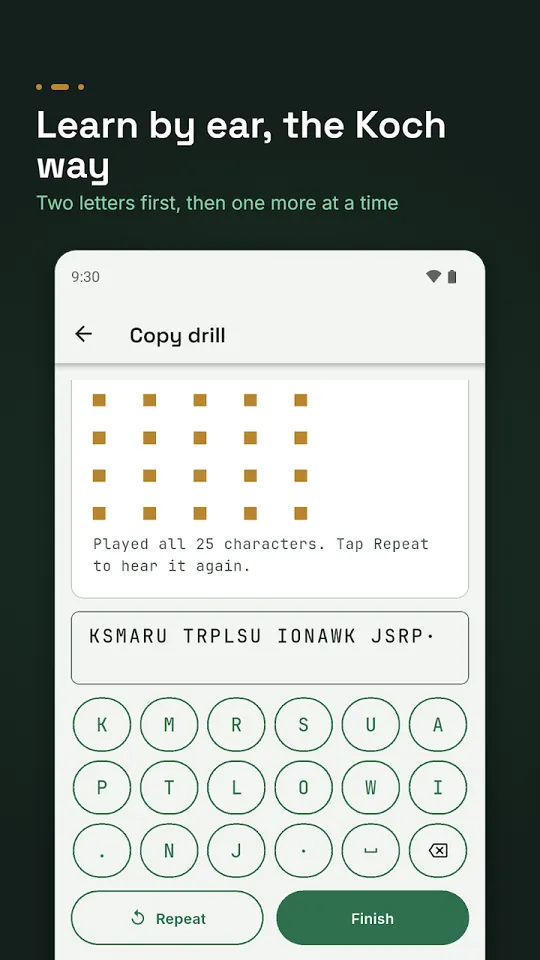
- Copy drills, head copy drills, callsign drills and a simulated QSO
- Straight key and iambic paddle sending practice with timing analysis: effective speed, dash to dit weighting, spacing and wrong characters
- A confusion matrix that ranks the character pairs you mix up
- Text to Morse and Morse to text with audio, visual and flashlight output
- Reference of characters, prosigns, Q-codes, abbreviations and the RST system, plus the NATO phonetic alphabet with a drill
- Statistics, streaks, a daily goal, light and dark themes

Learn by ear, the Koch way 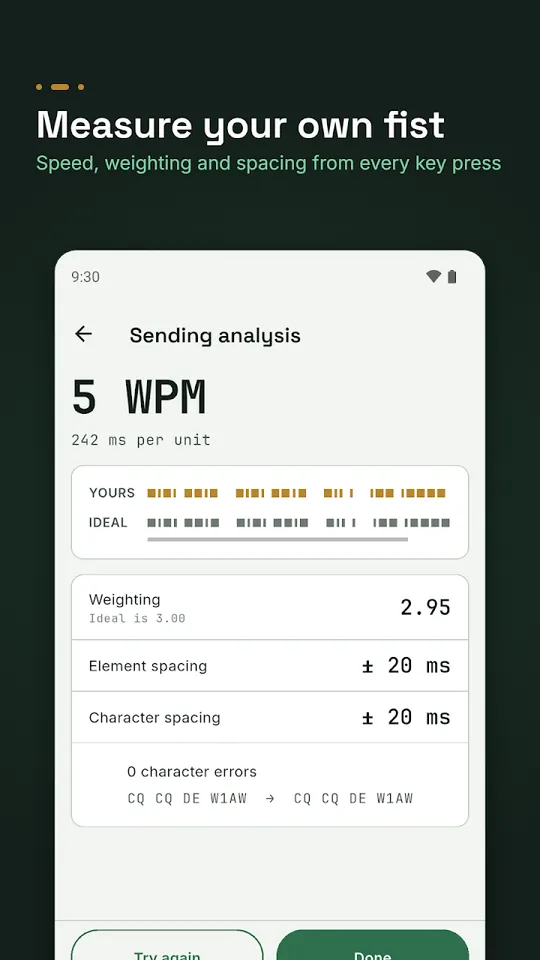
Measure your own fist 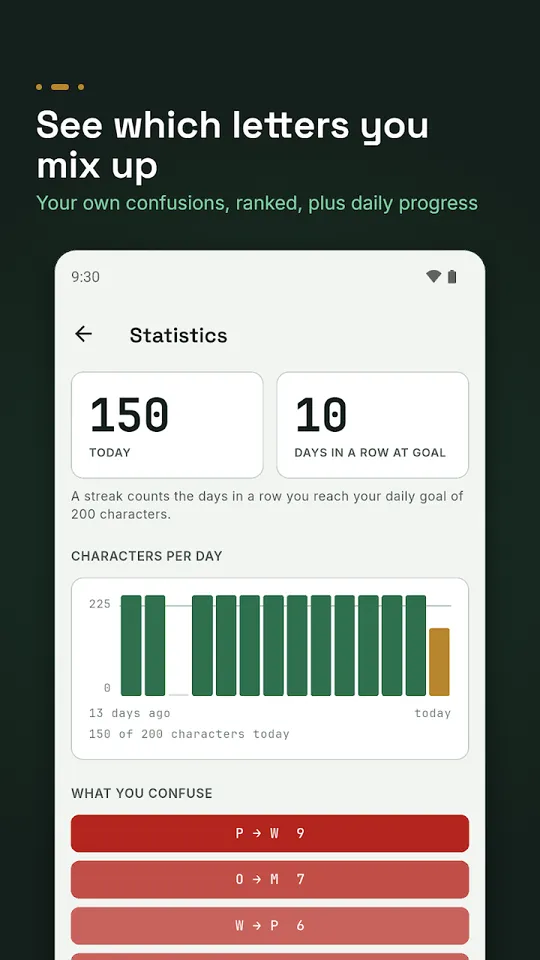
See which letters you mix up 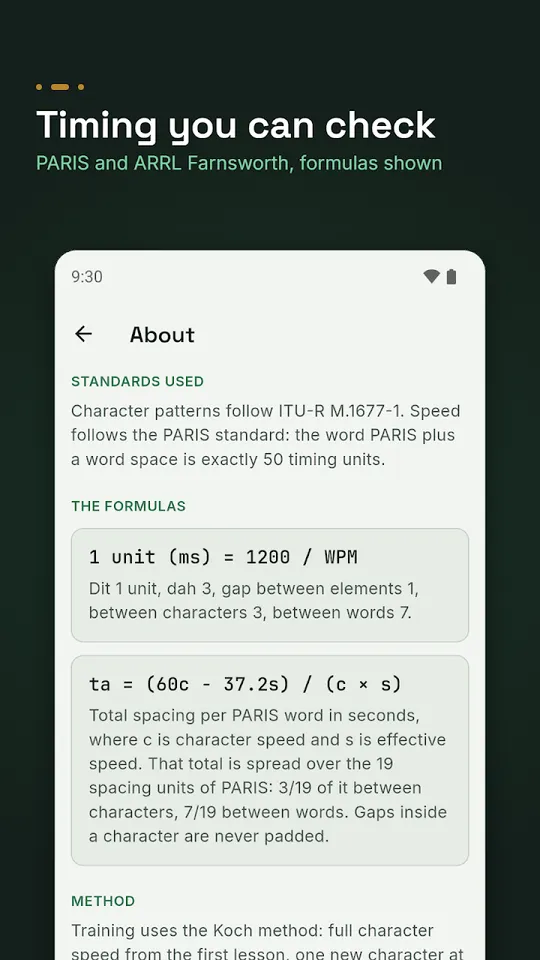
Timing you can check 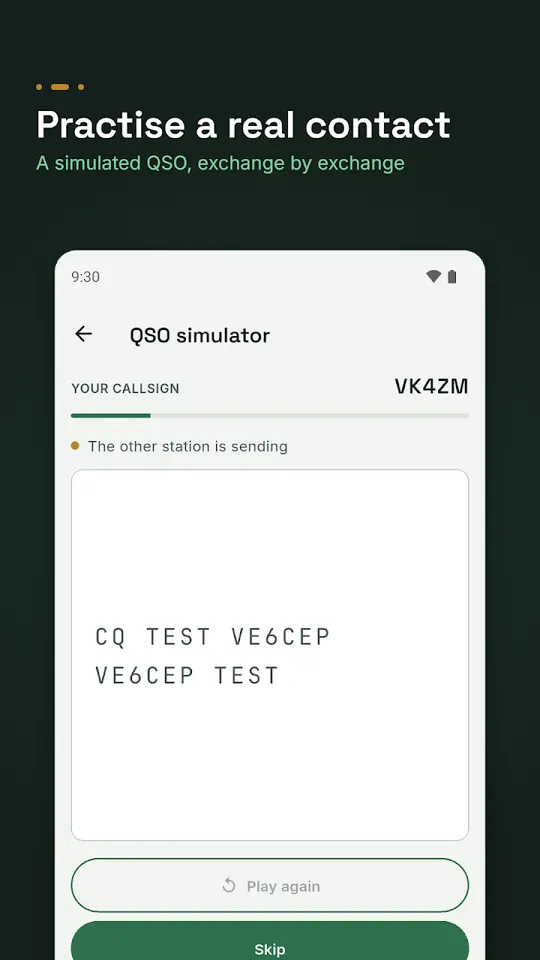
Practise a real contact 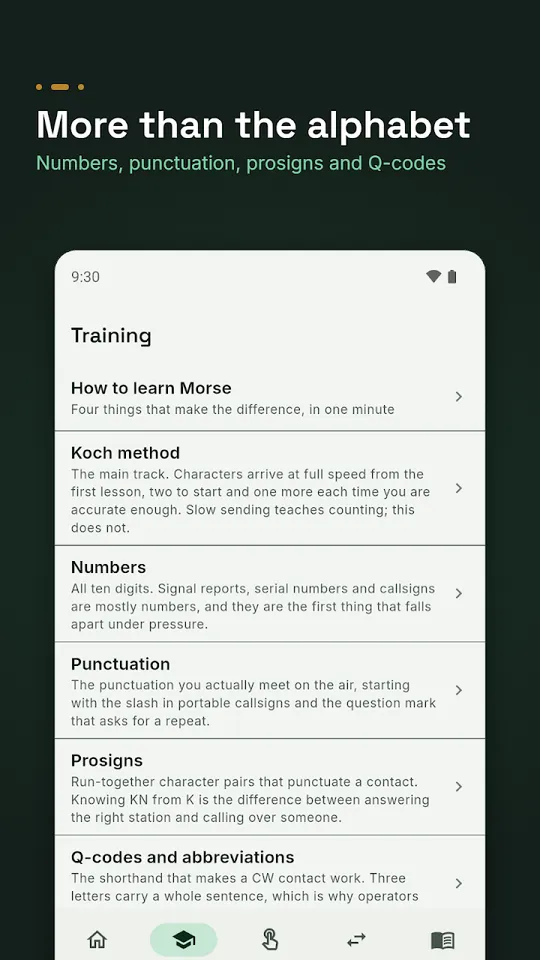
More than the alphabet 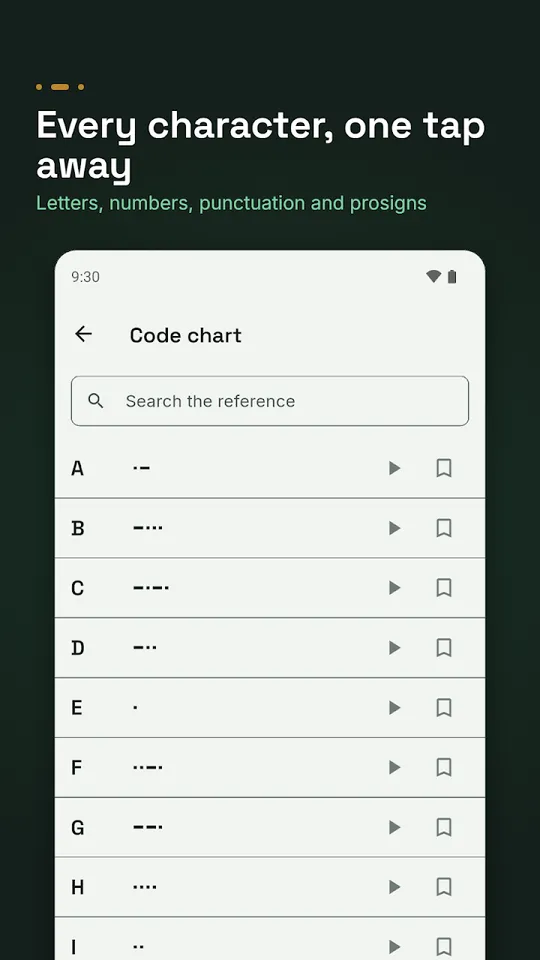
Every character, one tap away 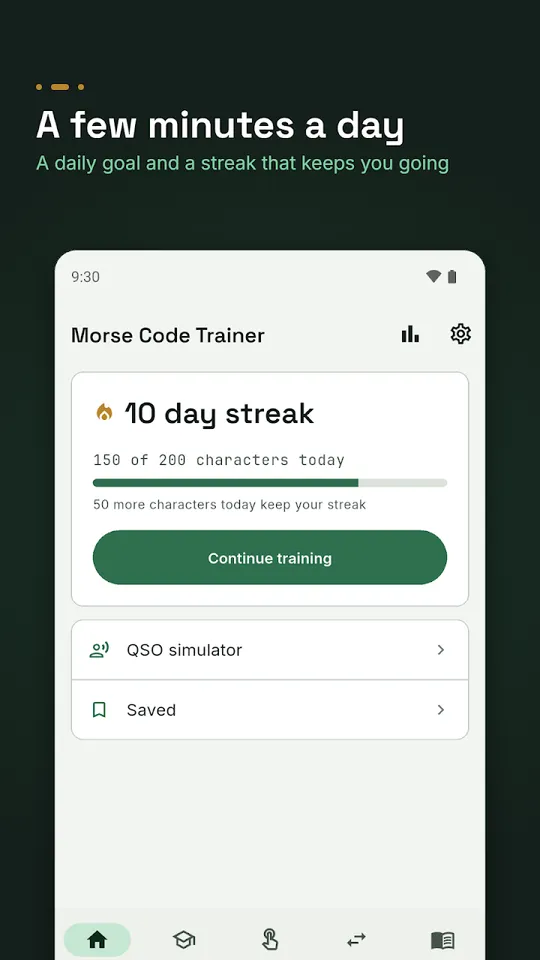
A few minutes a day
Koch method vs Farnsworth timing
They solve different problems and work best together. The Koch method, from the German psychologist Ludwig Koch in the 1930s, decides what you learn: you start with two characters sent at full speed, and add one more only when you copy the current set at about 90%. Every character is learned as a sound pattern from day one, never as a count of dits and dahs.
Farnsworth timing, named after Donald Farnsworth (W6TTB), decides how it is sent: each character keeps its full character speed, and only the gaps between characters and words are stretched to give you time to think. A setting of 20/10 means characters at 20 WPM with an overall pace of 10 WPM. As you improve you shrink the gaps until the two numbers meet.
The trainer above uses both: pick a Koch level, keep the character speed at 18 to 25 WPM, and set the effective speed as low as you need. The Morse Code Trainer app does the same, with accuracy-gated levels and both speeds set separately from 5 to 40 WPM.
Morse code timing: the PARIS standard
Morse speed is measured in words per minute against the word PARIS. With the gap after it, PARIS is exactly 50 units long, so one unit (a dit) lasts 1200 / WPM milliseconds. A dah is 3 units, the gap inside a character 1, between characters 3 and between words 7.
| WPM | Dit | Dah | Letter gap | Word gap |
|---|---|---|---|---|
| 5 | 240 ms | 720 ms | 720 ms | 1680 ms |
| 10 | 120 ms | 360 ms | 360 ms | 840 ms |
| 13 | 92 ms | 277 ms | 277 ms | 646 ms |
| 15 | 80 ms | 240 ms | 240 ms | 560 ms |
| 18 | 67 ms | 200 ms | 200 ms | 467 ms |
| 20 | 60 ms | 180 ms | 180 ms | 420 ms |
| 25 | 48 ms | 144 ms | 144 ms | 336 ms |
| 30 | 40 ms | 120 ms | 120 ms | 280 ms |
| 40 | 30 ms | 90 ms | 90 ms | 210 ms |
With Farnsworth spacing the ARRL formula gives the total delay per word: ta = (60c − 37.2s) / (c × s) seconds, where c is the character speed and s the effective speed. It is spread over the 19 spacing units of PARIS: 3/19 of it between characters and 7/19 between words. At 20/10, the dit stays 60 ms while the letter gap grows to 654 ms and the word gap to 1525 ms.
| Effective WPM | Letter gap | Word gap |
|---|---|---|
| 5 | 1601 ms | 3736 ms |
| 8 | 891 ms | 2078 ms |
| 10 | 654 ms | 1525 ms |
| 13 | 435 ms | 1015 ms |
| 15 | 338 ms | 788 ms |
| 20 | 180 ms | 420 ms |
Koch method character order
The trainer follows the widely used G4FON order. It mixes long and short characters early so you never get comfortable counting, and puts look-alike sounds apart. Level 2 is K and M; each level adds the next one:
K M R S U A P T L O W I . N J E F 0 Y V , G 5 / Q 9 Z H 3 8 B ? 4 2 7 C 1 D 6 X
Any order works as long as you add one character at a time and only at 90% accuracy. Forty characters at one new character every few days is two to three months of short daily sessions for most learners.
Morse code alphabet, numbers and prosigns
International Morse code as defined in ITU-R M.1677-1. Use the chart to look things up, not to learn from: memorising the dots and dashes visually is exactly the habit the Koch method avoids. To hear any character or translate text, use the Morse code translator.
Letters
- A ·−
- B −···
- C −·−·
- D −··
- E ·
- F ··−·
- G −−·
- H ····
- I ··
- J ·−−−
- K −·−
- L ·−··
- M −−
- N −·
- O −−−
- P ·−−·
- Q −−·−
- R ·−·
- S ···
- T −
- U ··−
- V ···−
- W ·−−
- X −··−
- Y −·−−
- Z −−··
Numbers
- 0 −−−−−
- 1 ·−−−−
- 2 ··−−−
- 3 ···−−
- 4 ····−
- 5 ·····
- 6 −····
- 7 −−···
- 8 −−−··
- 9 −−−−·
Punctuation
- . ·−·−·−
- , −−··−−
- : −−−···
- ? ··−−··
- ' ·−−−−·
- - −····−
- / −··−·
- ( −·−−·
- ) −·−−·−
- " ·−··−·
- = −···−
- + ·−·−·
- @ ·−−·−·
Prosigns
| Prosign | Code | Meaning |
|---|---|---|
| AR | ·−·−· | End of message |
| SK | ···−·− | End of contact |
| BT | −···− | Break, new paragraph (same as =) |
| KN | −·−−· | Over, only the station called may answer |
| K | −·− | Over, anyone may answer |
| AS | ·−··· | Wait |
| HH | ········ | Error, the last word is resent |
A practice plan that works
- Set the character speed once. 18 to 20 WPM is a good start; 25 if you already know some code. Leave it there.
- Use Farnsworth for room. Start the effective speed at 8 to 10 WPM and raise it by one or two when copying feels easy.
- Short and daily. Two or three sessions of 10 to 15 minutes beat one long session a week. Stop when you start to feel tired, accuracy drops fast after that.
- Advance at 90%. When a run scores 90% or more, add the next character. If a new one keeps failing, stay on the level for another day.
- After the 40 characters, move to words, callsigns and real contacts, then close the gap between the effective and character speeds.
Common mistakes when learning Morse code
- Learning at 5 WPM. At slow character speeds you count dits, and that habit is hard to break above 10 to 12 WPM. Keep characters fast; slow the gaps instead.
- Learning from a chart. Memorising "dot dash" patterns means translating twice in your head. Learn each character as a sound.
- Stopping on a missed letter. Leave a gap and keep copying; dwelling on one miss costs the next three.
- Adding characters too fast. Moving on below 90% piles up confusions, typically between pairs like K and R, U and V, or S and H.
- Receive only. Sending with a key or paddle is a separate skill. The app measures your sending: speed, dash to dit weighting against the ideal 3 to 1, and spacing.
Morse code in ham radio today
Amateur radio licences no longer require a Morse test in most countries since the ITU dropped the requirement in 2003 (the US FCC followed in 2007), yet CW is still one of the most popular modes on the bands. A narrow CW signal gets through noise and weak conditions where voice fails, a simple transmitter is enough, and the short exchanges of contests, portable activations and DX need no shared language.
A typical contact uses abbreviations and Q-codes: CQ to call, DE for "from", RST signal reports like 599, QTH for location, and the prosigns above to hand over or close. The Morse Code Trainer app includes callsign drills, a simulated QSO and a reference of Q-codes, abbreviations and the RST system for that step.
Questions
What is the fastest way to learn Morse code?
Learn by ear with the Koch method: hear each character at a real speed of about 20 WPM from the start, begin with two characters and add one each time you copy 90% correctly. Short daily sessions of 10 to 15 minutes work better than long ones.
What is the difference between the Koch method and Farnsworth timing?
Koch decides the order and pace of new characters; Farnsworth stretches the gaps between characters and words while each character keeps full speed. Most courses, including this trainer, use both.
How long does it take to learn Morse code?
With daily practice most people learn the 40 Koch characters in two to three months. Copying comfortably at 20 WPM takes longer and comes from regular on-air or simulated practice.
How is Morse code speed (WPM) measured?
Against the word PARIS, which is 50 units long including the word gap. One dit lasts 1200 divided by the WPM in milliseconds: 60 ms at 20 WPM.
Do I need Morse code for a ham radio licence?
Not in most countries. The ITU dropped the requirement in 2003 and the US FCC in 2007, but CW remains a popular mode for weak signals, contests and portable operating.
Is the Morse Code Trainer app free?
Yes. It is free with ads, the listing shows no in-app purchases, and there is no account. Training works without internet.

Take CW practice with you
Free on Android, with ads. No account; lessons, statistics and settings stay on your phone, and training works offline.
Facts from the Google Play listing, last checked .