What can rabbits eat? Safe and unsafe foods
Type a food to see if it is safe every day, fine sometimes or never to be fed, with the reason and the sources behind it. Then enter your rabbit's weight for a daily plate of hay, greens and pellets. The free Android app adds housing, litter training, body language and quizzes.
Can my rabbit eat it?
Type a food or tap one below. 57 foods, each checked against the House Rabbit Society, RSPCA, PDSA or RWAF.
Daily plate for an adult rabbit
Enter your rabbit’s weight to see hay, greens, pellets and treats.
For a healthy adult only. Babies, pregnant or nursing does, seniors and underweight or overweight rabbits eat differently: ask an exotics vet.
General guidance from welfare charities, not veterinary advice.
The whole rabbit-care guide, offline
The checker covers food. The Android app is the full handbook for a pet rabbit owner, with short lessons and quizzes that bust the common myths:
- Rabbit care guide with 10 articles: housing, diet, grooming, health warning signs, companionship, enrichment and seasonal care
- Hay-first diet lessons on hay, leafy greens, pellets, water and treats
- What can rabbits eat: a searchable list of 28 foods with a clear verdict (safe, in moderation or never) and a short note on each
- Step-by-step litter training, plus taming a shy rabbit and teaching your rabbit its name
- Tricks: come, spin, stand, paw, jump, tunnel and target training with a stick; fixing chewing, digging and nipping; harness walks and carrier trips
- Body language: thumping, binkies, ears and tooth sounds
- Breed cards for 10 breeds, from Mini Lop and Netherland Dwarf to Flemish Giant, with size, temperament and care notes
- 5 quizzes with 23 questions and hints, progress tracking, a daily streak, badges, favorites and an optional daily care reminder

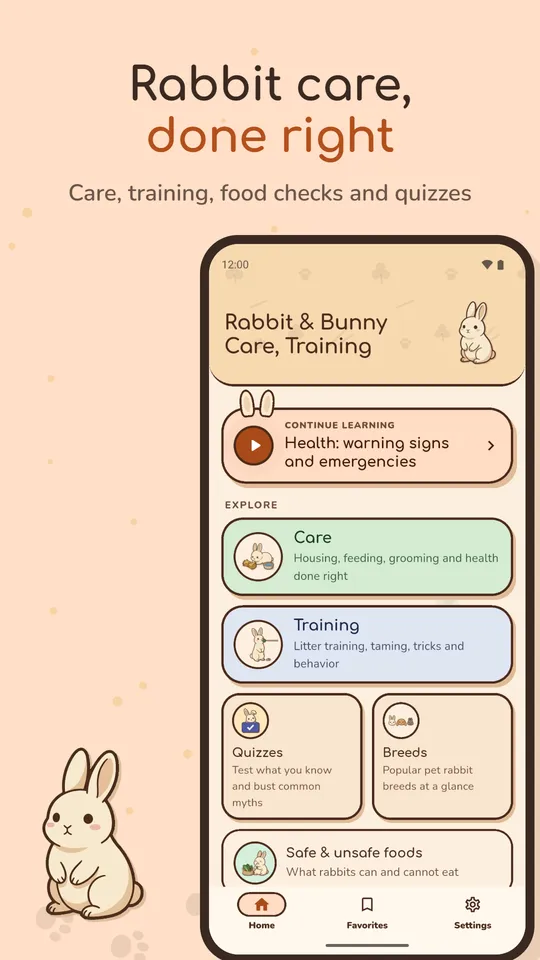
Your handbook 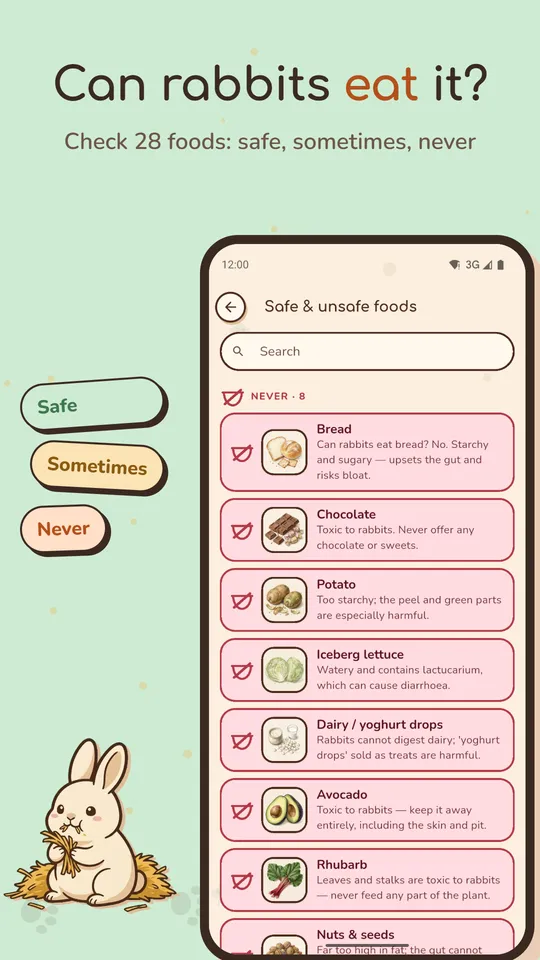
Safe or never 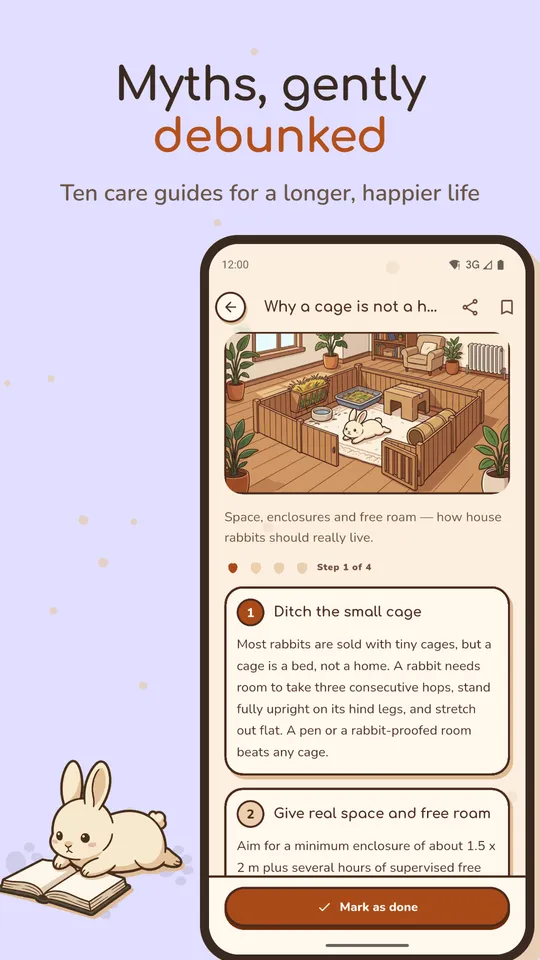
Myths, gently debunked 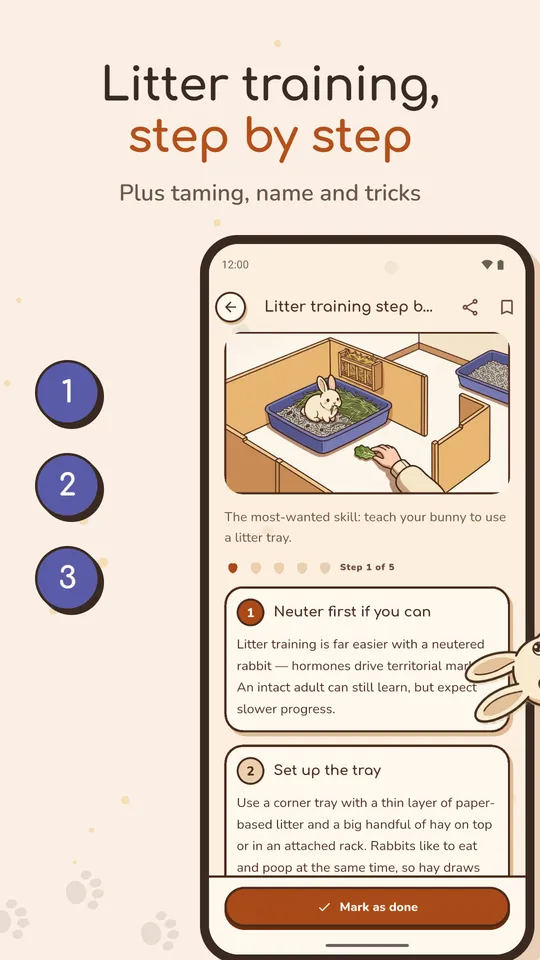
Litter training 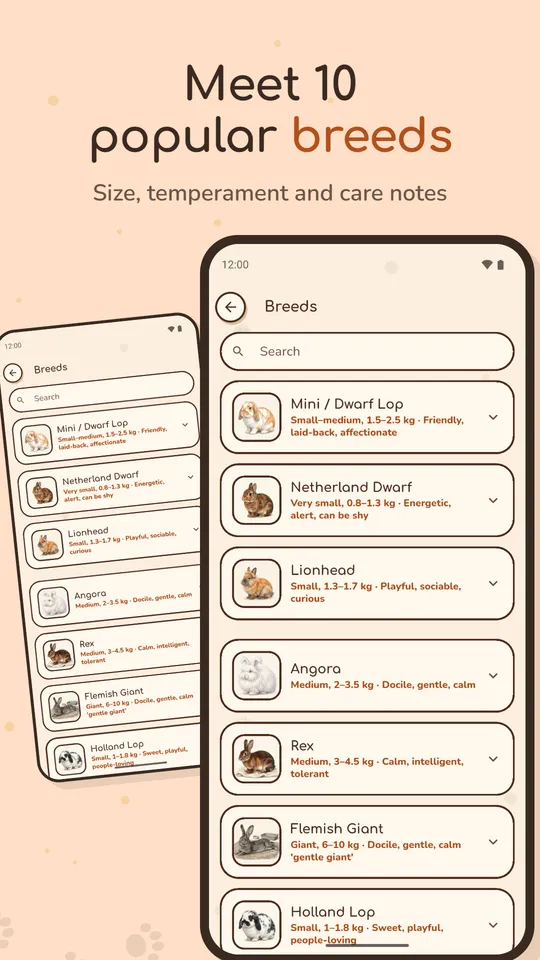
10 breeds 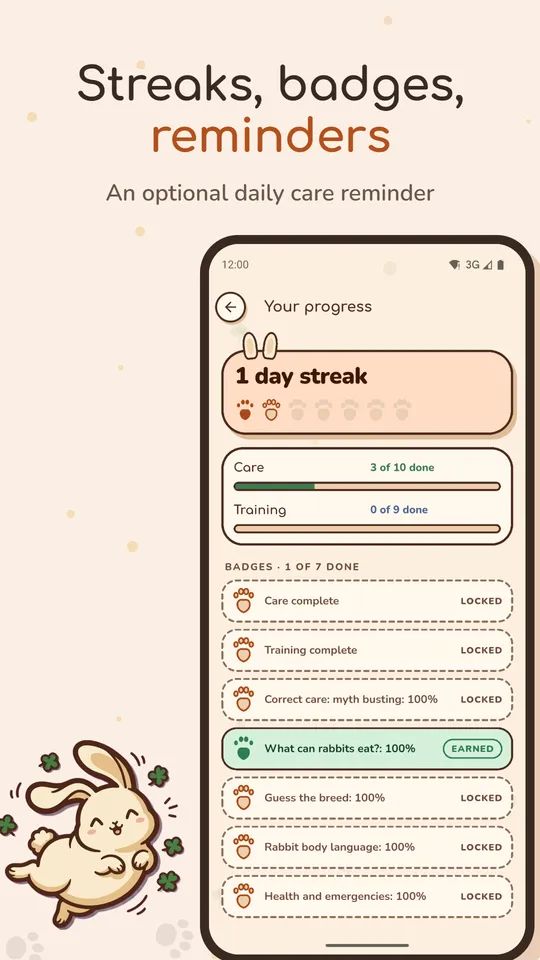
Streaks and badges
What can rabbits eat?
Mostly hay. The RSPCA and the Rabbit Welfare Association & Fund (RWAF) both give the same split: about 85% hay or grass, 10% leafy greens and 5% pellets. The House Rabbit Society (HRS) agrees on hay and pellets and adds that fruit and treats should stay under 5%. Fresh water is always available.
| Part of the diet | Share | Notes |
|---|---|---|
| Hay or grass | About 85% | Unlimited, every day. Adults do best on timothy and other grass hays. Alfalfa is for babies, nursing mothers and elderly or injured rabbits. |
| Leafy greens and vegetables | About 10% | At least three kinds a day (HRS). PDSA suggests five or six kinds for variety. Washed, and never foraged from roadsides or sprayed ground. |
| Pellets | About 5% | Fresh, high-fiber, timothy-based pellets (HRS: at least 18% fiber). Skip mixes with nuts, seeds or grains. |
| Fruit and treats | Under 5% | All fruit counts as a treat because of its sugar. HRS: a very small amount once or twice a week. |
Sources: RSPCA, RWAF, HRS diet, PDSA. The checker above gives a verdict for 57 common foods. If no source covers a food, the checker leaves it out and gives no verdict.
How much hay, greens and pellets does a rabbit need a day?
Hay has no limit: give a fresh bundle at least as big as the rabbit every day, and keep it topped up. Pellets are the part that needs measuring, and the sources differ a little: RWAF suggests 15 g per kg of body weight, the RSPCA 25 g (about an egg cup), and PDSA one tablespoon a day, or two for a rabbit over 3.5 kg. For vegetables, HRS gives 1 to 2 cups for every 4 lb of body weight. The table works these out for a healthy adult.
| Rabbit weight | Pellets per day | Greens and vegetables per day |
|---|---|---|
| 1 kg (2.2 lb) | 15 to 25 g, or 1 tablespoon | 0.5 to 1 cups |
| 2 kg (4.4 lb) | 30 to 50 g, or 1 tablespoon | 1 to 2.25 cups |
| 3 kg (6.6 lb) | 45 to 75 g, or 1 tablespoon | 1.75 to 3.25 cups |
| 5 kg (11 lb) | 75 to 125 g, or 2 tablespoons | 2.75 to 5.5 cups |
These are for a healthy adult. The RSPCA notes that growing, pregnant, nursing or underweight rabbits may need larger portions, and overweight rabbits may need fewer pellets (HRS). Too many pellets means less hay eaten, which PDSA links to overgrown teeth and gut stasis. If you are unsure, ask an exotics vet to weigh your rabbit and set the amounts.
Foods rabbits should never eat
The RSPCA warns that many of these are toxic, from mild problems such as excess gas to life-threatening conditions. If your rabbit has eaten any of them, call an exotics vet. The table gives each source’s reason. Where a source only lists the food as unsafe, the table says that.
| Food | What the sources say | Sources |
|---|---|---|
| Bread | HRS lists bread among processed human foods that are especially dangerous for a rabbit's delicate digestive system. The RSPCA also lists bread as unsafe. | HRS nutrition, RSPCA |
| Pasta, cereal, crackers and cookies | HRS lists cookies, crackers, breakfast cereals and pasta among processed human foods that are especially dangerous for rabbits. The RSPCA lists cereals and pasta as unsafe. | HRS nutrition, RSPCA |
| Chocolate | HRS calls it poisonous to most pets and the RSPCA lists it as unsafe. If a rabbit has eaten some, call an exotics vet. | HRS vegetables, HRS nutrition, RSPCA |
| Dairy, cheese and yogurt drops | HRS lists yogurt drops among the human treats to avoid and the RSPCA lists dairy products as unsafe. | HRS nutrition, RSPCA |
| Muesli-style mixes, nuts and seeds | The RSPCA says rabbits pick out the sugary bits of muesli-style mixes, which can lead to dental disease, digestive problems and obesity. HRS says to avoid gourmet pellets containing nuts, seeds or grains. | HRS nutrition, RSPCA |
| Iceberg lettuce | HRS says it is low in nutrients and high in water, and large amounts can cause diarrhea. The RSPCA also lists it as unsafe. | HRS vegetables, RSPCA |
| Onion, garlic and leek | HRS says garlic and onions are immunosuppressive. The RSPCA lists onions, leeks and garlic as unsafe. | HRS vegetables, RSPCA |
| Potato and sweet potato | HRS and the RSPCA both list potatoes as unsafe. The RSPCA names sweet potatoes too. | HRS vegetables, RSPCA |
| Avocado | Listed as unsafe by the RSPCA. | RSPCA |
| Rhubarb | Listed as unsafe by the RSPCA. | RSPCA |
| Corn and sweetcorn | HRS says rabbits cannot digest corn hulls, which can block the small intestine. The RSPCA lists sweetcorn, including dried corn, as unsafe. | HRS vegetables, RSPCA |
| Raw or dried beans | HRS says raw and dried beans are high in lectins that can damage the intestinal wall, and dried peas can cause a blockage. The RSPCA lists broad and kidney beans as unsafe. | HRS vegetables, RSPCA |
| Mushrooms | Listed as unsafe by the RSPCA. | RSPCA |
| Meat and eggs | Rabbits are plant eaters. The RSPCA lists meat and eggs as unsafe. | RSPCA |
| Chili peppers | Listed as unsafe by the RSPCA. | RSPCA |
| Tomato leaves and stems | HRS says unripe tomato fruit and the greens are toxic, and the RSPCA lists tomato leaves and stems as unsafe. | HRS vegetables, RSPCA |
| Apple pips and fruit stones | The RSPCA calls fruit seeds and pits poisonous and PDSA says apple pips are poisonous. The flesh of apples is fine as a small treat; remove the pips. | RSPCA, PDSA |
| Lawn mower clippings | PDSA and the RSPCA say clippings can make a rabbit ill. PDSA explains that mowers heat and damage the grass, so it spoils quickly and bacteria can grow. Fresh, uncut grass is not the same. | PDSA, RSPCA |
| Xylitol and caffeine | The RSPCA lists artificial sweeteners, especially xylitol, and caffeine as unsafe. | RSPCA |
| Sugary and salty human foods | The RSPCA lists processed foods and sugary or salty human foods as unsafe, and HRS calls processed human foods especially dangerous for rabbits. | RSPCA, HRS nutrition |
Can rabbits eat carrots, apples, cucumber and other treats?
Yes, in small portions. Carrots and fruit are high in sugar, and HRS puts both in the under-5% treat group. Add one new food at a time and watch the droppings: HRS says to drop any food that causes soft stools or diarrhea.
| Food | What the sources say | Sources |
|---|---|---|
| Spinach | HRS lists it as a safe green, but the RSPCA calls it an occasional green and PDSA says in moderation. Rotate it with other greens rather than feeding it every day. | HRS vegetables, RSPCA, PDSA |
| Cabbage | HRS lists red and savoy cabbage but warns that too much can cause thyroid enlargement and digestive problems. The RSPCA calls it occasional and PDSA says dark green cabbage in moderation. | HRS vegetables, RSPCA, PDSA |
| Broccoli | Listed as safe by HRS; PDSA says in moderation. Offer small amounts and watch the droppings. | HRS vegetables, PDSA |
| Cauliflower | Listed by HRS and PDSA (including leaves and stalks). HRS puts it in the small non-leafy group, about 1 tablespoon per 2 lb of rabbit. | HRS vegetables, PDSA |
| Celery | HRS lists it as high in water and says to cut it into 1 inch pieces, because strings can wrap around teeth. The RSPCA calls it occasional. | HRS vegetables, RSPCA, PDSA |
| Cucumber | Listed by HRS as safe but high in water, and by the RSPCA as an occasional treat. Not a staple. | HRS vegetables, RSPCA |
| Tomato (ripe fruit only) | HRS lists ripe tomato, high in water, in the small non-leafy group. Unripe fruit and the green parts are toxic (see tomato leaves and stems). | HRS vegetables, RSPCA |
| Bell pepper | Listed as safe by HRS and PDSA, but HRS flags it as high in sugars, so keep it small. Hot chili peppers are on the never list. | HRS vegetables, PDSA |
| Carrot | High in sugar. HRS counts carrots with the treats, to be limited to a very small amount once or twice a week, and the RSPCA calls them high in sugar and suggests the tops instead. | HRS vegetables, HRS diet, RSPCA |
| Green beans (fresh) | HRS lists fresh green beans in the small non-leafy group and the RSPCA lists them as an occasional vegetable. Raw or dried beans are different: see the never list. | HRS vegetables, RSPCA |
| Pumpkin and squash | HRS flags squash as high in sugars and PDSA lists it as a small treat. Small amounts only. | HRS vegetables, PDSA |
| Courgette (zucchini) | HRS lists it in the small non-leafy group. PDSA names the flowers, not the leaves. | HRS vegetables, PDSA |
| Apple (no pips) | A small treat. All fruit counts as a treat because of its sugar. Remove the pips, which the RSPCA and PDSA call poisonous. | HRS nutrition, RSPCA, PDSA |
| Banana | HRS says high-glycemic fruits such as bananas and grapes are occasional treats only. The RSPCA and PDSA list it as an occasional treat. | HRS nutrition, RSPCA, PDSA |
| Grapes | HRS says high-glycemic fruits such as bananas and grapes should be occasional treats only. Fruit overall stays under 5% of the diet. | HRS nutrition, HRS diet |
| Strawberries | A small treat in the RSPCA and PDSA lists. Fruit is high in sugar, so once or twice a week at most. | HRS nutrition, RSPCA, PDSA |
| Melon (including watermelon) | PDSA lists melon as a small treat and HRS counts all fruit as a sugary treat. The sources do not name watermelon separately, so treat it like any sweet fruit: a small piece, now and then. | HRS nutrition, PDSA |
| Pear | Listed by PDSA as a treat in small amounts. Fruit is high in sugar. | HRS nutrition, PDSA |
| Plum (no stone) | Listed by PDSA as a small treat. The RSPCA calls fruit seeds and pits poisonous, so remove the stone. | RSPCA, PDSA |
| Kiwi fruit | Listed by PDSA as a treat in small amounts. Fruit is high in sugar. | HRS nutrition, PDSA |
| Alfalfa hay | HRS reserves alfalfa for babies, nursing mothers and elderly or injured rabbits, because it is too high in calcium and calories for healthy adults. RWAF says it should only be fed as a treat. | HRS diet, RWAF |
Which greens can rabbits eat every day?
Leafy greens are the fresh part of the daily plate. These are listed as safe by at least one of HRS, the RSPCA and PDSA; rotate them so a rabbit gets several kinds a day.
- Romaine and other leaf lettuce. HRS vegetables, RSPCA, PDSA
- Kale. HRS vegetables, PDSA
- Spring greens. HRS vegetables, RSPCA, PDSA
- Cilantro (coriander). HRS vegetables, RSPCA, PDSA
- Parsley. HRS vegetables, PDSA
- Basil. HRS vegetables, RSPCA, PDSA
- Mint. HRS vegetables, RSPCA, PDSA
- Dill. HRS vegetables, PDSA
- Arugula (rocket). HRS vegetables, RSPCA, PDSA
- Watercress. HRS vegetables, RSPCA, PDSA
- Dandelion greens. HRS vegetables, RSPCA, PDSA
- Carrot tops. HRS vegetables, RSPCA, PDSA
- Chicory and endive. HRS vegetables, PDSA
- Bok choy (pak choi). HRS vegetables
Change the diet slowly. PDSA says to switch over 2 to 4 weeks, mixing a little of the new food into the old and increasing it each day. Moving off a muesli-style mix should take 14 to 28 days (RSPCA).
How to litter train a rabbit
Rabbits usually choose one corner for urine and most droppings, so training works with that habit instead of against it. These steps follow the House Rabbit Society.
- Watch where your rabbit already goes and put the box there. Give droppings a private spot too.
- Pick a roomy plastic box where the rabbit can turn around and stretch out. Avoid metal or wire bottoms. A low entry helps older or disabled rabbits.
- Use safe litter in a thin layer: paper-based pellets, compressed paper or wood pulp pellets, or wheat or grass based litter. Avoid clay or clumping cat litter, pine or cedar shavings, and corn cob or walnut shell litter.
- Put hay at one end of the box or just outside it. Rabbits like to eat while they go, which keeps them coming back.
- Spay or neuter. HRS says unfixed rabbits become territorial after puberty (3 to 6 months) and that fixing makes good litter habits much more likely.
- Clean accidents with white vinegar and water or a pet-safe enzymatic cleaner. Soap and water alone does not remove the traces of urine.
A few stray droppings are normal, because rabbits use them to mark territory. If a rabbit has too much room too soon, limit its space and build up again. If it ignores the box in one spot, add a second box there. If the habits change suddenly, think of stress, a new pet or person, or moved furniture. If nothing explains it, especially with dribbling, see a rabbit-savvy vet about a possible urinary tract infection.
Rabbit body language: what thumping, binkies and ear positions mean
One sign rarely tells the whole story, so read the ears, the body and the situation together. Meanings below follow the RSPCA.
| Sign | Usually means |
|---|---|
| Binky (a leap with a twist, all four paws off the ground) | Strong happiness. |
| Flopping on the side | A relaxed posture. |
| Quiet, gentle tooth grinding | Contentment, a soft sound a bit like a cat's purr. |
| Loud tooth grinding | Can mean pain. Call a vet. |
| Ears together and pointing up | Likely relaxed. Ears resting back can also be relaxed, but only if the rest of the body is calm. |
| Ears pressed tightly or flat against the back | Stress or worry. Look at the rest of the body for context. |
| Ears forward and fixed on one spot | High alert. |
| Thumping | Usually a warning about a possible threat. It can also mean fear, feeling unsettled or frustration with you (a grump thump). |
| Standing up and batting with the front paws, sometimes with a growl | Feeling threatened or frustrated (bunny boxing). |
| A gentle nip | May be an invitation to groom you or a request for attention, and it can also be a warning that the rabbit wants space. |
| Digging | Natural and linked to comfort. Being unable to dig can cause high stress. |
| Over-grooming or circling the enclosure | Can be a way of coping with anxiety or stress. |
When a rabbit stops eating or pooping: an emergency
HRS says that if a rabbit stops eating or producing droppings for 12 hours or more, treat it as an emergency and get the rabbit to a rabbit-savvy vet immediately. Signs of gut stasis include very small or no droppings, small droppings coated in mucus, very loud gurgles or silence from the gut, and a rabbit that is lethargic, has no appetite or hunches in a ball. Do not try home treatments or medicines without a vet.
Find an exotics or rabbit-experienced vet before you need one, because many emergency clinics do not see rabbits.
Housing, company and grooming: why a cage is not a home
- Space. The RSPCA minimum for two medium-sized rabbits is 3 m x 2 m x 1 m including shelter and exercise area, and each part must let them stand upright, stretch out and turn around. A small traditional hutch should never be a rabbit’s only home, and the exercise area should be attached and open at all times.
- Company. The RSPCA says rabbits need the company of another suitable rabbit, with enough room to be together and apart.
- Bathing. Do not. HRS says even an occasional bath is quite stressful and not recommended.
- Shedding. Rabbits shed about every three months, a light shed followed by a heavy one. HRS suggests weekly brushing, and more often during a heavy shed.
- Nails. Check them every 6 to 8 weeks and trim when overgrown.
Sources
Everything above comes from these pages, read on 23 October 2026. Guidance varies a little between organisations, so the page names the source wherever it matters. None of it replaces a vet who has examined your rabbit.
- House Rabbit Society: Vegetables and greens
- House Rabbit Society: Diet FAQ
- House Rabbit Society: Rabbit diet and nutrition
- RSPCA: What do rabbits eat?
- PDSA: The ideal diet for rabbits
- Rabbit Welfare Association & Fund: What to feed pet rabbits
- House Rabbit Society: Litter training
- House Rabbit Society: GI stasis
- House Rabbit Society: Grooming
- RSPCA: Rabbit behaviour
- RSPCA: Rabbit environment
Questions
What can rabbits eat every day?
Unlimited grass hay, a measured portion of timothy-based pellets and fresh leafy greens in at least three kinds. Hay is about 85% of the diet. Fruit and treats stay under 5%.
Can rabbits eat carrots?
Only as a small treat. Carrots are high in sugar, and the House Rabbit Society limits them to a very small amount once or twice a week. The leafy tops are a better daily choice.
Can rabbits eat bread?
No. The House Rabbit Society and the RSPCA both list bread among the processed human foods rabbits should not have, because it is hard on their delicate digestive system.
Can rabbits eat cucumber?
Yes, as an occasional treat. It is high in water and not a staple, so offer a few slices now and then next to hay and leafy greens rather than instead of them.
How much hay does a rabbit need a day?
As much as it wants. Give a fresh bundle at least as big as the rabbit every day and keep it topped up, because hay is about 85% of the diet and wears down teeth.
How do you litter train a rabbit?
Put a roomy plastic box where the rabbit already goes, add safe paper-based litter and hay at one end, and have the rabbit neutered. Clean accidents with white vinegar and water.
When should I call a vet about my rabbit's eating?
At once. The House Rabbit Society treats a rabbit that has stopped eating or producing droppings for 12 hours or more as an emergency. Take it to a rabbit-savvy vet immediately.
Is the app free, and is it a replacement for a vet?
It is free with ads, needs no account, works offline and comes in 90+ languages. It is an educational guide and not a substitute for a vet who has examined your rabbit.

Get rabbit care right from the start
Free on Android, in 90+ languages. No account, works offline. Educational only, not a substitute for a vet: if your rabbit stops eating or pooping, call a vet right away.
Facts from the Google Play listing, last checked .