J1939 fault code lookup: what the SPN and FMI mean, and what to check first
Type the code your dash or scan tool shows, like SPN 3226 FMI 2, or paste the four raw bytes, and the lookup below says what the parameter is, what the failure mode means, the likely causes and what to check first. It is a reference, not a scan tool. The free Android app holds over 8,000 codes, offline.
Fault code lookup
Type the code your dash or scan tool shows. 196 common J1939 parameters, all 32 failure mode slots, nothing uploaded.
Read the code, then the answer
Type an SPN with its FMI, paste the four bytes of a trouble code, or search by what you can see: coolant, oil, boost, dpf, def.
Browse the 196 parameters
A reference, not a scan tool: it never connects to your truck. Causes and checks are a general first-look order, not a manufacturer procedure. Follow the manufacturer's documentation, especially when a warning lamp says to stop.
Over 8,000 codes in your pocket, offline
The lookup on this page carries the common parameters. The Android app is the full reference for drivers, owner-operators and diesel technicians, and it works in a yard or on the hard shoulder with one bar of signal:
- 8000+ J1939 SPN entries with causes and check-first steps
- All 32 J1939 failure modes (FMI) and the 16-mode J1587 table
- J1587 and J1708 lookup by MID and PID, or SID and FMI, for older trucks
- Raw DTC byte decoder: four bytes to SPN, FMI and occurrence count
- PGN reference, including DM1 active and DM2 stored codes, and source addresses
- Dash lamp meanings: amber, red, MIL and protect
- Symptom-first search: white smoke, no start, derate, DPF, DEF
- Guides on derates, DPF regeneration, DEF, AdBlue and SCR, and active versus stored codes

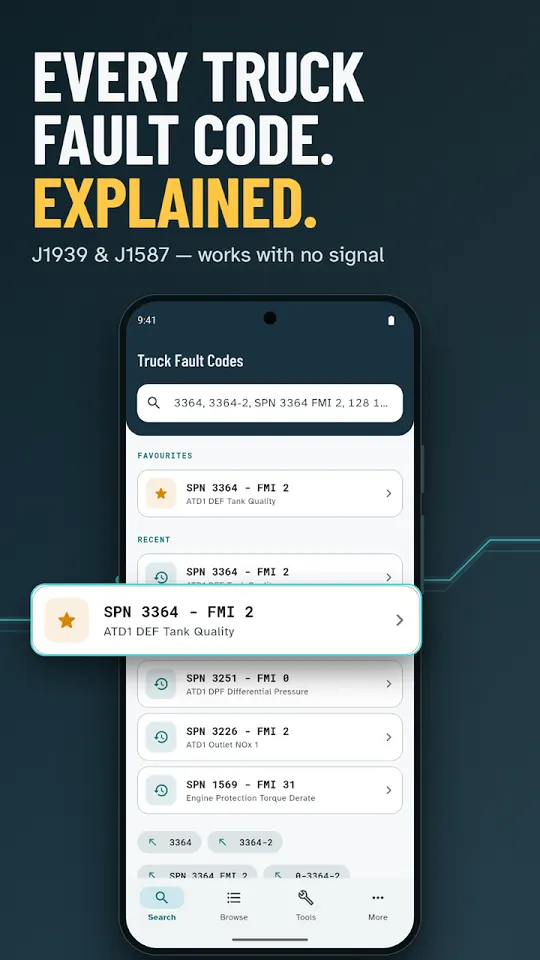
Search by SPN, FMI, PID or SID 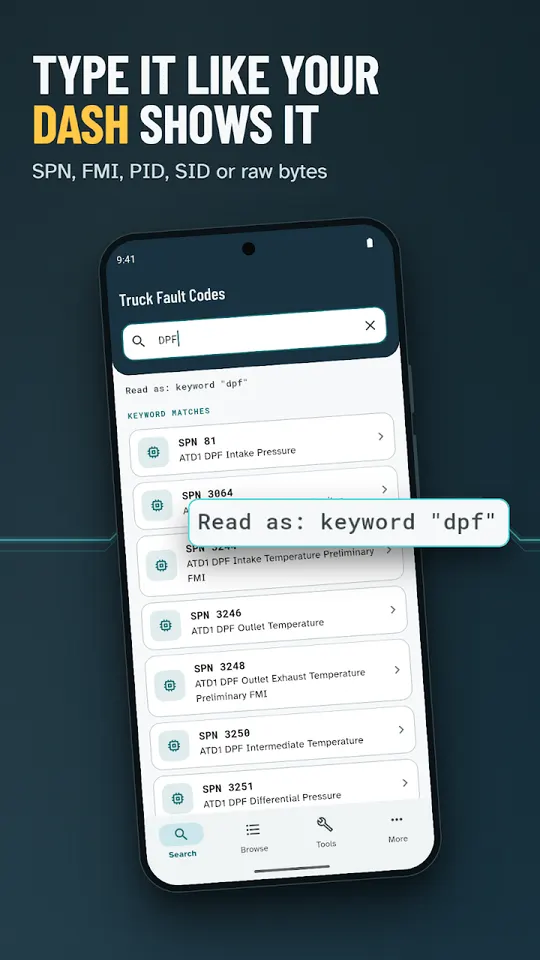
Type it like your dash shows it 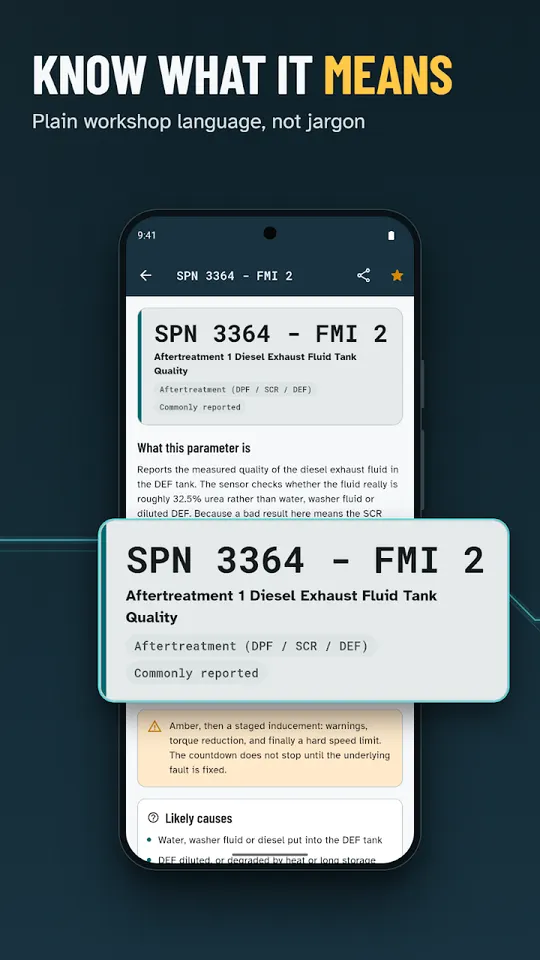
What the code means 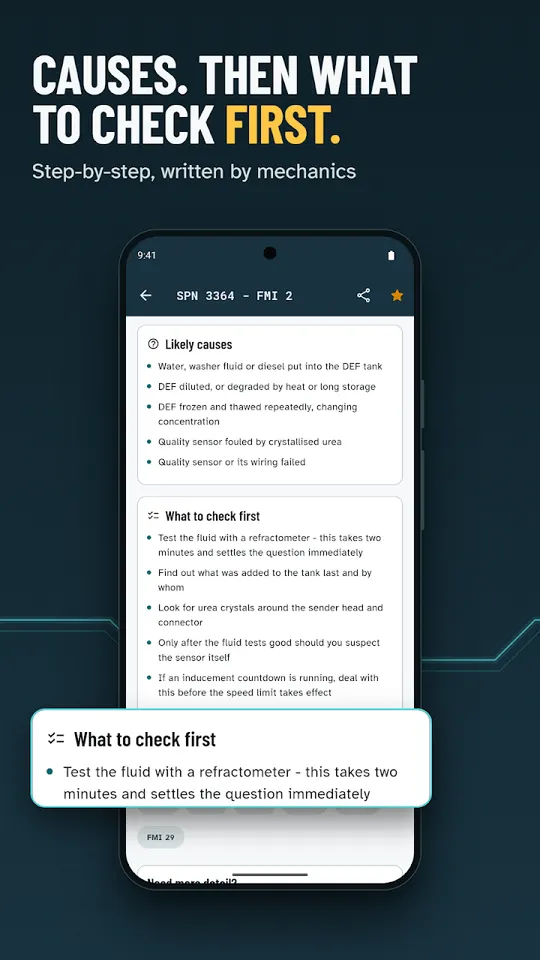
Causes, then what to check first 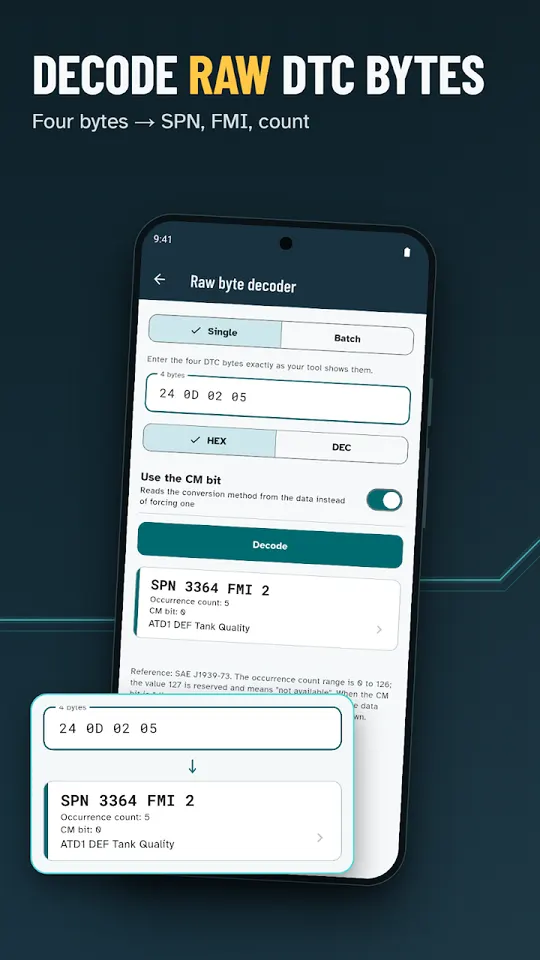
Decode raw DTC bytes 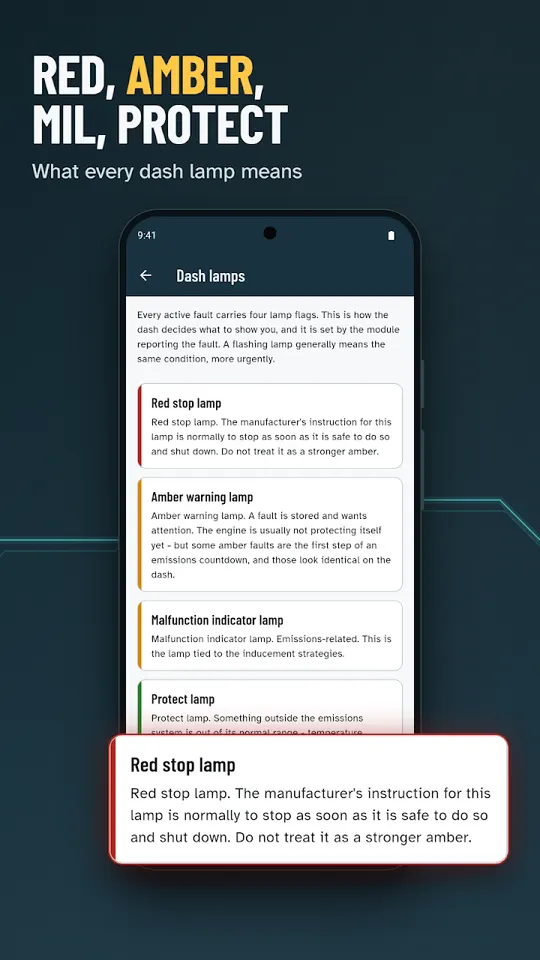
Red, amber, MIL and protect 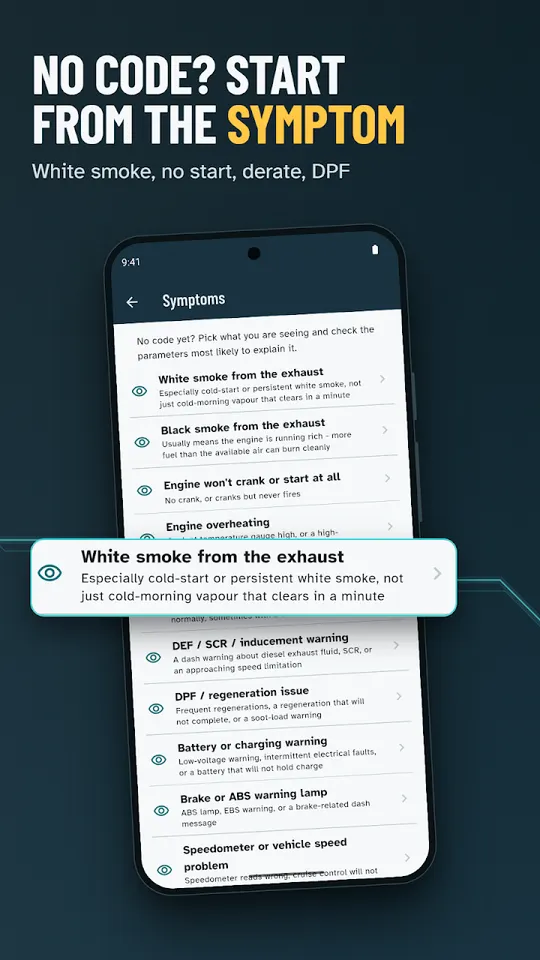
No code? Start from the symptom 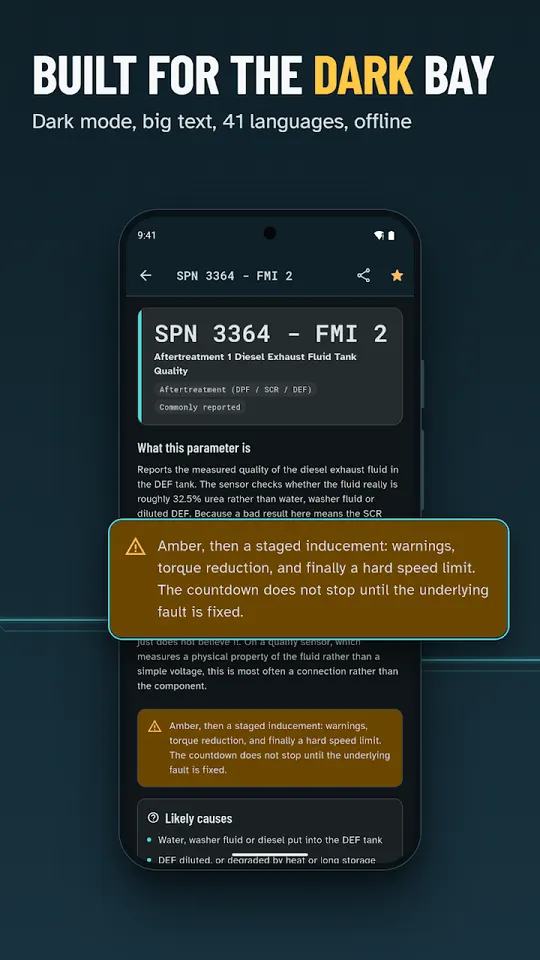
Built for the dark bay
What is an SPN on a truck fault code?
SPN stands for suspect parameter number. It names the thing that is faulty: SPN 110 is the engine coolant temperature, SPN 100 the engine oil pressure, SPN 190 the engine speed and SPN 3226 the outlet NOx sensor. Heavy-duty trucks, buses and many diesel engines report faults on a data link called J1939, and every parameter on that link has its own SPN.
The SPN only says what. The failure mode identifier, the FMI, says how it failed. A code is always the pair, so write it down as one: SPN 110 FMI 0 means the coolant temperature is above its most severe limit, and SPN 110 FMI 3 means the coolant temperature sensor circuit reads high. Same part, very different job.
What does an FMI mean? The full failure mode table
The FMI is a number from 0 to 31. This page lists the modes it knows: 0 to 21 and 31. The wording below is our own plain version of the table that SAE J1939-73 defines, checked against the CODESYS J1939 documentation. Engine makers sometimes add meanings of their own, so a code can carry a manufacturer note on top.
| FMI | Name | What it means |
|---|---|---|
| 0 | Above normal, most severe | The reading is valid, but it is above the most severe upper limit the module allows. |
| 1 | Below normal, most severe | The reading is valid, but it is below the most severe lower limit the module allows. |
| 2 | Erratic, intermittent or incorrect | The value jumps around, changes at rates that are not possible, or comes and goes. This points at the measuring device or its connection. |
| 3 | Voltage above normal, or shorted high | The signal voltage is out of range on the high side, or a signal that should be low is stuck high. |
| 4 | Voltage below normal, or shorted low | The signal voltage is out of range on the low side, or a signal that should be high is stuck low. |
| 5 | Current below normal, or open circuit | Too little current is flowing, or the circuit is open: it stays off when the module commands it on. |
| 6 | Current above normal, or grounded circuit | Too much current is flowing, or the circuit is shorted to ground: it stays on when the module commands it off. |
| 7 | Mechanical system not responding | A mechanical adjustment or response is wrong, and it is not an electrical failure. |
| 8 | Abnormal frequency, pulse width or period | The frequency, duty cycle or pulse width is outside its limits or does not fit what the module is outputting. |
| 9 | Abnormal update rate | The data is not being sent or received as often as it should be. |
| 10 | Abnormal rate of change | The data is valid but changes faster than the allowed limits. |
| 11 | Root cause not known | The module has found a failure in a subsystem but cannot say exactly what kind. |
| 12 | Bad intelligent device or component | An internal failure in a controller that calls for replacing the module. The communication system is not what failed. |
| 13 | Out of calibration | The fault comes from a wrong or outdated calibration, including a mechanical subsystem that is out of calibration. |
| 14 | Special instructions | The fault is narrowed to a few possibilities, and the technician has to follow the manufacturer's instructions to finish the diagnosis. |
| 15 | Above normal, least severe | The reading is valid and above normal, judged against the least severe limits. |
| 16 | Above normal, moderately severe | The reading is valid and above normal, judged against the moderately severe limits. |
| 17 | Below normal, least severe | The reading is valid and below normal, judged against the least severe limits. |
| 18 | Below normal, moderately severe | The reading is valid and below normal, judged against the moderately severe limits. |
| 19 | Received network data in error | Data received over the network carries an error flag, so the module that sent it has the problem. |
| 20 | Data drifted high | The value is in range but does not agree with other measurements, which suggests it has drifted high. |
| 21 | Data drifted low | The value is in range but does not agree with other measurements, which suggests it has drifted low. |
| 31 | Condition exists | The condition named by the parameter exists and no other failure mode fits. It is also the value that means "not available" when a parameter is unavailable. |
The range modes come in three strengths: 0 and 1 are the most severe limits, 16 and 18 the moderately severe ones, and 15 and 17 the least severe. A truck can raise a warning at the mild level long before the severe one.
How do you read a J1939 fault code?
Take the parameter first, then the failure mode, then the lamp.
- Find the SPN. Look it up by number. If the name is not enough, read what the parameter measures.
- Read the FMI. It tells you whether the reading is out of range, the wiring is open or shorted, the part is stuck or the data is missing.
- Check the lamp. The lamp the module lights is the real instruction. Red means stop.
- Note whether it is active or stored and how many times it has set.
Worked example: SPN 3226 FMI 2
Aftertreatment outlet NOx sensor. FMI 2 is erratic or intermittent data. The value jumps around, changes at rates that are not possible, or comes and goes. This points at the measuring device or its connection. So the question is whether the sensor is failing or the connection to it is. The page's check list starts with: Look for exhaust leaks near the sensor.
Worked example: SPN 110 FMI 0
Engine coolant temperature, above the most severe limit. The reading is valid, but it is above the most severe upper limit the module allows. FMI 0 on a protection parameter is usually a real overheat, so confirm it with a gauge, look at coolant level, the fan and airflow through the radiator, and treat a red stop lamp as an order to stop.
How do four bytes become an SPN and an FMI?
Some tools show a trouble code as four raw bytes. The layout is fixed. The first two bytes hold the low 16 bits of the SPN, the top three bits of the third byte hold the high three bits of the SPN, and its lower five bits are the FMI. The fourth byte holds a conversion bit and a seven-bit occurrence count. The page reads the bytes this way, as implemented in the python-can-j1939 library.
| Byte | Holds |
|---|---|
| 1 | SPN, bits 0 to 7 |
| 2 | SPN, bits 8 to 15 |
| 3 | Bits 7 to 5: SPN, bits 16 to 18. Bits 4 to 0: FMI |
| 4 | Bit 7: conversion method. Bits 6 to 0: occurrence count |
Worked example with the bytes 24 0D 02 05: bytes 1 and 2 give 0x0D24, which is 3,364. Byte 3 is 0x02, so the high SPN bits are 0 and the FMI is 2. Byte 4 is 0x05, so the conversion bit is 0 and the code has set 5 times. That is SPN 3364 FMI 2: Aftertreatment diesel exhaust fluid quality. Paste the same bytes into the lookup above to check it.
An occurrence count of 127 means not available. A conversion bit of 1 belongs to older layouts, so check the SPN against the one your tool shows.
What do the common FMIs 0, 1, 2, 3, 4, 5, 7 and 9 usually mean?
| FMI | Usually | Try first |
|---|---|---|
| 0 | A real over-limit reading: overheating, over-pressure, overspeed. | Confirm the condition with a gauge before touching the sensor. |
| 1 | A real under-limit reading: lost oil pressure, low coolant, an empty DEF tank. | Check the level or pressure by hand, then the sensor. |
| 2 | A signal that jumps or drops out: a chafed wire, a loose pin, a drifting sensor. | Wiggle the harness and connector while you watch the live value. |
| 3 | A signal voltage that is too high: a short to a voltage source or a broken return wire. | Check the ground and return wire, then look for a rubbed-through harness. |
| 4 | A signal voltage that is too low: a signal wire shorted to ground. | Look for insulation rubbed through against metal, and for water in the connector. |
| 5 | An open circuit: a broken wire or an unseated connector. | Reseat and inspect the connector, then test continuity. |
| 7 | A mechanical part that is not responding: a stuck actuator or valve. | Check that the part moves freely before testing the wiring. |
| 9 | Data not arriving often enough: a data link or module problem. | Check battery voltage and grounds, then the data link wiring. |
The first-look order here is general. It is meant to save you from replacing a good sensor for a bad connector, and it does not replace the manufacturer's procedure.
What do the red, amber, MIL and protect lamps mean?
- Red stop lamp. The control module has found a fault that could damage the engine or compromise safety. Pull over when it is safe, shut down and get help. Do not keep driving on it.
- Amber warning lamp. A fault exists that does not call for an immediate shutdown. Finish the trip, then get it diagnosed. A fault left alone can turn into a red lamp.
- Malfunction indicator lamp. An emissions-related fault. Usually not an emergency, but ignoring it can lead to a derate and compliance problems.
- Protect lamp. Engine protection is active, so the module may already be limiting power or speed. If it comes on together with the red lamp, stop at once.
The module that reports the fault sets the lamps. In the DM1 message each lamp is a two-bit field, and the fault list follows it.
What is the difference between active and stored codes?
Active codes are the faults the module is reporting right now, in the DM1 message, and the lamps follow them. Stored codes, in DM2, are faults that have gone away but were logged. They are the way to catch an intermittent fault. Write down both lists before you clear anything: clearing resets the occurrence count and wipes the history you would use to find the cause.
What do DEF, SCR and DPF fault codes mean, and will the truck derate?
The aftertreatment system cleans the exhaust. The DPF traps soot, the SCR uses DEF, a urea solution also sold as AdBlue, to cut NOx, and the NOx sensors check that it works. Codes for DEF level, DEF quality, dosing and the NOx sensors can lead to a derate if they are left: the control module limits torque first and speed after that. Fix the cause, because the countdown does not stop until the fault is gone.
Never delete, bypass or simulate these systems. The EPA says tampering with a vehicle's emission controls, including removing EGR, DPF or SCR parts or altering the software, is illegal under the Clean Air Act, and the same goes for selling or fitting defeat devices.
Is J1939 different from J1587 and OBD-II codes?
Yes. J1939 codes are an SPN and an FMI. Older heavy trucks use J1587 over a J1708 cable, where a fault is a MID, a PID or SID, and an FMI. The MID says which module reports it: 128 is the first engine controller and 130 the transmission. A PID is a standard parameter, and a SID names a subsystem that has no PID. OBD-II P-codes, such as P0301, are a different system for cars and light vehicles. This page decodes J1939. The Android app also looks up J1587 codes by MID with PID or SID.
Common J1939 SPNs by system
The 196 parameters the lookup carries, from the public parameter lists named below. Descriptions of what each one means are written for this page. The app holds over 8,000.
Engine (31)
| SPN | Parameter |
|---|---|
| 92 | Engine percent load at current speed |
| 188 | Engine speed at idle |
| 190 | Engine speed (crankshaft speed and position) |
| 247 | Engine total hours of operation |
| 612 | Engine magnetic speed and position sensor |
| 626 | Start enable device 1 (ether injection) |
| 629 | Engine control module |
| 630 | Engine control module calibration memory |
| 677 | Starter relay driver circuit |
| 723 | Engine camshaft speed and position sensor |
| 1081 | Engine wait to start lamp |
| 1109 | Engine protection system approaching shutdown |
| 1136 | Engine ECU temperature |
| 1213 | Malfunction indicator lamp |
| 1267 | Idle shutdown vehicle accessories relay driver circuit |
| 1322 | Engine misfire, multiple cylinders |
| 1323 | Engine misfire cylinder 1 |
| 1324 | Engine misfire cylinder 2 |
| 1325 | Engine misfire cylinder 3 |
| 1326 | Engine misfire cylinder 4 |
| 1327 | Engine misfire cylinder 5 |
| 1328 | Engine misfire cylinder 6 |
| 1378 | Engine oil change interval |
| 1383 | Engine shut down hot |
| 1569 | Engine protection torque derate |
| 1632 | Engine torque limit feature |
| 1675 | Engine starter mode overcrank protection |
| 5357 | Engine fuel injection quantity error, multiple cylinders |
| 5395 | Engine idle fuel quantity |
| 5793 | Desired engine fueling state |
| 520435 | Glow plug module |
Fuel (30)
| SPN | Parameter |
|---|---|
| 94 | Engine fuel delivery pressure |
| 95 | Engine fuel filter differential pressure |
| 96 | Fuel level |
| 97 | Water in fuel indicator |
| 174 | Engine fuel temperature |
| 183 | Engine fuel rate |
| 185 | Engine average fuel economy |
| 633 | Electronic fuel injection control valve circuit |
| 651 | Injector solenoid driver cylinder 1 |
| 652 | Injector solenoid driver cylinder 2 |
| 653 | Injector solenoid driver cylinder 3 |
| 654 | Injector solenoid driver cylinder 4 |
| 655 | Injector solenoid driver cylinder 5 |
| 656 | Injector solenoid driver cylinder 6 |
| 657 | Injector solenoid driver cylinder 7 |
| 658 | Injector solenoid driver cylinder 8 |
| 659 | Injector solenoid driver cylinder 9 |
| 660 | Injector solenoid driver cylinder 10 |
| 661 | Injector solenoid driver cylinder 11 |
| 662 | Injector solenoid driver cylinder 12 |
| 663 | Injector solenoid driver cylinder 13 |
| 664 | Injector solenoid driver cylinder 14 |
| 665 | Injector solenoid driver cylinder 15 |
| 666 | Injector solenoid driver cylinder 16 |
| 1075 | Electric lift pump for engine fuel supply |
| 1239 | Engine fuel leakage |
| 1347 | Engine fuel pump pressurizing assembly 1 |
| 1349 | Injector metering rail 2 pressure |
| 5571 | High pressure common rail fuel pressure relief valve |
| 6301 | Water in fuel indicator 2 |
Air and boost (24)
| SPN | Parameter |
|---|---|
| 27 | EGR valve position |
| 101 | Crankcase pressure |
| 102 | Engine intake manifold 1 pressure |
| 103 | Turbocharger 1 speed |
| 105 | Engine intake manifold 1 temperature |
| 107 | Engine air filter differential pressure |
| 108 | Barometric pressure |
| 171 | Ambient air temperature |
| 411 | Exhaust gas recirculation differential pressure |
| 412 | Exhaust gas recirculation temperature |
| 641 | Variable geometry turbocharger actuator driver circuit |
| 649 | Engine exhaust back pressure regulator control circuit |
| 729 | Engine intake air heater 1 |
| 1127 | Engine turbocharger 1 boost pressure |
| 1172 | Turbocharger 1 compressor intake temperature |
| 1176 | Turbocharger 1 compressor intake pressure |
| 1209 | Exhaust gas pressure 1 |
| 2630 | Engine charge air cooler outlet temperature |
| 2633 | Engine variable geometry turbocharger nozzle position |
| 2789 | Turbocharger turbine intake temperature |
| 2791 | EGR valve control circuit |
| 3667 | Engine air shutoff circuit |
| 5019 | Engine exhaust gas recirculation outlet pressure |
| 5838 | EGR valve malfunction |
Cooling (7)
| SPN | Parameter |
|---|---|
| 109 | Engine coolant pressure |
| 110 | Engine coolant temperature |
| 111 | Engine coolant level |
| 647 | Fan control circuit |
| 1639 | Fan speed |
| 3060 | Engine cooling system monitor |
| 5484 | Engine fan clutch 2 control circuit |
Oil (5)
| SPN | Parameter |
|---|---|
| 98 | Engine oil level |
| 100 | Engine oil pressure |
| 104 | Engine turbocharger lube oil pressure |
| 175 | Engine oil temperature |
| 969 | Engine oil filter differential pressure |
DPF, SCR, DEF (57)
| SPN | Parameter |
|---|---|
| 81 | Diesel particulate filter intake pressure |
| 1761 | Aftertreatment diesel exhaust fluid tank level |
| 3031 | Aftertreatment diesel exhaust fluid tank temperature |
| 3216 | Aftertreatment intake NOx sensor |
| 3217 | Aftertreatment intake oxygen sensor |
| 3218 | Aftertreatment intake NOx sensor power supply |
| 3226 | Aftertreatment outlet NOx sensor |
| 3227 | Aftertreatment outlet oxygen sensor |
| 3228 | Aftertreatment outlet NOx sensor power supply |
| 3242 | Diesel particulate filter intake temperature |
| 3246 | Diesel particulate filter outlet temperature |
| 3249 | Aftertreatment exhaust gas temperature 2 |
| 3251 | Diesel particulate filter differential pressure |
| 3361 | Aftertreatment diesel exhaust fluid dosing unit |
| 3362 | Aftertreatment diesel exhaust fluid dosing unit input lines |
| 3363 | Aftertreatment diesel exhaust fluid tank heater |
| 3364 | Aftertreatment diesel exhaust fluid quality |
| 3521 | Aftertreatment diesel exhaust fluid property |
| 3556 | Aftertreatment doser |
| 3610 | Diesel particulate filter outlet pressure |
| 3695 | Aftertreatment regeneration inhibit switch |
| 3703 | Particulate trap active regeneration inhibit switch |
| 3713 | Diesel particulate filter active regeneration inhibited (system timeout) |
| 3750 | Diesel particulate filter conditions not met for active regeneration |
| 3826 | Aftertreatment diesel exhaust fluid average consumption |
| 3936 | Diesel particulate filter system |
| 4094 | NOx limits exceeded due to insufficient reagent quality |
| 4096 | Aftertreatment diesel exhaust fluid tank empty |
| 4331 | Aftertreatment SCR actual dosing reagent quantity |
| 4334 | Aftertreatment diesel exhaust fluid pressure sensor |
| 4337 | Aftertreatment diesel exhaust fluid dosing temperature sensor |
| 4340 | Aftertreatment diesel exhaust fluid line heater 1 |
| 4342 | Aftertreatment diesel exhaust fluid line heater 2 |
| 4344 | Aftertreatment diesel exhaust fluid line heater 3 |
| 4360 | Aftertreatment SCR intake temperature |
| 4363 | Aftertreatment SCR outlet temperature |
| 4364 | Aftertreatment SCR catalyst conversion efficiency |
| 4376 | Aftertreatment diesel exhaust fluid return valve |
| 4765 | Diesel oxidation catalyst intake temperature |
| 4766 | Diesel oxidation catalyst outlet temperature |
| 4792 | Aftertreatment SCR catalyst system |
| 5018 | Diesel oxidation catalyst face plugged |
| 5024 | Aftertreatment intake NOx sensor heater |
| 5031 | Aftertreatment outlet NOx sensor heater |
| 5245 | Aftertreatment SCR operator inducement active |
| 5246 | Aftertreatment SCR operator inducement |
| 5298 | Diesel oxidation catalyst conversion efficiency |
| 5319 | Diesel particulate filter incomplete regeneration |
| 5394 | Aftertreatment diesel exhaust fluid dosing valve |
| 5397 | Diesel particulate filter regeneration too frequent |
| 5741 | Aftertreatment outlet soot sensor |
| 5839 | Diesel exhaust fluid consumption malfunction |
| 5840 | Diesel exhaust fluid dosing malfunction |
| 5841 | Diesel exhaust fluid quality malfunction |
| 5842 | SCR monitoring system malfunction |
| 6802 | Aftertreatment diesel exhaust fluid dosing system frozen |
| 6881 | SCR operator inducement override switch |
Electrical (12)
| SPN | Parameter |
|---|---|
| 168 | Battery 1 voltage |
| 1800 | Battery temperature |
| 3353 | Alternator 1 status |
| 3509 | Sensor supply 1 |
| 3510 | Sensor supply 2 |
| 3511 | Sensor supply 3 |
| 3512 | Sensor supply 4 |
| 3513 | Sensor supply 5 |
| 3514 | Sensor supply 6 |
| 3597 | Injector power supply and ECU power output supply voltage 1 |
| 5125 | Sensor supply 7 |
| 6655 | Maintain ECU power lamp |
Pedals and speed (13)
| SPN | Parameter |
|---|---|
| 84 | Wheel-based vehicle speed |
| 91 | Accelerator pedal position sensor 1 |
| 237 | Vehicle identification number |
| 251 | Real time clock |
| 521 | Brake pedal position |
| 558 | Accelerator pedal idle validation switch |
| 596 | Cruise control enable switch |
| 597 | Brake switch circuit |
| 599 | Cruise control set switch |
| 974 | Remote accelerator pedal position sensor 1 |
| 1590 | Adaptive cruise control mode |
| 1623 | Tachograph output shaft speed |
| 2623 | Accelerator pedal position sensor 2 |
Brakes and gearbox (9)
| SPN | Parameter |
|---|---|
| 127 | Transmission oil pressure |
| 177 | Transmission oil temperature |
| 191 | Transmission output shaft speed |
| 563 | Anti-lock braking (ABS) controller |
| 748 | Transmission output retarder |
| 1072 | Engine brake actuator driver 1 |
| 1073 | Engine brake actuator driver output 2 |
| 1112 | Engine brake actuator driver 3 |
| 1818 | Roll over protection brake control active |
Modules and network (8)
| SPN | Parameter |
|---|---|
| 625 | Proprietary datalink (OEM or vehicle) |
| 639 | J1939 multiplexing and datalink |
| 1194 | Anti-theft encryption seed |
| 1195 | Antitheft password valid indicator |
| 1231 | J1939 network 2 |
| 1235 | J1939 network 3 |
| 1563 | Control module identification input state error |
| 1668 | J1939 network 4 |
What the Android app adds
The lookup here covers the common parameters. The app, Truck Fault Codes: J1939 SPN, is the full offline reference:
- Over 8,000 J1939 SPN entries with causes and check-first steps.
- All 32 J1939 failure modes and the 16-mode J1587 table.
- J1587 and J1708 lookup by MID with PID, or SID with FMI, for older trucks.
- A raw DTC byte decoder, for one code or a batch.
- PGN reference including DM1 active and DM2 stored codes, and source addresses.
- Dash lamp meanings and a symptom-first search: white smoke, no start, derate, DPF, DEF.
- Guides on derates, DPF regeneration, DEF, AdBlue and SCR, and active versus stored codes.
- Adjustable text size and a bold contrast mode, and 40+ languages.
Honest notes
- Neither this page nor the app is a scan tool. They do not connect to your truck, read the ECU or clear anything. You enter the code your dash or scan tool gave you.
- The causes and checks are a general first-look order. For the exact test values, follow the manufacturer's documentation, especially when a lamp says to stop.
- It is an independent reference. It is not affiliated with, endorsed by or sponsored by any vehicle or engine manufacturer. Brand names are used only to say what it works with.
- Parameters outside the page's set show the failure mode only, not a made-up meaning.
Working on the wiring? The voltage drop and wire size calculator and Ohm's law calculator help with the circuit checks.
Sources
- CODESYS J1939 library documentation, FMI (ENUM): the failure modes 0 to 21 and 31.
- Kato Works, Cummins SPN and FMI fault code table and Garmin, J1939 information: SPN numbers and parameter names.
- python-can-j1939, diagnostic messages source: the trouble code byte layout and the lamp fields.
- Heavy Vehicle Inspection, J1939 fault codes: SPN and FMI explained: dash lamps, active and stored codes, derates and the occurrence count.
- Wikipedia, SAE J1939: what J1939, PGNs and SPNs are.
- Kvaser, Introduction to SAE J1587: MID, PID and SID.
- Clean Air Northeast (EPA funded), Tampering and Aftermarket Defeat Devices: emission control tampering is illegal, page updated September 15, 2025.
Questions
What does SPN mean on a truck fault code?
Suspect parameter number. It names the part or value that is faulty: SPN 110 is the engine coolant temperature, SPN 100 the engine oil pressure and SPN 190 the engine speed. The FMI that comes with it says how it failed.
What does FMI mean in a J1939 code?
Failure mode identifier, a number from 0 to 31 that says how the parameter failed: out of range high or low (0, 1, 15 to 18), an erratic signal (2), voltage too high or low (3, 4), an open or shorted circuit (5, 6), a mechanical fault (7), missing data (9) and others.
What does SPN 3226 mean?
The outlet NOx sensor of the aftertreatment system. FMI 2 means its data is erratic or intermittent, so check the sensor connector and wiring and look for exhaust leaks near the sensor, and check DEF quality and dosing, before you replace it.
Can I keep driving with a fault code?
The dash lamp decides. A red stop lamp means pull over when it is safe and shut down. An amber lamp means finish the trip and get it diagnosed. A protect lamp together with a red one means stop at once.
How do I read a J1939 trouble code that is four bytes?
The first two bytes are the low 16 bits of the SPN, the top three bits of byte 3 are the high bits of the SPN, the low five bits of byte 3 are the FMI, and byte 4 holds a conversion bit and the occurrence count. 24 0D 02 05 is SPN 3364, FMI 2, seen 5 times. Paste bytes into the lookup to check.
Will a DEF or SCR fault derate the truck?
It can. If a DEF, NOx or SCR fault is left, the control module limits torque and then speed. Fix the cause. Removing or bypassing the system is not an option: the EPA says tampering with emission controls is illegal under the Clean Air Act.
Can this page read or clear codes from my truck?
No. It is a reference: you type in the code your dash or scan tool shows. Neither the page nor the app connects to the truck, reads the ECU or clears anything. Write down active and stored codes before you clear them with a scan tool.
Is the Truck Fault Codes app free and offline?
Yes. It is free with ads, needs no account and works with no signal. Everything is on the phone.

Keep the code book in the cab
Free on Android, with no account and no sign-in. It never connects to your truck, so it cannot read or clear codes: you type in what the dash shows.
Facts from the Google Play listing, last checked .