Chicken egg incubation calendar: candling, lockdown and hatch day
Enter the date and time your eggs went in and the calendar below lists every date that matters: the candling days, the day to stop turning and the hatch window, with the temperature and humidity for each phase. It covers chicken, duck, Muscovy, goose, turkey, guinea fowl, pheasant and quail, keeps your batches on this device and adds the dates to your phone calendar. The free Android app also logs eggs, temperature and hatch rates and sends reminders.
Warming up the incubator…
The calendar, the egg log and the reminders in one app
This page plans one batch at a time. The Android app keeps every batch and every hen, reminds you only on the days that matter and records how each hatch went, offline:
- Unlimited incubation batches with your own names, set date and egg count
- Species presets with typical incubation days and the stop-turning day for chicken, bantam, duck, Muscovy, goose, turkey, guinea, pheasant, peafowl, quail, chukar and grouse
- A countdown for every batch: day 12 of 21, the next event and the hatch window
- Candling days (day 7 and 14 for chicken, editable) with a result for every egg
- Lockdown and hatch day alerts only on event days, and optional turning reminders that stop at lockdown
- Incubator temperature and humidity log in °F or °C with the typical range shown, and the hatch rate of eggs set and of fertile eggs
- A daily egg log per flock or per hen with big plus and minus buttons, laying stats by week, month and hen, feed costs and cost per dozen
- Backup to a file, CSV export, a home screen widget, light and dark themes and 30+ languages

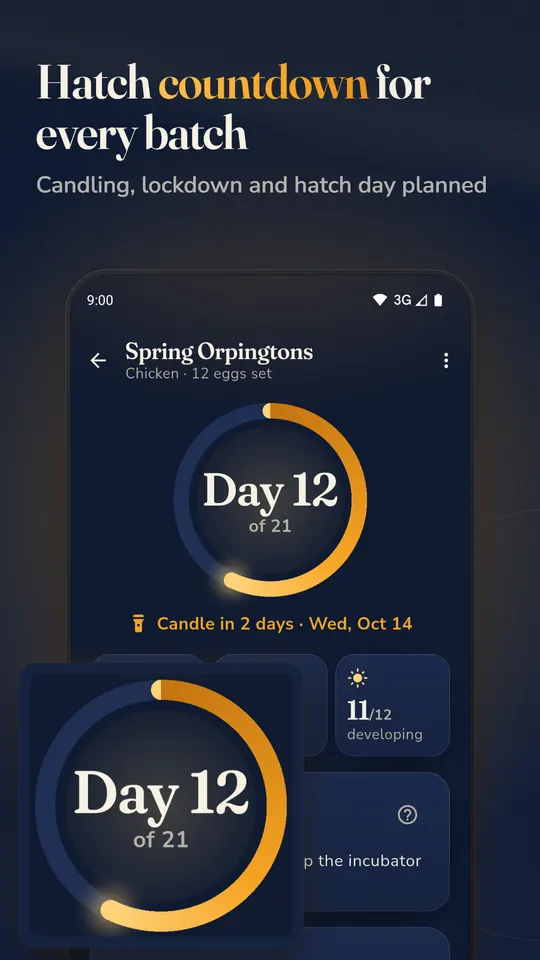
Hatch countdown for every batch 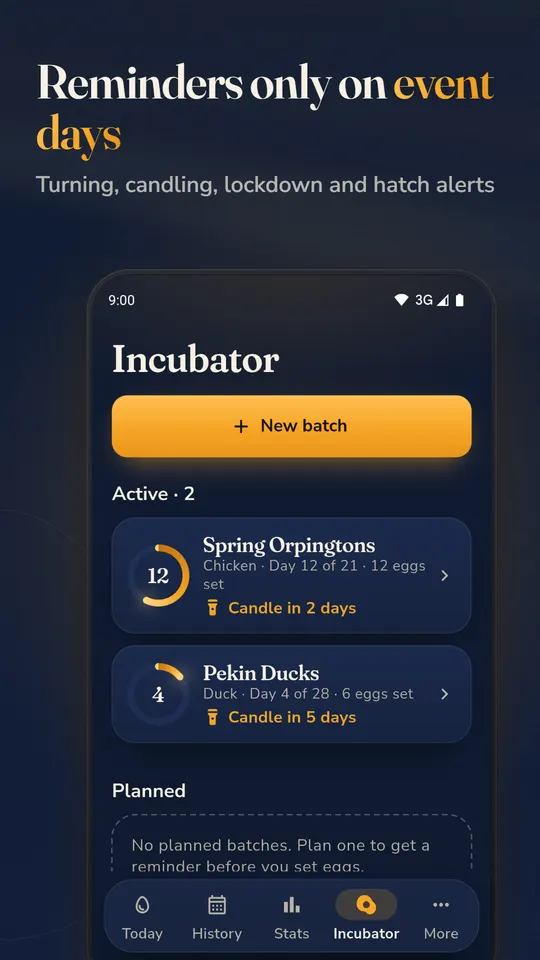
Every batch and its next event 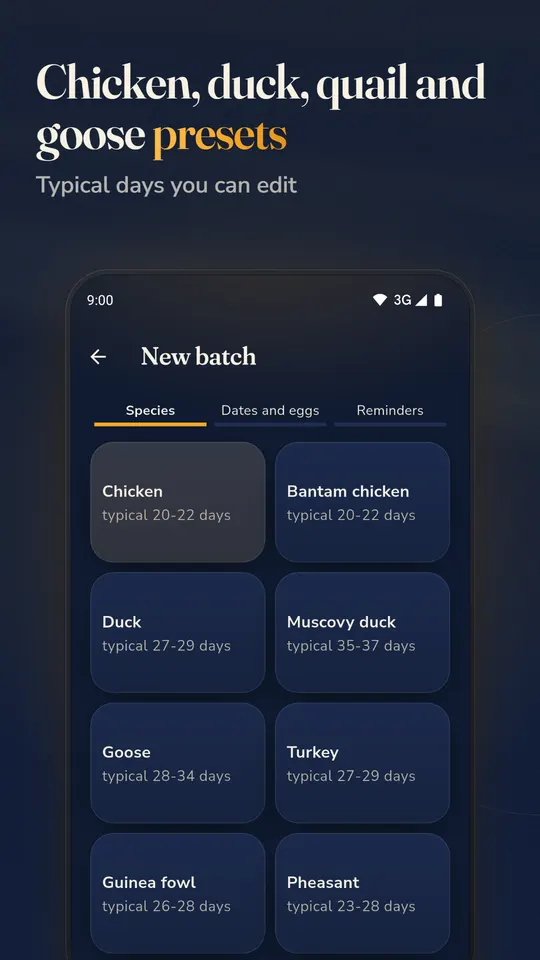
Species presets with typical days 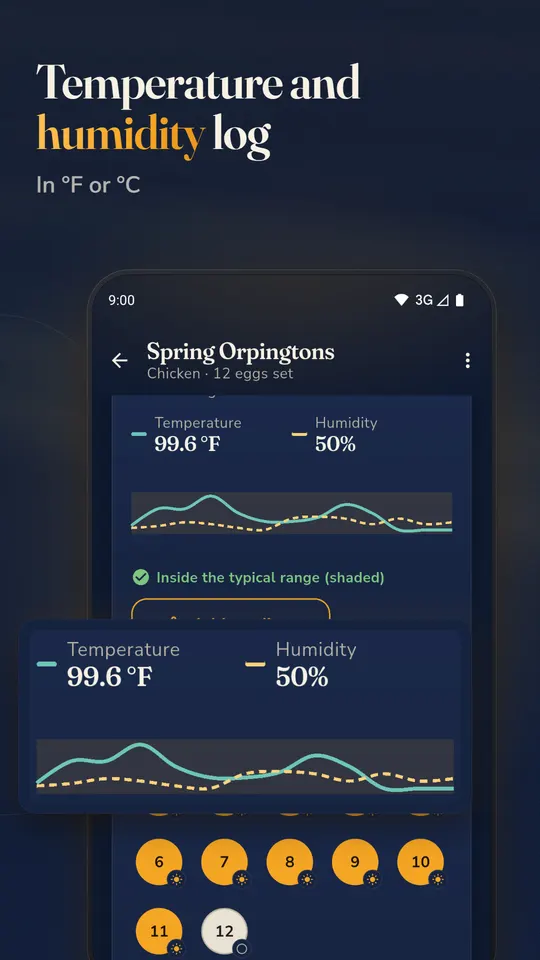
Temperature and humidity log 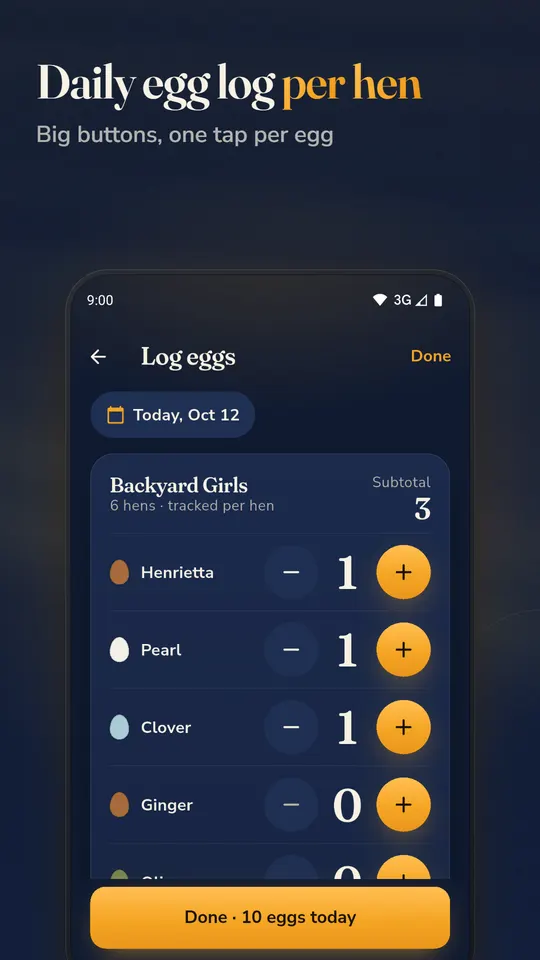
One-tap egg log per hen 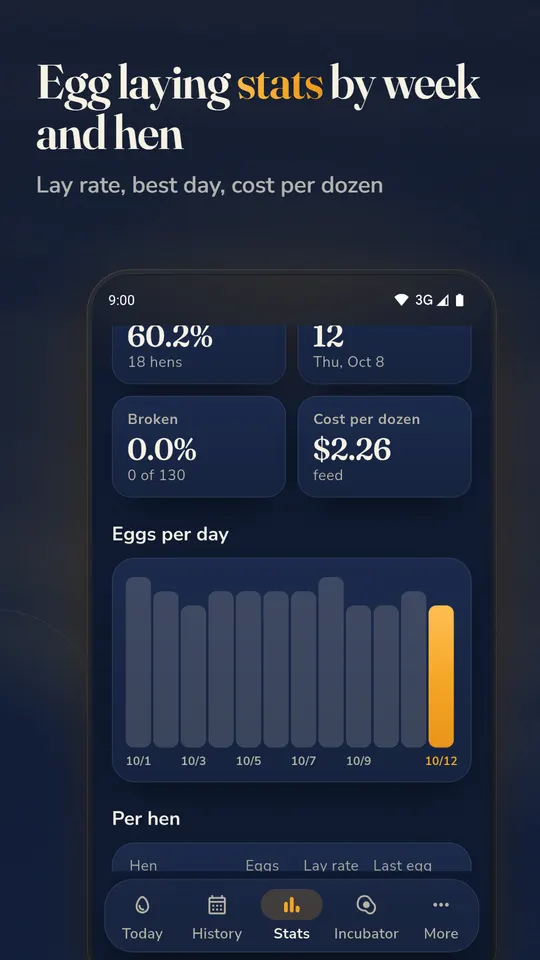
Laying stats by week and hen 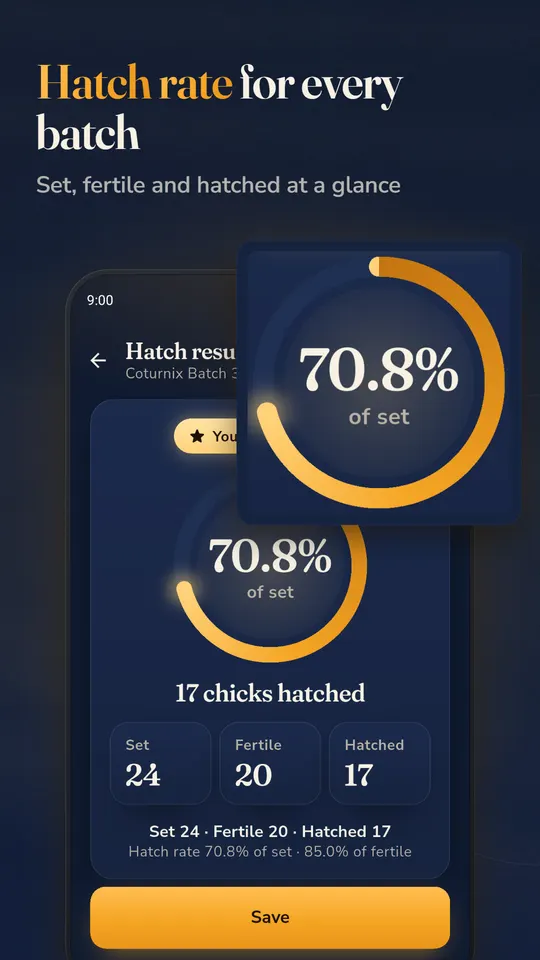
Hatch rate for every batch 
Backup and CSV export
How many days do chicken eggs take to hatch?
Chicken eggs take 21 days to hatch. Count from the moment the eggs go into the incubator. Ducks and turkeys take 28 days, geese about a month and quail 17 to 24, depending on the kind.
Utah State University Extension, Oklahoma State and Mississippi State all give 21 days for chickens. For other birds the sources differ by a day or more, so the table shows the Utah State range next to the figure from Oklahoma State. The calendar above uses the Utah State row, and where that row is a range it counts toward the middle of it.
| Bird | Days (Utah State) | Calendar counts to | Stop turning on day | Days (Oklahoma State) |
|---|---|---|---|---|
| Chicken | 21 | day 21 | day 18 | 21 |
| Duck | 28 | day 28 | day 25 | 28 |
| Muscovy duck | 35 to 37 | day 36 | day 31 | 36 |
| Goose | 28 to 34 | day 31 | day 25 | 32 |
| Turkey | 28 | day 28 | day 25 | 28 |
| Guinea fowl | 28 | day 28 | day 25 | 27 |
| Pheasant | 23 to 28 | day 26 | day 21 | 23 |
| Peafowl | 28 to 30 | day 29 | day 25 | 29 |
| Bobwhite quail | 23 to 24 | day 24 | day 20 | 23 |
| Coturnix quail | 17 | day 17 | day 15 | 16 |
| Chukar | 23 to 24 | day 24 | day 20 | not listed |
| Grouse | 25 | day 25 | day 22 | 23 |
Sources: Utah State University Extension, Hatching and Caring for Chicks (Table 1, adapted from Smith 2004), Oklahoma State University, Artificial Incubation (Berry, 2017) and Mississippi State University Extension, Incubation duration periods, which gives geese at about 33 days. Differences like these are why the calendar shows a range for geese, pheasants, peafowl and quail instead of one day.
What does the incubation calendar for chicken eggs look like?
Day 0 is the day and hour the eggs go in. Everything after that is a count of 24-hour days from that moment. For eggs set on Sun, Nov 1 at 6 pm the calendar reads:
| Day | Date | What to do |
|---|---|---|
| 0 | Sun, Nov 1 | Eggs set. Start turning and keep the temperature steady. Day 0 is the moment the eggs went in. |
| 7 | Sun, Nov 8 | First candling. A healthy embryo shows veins reaching out to the shell. Remove eggs that are clear, and any with a blood ring and no organised veins. |
| 14 | Sun, Nov 15 | Last candling. A chick is usually visible. Utah State advises against candling after this day to keep the eggs at a steady temperature. |
| 18 | Thu, Nov 19 | Stop turning, raise humidity. Lockdown: stop turning, move the eggs to the hatching tray if your incubator has one, raise the humidity and open the vents more. Then leave the incubator closed. |
| 21 | Sun, Nov 22 | Expected hatch day. Pips and peeping start about now. Hatching can take many hours, so do not open the incubator to look. |
| 23 | Tue, Nov 24 | Last day of the usual late margin. Utah State notes chicks can hatch a day or two late when the incubator ran a little cool. Past this day, check the temperature record before deciding what happened. |
Between day 0 and day 17 the eggs are turned. On day 18 turning stops and the humidity goes up. From day 21 the chicks pip and hatch. The last row marks the 2 extra days after the expected hatch that the Utah State guide treats as possible when the incubator ran a little cool. Enter your own date in the calendar to get the same list for your batch, with a calendar file you can add to your phone.
When should I candle chicken eggs?
Candle on day 7 to remove clear eggs and again on day 14 to confirm the chicks are growing. After day 14, candle only if you must.
Candling means holding a bright light against the egg in a dark room. Utah State says to do it every seven days and to keep the eggs out of the incubator for as short a time as possible. A healthy embryo shows veins reaching the shell by day 7. By day 14 a chick can usually be seen, although dark shells make that harder. An egg with nothing in it is infertile and should go. An egg with a ring and no organised veins stopped growing and should also go, so it does not contaminate the rest. After day 14 the guide says most eggs should not be candled, to keep the temperature steady.
Mississippi State’s Hatching Quality Chicks says eggs are normally tested after 4 to 7 days, that white shells can be tested earlier than dark ones and that a homemade candler works: a bulb in a cardboard box with a hole of half to three quarters of an inch. Both guides use the air cell as a humidity check. It should grow as the egg loses water; Utah State says to lower the humidity to enlarge it and raise the humidity to shrink it.
| Bird | First candling | Last candling |
|---|---|---|
| Chicken | day 7 | day 14 |
| Duck | day 9 | day 19 |
| Muscovy duck | day 12 | day 24 |
| Goose | day 10 | day 21 |
| Turkey | day 9 | day 19 |
| Guinea fowl | day 9 | day 19 |
| Pheasant | day 9 | day 17 |
| Peafowl | day 10 | day 19 |
| Bobwhite quail | day 8 | day 16 |
| Coturnix quail | day 6 | day 11 |
| Chukar | day 8 | day 16 |
| Grouse | day 8 | day 17 |
Day 7 and day 14 are Utah State’s chicken days. For other birds the calendar uses the same thirds of the incubation period, so a 28-day duck is candled on days 9 and 19. That scaling is this page’s own rule, not a published one.
When is lockdown for chicken eggs, and what changes?
Lockdown starts on day 18 for chickens. You stop turning the eggs, raise the humidity, open the vents more and keep the incubator closed until the hatch is over.
The 18th day comes from the “do not turn after” column in the Utah State table, and Mississippi State agrees that chickens should not be turned after the 18th day. Mississippi State’s general rule is the last three days. Utah State explains the reason for the extra humidity: it keeps the egg membrane pliable while the chick hatches. If your incubator has a hatching tray, this is the day to move the eggs there.
Other birds lock down on other days: day 25 for ducks and turkeys, day 31 for Muscovy ducks, day 21 for pheasants and day 15 for Coturnix quail. The table above lists every one.
What temperature and humidity should the incubator hold?
A forced-air incubator holds about 100 °F (37.8 °C). Humidity is read with a wet-bulb thermometer: about 85 to 87 °F while the eggs are turned and 90 °F for the last three days.
Oklahoma State gives 99 to 100 °F for forced-draft machines and Mississippi State 100 °F, with the variation kept within 1 °F in both. Utah State asks for about 99.5 °F and says never to exceed 102 °F. Still-air incubators run hotter and the thermometer belongs at the top of the eggs: Oklahoma State gives 101 °F in the first week, 102 °F in the second and 103 °F after that, and Mississippi State gives 102 °F. Even half a degree matters, says Utah State.
| Bird | Temperature | Wet bulb while turning | Wet bulb in lockdown |
|---|---|---|---|
| Chicken | 100 °F · 37.8 °C | 85 to 87 °F 29.4 to 30.6 °C | 90 °F · 32.2 °C |
| Duck | 100 °F · 37.8 °C | 85 to 86 °F 29.4 to 30 °C | 90 °F · 32.2 °C |
| Muscovy duck | 100 °F · 37.8 °C | 85 to 86 °F 29.4 to 30 °C | 90 °F · 32.2 °C |
| Goose | 99 °F · 37.2 °C | 86 to 88 °F 30 to 31.1 °C | 90 °F · 32.2 °C |
| Turkey | 99 °F · 37.2 °C | 84 to 86 °F 28.9 to 30 °C | 90 °F · 32.2 °C |
| Guinea fowl | 100 °F · 37.8 °C | 85 to 87 °F 29.4 to 30.6 °C | 90 °F · 32.2 °C |
| Pheasant | 100 °F · 37.8 °C | 86 to 88 °F 30 to 31.1 °C | 92 °F · 33.3 °C |
| Peafowl | 99 °F · 37.2 °C | 84 to 86 °F 28.9 to 30 °C | 90 °F · 32.2 °C |
| Bobwhite quail | 100 °F · 37.8 °C | 84 to 87 °F 28.9 to 30.6 °C | 90 °F · 32.2 °C |
| Coturnix quail | 100 °F · 37.8 °C | 85 to 86 °F 29.4 to 30 °C | 90 °F · 32.2 °C |
| Chukar | 100 °F · 37.8 °C | 81 to 83 °F 27.2 to 28.3 °C | 90 °F · 32.2 °C |
| Grouse | 100 °F · 37.8 °C | 83 to 87 °F 28.3 to 30.6 °C | 90 °F · 32.2 °C |
In relative humidity, Oklahoma State gives 60% until the eggs begin to pip and 70% after. Mississippi State gives 58 to 60% until three days before hatching and 65% or more after. For a dry bulb of 100 °F, Oklahoma State’s table pairs wet bulb readings with relative humidity like this:
| Wet bulb | 84 °F | 85 °F | 86 °F | 87 °F | 88 °F | 89 °F | 90 °F |
|---|---|---|---|---|---|---|---|
| Relative humidity | 51% | 54% | 57% | 60% | 63% | 65% | 68% |
The sources do not agree to the last point, and every incubator moves air differently. Treat these as a starting point and let your manual decide. Sources: Utah State, Oklahoma State and Mississippi State, Important incubation factors.
How often do I turn the eggs, and when do I stop?
Turn the eggs several times a day and stop on the lockdown day. Do not turn them in the last three days.
| Source | How often | When to stop |
|---|---|---|
| Mississippi State, Hatching Quality Chicks | At least 2 to 3 times a day in the first 18 days | Not in the 3 days before hatching |
| Mississippi State, Important incubation factors | At least 4 to 6 times a day | Not after day 18 for chickens |
| Oklahoma State | At least 4 times in 24 hours, turning through 90 degrees | One to three days before hatching, or after pipping |
| Utah State | Several times daily | Three days before the expected hatch |
The pages differ on the count, so the safe reading is: more than once, spread through the day, as many times as your routine allows, and an automatic turner does it for you. Mississippi State’s tip is to mark an X on one side of each egg and an O on the other so you can see at a glance which eggs were turned, and to be gentle in the first week, when the blood vessels are delicate. It also says turning keeps the embryo from sticking to the shell membranes.
My chicken eggs have not hatched on day 21. What now?
Wait, and keep the incubator closed. Utah State says chicks can hatch a day or two early if the incubator ran a little warm and a day or two late if it ran a little cool.
That is why the calendar keeps a window open for 2 days after the expected day before it says the batch is overdue. The same guide says the incubator should stay closed until the hatch date, even though it is tempting to peek, that dry chicks may be taken out once a day, and that more ventilation helps the chicks dry. It also says even half a degree of temperature makes a huge difference, so check your temperature record for the batch.
Past the margin the advice is plain: Utah State says a chick that has not hatched one or two days after the hatching period likely will not survive, and that attempts to free a chick from its shell are usually unsuccessful. If many eggs did not hatch, the factors the guides stress are the ones to check next time: a steady temperature within a degree, the right humidity, turning that stopped on time, and eggs that were not stored too long before setting.
How long can I store hatching eggs before setting them?
Set them within 7 to 10 days. Mississippi State says hatchability stays high for eggs stored fewer than 7 to 10 days and falls to near zero after 3 weeks.
The best storage is a cool, humid room near 60 °F and 75% humidity, and hatchability drops if the temperature falls below 40 °F. If you hold the eggs more than 3 or 4 days, turn them daily, stored with the small end down and slanted 30 to 45 degrees. The cool temperature holds embryonic growth back until incubation begins. Source: Mississippi State University Extension, Hatching Quality Chicks.
Can I use the same calendar for ducks, geese, turkeys and quail?
Yes. Choose the bird in the calendar and every date shifts: ducks lock down on day 25 and hatch around day 28, Muscovy ducks lock down on day 31 and hatch from day 35 to 37, and Coturnix quail lock down on day 15 and hatch around day 17. Set a bird that is not on the list as “Other bird” with its own number of days; turning then stops three days before the end, as Mississippi State advises for the last three days. Bantam chickens are not listed apart from chickens in the extension tables I read, so use the chicken row.
More from the studio: for the cost side of a coop, the concrete calculator sizes a pad or footing, and the block and brick calculator counts the units for a wall.
What the Android app adds to this calendar
This page is a calendar for one batch at a time. The Chicken Egg Tracker app is built for the whole year of a flock. It keeps unlimited batches with their own dates and egg counts, and sends candling, lockdown and hatch day reminders only on the days that matter. It records every egg’s candling result, logs incubator temperature and humidity in °F or °C, and shows the hatch rate of eggs set and of fertile eggs.
Beside the incubator planner it has a daily egg log per flock or per hen, with laying statistics by week, month and hen, optional feed costs, a home screen widget and CSV export. It works offline with no account, and ads never appear on the egg entry screen or the batch checklist. Its incubation days are typical values, and its own listing tells you to follow your incubator manual, which is also the advice here.
Sources
- Utah State University Extension, Hatching and Caring for Chicks: Table 1 (incubation period, temperature, wet bulb, do-not-turn day, hatching humidity), candling and hatching advice.
- Oklahoma State University Extension, Artificial Incubation (AFS-8100, Berry, 2017): incubation periods, temperatures, relative humidity and the wet bulb table, turning.
- Mississippi State University Extension, Important incubation factors: temperature, humidity, turning and ventilation by day.
- Mississippi State University Extension, Hatching Quality Chicks (P1182): storage, candling, turning.
- Mississippi State University Extension, Incubation duration periods: days for common birds.
These are general guides. Incubators differ, and some of these pages are several years old. Follow your incubator’s manual, and ask a poultry vet or your extension office about a problem batch.
Questions
How many days do chicken eggs take to hatch?
21 days, counted from the moment the eggs go into the incubator. The Utah State, Oklahoma State and Mississippi State extension guides all give 21 days for chickens. Chicks can hatch a day or two early if the incubator ran warm and a day or two late if it ran cool.
On which days should I candle chicken eggs?
Day 7 and day 14. At day 7 a healthy embryo shows veins reaching the shell and clear eggs can be removed; by day 14 a chick is usually visible. Utah State advises against candling after day 14 so the temperature stays steady.
What day is lockdown for chicken eggs?
Day 18. Stop turning, raise the humidity, open the vents more and keep the incubator closed until the hatch is over. As a general rule the eggs are not turned in the last three days before hatching.
What temperature should a chicken egg incubator be?
About 100 °F (37.8 °C) in a forced-air incubator. Oklahoma State gives 99 to 100 °F and Utah State about 99.5 °F, never above 102 °F. Still-air incubators run hotter, measured at the top of the eggs. Even half a degree matters, so follow your incubator manual.
What humidity do chicken eggs need?
The extension guides read it with a wet bulb: about 85 to 87 °F while the eggs are turned and 90 °F for the last three days. That is roughly 58 to 60 percent relative humidity, then 65 to 70 percent. Your incubator may give its own targets, and those come first.
Can I use this calendar for duck, goose, turkey or quail eggs?
Yes. Pick the bird and every date moves: duck 28 days, turkey 28, Muscovy 35 to 37, goose 28 to 34 and Coturnix quail 17. Candling days for birds other than chickens are scaled from the chicken's day 7 and 14, which is this page's own rule.
How long can I store hatching eggs before setting them?
Within 7 to 10 days. Mississippi State says hatchability stays high for eggs stored fewer than 7 to 10 days and falls to near zero after three weeks. Keep them near 60 °F and 75 percent humidity, small end down, and turn them daily after the first 3 or 4 days.
My eggs have not hatched on day 21. Should I worry?
Not yet. A hatch can run a day or two late if the incubator was a little cool, so keep it closed. Utah State says a chick that has not hatched one or two days after the hatching period likely will not survive.
Is the Chicken Egg Tracker app free and does it work offline?
Yes to both. It is free with ads, needs no account and works offline. There are never ads on the egg entry screen or the batch checklist, and one short video removes all ads for 10 minutes. CSV export, advanced charts and extra color themes open with a short video.

Never miss candling or lockdown day
Free on Android, with ads. No account, works offline, and there are never ads on the egg entry screen or the batch checklist.
Facts from the Google Play listing, last checked .