Gravel calculator: how many tons or yards you need, with compaction
Enter the area, the depth of each layer and the stone, and the calculator below gives the cubic yards, the tons, the truck loads and the cost, with a cross-section that redraws as you type and every sum written out. The free Android app adds saved projects, a history and a weight range, offline.
Gravel calculator
Area, depth and material in: cubic yards, tons, truck loads and cost out, as you type.
1 · The area
Path, bed, patio, parking pad: length times width.
This area: 200 ft²
2 · The layers
- Layer 1 · laid first
Density: 100 lb/ft³ preset
Sources range from 90 to 100 lb/ft³. Ask your supplier.
3 · Cost, trucks and bags (optional)
Order about
3.67 tons
2.72 yd³ · 73 ft³ · 3.33 tonnes
3.3 to 3.67 tons across the densities found in the sources
Cross-section
By layer
| Layer | Depth | yd³ | Tons |
|---|---|---|---|
| Crushed stone, ¾ in (#57, #67) | 4 in | 2.72 | 3.67 |
- Area
- 200 ft²
- Loose volume, no allowance
- 2.47 yd³
How is this calculated?
Area
- Area = 20 ft × 10 ft = 200 ft²
Layer 1: Crushed stone, ¾ in (#57, #67)
- Volume = 200 ft² × 4 in ÷ 12 = 0.333 ft = 66.67 ft³, which is 2.47 yd³ (÷ 27)
- With 10% allowance = 73.33 ft³, 2.72 yd³
- Weight = 73.33 ft³ × 100 lb/ft³ = 7,333 lb = 3.67 tons
Weight = order volume × density. The density is a loose bulk figure, and moisture can add to it.
Estimates only. Density changes with the quarry, the moisture and how the stone is graded: confirm the tons per yard and the amount with your supplier before you order.
Keep every job, offline
This page works out one job at a time. The Android app keeps a history and saved projects, adds an overage and a compaction allowance to every result and handles a mix of shapes, with no connection needed:
- Volume in cubic yards, cubic metres or cubic feet, and weight in tons, tonnes, kilograms or pounds
- Estimated material cost in your chosen currency
- Rectangle, circle, triangle and custom area, with several areas combined into one total
- Density presets for gravel, crushed stone, sand, soil, topsoil, road base and more, plus your own density when your supplier gives one
- An overage allowance so you order a little extra, and a compaction allowance for material that settles
- A weight range as well as a single figure, because density varies
- Calculation history and saved projects to keep jobs apart and reusable
- Full metric and US units you can switch at any time, light and dark themes, 20+ languages, no account

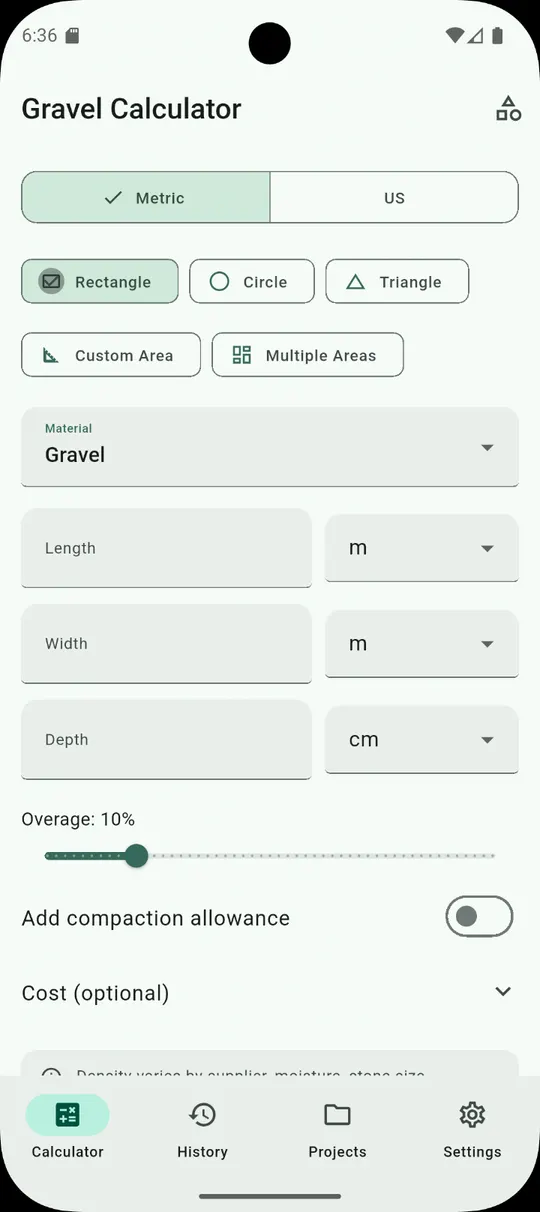
Shapes, material and overage 
Common materials or your own density 
Weight, volume and cost 
History and projects 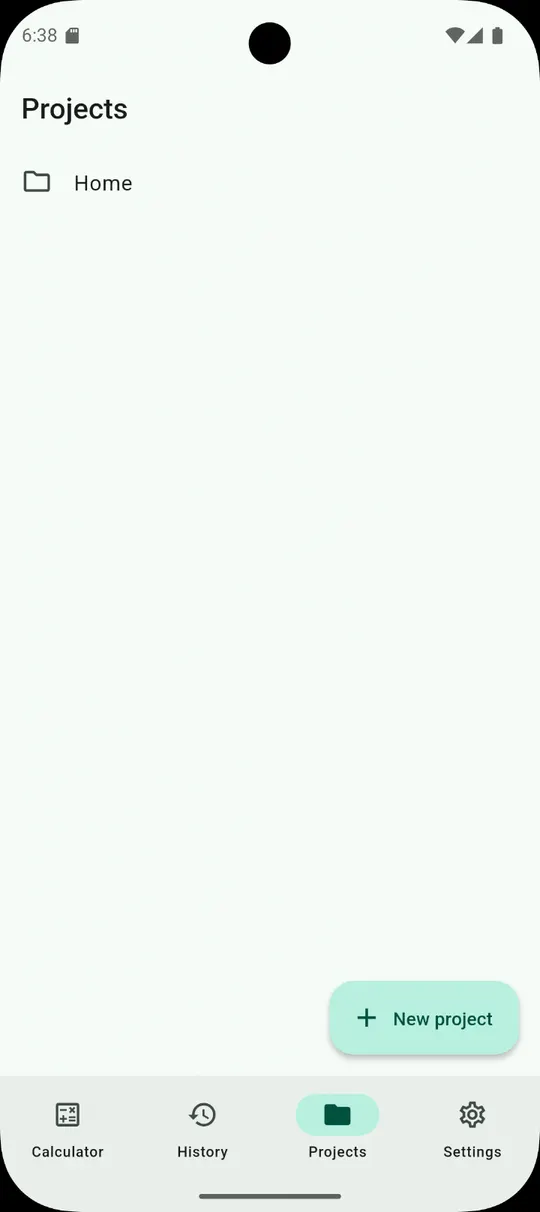
Saved projects
How much gravel do I need? The formula
Gravel is bought by weight or by volume, and both start from the same number: length × width × depth, with all three in the same unit. A 30 ft by 20 ft area spread 4 in deep is 30 × 20 × (4 ÷ 12) = 200 ft³. A cubic yard is 3 × 3 × 3 = 27 ft³, so that is 200 ÷ 27 = 7.41 yd³.
To get tons, multiply the volume by the density of the stone. Crushed stone is about 1.35 tons per cubic yard, so the same job is 7.41 × 1.35 = 10 tons. Vertigraph works the same 30 × 20 ft, 4 in example to about 10 tons.
In metric, a 6 m by 3 m area at 10 cm is 6 × 3 × 0.10 = 1.8 m³, and at 1,602 kg/m³ that is 2.88 tonnes before any allowance.
Order a little more than the sum. With a 10% allowance the 30 × 20 ft example becomes 8.15 yd³ and 11 tons, and the metric one 3.17 tonnes. The calculator above does this with your numbers and writes each step out under How is this calculated?
How many tons are in a cubic yard of gravel?
Between about 1.2 and 1.7 tons, depending on the stone. Dense, graded road base sits at the top, and open-graded crushed stone and pea gravel in the middle. The table gives the figure the calculator uses and the lowest and highest I found across the sources, which do not fully agree.
| Material | lb/ft³ | Tons per yd³ | kg/m³ | Range in sources (tons per yd³) |
|---|---|---|---|---|
| Road base, crusher run, dense graded | 120 | 1.62 | 1,922 | 1.55 to 1.69 |
| Crushed stone, ¾ in (#57, #67) | 100 | 1.35 | 1,602 | 1.22 to 1.35 |
| Crushed stone, 1½ to 2½ in (#3) | 93 | 1.26 | 1,490 | one source |
| Pea gravel | 100 | 1.35 | 1,602 | 1.28 to 1.42 |
| Bank-run gravel | 112 | 1.51 | 1,794 | 1.4 to 1.62 |
| Sand | 96 | 1.3 | 1,538 | 1.28 to 1.35 |
| Stone dust, screenings | 100 | 1.35 | 1,602 | one source |
| River rock | 105 | 1.42 | 1,682 | one source |
| Decomposed granite | 103 | 1.39 | 1,650 | one source |
| Recycled crushed concrete | 100 | 1.35 | 1,602 | 1.2 to 1.35 |
These are loose densities and they do not allow for moisture, which adds weight. A single figure also hides real differences between quarries, so the most useful number is the one your supplier quotes. Type it into Density on each layer.
How deep should gravel be?
For a driveway, at least 4 in of base, and 6 to 8 in if heavy vehicles use it. A full driveway is built in layers: a coarse base of 4 to 6 in, a middle layer of 3 to 4 in of ¾ in crushed stone, and a surface layer of 2 to 3 in, 8 to 12 in in all. For a paver patio, 4 in of crushed stone under 1 in of bedding sand is the usual base.
| Use | Depth | Source |
|---|---|---|
| Driveway base, coarse angular stone | 4 to 6 in | Stone Centers |
| Driveway middle layer, #57 stone | 3 to 4 in | Stone Centers |
| Driveway surface layer | 2 to 3 in | Stone Centers |
| Whole driveway, residential | 8 to 12 in | Stone Centers |
| Driveway with heavy vehicles, base only | 6 to 8 in | Stone Centers |
| Paver patio, crushed rock plus bedding sand | 4 in + 1 in | Concrete Network |
Guides disagree on the totals, and several are written by stone suppliers, so treat these as a starting point. Soft ground, drainage and frost can all call for more. The calculator’s three starting points use the lower half of these ranges: driveway, three layers (base, middle and surface, 9 in in all) and paver patio base (4 in of crushed stone and 1 in of bedding sand).
How much gravel for a 10 × 20 ft driveway?
A 10 ft by 20 ft area is 200 ft². At 4 in it takes 2.47 yd³ or 3.3 tons of ¾ in crushed stone, and about 3.7 tons with a 10% allowance. The table shows other depths.
| Depth | yd³ | Tons | Tons with 10% | Bags of 0.5 ft³ |
|---|---|---|---|---|
| 2 in | 1.23 | 1.67 | 1.83 | 67 |
| 3 in | 1.85 | 2.5 | 2.75 | 100 |
| 4 in | 2.47 | 3.33 | 3.67 | 134 |
| 6 in | 3.7 | 5 | 5.5 | 200 |
How much area does a ton or a cubic yard of gravel cover?
A cubic yard covers 324 ft² at 1 in, 162 ft² at 2 in, 108 ft² at 3 in and 81 ft² at 4 in, whatever the stone. A ton covers less when the stone is dense, because a ton of it is a smaller volume.
| Depth | Pea gravel | Crushed stone, ¾ in (#57, #67) | Road base, crusher run, dense graded |
|---|---|---|---|
| 1 in | 240 ft² | 240 ft² | 200 ft² |
| 2 in | 120 ft² | 120 ft² | 100 ft² |
| 3 in | 80 ft² | 80 ft² | 67 ft² |
| 4 in | 60 ft² | 60 ft² | 50 ft² |
| 6 in | 40 ft² | 40 ft² | 33 ft² |
In metric, one tonne of gravel at 1,600 kg/m³ covers about 6.25 m² at 10 cm (1 ÷ 1.6 ÷ 0.10). Divide by two for 20 cm, and so on.
How much extra gravel should I order for compaction?
Most sources say 5% to 15%. Vertigraph says a loose cubic yard occupies roughly 0.85 to 0.90 yd³ once compacted and suggests ordering 10% to 15% more than the plain volume to cover compaction, settling and spillage. Aggregate Markets says 5% to 10%, and CalculatorSoup 5% to 15%. The calculator starts at 10% per layer, the middle of those ranges, and you can change it from 0 to 30%.
- Use more for a thick base that will be compacted with a plate compactor.
- Use less, or none, for a decorative top layer that is only raked level, such as pea gravel or river rock.
- A small job is more sensitive: a few spilled or uneven shovelfuls are a larger share of two yards than of twenty.
How do I measure an area that is not a rectangle?
Split it into rectangles, triangles and circles, work out each area and add them. The calculator has a button for that: enter one shape, press Add to the total, then enter the next. The formulas are the usual ones:
- Rectangle: length × width.
- Triangle: base × height ÷ 2.
- Circle: π × (diameter ÷ 2)². A 12 ft circle is 113.1 ft².
Measure the depth in several places, not once. If the ground slopes or dips, use the average, and add a few percent for a crowned driveway with the Crown and grade extra field.
Should I buy bags or have it delivered?
Bags are for small jobs. A 0.5 ft³ bag is 1/54 of a cubic yard, so one yard is 54 bags. A 10 ft by 3 ft path at 3 in needs 7.5 ft³, or 15 bags. Past one or two yards, bulk delivery by weight is the usual choice. Ask your supplier for the minimum load, the delivery charge and the truck’s rated payload, and enter the payload under Cost, trucks and bags to see how many loads you need.
What this calculator does not do
- It does not design anything. The depth a driveway or base needs depends on the ground, the loads and local rules. For a structural or drainage job, ask a professional.
- It does not know your stone. The densities are typical loose values from published tables, and the range in the table above is the spread between those tables. Your supplier’s figure beats all of them.
- It does not add moisture. Wet stone weighs more, and a delivery ticket in tons is what you pay for.
- Concrete, bricks and blocks are different jobs: the concrete calculator and the brick and block calculator cover them, and the landscaping calculator covers mulch, topsoil, sod and pavers.
Sources
- Vertigraph, How to calculate gravel tonnage (updated May 2026): the formula, the density table for pea gravel, crushed stone, sand, recycled concrete and road base, and the compaction advice.
- CalculatorSoup, Gravel calculator: densities by gravel type in kg/m³ and lb/yd³, coverage per cubic yard, 5% to 15% extra.
- Designing Buildings, Converting between weight and volume for bulk construction materials (edited Sep 2026): indicative loose bulk densities for sands, gravels and crushed stone.
- Aggregate Markets, How to calculate how much sand, gravel or soil you need (Jan 2026): the 1.4 tons per cubic yard rule of thumb, a 6 in driveway example and a 5% to 10% buffer.
- Stone Centers, How to make a gravel driveway: layer depths for a driveway and the 4 in minimum base.
- Concrete Network, Thickness of concrete pavers: 4 in of crushed rock with 1 in of bedding sand for a patio.
Questions
How many tons of gravel do I need for a driveway?
Work out length × width × depth in feet (4 in is 4 ÷ 12 ft), divide by 27 for cubic yards, then multiply by about 1.35 tons per cubic yard for crushed stone. A 10 × 20 ft driveway at 4 in is 2.47 yd³, or 3.3 tons, and about 3.7 tons with a 10% allowance. A 50 × 10 ft driveway at 4 in is 6.2 yd³, or 8.3 tons.
How much does a cubic yard of gravel weigh?
Usually between 1.2 and 1.7 tons, or 2,400 to 3,400 lb. The sources read for this page give crushed stone about 1.35 tons, pea gravel 1.3 to 1.4 tons, sand 1.3 tons and dense road base or crusher run 1.55 to 1.7 tons. Your supplier's figure is the one to use.
How do I convert cubic yards of gravel to tons?
Multiply the cubic yards by the tons per cubic yard of that stone: 7.41 yd³ × 1.35 = 10 tons for crushed stone. To go the other way, divide tons by tons per yard. In metric, multiply cubic metres by the density in tonnes per cubic metre.
How deep should a gravel driveway be?
At least 4 in of base, and 6 to 8 in where heavy vehicles drive. A full build is a coarse base of 4 to 6 in, a 3 to 4 in middle layer and a 2 to 3 in surface, 8 to 12 in in all, according to one driveway guide. Soft ground can need more.
How much extra gravel should I order for compaction?
About 10%. Sources give 5 to 10%, 5 to 15% and 10 to 15%, because a loose yard shrinks to roughly 0.85 to 0.90 yd³ once compacted. Use more for a thick base you will compact with a plate, and little or none for a decorative top layer that is only raked.
How many square feet does a ton of gravel cover?
About 120 ft² at 2 in, 80 ft² at 3 in and 60 ft² at 4 in for crushed stone at 100 lb/ft³. A cubic yard covers 324 ft² at 1 in, 162 ft² at 2 in and 81 ft² at 4 in, whatever the stone.
How much gravel do I need for a 10 × 10 ft area at 2 inches?
16.7 ft³, or 0.62 yd³, which is about 0.83 tons of crushed stone and 0.9 tons with a 10% allowance. That is 34 bags of 0.5 ft³, or 37 with the allowance.
Is pea gravel heavier than crushed stone?
About the same. The three density tables read for this page put pea gravel at 95 to 105 lb/ft³ and ¾ in crushed stone at 90 to 100 lb/ft³, so pea gravel is up to 5% heavier. Dense road base is the heavy one, at about 115 to 125 lb/ft³.
Is the Gravel Calculator app free and does it work offline?
Yes to both. It is free with ads, needs no account and calculates offline. Results are approximate, so confirm quantities with your supplier.
Take the numbers to the supplier
Free on Android, with ads. No account, calculations work offline. An estimate only: confirm the density and the quantity with your supplier before you order.
Facts from the Google Play listing, last checked .