Mulch and landscaping calculator: how many yards, bags or rolls you need
Pick a shape, a material and a depth, add as many areas as the yard has, and the calculator below gives one shopping list: cubic yards or metres, bags, weight, sod rolls, pounds of seed or pavers, with a drawing of the yard and every sum written out. The free Android app adds 14 calculators, editable densities, truck loads and saved projects, offline.
Yard material calculator
Pick a shape and a material, type the sizes, add the area, repeat. One shopping list for the whole yard.
1 · Shape of the area
Square or rectangular beds and lawns: length × width.
2 · What goes on it
Bark, wood chips and straw for beds and tree rings.
Your yard
For this area
0.41 yd³
- 11 ft³
- 6 bags of 2 ft³
- about 0.1 tons
includes 10% extra
One cubic yard covers 108 ft² at this depth.
Show the sums
- Area: 10 ft × 4 ft = 40 ft²
- Depth: 3 in ÷ 12 = 0.25 ft
- Volume: 40 ft² × 0.25 ft = 10 ft³, and 10 ÷ 27 = 0.37 yd³
- Extra: 0.37 yd³ × 1.1 = 0.407 yd³ to order
- Bags: 11 ft³ ÷ 2 ft³ per bag = 5.5, so 6 bags
- Weight: 0.407 yd³ × 500 lb per yd³ = 204 lb, or 0.1 tons
Shopping list
This list is for the area above. Press Add this area to the plan to build a list for several areas.
| Material | Order | Price (optional) | Cost |
|---|---|---|---|
| Mulchincludes 10% extra | 0.41 yd³11 ft³ · 6 bags of 2 ft³ · about 0.1 tons | – |
Estimates for planning. Density, bag size and how much a pallet holds change from supplier to supplier: confirm them before you order.
Every material, every unit, on site
This page covers mulch, topsoil, compost, sod, seed and pavers. The Android app has 14 calculators with an editable density for every material, truck loads by volume and weight, and projects with an estimate you can send, all offline:
- 14 calculators: mulch, topsoil, gravel and stone, sand, concrete, pavers with base and bedding sand, retaining walls, sod, grass seed, area, cost, truck loads and a unit converter
- An editable density for every material, from hardwood mulch and screened topsoil to pea gravel, number 57 stone, crusher run, decomposed granite and river rock
- Show formula on any result: the area, the depth conversion, the density, the waste factor and the final number
- Rectangle, L shape, circle, ring around a tree, triangle, trapezoid, border strip or a known area, with as many sections as the job needs and one total
- Fractions the way you measure them: type three quarters of an inch or 1 1/2 feet, with quick fraction keys
- Waste and overage defaults per material, compaction and settling factors for bark and crushed stone, and bag mode from 1 to 3 cubic feet or a custom size
- Cubic yards, cubic feet, cubic metres, litres, US tons, tonnes, pounds and kilograms at once, and truck loads by volume and by weight with an overload warning
- Unlimited saved projects with named sections, prices per yard, ton or bag plus delivery and tax, a text estimate or PDF, light and dark themes, no account

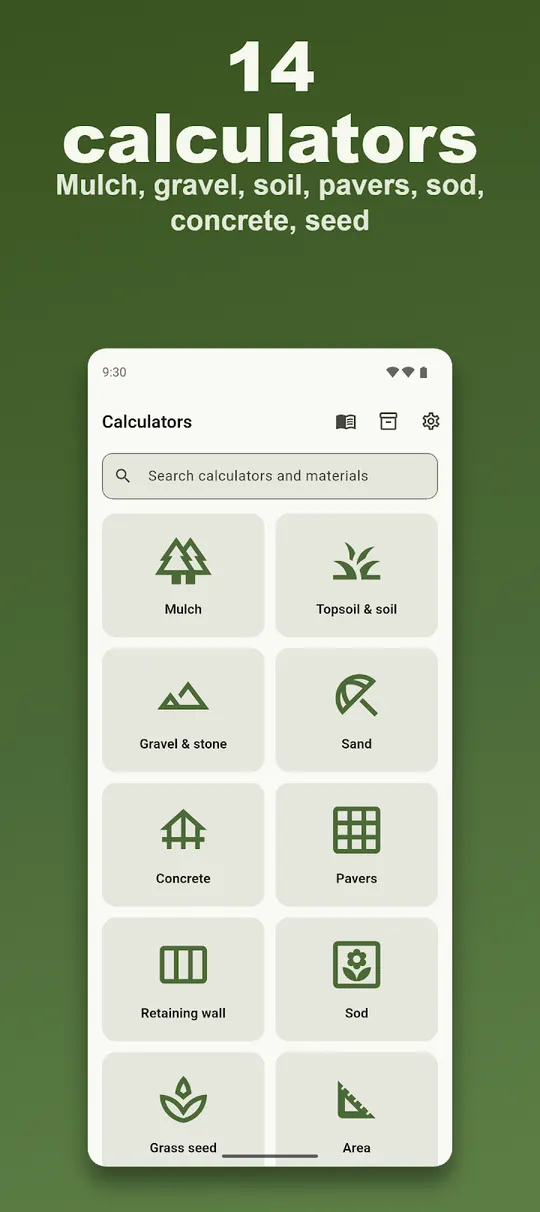
14 calculators 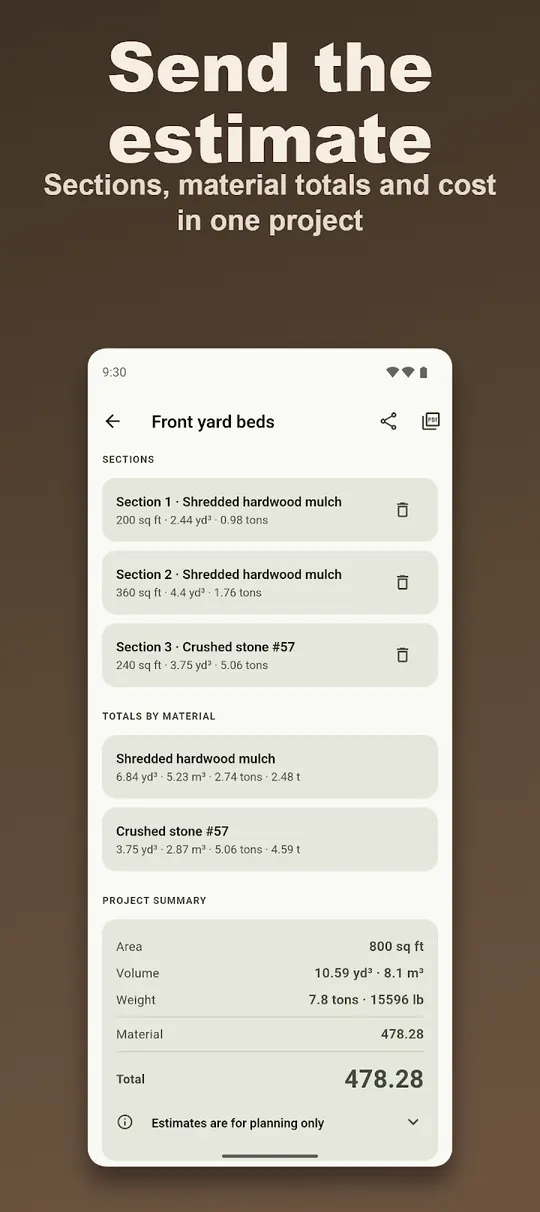
Sections, totals and cost in one project 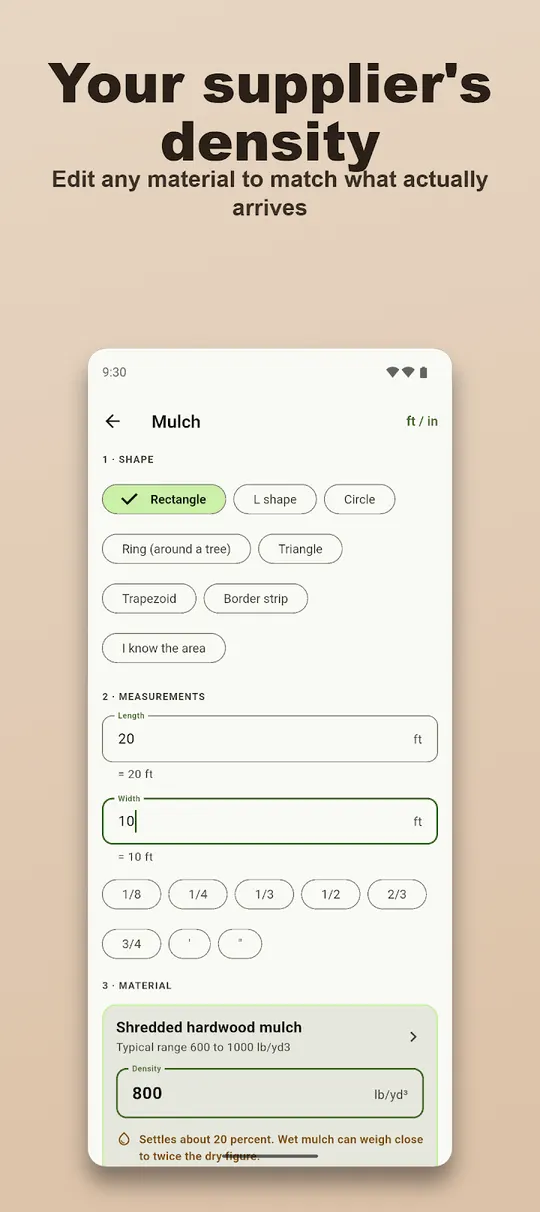
Your supplier density 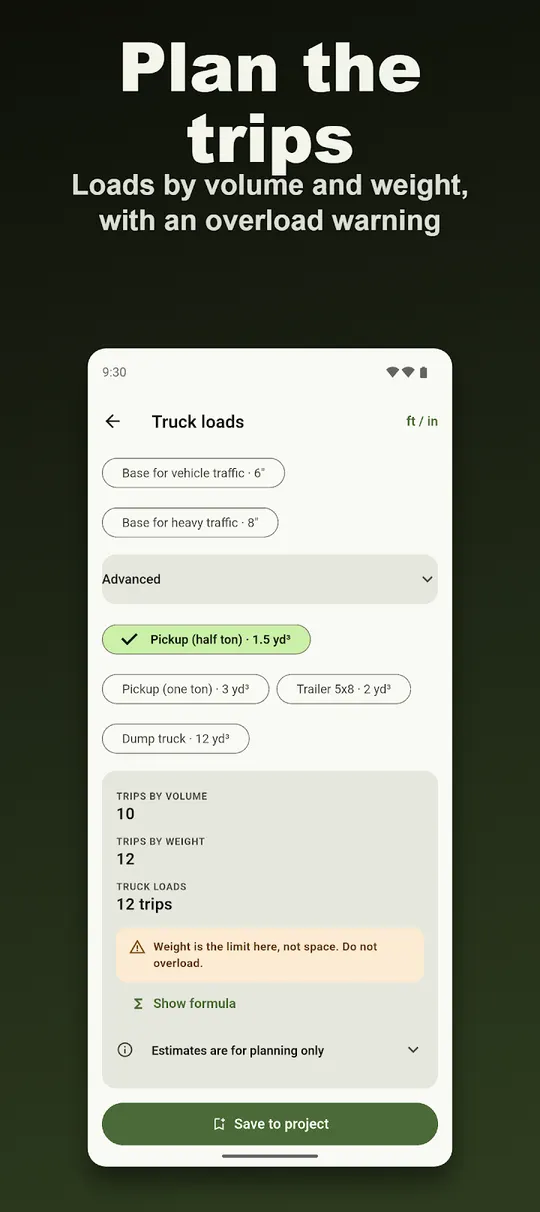
Truck loads with an overload warning 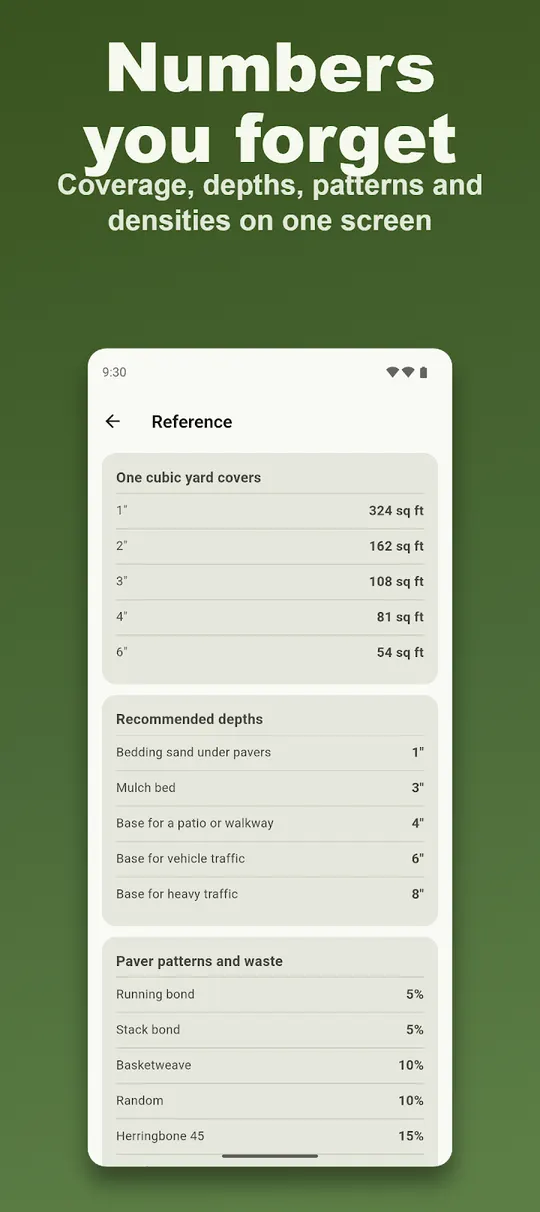
The numbers you forget 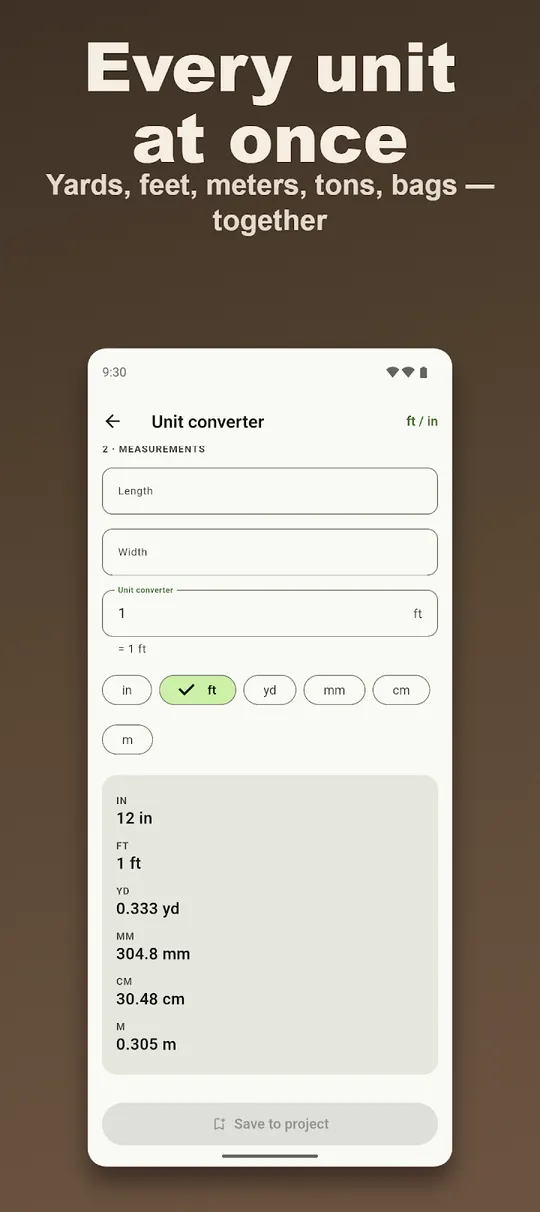
Every unit at once 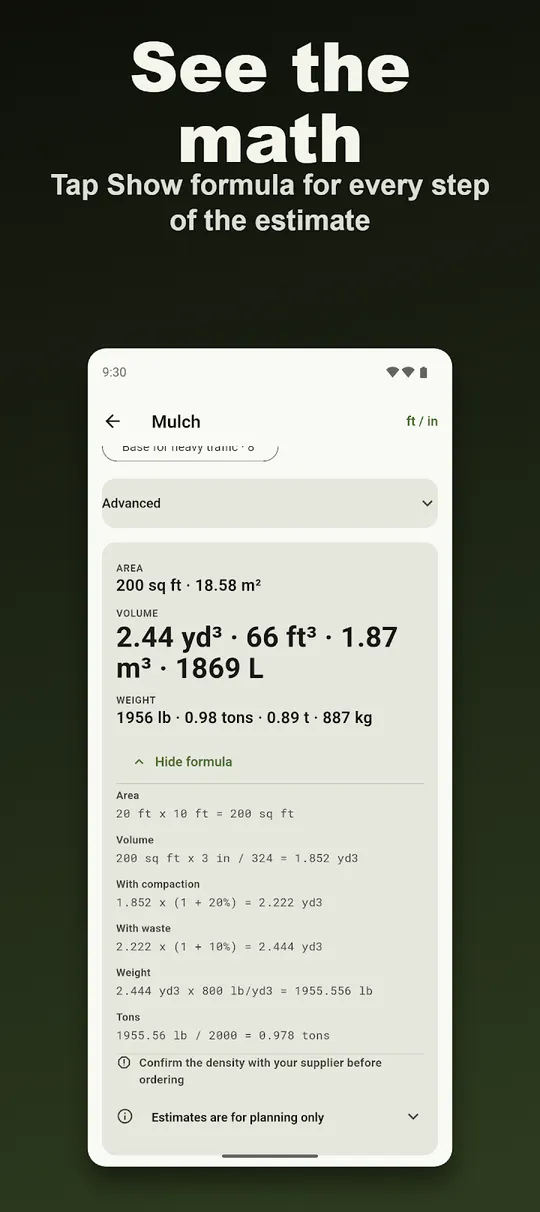
Show the math 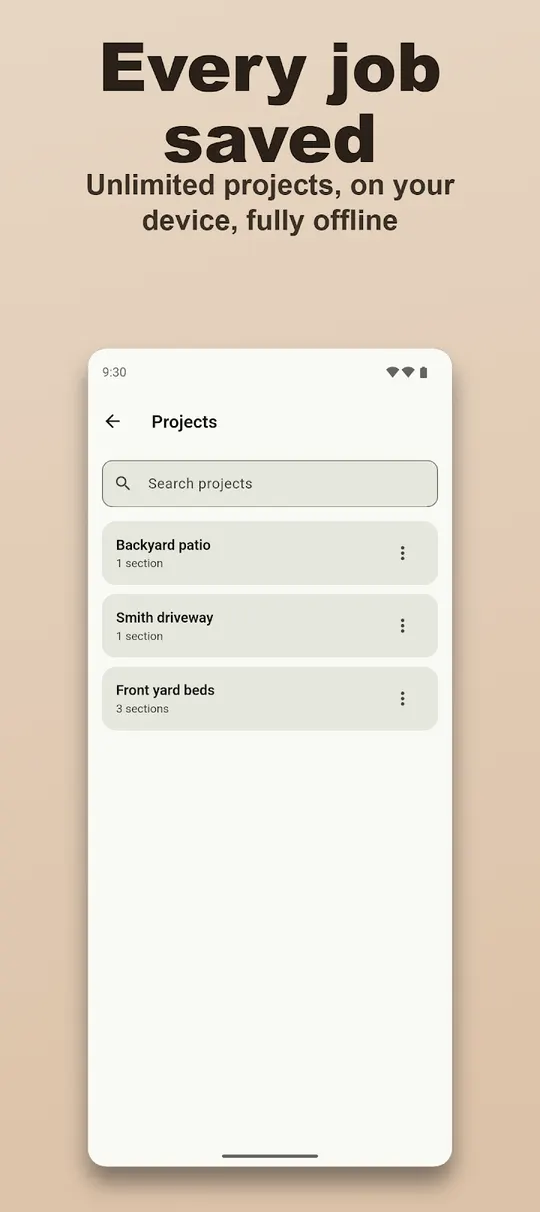
Saved projects, fully offline
How much mulch do I need? The formula
Multiply the area by the depth, then add a little extra. A bed 10 ft long and 4 ft wide is 40 ft². Mulched 3 in deep, which is 0.25 ft, that is 40 × 0.25 = 10 ft³. A cubic yard is 27 ft³, so the bed needs 0.37 yd³. Add 10% for settling and uneven ground and you order 0.41 yd³, or 6 bags of 2 ft³ (5.5 rounded up).
In metric, a 3 m by 1.2 m bed at 7.5 cm deep is 3 × 1.2 × 0.075 = 0.27 m³. With 10% extra that is 0.3 m³, or about 297 litres, which is 6 bags of 50 L.
Every other material in the calculator uses the same idea. Topsoil and compost are area × depth. Sod and seed need only the area. Pavers divide the area by the size of one paver. Open Show the sums under the result in the calculator and each step is written out with your numbers.
How far does a cubic yard of mulch go?
One cubic yard covers 324 ft² at a depth of 1 in, because 27 ft³ spread 1/12 ft deep covers 27 × 12 = 324 ft². Divide 324 by the depth in inches for any other depth: 108 ft² at 3 in, 81 ft² at 4 in. In metric, divide 1 by the depth in metres: 1 m³ covers 10 m² at 10 cm and about 13 m² at 7.5 cm.
| Depth | 1 yd³ covers (ft²) | 1 m³ covers (m²) | 2 ft³ bags for 100 ft² |
|---|---|---|---|
| 1 in (2.5 cm) | 324 | 39.4 | 4.2 |
| 2 in (5.1 cm) | 162 | 19.7 | 8.3 |
| 3 in (7.6 cm) | 108 | 13.1 | 12.5 |
| 4 in (10.2 cm) | 81 | 9.8 | 16.7 |
| 6 in (15.2 cm) | 54 | 6.6 | 25 |
The last column is the plain figure. With 10% extra, 100 ft² at 3 in needs 13.8 bags, so 14.
How deep should mulch be?
Two to three inches for most beds. The USDA Forest Service advises 2 to 3 inches of mulch for most plants and garden beds: deep enough to block light from weed seeds, shallow enough to let the soil breathe. Mississippi State Extension calls a 2- to 3-inch layer sufficient for most uses and says 10 inches is far too much. Some sources go to 4 in for trees, and the University of Illinois Extension gives 2 to 4 in.
Mulch settles, so a fresh layer can start a little deeper than the target. Illinois Extension suggests up to 2 in more than you want to end up with, for example 4 to 6 in to settle to a steady 2 to 4 in. In sandy soil the Forest Service suggests one more inch. For shallow-rooted plants such as hydrangeas, boxwood and azaleas it suggests a little less.
Keep mulch off the trunk. A mound piled against a tree, the “mulch volcano”, holds moisture on the bark. Illinois Extension warns that this can rot the bark and kill the tree, and that it gives insects and voles cover next to the trunk. It recommends leaving a gap of about 2 in. The Forest Service says to pull mulch at least 2 to 6 in away from the trunk and spread it wide, ideally out to the dripline. In the calculator, use the Ring shape for the bed around a trunk: it subtracts the bare middle.
Too much is not harmless. Mississippi State Extension notes that a deep layer can delay spring warming of the bed and so delay growth.
How much topsoil do I need?
For a new lawn, New Mexico State University’s turfgrass guide says to add topsoil until the total depth is 4 to 6 inches after firming, and to till it into the subsoil to at least 6 in so the two layers bond. The Old Farmer’s Almanac topsoil calculator gives 1 to 3 in to smooth low spots or prepare for seeding, 4 to 6 in for sod, about 6 in for a new garden bed and 6 to 12 in for raised beds. Soil compacts, so order for the depth you want after it has settled.
| Depth | Cubic yards | Cubic feet | Cubic metres |
|---|---|---|---|
| 1 in | 3.09 | 83 | 2.36 |
| 2 in | 6.17 | 167 | 4.72 |
| 3 in | 9.26 | 250 | 7.08 |
| 4 in | 12.35 | 333 | 9.44 |
| 6 in | 18.52 | 500 | 14.16 |
A lawn of 1,000 ft² at 4 in is 12.3 yd³. At the 1,600 lb per yd³ that Meadows Farms gives for topsoil, that is about 19,753 lb. Weight swings with moisture, so ask the supplier what a yard of the load you are buying weighs, and type that into the density field.
How much sod do I need?
Measure the lawn in square feet, add 5 to 10% for cuts and measuring errors, and divide by what one roll covers. Sod Solutions advises ordering 5 to 10% extra. Rolls differ by region: a large roll covers 10 ft², a mini roll 5 ft² and a southern slab, 16 by 24 in, 2.66 ft². Pallets come in different sizes too.
| Format | Covers | Pallet sizes (ft²) | Pieces for 1,100 ft² |
|---|---|---|---|
| Large roll, 10 ft² | 10 ft² (0.93 m²) | 500, 600, 700 | 110 |
| Mini roll, 5 ft² | 5 ft² (0.46 m²) | 400, 450, 500 | 220 |
| Slab, 16 × 24 in | 2.66 ft² (0.25 m²) | 400, 450, 500 | 414 |
Example: 1,000 ft² plus 10% is 1,100 ft², which is 110 large rolls or 3 pallets of 500 ft². Check whether your supplier sells sod by the roll or only by the pallet.
How much grass seed do I need?
It depends on the grass and on whether you are starting a lawn or overseeding one. Kansas State University says to use 6 to 8 lb of tall fescue seed per 1,000 ft² for new areas and 2 to 3 lb of Kentucky bluegrass. The University of Nebraska–Lincoln gives 8 to 10 lb for tall fescue and 3 to 4 lb for bluegrass, and says overseeding can use up to 50% less: 4 to 6 lb of fescue and 1 to 2 lb of bluegrass. The two sources overlap but do not agree, so the calculator uses the whole range and shows the middle.
| Lawn (ft²) | Tall fescue, new | Tall fescue, overseed | Kentucky bluegrass, new | Kentucky bluegrass, overseed |
|---|---|---|---|---|
| 1,000 | 6 to 10 | 3 to 6 | 2 to 4 | 1 to 2 |
| 2,500 | 15 to 25 | 8 to 15 | 5 to 10 | 3 to 5 |
| 5,000 | 30 to 50 | 15 to 30 | 10 to 20 | 5 to 10 |
| 10,000 | 60 to 100 | 30 to 60 | 20 to 40 | 10 to 20 |
The label on your seed bag is the best guide for your blend, and your local extension office knows the grasses that suit your climate. Type the label rate into Your own rate and the calculator uses it instead of the range. One pound per 1,000 ft² is 0.49 kg per 100 m².
How many pavers do I need?
Divide the area by the area of one paver including its joint, then add extra for cuts. A 6 by 9 in paver with no joint covers 54 in², so a square foot (144 in²) takes 2.67 pavers, and 200 ft² takes 533. With 5% extra that is 560 pavers. A joint of 1/8 in lowers the count a little, and the calculator takes the joint you type.
| Paver size | Per ft² | For 100 ft² |
|---|---|---|
| 4 × 8 in | 4.3 | 430 |
| 6 × 6 in | 3.84 | 384 |
| 6 × 9 in | 2.58 | 258 |
| 12 × 12 in | 0.98 | 98 |
| 12 × 24 in | 0.49 | 49 |
| 24 × 24 in | 0.25 | 25 |
Extra for waste depends on the pattern, because angled patterns mean more cut pieces. The calculator starts from 5% for running bond, 5% for stack bond, 10% for basketweave, 10% for random, 15% for herringbone 45°. These are planning figures from the Android app’s reference screen, not a standard: raise them for a small patio with many cuts. The same screen lists 4 in of compacted base for a patio and 1 in of bedding sand under the pavers, which are the calculator’s defaults. Follow the paver manufacturer’s instructions for your soil and use. The base and the sand show up as separate lines in the shopping list. For driveways and deep bases, use the gravel and material calculator.
How do I measure an irregular garden bed?
Split the bed into shapes you can measure and add them up. Add one area per shape in the plan and the shopping list totals them for you.
- Curved borders: lay a hose or string along the middle of the bed, straighten it and measure its length, then measure the width at three or four spots and average them. Use the Curved strip shape.
- Round beds and tree rings: measure straight across the middle. Use Circle, or Ring to leave the middle bare.
- Corners: a triangular bed is half of the base times the height, where the height is the straight distance from the base to the far point.
- Anything else: sketch it on graph paper, count the squares, and type the total into I know the area.
Bags or bulk: how many bags make a cubic yard?
A cubic yard is 27 ft³: that is 27 bags of 1 ft³, 18 bags of 1.5 ft³, 13.5 bags of 2 ft³ or 9 bags of 3 ft³. In metric, a cubic metre is 1,000 litres: 20 bags of 50 L. So 13.5 bags of 2 ft³ equal one yard. Bags are easy to carry and fine for small beds. For anything past a couple of yards, compare the price per yard of a delivery, including the delivery fee, with the price of the bags: type both into the list and read the totals.
How much does a yard of mulch or topsoil weigh?
Meadows Farms gives about 500 lb per cubic yard for mulch and 1,600 lb for topsoil, and says all its weights are approximate. Compost bags it sells weigh 40 lb at 27 bags to the yard, which works out to about 1,080 lb. Wet material weighs more, sometimes a lot more. That matters for a pickup truck or a trailer, not for the amount you spread. The calculator starts from these figures and lets you change the density to match your supplier’s.
What this calculator does not do
- It assumes level ground and an even depth. Slopes, hollows and the roots of an existing lawn change the real volume, which is what the extra percentage is for.
- The default extra is 10% for bulk material and sod. It is a planning figure, not a standard. Raise it for small, awkward beds and lower it for a big flat lawn.
- Density, bag sizes and pallet sizes vary by supplier and by season. The metric bag sizes in the list are common sizes, not a standard. Confirm yours before you order.
- Seed rates here are extension ranges for two grasses. Other grasses, shade mixes and warm-season lawns have their own rates.
- It does not design anything. For retaining walls, drainage and anything structural, use the plans, a professional or your local code.
Sources
- USDA Forest Service, Northern Research Station, Mulching (if done right) benefits trees and shrubs: 2 to 3 in for most plants and garden beds, an extra inch in sandy soil, mulch 2 to 6 in from the trunk.
- University of Illinois Extension, Volcano mulch (April 9, 2018): 2 to 4 in, settling allowance, a 2 in gap at the trunk, harm from piled mulch.
- Mississippi State University Extension, Use mulch for beauty and weed and temperature control (2022, updated 2025): a 2- to 3-inch layer, 10 in is too much, deep mulch delays spring warming.
- New Mexico State University, Turfgrass Establishment, Guide H-509: 4 to 6 in of topsoil after firming, tilling it into the subsoil.
- The Old Farmer's Almanac, Topsoil calculator: depths for lawns, new beds and raised beds.
- Kansas State University, Fall turfgrass recommendations and tips (August 27, 2019): 6 to 8 lb of tall fescue and 2 to 3 lb of Kentucky bluegrass per 1,000 ft², half for overseeding or shade.
- University of Nebraska–Lincoln Extension, Spring lawn overseeding (April 25, 2023): 3 to 4 lb of bluegrass and 8 to 10 lb of tall fescue per 1,000 ft², 1 to 2 and 4 to 6 lb when overseeding.
- Sod Solutions, Square feet per pallet: roll and slab sizes, pallet coverage, 5 to 10% extra.
- Meadows Farms, Mulch calculator: about 500 lb per yd³ of mulch and 1,600 lb per yd³ of topsoil, 27 bags to the yard.
Questions
How many cubic yards of mulch do I need?
Multiply length × width × depth, all in feet, then divide by 27. A 10 ft by 4 ft bed mulched 3 in deep is 10 ft³, which is 0.37 yd³; with 10% extra order about 0.41 yd³. The calculator above does it for any shape.
How much does a cubic yard of mulch cover?
324 ft² at 1 in deep, 162 ft² at 2 in, 108 ft² at 3 in and 81 ft² at 4 in. Divide 324 by the depth in inches. In metric, 1 m³ covers 10 m² at 10 cm.
How deep should mulch be?
Two to three inches for most beds, according to the USDA Forest Service and Mississippi State Extension. Keep it at least 2 in away from tree trunks: mulch piled against bark can rot it.
How many bags of mulch are in a cubic yard?
13.5 bags of 2 ft³, 9 bags of 3 ft³ or 27 bags of 1 ft³, because a cubic yard is 27 ft³. In metric, a cubic metre is 20 bags of 50 L. Check the volume printed on your bag: it varies by brand.
How much topsoil do I need for a new lawn?
New Mexico State University turfgrass guide says to aim for 4 to 6 in of topsoil in total after firming. For 1,000 ft² at 4 in that is about 12.3 yd³. Order for the depth you want after the soil settles.
How much extra sod should I order?
Sod Solutions advises 5 to 10% more than the lawn area, for cuts and measuring errors. A 1,000 ft² lawn plus 10% is 1,100 ft², which is 110 large 10 ft² rolls.
How much grass seed do I need per 1,000 square feet?
Kansas State University says 6 to 8 lb of tall fescue or 2 to 3 lb of Kentucky bluegrass for new areas, and about half as much for overseeding or shade. Nebraska Extension gives 8 to 10 lb and 3 to 4 lb. The bag label for your blend wins.
Is the Landscaping Calculator app free and does it work offline?
Yes. It is free with ads, needs no account and works with no signal. Projects stay on your phone, and you can share a text estimate or export a PDF.

Order the right amount, not half a load off
Free on Android, with ads. No account, works fully offline, metric and imperial. Estimates for planning: confirm density and quantities with your supplier.
Facts from the Google Play listing, last checked .